Connect with us

BBC News World

‘Fear is everywhere’: BBC reports from Mexican city turned into war zone by drug cartel feud
Culiacán in northern Mexico has seen a surge in violence as rival factions of the Sinaloa cartel battle for control.​Culiacán in northern Mexico has seen a surge in violence as rival factions of the Sinaloa cartel battle for control. 

‘Fear is everywhere’: BBC reports from Mexican city turned into war zone by drug cartel feud
Quentin SommervilleInternational correspondent, in Culiacán, Mexico
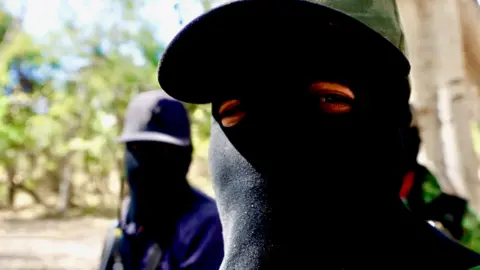
Darren Conway/BBC A cartel member wearing a black balaclava looks into the camera, another - also wearing a balaclava, stands in the background.Darren Conway/BBC

Mexico’s president has praised the special forces for “bringing down” the country’s most wanted man, drug lord Nemesio Oseguera Cervantes.

But as the BBC’s Quentin Sommerville found in another Mexican cartel hotspot – Culiacán in northern Sinaloa state – the vacuum left by the removal of a powerful cartel leader can trigger a surge in violence as warring factions battle for control.
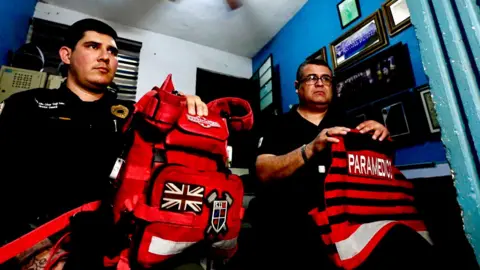
Darren Conway/BBC Two paramedics, Julio César Vega and Héctor Torres, sit in a small room. They are holding their kit on their knees. Both are wearing black uniforms and Torres is wearing glasses.Darren Conway/BBC

Warning: This article contains graphic accounts of cartel violence which readers may find upsetting.

“The fear is everywhere and the fear is constant,” said paramedic Héctor Torres, 53, from the front seat of the ambulance in Culiacán.

We had just come from the scene of a shooting inside a garage in the city centre.

The owner was lying dead in his office, blood spreading across the white tiled floor. As Héctor and the other paramedic, Julio César Vega, 28, entered the premises, a woman ran in wailing.

She was the man’s wife, but there was nothing to be done. Héctor checked for vitals and then placed a paper blanket over the corpse.

For the last year and a half, the Sinaloa cartel, one of the world’s largest and most feared drug gangs has been at war with itself, after the son of one of its leaders betrayed another.

The removal of that cartel leader, Ismael “El Mayo” Zambada, who is now in prison in the US, has wrought mayhem across Sinaloa and provides a warning of the dangers facing the country.

Héctor said the violence in Culiacán had never been so bad or gone on for so long. Last year, their number of call outs increased by over 70%.

But in the week I spent with Héctor and Julio almost every incident they responded to ended the same way, with a dead body in a building or by the side of the road, and grief-stricken relatives nearby asking for answers.

Few cartel victims survive, and nowhere is safe; schools, hospitals and even funerals have been attacked.

“Sinaloa cartel was like a family. Everyone was united in a single cartel. They were friends, they ate at the same table,” Héctor explained. “They were like brothers –parents, uncles, sisters – and suddenly they were fighting… and locked in a deadly feud,” he said.

That family business was built into a billion-dollar enterprise producing the deadly drug fentanyl and flooding US streets with opioids which have cost tens of thousands of lives.

US President Donald Trump declared the cartel, and others, terrorist organisations, and labelled fentanyl a weapon of mass destruction. He’s threatened Mexico with direct military action if it doesn’t bring the drug and the traffickers under control.

Both Héctor and Julio were wearing body armour, 14kg of Kevlar and armour plate.

Julio said it was essential: “We don’t know if the people responsible for the attacks are still at the scene or if they completed their objective and suddenly disappeared. So we run the risk of being caught in the crossfire of an attack and getting injured.”

The sun was beginning to set as we drove back to the paramedic base, and a city that once came alive at night, would soon be deserted. Traffic was slow.

The Mexican government has sent thousands of troops to Sinaloa, and they’d set up checkpoints on most of the roads.

It turned out that when the garage owner was killed, three men were kidnapped from the premises at the same time. The heavily armed soldiers and marines were checking cars for any sign of them.
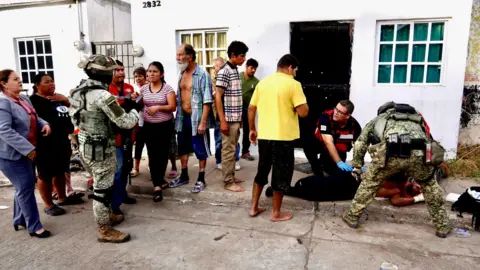
Darren Conway/BBC Julio César Vega and Héctor Torres tend to a man lying on the pavement while people look on. Two soldiers wearing uniform and helmets are also at the scene.Darren Conway/BBC

Warning: The following paragraphs contain descriptions of violence and torture which readers may find upsetting.

Kidnapping in Culiacán can be a fate worse than death.

Earlier in the week, a body had been found dumped on the pavement outside one of the main shopping malls.

From the state of the victim’s corpse, it was clear he’d been tortured. His body was intact, but the skull had been flayed and the eyes removed.

A sign was left with the corpse, in large lettering, a message from one cartel faction to another. It accused the dead man of being a traitor and came with a warning: “We are coming for the rest of you.”

Culiacán is a prosperous city, full of shopping malls, neat parks and fancy car dealerships. Outside the mall, a man in black cycling gear stopped in the rush-hour traffic to stare as the police placed the remains of the man into a body bag.

The next day, the body of another victim – mutilated in the same way – was left by the main road heading north outside of the city. When the forensic team lifted the accompanying sign, it was difficult to read, blood ran down its surface and puddled in the gravel verge.

At each new crime scene, I would meet Ernesto Martínez, who has been reporting on the violence here for 27 years. A 16-year-old boy had been shot dead in the city’s San Rafael neighbourhood; Emmanuel Alexander legs were still tangled in his bike frame as the police marked out the more than a dozen bullet casings around his body.

He’d been killed at close range by a handgun.
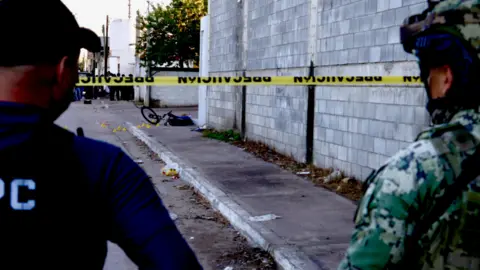
Darren Conway/BBC A soldier and another uniformed man stand behind a crime scene tape. In the distance, on the pavement, a boy is lying dead next to his bike.Darren Conway/BBC

Martínez explained that “there used to be more police officers, there were more soldiers, there was more security”.

“You’d find a checkpoint on every corner, and yet the homicides continued, they didn’t decrease, they remained at an average of five or six homicides a day. And the same trend continues.”

So what might end the violence? I met one of the Sinaloa factions to ask that question. Before the meeting, I was told not to bring my phone, nor any tracking devices.

They are vicious criminals, who show little remorse, and they have a simple solution to the killings. The government should step out of the way and let them murder each other – regardless of the threat to bystanders – until one faction is left standing.

They arrived at the meeting fully armed, and donned face masks for the interview, after insisting on having their identities disguised.

When I asked “Marco” (not his real name) if he had any guilt he said: “Yes, it’s true because a lot of times innocent people die. Children die. There’s a lot of death of innocent people.”

Sitting beside him, “Miguel” (not his real name) was more ruthless: “A lot of people will keep dying because the cartel is still fighting, and it keeps getting worse. The war will continue. Nothing will calm down until there’s only one faction left.”

The cartel violence is not just driving up the number of bodies being found but also the number of those reported missing.

Reynalda Pulido’s son, Javier Ernesto, disappeared in December 2020. She’s still searching for him, and for others too – and leads the group Mothers Fighting Back.

On a chilly morning, at a petrol station not far from Culiacán, Pulido and a group of other mothers hugged each other before setting out on a search.

The women, more than a dozen, were nearly all wearing white T-shirts with the pictures and names of their missing loved ones.

They began by fixing the pictures of some of the missing to lamp posts, the sound of their tape tearing across the noise of neighbourhood dogs which barked aggressively when they passed by homes. With them was a military escort, half a dozen heavily armed soldiers, in an armoured truck and pick-up truck with a top mounted gunner, acting as their convoy.

In a field where buzzards were flying overhead, they used metal probes and pick axes and shovels in their search for remains. They were looking for disturbed soil, indentations in the ground, any sign of a makeshift grave. As they probed the earth, they smelt the dirt, looking for the distinctive odour of human remains.
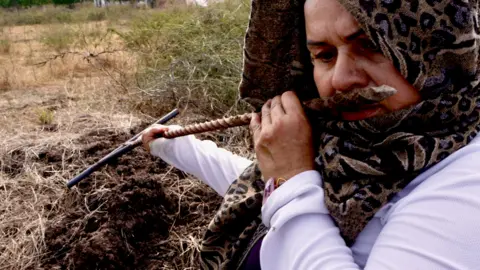
Darren Conway/BBC Reynalda Pulido, wearing a scarf in an animal-print pattern wrapped around her head to shield herself from the sun, smells a metal rod she has just pulled from the ground.Darren Conway/BBC

During a break in the search, Reynalda Pulido told me that when she wakes up every day she asks God: “Tell me why I’m here?”.

“What gives me strength is realizing that no one else is going to look for them. I realize it because no one is moving to search for the disappeared in Sinaloa. And a mother will always look for her child, no matter if it’s to the ends of the earth, she will look.”

The women had received several tip-offs that a body may have been disposed of in the field, but after hours in the midday sun, they found nothing but animal bones.

I asked Reynalda gently if she thought she would ever find her son. “It’s something I ask myself very often,” she said, wiping tears from her eyes.

“But I’ve already found my son in the 250 bodies I’ve located, and in the thirty-something people I’ve found alive. They are my children, too. And the children of all the families who come to ask me for help become my children. My son is there, in each and every one of them. All of them carry a little piece of my son.”

The root cause of Culiacán’s misery is the fentanyl trade.

In a cartel-owned basement, “Román” (not his real name), who produces the drug, tells me to follow him.

He’d just packed his latest shipment of the drug, more than half a dozen packages of tightly pressed white powder, bound for the United States.

He wore a face mask and gloves while handling the deadly bundles.

When he opened one package, it was pressed solid, the number 300 indented in the surface.

Before they would ship pills to the US, now they send powder, which they believe makes it easier to avoid US Customs.

Each package weighs a kilo and is worth $20,000 (£14,800). But Román explained that depending on the city it is sent to, it can fetch more. “If we take it to New York, it can go as high as $28,000 or $29,000. The further up it goes, the higher the price, and the greater our profit.”

He takes no responsibility, feels no shame for the business he is in. And he says that whatever the Mexican and United States governments think, the fentanyl will keep flowing.

“Even though the government has intensified the search, they’re coming after us more and getting closer, yes,” he said. “But when it comes to production, we’ve never stopped. Sometimes we do scale back because things get hot, the government gets too close. So we lay low for a few days, but once that problem passes, we either continue or move to other areas.”

The US has labelled you terrorists, we tell him. He replies, blithely: “Well, even though President Donald Trump refers to us as terrorists, I would just remind him that as long as there are consumers, we’re going to keep doing this but that doesn’t necessarily make us terrorists. As long as people want to consume it, they are free to do so. No one is forcing them. No one forced them to start this vice, to start using this stuff.”

The Mexican government has said it is making progress in its fight against drug trafficking. It says it has cut the fentanyl supply to the US by 50%.

From Culiacán I travelled to Mexico City. The capital’s airport was noisy with the sound of drilling and plaster being pulled from walls, preparations for World Cup 2026.

At one of her regular news conferences – held before Sunday’s killing of “El Mencho” – I asked President Claudia Sheinbaum what it would take to bring the violence in Sinaloa under control.

She blamed the internal power struggle within the Sinaloa cartel for the surge in violence in the northern state and insisted that her government was “trying to avoid harm to civilians, to the people”.
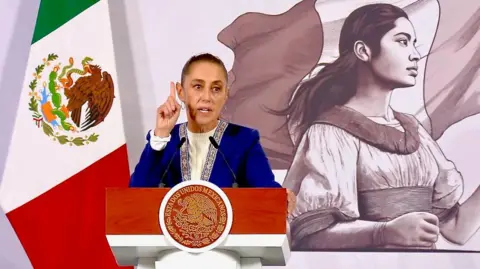
Darren Conway/BBC Mexican President Claudia Sheinbaum stands at a lectern in front of a Mexican flag and a mural depicting a Mexican woman during her regular news conference. She is wearing a blue jacket with gold-coloured embroidery on the lapels. Her hair is tied back and she is gesturing as she speaks.Darren Conway/BBC

Back in Sinaloa, I’d had a final call out with the paramedics, Héctor and Julio, to another shooting downtown. As a police helicopter flew overhead, we passed through the crime scene tape to find a man on the pavement bleeding from a bullet wound to the chest. He was still breathing and screaming for help. As Héctor began treating him, Julio raced to another man around the corner, who was critically injured and wasn’t responding.

The fear that the cartel might return, even despite the presence of soldiers and marines around us added greater urgency to the men’s work.

Both victims were patched up and rushed to a nearby hospital. They were bystanders, it turned out, caught in crossfire. But, still the military placed an armed cordon around the hospital in case of attack. We would later learn that the men survived.

Both Héctor and Julio removed their blue rubber medical gloves, still wet with blood, and shared a cigarette. “These are the first victims we’ve found alive since November,” Héctor said.


Continue Reading
Click to comment

Leave a Reply

Your email address will not be published. Required fields are marked *

BBC News World

Five Iranian footballers granted Australian visas after anthem protest

​ Five Iranian footballers granted Australian visas after anthem protest. 2 hours ago. Katy Watsonand. Simon Atkinson,reporting from the Gold Coast. Five members of the Iranian women’s football team have been granted humanitarian visas in Australia after their elimination in the Asian Cup, the government in Canberra says.. Immigration Minister Tony Burke said the women “were moved to a safe location” by Australian police. He said other squad members had been told they are welcome to stay in the country.. The women had been due to fly home, but supporters had raised fears for their safety after the team declined to sing the national anthem ahead of their match against South Korea last week.. This prompted criticism in Iran, with one conservative commentator accusing the team of being “wartime traitors” and pushing for harsh punishment.. Australia’s humanitarian visa programme grants permanent protection to refugees and people in humanitarian need. Visa holders can live, work and study in the country.. The remainder of the team has been taken to Gold Coast Airport and is expected to fly to Sydney later this evening.. The team’s coach was briefly stopped by dozens of activists who tried to persuade the other players to stay in Australia. Some protesters lay on the ground in an attempt to block the coach from moving forward. The players watched from inside the bus.. Speaking early on Tuesday, Burke said the five players were happy for their names to be confirmed as Fatemeh Pasandideh, Zahra Ghanbari, Zahra Sarbali, Atefeh Ramazanzadeh, and Mona Hamoudi.. “They want to be clear they are not political activists. They are athletes who want to be safe,” he said, adding that talks had been going on over several days.. He said that on Monday “it was made clear that there were five women who wanted to be able to stay in Australia”.. The group left their hotel the same day and were moved to a safe location by police. Shortly after they left the BBC witnessed some of their minders running across the hotel to try to find them – but they had already gone.. Follow live updates. Burke said he met the women at the safe location and then signed off for their applications to go onto humanitarian visas – a process completed at about 01:30 local time on Tuesday (15:30 GMT Monday).. It’s unclear what repercussions there might be for the players’ families as a result.. “I say to the other members of the team, the same opportunity is there. Australia has taken the Iranian women’s soccer team into our hearts. These women are tremendously popular in Australia.. “But we realise they are in a terribly difficult situation with the decisions that they’re making,” Burke said.. Reuters. Australian Prime Minister Anthony Albanese later confirmed that the five players had been given humanitarian visas.. On Sunday evening, hundreds of supporters surrounded the Iranian Lionesses’ coach as it left the stadium on the Gold Coast, with chants of “save our girls”.. On Monday, US Presiden  

Continue Reading

BBC News World

China exports surge despite Trump tariffs
​ China exports surge in first two months of the year despite Trump tariffs. 19 minutes ago. Osmond ChiaBusiness reporter. Getty Images. China’s exports surged in the first two months of this year despite trade tensions with the US.. Official figures show exports jumped by more than 20% in January and February, which is almost three times the rate predicted by economists. It puts the country on track to top the record-breaking annual trade surplus it saw in 2025.. The announcement comes as US President Donald Trump is expected to visit China in early April to meet his Chinese counterpart Xi Jinping.. The world’s second largest economy is heavily reliant on exports as it faces a number of issues including weak consumer spending, a shrinking population and a property market crisis.. Beijing typically combines January and February trade data to adjust for distortions caused by the Lunar New Year holiday, which falls on different dates each year.. China’s exports were boosted by strong demand for electronics while shipments of agricultural and manufactured goods also rose.. Trade with European countries grew by 27.8%, while exports to Asean countries – a group of South East Asian nations including Thailand, Singapore and Philippines – climbed by nearly 30%.. But China’s exports to America fell more than 10% as Trump imposed tariffs and other measures to address trade imbalances between the two countries.. Last week, China set an annual economic growth target of 4.5%-5%, down from its 5% goal in 2025, which had been met largely due to exports.. Exports have been the key driver of China’s economy, lifting it in spite of poor domestic spending and a property slump.. The meeting between Trump and Xi come as China, like many country’s in Asia, is dealing with the economic impact of the US-Israeli war with Iran, which has disrupted the global energy market.. China sets lowest economic growth target since 1991. ‘What is the game plan?’: The Iran war is unsettling China and its ambitions. International Business. Economics. China. Global trade. Donald Trump  

Continue Reading

BBC News World

Two men charged with terror offences after homemade bomb thrown outside NYC mayor’s home

​ Two men charged with terror offences after homemade bomb thrown outside NYC mayor’s home. 6 hours ago. Brandon Drenonand. Madeline Halpert,New York City. Two men have been charged with terror offences after police said they attempted to bomb a protest outside the New York City mayor’s home in an attack allegedly inspired by the Islamic State group (IS).. The suspects, 18-year-old Emir Balat and 19-year-old Ibrahim Kayumi, allegedly told police that they aimed for the Saturday attack to be “even larger” than the Boston Marathon bombing in 2013 that left three dead.. New York police say the pair attempted to detonate two explosives outside Gracie Mansion, where Mayor Zohran Mamdani lives. Authorities found a third bomb in their car.. The incident happened during an anti-Islam protest. None of the explosives went off as intended.. Footage of the incident shows one of the suspects being detained just seconds after igniting one of the explosives, which did not detonate.. New York City Police Commissioner Jessica Tisch said the two suspect had admitted to being inspired by IS and had watched IS propaganda videos. The two did not have any previous criminal history, she said.. They are facing charges, including attempting to provide material support to IS and using a weapon of mass destruction.. “We were fortunate that the devices used this weekend did not cause the kind of harm that they were certainly capable of causing,” Tischsaid during a news conference on Monday. “But luck is never a strategy. Devices like these have the potential to cause devastating harm.”. Tisch said one of the defendants, Balat, made several statements about IS while being transported to the police station, including saying: “If I didn’t do it, someone else will come and do it”.. Later, she said, Balat allegedly said he hoped the attack would be “even bigger than the Boston Marathon bombing, which he noted resulted in only three deaths”.. That attack, which happened in 2013 as runners were crossing the finish line of the Boston Marathon, left three people dead and hundreds of runners and spectators injured, including many who lost limbs.. During their first court appearance on Monday, the two wore prison jumpsuits and a federal magistrate judge ordered them to be detained until their next court appearance on 8 April.. Following the hearing, Balat’s lawyer said his client is a high school senior and a US citizen with no prior arrests and that he has “complicated stuff going on” in his personal life, the New York Times and Associated Press said.. The BBC has contacted both Balat and Kayumi’s lawyers for comment.. According to court documents, both waived their constitutional rights to remain silent after their arrest.. Balat requested a piece of paper and wrote on it that he pledges allegiance to IS and called for death of nonbelievers or infidels, according to the criminal complaint obtained by the BBC.. Kayumi stated that he was affiliated with IS, watched IS propaganda on his  

Continue Reading

BBC News World

Rising prices, mixed messages: Iran war is fraught with political risk for Trump

​ Rising prices, mixed messages: Iran war is fraught with political risk for Trump. 3 hours ago. Anthony ZurcherNorth America correspondent. President Donald Trump and his administration have so far offered mixed messages and contradictory explanations on the joint US-Israeli military campaign against Iran. And Monday – the 10th day of an operation that has rattled allies and shaken markets – typified this confusion around the war’s timeline and ultimate goals.. After a tumultuous morning during which US stock market indexes dropped and oil prices surged, the American president began speed-dialing reporters in an apparent effort to soothe nerves. His comments, however, were lacking in clarity even when he was pushed for more detail.. “I have a plan for everything, okay?” he told a reporter from the New York Post when asked about spiking oil prices. “I have a plan for everything. You’ll be very happy.”. To CBS News, he said the war “is very complete, pretty much”.. “We’re very far ahead of schedule,” he added. When asked whether the operation could therefore end soon, Trump said: “I don’t know, it depends. Wrapping up is all in my mind, nobody else’s.”. His telephone spree, at least in an economic sense, had the desired effect. Stock markets rallied, and the price of a barrel of oil – which had reached $120 earlier in the day – dropped below $90.. Just days ago, Trump said that he would not stop the war until Iran’s “unconditional surrender”. But after his comments on Monday, it appeared as though an end to a military operation that has roiled the Middle East and led to the near complete shutdown of shipping traffic through the Straits of Hormuz could be in sight.. Follow live updates. Why the price of oil matters more than you might think. In maps: Ten days of strikes across the Middle East. Iran’s new leader has never been tested. He now faces an existential battle. By evening, however, Trump was walking back those comments.. “We could call it a tremendous success right now,” he said. “Or we could go further. And we’re going to go further.”. He said the US was “very close to finishing” what he called an “excursion”, but warned that the US would intensify its strikes if Iran continued to threaten oil tankers exiting the Persian Gulf.. “We will hit them so hard that it will not be possible for them or anybody else helping them to recover that section of the world,” he said.. Trump also laid out an expansive mission for the war. His goal, he said, was to ensure that Iran could not develop weaponry to target the US, Israel or any American allies “for a very long time”.. That ultimately might require the kind regime change that Trump has been unable to secure so far, as the late Ayatollah Ali Khamenei has been replaced as leader by his son.. Within a space of hours, the messaging from the president had been dizzying. Those looking for signs of when this massive military operation could end or clues as to its concrete goals were left with more questio  

Continue Reading

BBC News World

High-profile real estate brothers convicted in sex trafficking case

​ High-profile real estate brothers convicted in sex trafficking case. 6 hours ago. Reuters. Two famous brothers who worked as real estate brokers have been convicted of drugging and raping dozens of women over the course of decades.. Tal Alexander, 39, and Oren Alexander, 38, rose to prominence from their sales of luxury real-estate properties in New York and Miami. Along with a third brother Alon, 38, a jury found all three guilty of sex trafficking by a jury in New York.. Prosecutors had accused the brothers of using their wealth to lure women to parties and luxury homes, then taking advantage of them. But their attorneys argued the women were willing participants.. They were found guilty on all 10 criminal counts, including sex trafficking and sexual exploitation of a minor.. Sentencing in the case is scheduled for 6 August and the brothers could face up to life in prison.. In closing arguments, Assistant US Attorney Andrew Jones said the brothers committed crimes without remorse and with “callousness” and “a perverse sense of pride”.. Lawyers for the brothers had argued they were womanisers – but not rapists.. “They’re not drugging them, they’re not raping them, but they’re certainly pursuing them,” said Marc Agnifilo, a lawyer for Oren Alexander. Agnifilo had previously represented rapper Sean “Diddy” Combs in his sex trafficking trial last year.. During the five-week trial, 11 women – including several who said they were minors at the time of the incidents – testified against the brothers, alleging they gave them gifts and flew them to locations and parties where they fed them drugs before assaulting them.. Prosecutors said the brothers “surreptitiously” put drugs in women’s drinks, and told jurors that they “physically restrained and held down their victims during the rapes and sexual assaults and ignored screams and explicit requests to stop”.. Jurors were shown a video during the trial of Oren Alexander allegedly raping a drugged 17-year-old at his Manhattan apartment in 2009.. During the trial, a new allegation surfaced as part of a separate lawsuit, when reality television star and top real estate agent Tracy Tutor accused Oren Alexander of drugging and sexually assaulting her in New York City in 2024.. A lawyer for Alexander called the civil suit a “demonstrably false lawsuit for maximum media impact”.. US Attorney Jay Clayton, whose office in the Southern District of New York prosecuted the case, said the verdict is “an important step in our fight against sex trafficking”.. “The jury saw the Alexander’s [sic] conduct for what it was—calculated, brutal sexual abuse that, unimaginably, the defendants celebrated,” Clayton said in a statement.. “This verdict cannot undo the effects of heinous abuse the Alexanders’ many victims endured, but it does send a message: New Yorkers want to bring an end to sex trafficking in all our communities.”. Agnifilo said that that it was “not the verdict we were looking for, but we’re going to keep fight  

Continue Reading

Latest News

Politics52 minutes ago

‘What happened in Dec’: IndiGo CEO Pieter Elbers quits 18 months ahead of term end, founder Rahul Bhatia takes charge

 IndiGo, India’s largest airline, announced on Tuesday that its chief executive officer (CEO) Pieter Elbers has resigned. Neither Elbers, who...

Politics2 hours ago

‘Steps taken to enhance production’: Hindustan Petroleum after LPG supply hit in India amid US-Iran war

 As concerns grow over the availability of LPG amid disruptions in global fuel supply triggered by the ongoing Iran-US conflict,...

Politics3 hours ago

Speedy trial means justice for victims too, says SC

 On Tuesday, the Supreme Court stressed that the constitutional right to a speedy trial aims to protect undertrials from prolonged...

Politics3 hours ago

Speedy trial means justice for victims too, says SC

 On Tuesday, the Supreme Court stressed that the constitutional right to a speedy trial aims to protect undertrials from prolonged...

Politics3 hours ago

Speedy trial means justice for victims too, says SC

 On Tuesday, the Supreme Court stressed that the constitutional right to a speedy trial aims to protect undertrials from prolonged...

Politics4 hours ago

Jaipur firm bought Amul items near expiry, tweaked dates to sell, 1.5 lakh kg destroyed: ‘Learnt method on YouTube’

 Rajasthan’s Food Safety Department destroyed about 1.5 lakh kilograms of expired food products after cracking down on a local distribution...

Politics4 hours ago

Jaipur firm bought Amul items near expiry, tweaked dates to sell, 1.5 lakh kg destroyed: ‘Learnt method on YouTube’

 Rajasthan’s Food Safety Department destroyed about 1.5 lakh kilograms of expired food products after cracking down on a local distribution...

Politics4 hours ago

Madhya Pradesh: Stray cattle to get saffron tags to help manage them better

 Approximately four million stray cattle in Madhya Pradesh will receive unique 12-digit saffron tags to distinguish them from domestic animals...

Politics4 hours ago

Madhya Pradesh: Stray cattle to get saffron tags to help manage them better

 Approximately four million stray cattle in Madhya Pradesh will receive unique 12-digit saffron tags to distinguish them from domestic animals...

Politics6 hours ago

Meghalaya: 2 killed in police firing as GHADC unrest spirals; curfew imposed

 Two individuals were killed by police gunfire in West Garo Hills, Meghalaya, on Tuesday amid an ongoing night curfew imposed...

Trending News

Join Our Newsletter

Stay updated with breaking news and exclusive content.