Politics
Assisted dying bill runs out of time but supporters vow to try again

Assisted dying bill runs out of time but supporters vow to try again

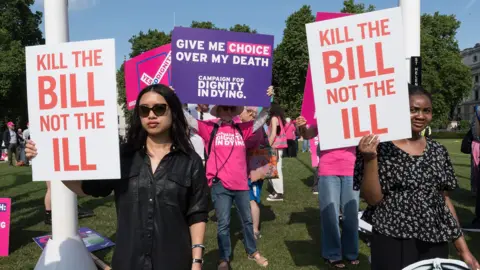
A proposed law to legalise assisted dying in England and Wales has run out of time to become law, almost 17 months after MPs first voted in favour of it.
The bill stalled in the House of Lords after the House of Commons supported allowing terminally ill adults expected to die within six months to seek medical help to end their life, subject to certain safeguards.
But supporters said they would not give up and were confident the legislation would return in the next session of Parliament, which will begin on 13 May.
They have accused some peers of using delaying tactics to block the bill’s progress but critics have argued it does not have sufficient safeguards to protect vulnerable people.
More than 1,200 amendments were tabled in the Lords, which is believed to be a record high for a bill introduced by a backbench MP.
The Terminally Ill Adults (End of Life) Bill was supported in principle by MPs on 29 November 2024 by a majority of 55 and cleared the Commons on 20 June last year with a majority of 23.
In the Lords, the bill did not clear all its stages and Friday marked the 14th and final day of committee stage – which allowed the legislation to be assessed line by line and for changes to be considered.
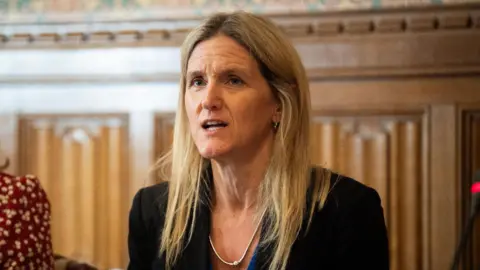
Labour MP Kim Leadbeater who introduced the bill in the Commons, said there was a “real sense of sadness and sorrow” at its failure to pass.
However, she insisted there was was “appetite” for the legislation to return and said she was “confident” it would do so.
Speaking at a news conference after the bill fell, she argued that peers in the House of Lords had held up the legislation adding: “This isn’t what democracy looks like”.
Leadbeater said there were MPs willing to take the same bill on during the next session should they be successful in the Private Members’ Bill ballot, which allow MPs to propose legislation and can guarantee debating time on Friday sittings.
Supporters of assisted dying say they have so many MPs lined up they are confident it will come back in the next session. One told the BBC more than 100 are ready – and another 100 could be persuaded.
Leadbeater said she hoped the bill would then clear the Commons again and agreement could be reached with peers over amendments.
She also acknowledged the powers in the Parliament Acts could be used to prevent peers blocking the legislation.
Under the terms of the rarely used legislation, if an identical bill passes the Commons a second time then the Lords cannot prevent it progressing again and it would become law at the end of that second session even without peers’ approval.
The Parliament Acts were last used in 2004 to push through a ban on fox hunting.
Baroness Grey-Thompson said the bill, which she opposed, failed as there were “tonnes of holes in it” and it had arrived in the Lords with a “very clear message” from MPs to make improvements.
The independent crossbench peer, who is also an 11-time Paralympic gold medallist, told the BBC: “It doesn’t give me any sense of satisfaction that this bill has failed because it doesn’t fix the problem that we’re trying to solve.
“In the chamber today we repeatedly heard about the voices of terminally ill people, yes that’s important, but also the voices of those who feel they have no choice.”
Baroness Grey-Thompson said she had received thousands of emails, adding many of them were from disabled people saying “thank you for protecting our rights and looking out for us”.
Leadbeater was joined after the debate in the Lords by Sophie Blake, who has stage four secondary breast cancer and Rebecca Wilcox, the daughter of broadcaster Esther Rantzen, who has lung cancer.
Blake said she felt that the “hope” she and other supporters of the bill had felt when the bill was first backed by MP “had been taken away” by an “unelected and accountable group of individuals”.
Wilcox said she was hopeful the same bill would get through in the future telling reporters: “We’ve got the stamina, we’ve got the energy, we will do it.”
However, she said she was not sure if her mother would live to see the bill become law, adding: “I’m a bit furious about that.”
Lord Falconer, who was leading the bill through the House of Lords, opened the final day of debate by telling peers he felt “despondent”.
He said the bill had not failed “on its merits” but as a result of “procedural wrangling”.
Baroness Coffey was one of the peers who had tabled several amendments to the bill.
The former Conservative minister said her amendments had tried to “draw out how the bill would work in practice – whether the safeguards claimed would really provide safeguards in practice”.
“I do fear that many peers and many MPs are putting choice for some, ahead of concern on coercion for others,” she added.
Baroness Campbell of Surbiton, a former commissioner at the Equality and Human Rights Commission (EHRC), said the bill “frightens” disabled people and that concerns were “real and repeated”.
She said the amendments she had contributed to had “sought to strengthen safeguards”, adding: “That is not obstruction; it is our duty.”
During the debate several peers echoed Lord Falconer’s criticism that opponents had deliberately held up the bill.
Crossbench peer Lord Pannick said the Lords’ “failure” to get to the point of holding a vote on the bill was “a stain on the reputation of this House”, while Conservative Lord Baker described it as a “constitutional farrago”.


Sign up for our Politics Essential newsletter to keep up with the inner workings of Westminster and beyond.