
PM office canada
Canada, EU plan to link next-gen payment systems, easing transactions

Canada and the European Union plan to link next-generation payment systems to enable faster cross-border transactions, according to a draft joint statement prepared for a summit between Ottawa and Brussels later this month.
This will help remove obstacles to business and investment between the two jurisdictions, according to the statement, an early version of a summit communiqué that was viewed by The Globe and Mail. It adds that the new partnership will be called an “Alliance for the Future.”
The draft statement doesn’t detail what next-generation payment systems include, but this term has been used by others to refer to a major upgrade of a country’s core payment infrastructure, usually built around real-time payments. The core infrastructure is a central set of systems that clear and settle payments between financial institutions.
Canada’s bet on European trade faces plenty of hurdles
The Prime Minister’s Office declined to offer any response to the draft joint statement, saying it would not comment on leaked documents.
Canada and the EU are working to modernize the electronic systems that their businesses and people use to move money from place to place.
Both have identified the United States’s sway over the current generation of payment systems as a risk, given that Washington has grown increasingly unpredictable and protectionist under President Donald Trump.
Earlier this month, Prime Minister Mark Carney identified a country’s control over payment systems as a feature of modern sovereignty. In an address to the European Parliament on Sept. 17, he said Canada and Europe should “secure our strategic autonomy” through co-operation in strategic capabilities including “critical minerals, defence industrial capacity, AI and compute, energy security, space, and payments.”
Mr. Carney is welcoming EU officials in Montreal at the end of October to begin to define a new relationship with Brussels – one that European Commission President Ursula von der Leyen has said could make Canada an “associate member” of the 27-country bloc.
The draft of the coming summit’s joint statement, dated Sept. 21, says Canada and the EU will commit to stitching together payment systems. It is a work in progress of the text that the two sides are planning to release at the Montreal event.
“We will also work toward connecting next-generation payment systems to facilitate faster, lower-cost and more seamless cross-border transactions, making it easier for Canadians and Europeans to conduct business, invest and transfer funds internationally,” the statement says. “These efforts will help mobilize capital for strategic sectors and support long-term economic growth and competitiveness.”
The U.S.’s power over international payments was demonstrated in 2025 when Mr. Trump imposed sanctions on Winnipeg-born International Criminal Court judge Kimberly Prost over her work on a case involving American troops in Afghanistan. The U.S. sanctions left Ms. Prost unable to use most credit cards or multinational services such as Amazon or airlines.
Opinion: ‘Associate member’ of the EU? Why not, Canada?
Vass Bednar, managing director of the Canadian Shield Institute think tank, pointed out that several major European digital payment networks and wallet providers, including Bizum, Bancomat and Wero, are joining forces to create a cross-border payments network that would challenge the U.S. dominance of payment systems.
“If we’re serious about digital sovereignty, we should expect stronger positioning on alternative payment infrastructure from the government,” she said.
BMO chief economist Douglas Porter said he sees linking payment systems between Canada and Europe as a defensive step, providing “an alternative option, or almost a possible shield in case the payments system comes under duress.”
The draft Canada-EU statement maps out future co-operation including the joint purchase of 50 water bombers to fight forest fires in Canada and on the continent. It says the aircraft would be purchased from De Havilland and enter into service starting in 2030.
The pact also commits Ottawa and Brussels to study where they might add new subsea cables between Europe and Canada and Asia “to enhance digital links.”
Mr. Carney, speaking to The New York Times earlier this month, said he sees more opportunity for Canadian economic gains in Europe than in China. “If you look at revealed comparative advantage in Canada, where we can grow our economy and grow our exports, it is our biggest opportunity. Greater penetration of Europe is a bigger opportunity for Canada than China is,” he said.
Opinion: Carney’s beautiful Euro vision must meet harsh reality
The Editorial Board: Stronger ties with the European Union aren’t a lifeline for Canada
The draft statement shows that Canada and the EU plan to announce that they’ve completed a Digital Trade Agreement “to allow for faster, lower-cost secure digital trade and transactions” and that they plan deeper co-operation on critical minerals.
It says Ottawa and Brussels plan to announce that Canada and the European Investment Bank have “completed negotiations of an agreement that will facilitate European Investment in critical Canadian resources, in particular, critical minerals.”
The capitals also plan to announce a deal between competition watchdogs in the EU and Canada “to effectively address anti-competitive conduct” as well as the launch of negotiations “toward a framework” for Canada to participate in the European Union’s Galileo space program.
In addition, the Canada-EU draft statement says they plan a “long-term feasibility study on Liquefied Natural Gas (LNG) exports to Europe” from Canada.
And, it says, Canada and the EU will launch negotiations toward participation in Erasmus+, the EU’s flagship education and mobility program that enables students to study at universities in the bloc.
PM office canada
Carney, Poilievre bring federalist push to Alberta ahead of referendum vote
Prime Minister Mark Carney and Opposition Leader Pierre Poilievre are both bringing a pro-unity message to Alberta, just days before voters in the province decide whether to trigger a binding referendum on separation.
Carney is scheduled to join former Alberta deputy premier Thomas Lukaszuk at a rally for his “Forever Canadian” group on Thursday in Calgary. The prime minister is also expected to attend a similar event on Friday in Edmonton, where he grew up, ahead of Monday’s vote.
The critical Oct. 19 vote follows decades of Western grievances and a sense of alienation from Ottawa and was brought forward by separatists after Alberta Premier Danielle Smith lowered the threshold needed to prompt a public referendum.
The ballot includes 10 questions addressing immigration and constitutional issues, and one on whether the province should stay in Canada or hold a binding referendum on separating.
Over the weekend, Carney focused his Thanksgiving Day message on Alberta’s upcoming referendum, saying the country is “worth fighting for,” while pointing to projects Ottawa backs, including the proposed new pipeline to the West Coast.
“You can’t build big things on fault lines,” he said.
Since Oct. 6, the government has been using a new video that uses archetypal images — from outdoor hockey to rolling mountains to a hospital gurney — as the national anthem is read aloud to pitch that a “united Canada is a stronger Canada.”
The campaign, running both on television and online ahead of Monday’s vote, will cost an estimated $250,000, according to the Privy Council Office.
Poilievre will join Smith on Friday at the Canada Strong and Free Network conference in Calgary, where he’s expected to speak.
Just Asking wants to know: What questions do you have about the Alberta referendum and the impact the vote will have on both the province and Canada? Send us your questions before our October 17 show.
Last week, the Conservative leader, also from Alberta, dismissed tech billionaire Elon Musk’s calls for Quebec, Alberta and Saskatchewan to separate from Canada, saying “Canadians control their own destiny.”
PM office canada
What does Alberta’s referendum on separation from Canada mean?
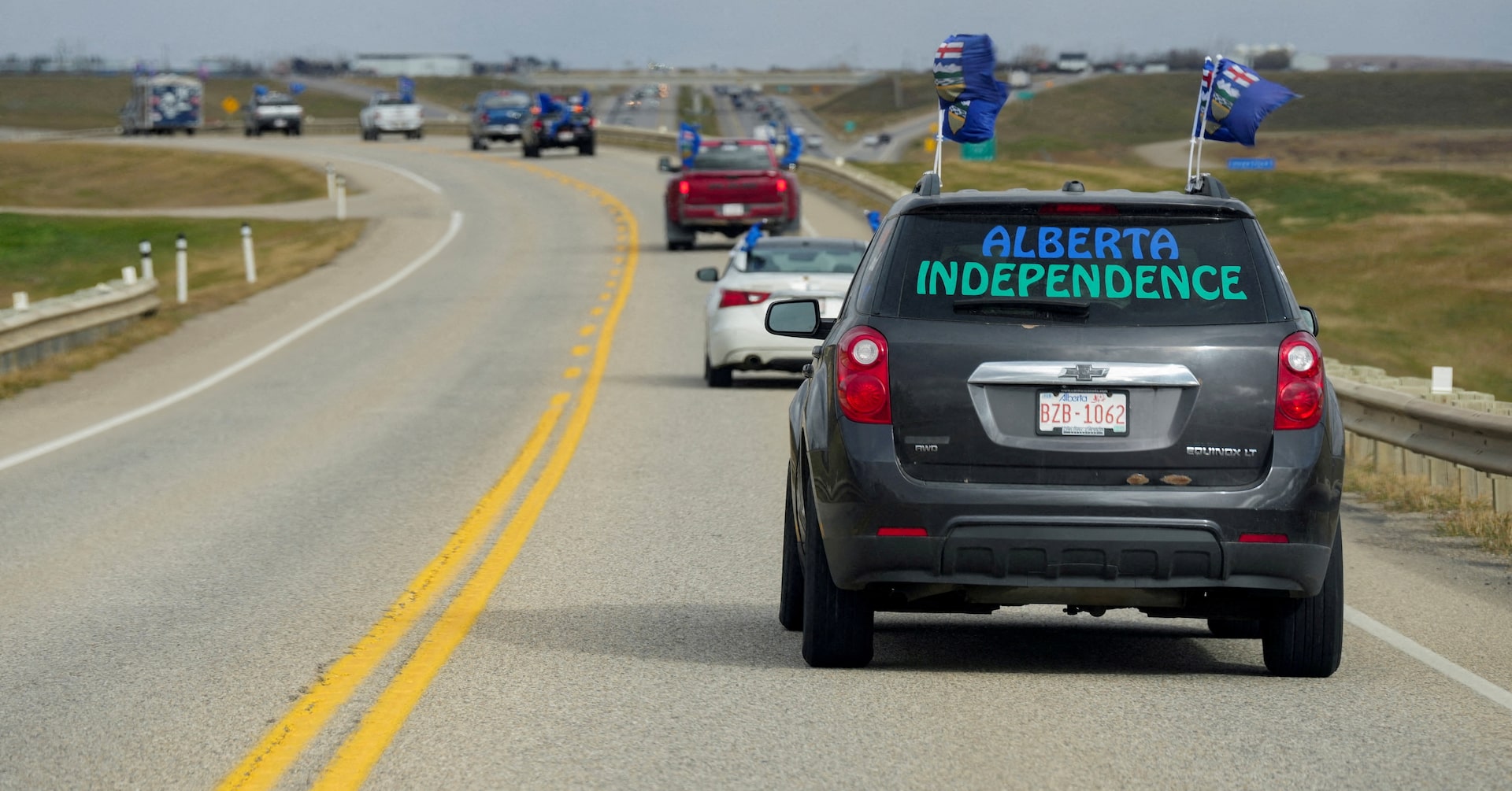
OTTAWA, October 15 – Alberta is holding a nonbinding referendum on Monday to ask residents if they want to remain part of Canada, marking the first time the oil-rich province has ever put the question of separation to the public. Polls have consistently shown most Albertans — about 70% — want to stay in Canada, with roughly a quarter of residents supporting an independent Alberta.
WHAT WILL RESIDENTS BE ASKED?
There are 10 questions, each with its own color-coded ballot. The last ballot voters see is question 10, on whether Alberta should remain a Canadian province or start the legal process required to hold a binding referendum on separation. A simple majority in favor of separation could trigger that process. There are nine other nonbinding questions about immigration, access to provincial services — including education, social care and healthcare — and voter identification requirements.
Sign up here.
WHY IS ALBERTA HAVING THIS REFERENDUM?
Alberta Premier Danielle Smith said in May it was “time to have a vote, understand the will of Albertans on this subject, and move on,” when she announced the government would add a question on separation. Smith’s decision followed months of campaigning by a small but vocal group of separatists, who argue Alberta’s energy wealth is subsidizing poorer parts of the country and that bureaucracy in Ottawa has stifled the province’s economy. Some members of the group had backed Smith’s candidacy for premier. Smith says she voted for Alberta to remain in Canada during advance polling, according to a video she posted on social media on Wednesday.
HAVE THERE BEEN PREVIOUS SEPARATIST REFERENDUMS IN CANADA?
Yes, but not in Alberta. The majority French-speaking province of Quebec has had two referendums, in 1980 and 1995. Quebecers voted to remain in Canada both times, but by the slimmest of margins in 1995. The separatist Parti Quebecois won a provincial election earlier this month and has pledged to hold a third referendum, but only after US President Donald Trump has left office and if the party holds a majority. The PQ was elected with a minority government on October 5, meaning it will rely on smaller parties to pass legislation.
Canada is a federation of 10 provinces and three territories. While Ottawa is responsible for matters of national interest, such as defense, trade and foreign policy, the provinces and territories hold significant power over medical care, education and land rights.
WHEN WILL THE RESULTS BE KNOWN?
Polls are scheduled to close at 8 p.m. on Monday (0200 GMT on Tuesday). Elections Alberta says it will count ballots by hand and that the question on separation will be counted first.
It will publish results on the Elections Alberta website as they are received, and unofficial results are expected within 48 hours after voting ends.
WHAT HAPPENS IF MOST ALBERTANS VOTE TO START THE PROCESS OF LEAVING CANADA?
Smith has said she will respect the result and quickly begin the process to hold a legally binding referendum. But separation would not happen imminently. After the 1995 Quebec referendum, Canada’s Parliament passed the Clarity Act in 2000, which says talks about secession can only be triggered if there is a clear majority from the public, without specifying the necessary threshold. The act also states provinces and territories have no unilateral right to leave Canada and that a constitutional amendment negotiated by provincial, territorial and federal governments is required.
First Nations groups have objected to the idea of an independent Alberta, as their land treaties with Canada predate Alberta’s entry into Confederation. In May, an Alberta court judge ruled the province’s chief electoral officer was wrong to allow separatists to collect signatures requesting a referendum, because the process should have prompted a consultation with Indigenous peoples whose rights might be violated by separation. Alberta has appealed the decision.
WHAT HAS PRIME MINISTER MARK CARNEY SAID ABOUT THE REFERENDUM?
Carney, who was largely raised in Alberta, has previously said “the best place for Alberta is in Canada” and that the country cannot succeed if it’s divided. He released a video on Canadian Thanksgiving, October 12, saying national unity is critical as Canada fights threats from abroad, including a trade war with the US. Carney has campaigned for Alberta to remain in Canada.
Reporting by Maria Cheng; Editing by Caroline Stauffer and Rod Nickel
PM office canada
Métis leaders in oilsands region say they haven’t been consulted on proposed Pacific Link pipeline
Métis leaders in Alberta’s Wood Buffalo region are accusing the federal government of excluding them from discussions on the proposed Pacific Link pipeline project.
Before announcing earlier this month that the new West Coast oil pipeline would be designated as being in the national interest under the Building Canada Act, Prime Minister Mark Carney met with several First Nations leaders about the issue. But the leaders of six Métis communities say he never met with them to discuss the proposed pipeline before announcing it.
At a news conference held in Fort McMurray, Alta., on Tuesday, Métis leaders noted they were also not invited to the joint federal-provincial news conference for the pipeline announcement on Oct. 1, and were not told about ownership stakes for the project.
“Silence is acceptance and that’s why we’re not silent,” Kelly Myers, district captain for Fort McMurray Métis, told reporters.
“Based on the fact that there were so many others that were invited to this announcement and we were not clearly shows a sign of disrespect to Métis as a whole, and it’s one that we’re just not going to accept.”
CBC News contacted the federal government’s Privy Council Office for comment but had yet to receive a response at the time of publication.
If approved, the proposed Pacific Link pipeline will carry one million barrels of oil per day from Alberta’s oilsands region to tankers at a deepwater port near Delta, B.C. The federal government and Alberta’s provincial government hope to have approvals for construction by September 2027 and to have the pipeline operational by 2032 or 2033.
Carney has said a 10 per cent ownership stake will be available for Indigenous communities. The federal government says there will also be Indigenous contracting and employment opportunities.
“We’re developing this pipeline with Indigenous peoples involved from the start,” Carney said during his announcement on Oct. 1. “This is the start of that development with the opportunities to share in the prosperity that Pacific Link will create.”
The Métis leaders who say they were not consulted about the project represent communities in Fort McMurray, Fort Chipewyan, Fort McKay, Willow Lake, Conklin and Chard.
At Tuesday’s news conference, none of them said they opposed the pipeline, but in a statement and media scrum, they said they have concerns and questions that they want to raise before any federal approvals are signed.
Ruby Ladouceur, president of Fort Chipewyan Métis Nation, said she believes the pipeline will lead to more oilsands development. Premier Danielle Smith has previously said she wants oilsands production to double to eight million barrels per day by 2035.
Ladouceur said she worries that increased production will increase the risk of accidents that could have environmental impacts on water, land and the air.
“Anything done without us is actually against us,” said Ladouceur, who also pointed out that Carney met with First Nations chiefs on National Day for Truth and Reconciliation.
“They didn’t consult with us, they didn’t even let us know about anything that was taking place about the pipeline and it goes through our region,” said Stella Lavallee, president of Willow Lake Métis Nation.
Zoe De Jonge, press secretary for Alberta Indigenous Relations Minister Rajan Sawhney, told CBC News in an email that the ministry has been meeting with Indigenous leaders about the project. She said the province could not comment on any engagement decisions made by the federal government.
“Our commitment to engaging with First Nations and Métis communities remains a priority for Alberta’s government,” said De Jonge.
“Minister Sawhney has met with Métis leaders and communities across the Fort McMurray Wood Buffalo region, and remains committed to maintaining those relationships through continued dialogue and engagement.”
PM office canada
Carney needs to overhaul Trudeau-era immigration system, report says

OTTAWA — Canada needs to overhaul the Trudeau-era immigration system so that applicants are selected largely on their ability to boost the economy, a new think tank report suggests, part of a wide-ranging set of policy suggestions for governments at all levels.
The C.D. Howe Institute report, to be released Thursday, argues that Canada should go back to assessing skilled immigrant applicants based on a points system designed to evaluate their likelihood to succeed economically. That system, which was quietly dropped by former prime minister Justin Trudeau’s government in 2023, ran for two decades by rating applicants on key metrics such as education, work experience, language skills and a demonstrated ability to earn a living.
But that changed about three years ago, the report says, when Ottawa started focusing on other metrics, such as preferences for certain professions and applicants who could speak French.
The think tank’s report, a wide-ranging set of policy recommendations to boost Canada’s lagging productivity and economic growth, said the old system worked better because it focused on applicants who were most likely to do well and meant fewer new Canadians doing work that didn’t match their skills.
If adopted, the change would mark another key policy from the Trudeau era to be cancelled or sharply curtailed by Prime Minister Mark Carney. The current Liberal government has already changed direction on such Trudeau-era policies as the consumer carbon tax, a proposed capital gains tax increase and higher immigration levels.
The recommendations on immigration form a key part of the report’s focus on human capital, one of eight policy areas that it addresses. It also calls for governments to do more to verify foreign credentials used in immigration applications, raise admission standards for international students, link immigration levels to economic growth and select more immigrants who are likely to be entrepreneurs.
The report, called The Productivity Blueprint: An Agenda for Higher Living Standards in Canada, calls for more than 100 policy changes that would help close the gap between the country’s lagging productivity and that of other industrialized countries. Between 2014 and 2024, real gross domestic product per capita, one of the most common measures of living standards, grew just 3.5 per cent in Canada, the worst performance among nine peer countries. In the U.S., by comparison, the economy grew 20.2 percent during that same period based on the same metric.
Jeremy Kronick, the institute’s chief executive officer, was quoted in a release saluting some of the Carney government’s steps to boost the economy, such as its new Major Projects Office and the accounting changes for business investment, but said long-term improvement will take a commitment to change. “There’s no quick fix for productivity,” he said. “If Canadians want stronger wages and living standards over the long term, raising productivity needs to be Canada’s number one priority.”
The Carney government is also trying to inoculate the Canadian economy as much as possible from the trade war started by U.S. President Donald Trump’s tariff policies.
The federal government’s initial response was to offer short-term support payments for companies and workers hit by the disruption from the south, but has in recent months been focusing more on structural factors such as pipelines, transportation infrastructure, faster approval times for major projects and making Canada a more competitive place to invest.
The C.D. Howe report also calls for sweeping changes to the country’s tax policy regime, including a reduction in the general corporate income tax rate to 10 per cent from 15. Ottawa has already cut corporate income taxes almost in half since 2000-01, when the rate stood at 28 per cent. Yet during that time, the federal government’s revenue from that stream has climbed in the last fiscal year to $97.1 billion from $28.3 billion.
The report, which draws on decades of research, also calls on Ottawa to reduce the number of personal income tax brackets to three from five and to replace most existing tax credits with a $10,000 basic allowance. To help spur business, the report also calls on the federal government to rein in business subsidies, which have grown 125 per cent since 2015, consuming $37.4 billion of taxpayer dollars.
While many of the proposed changes carry hefty price tags, a more productive, competitive economy means higher wages and profits that lead to healthier government coffers. The C.D. Howe report says the suggested changes would unlock $140 billion in new business investment and would add 2.5 per cent to the overall economy.
PM office canada
In Unreliable Boyfriend, Chrystia Freeland details the rift between her and Trudeau
In Unreliable Boyfriend, one-time finance minister and deputy prime minister Chrystia Freeland digs into how her political relationship with Justin Trudeau went from a warm face-to-face invite into public service to a cold Zoom call where he booted her from the finance role years later.
While the book’s “unreliable boyfriend” is the United States under U.S. President Donald Trump, readers could be forgiven for thinking the title is actually inspired by Trudeau.
She enthuses about how the pair worked together on the trade file, their management of the pandemic and their rollout of national child care. Yet she also details Trudeau’s slide into unpopularity, penchant for humiliating members of his cabinet, word-policing and tendency to pick on those weaker than him.
While their relationship ended bitterly, she is still able to praise Trudeau for his strengths, one of which she noticed at a party in Toronto in late 2012, before Trudeau the Liberal MP became Trudeau the prime minister.
At that party celebrating the launch of Freeland’s book Plutocrats, her father cornered Trudeau to convey his thoughts on politics, eager to speak with “Liberal political royalty.”
“I was mortified,” Freeland recalled as she rushed over to try and free Trudeau from her father’s grip — only to learn that the future prime minister was enjoying the chat.
The following summer Freeland was invited to a breakfast that included Trudeau and former Ontario premier and current MP Bob Rae.
She was told Rae was stepping down from his Toronto seat and was asked if she’d consider running in an upcoming byelection.
“I spent the next six weeks agonizing over Justin’s offer,” she wrote.
She worried about uprooting her children from the life she and her husband had built for them in New York. And with the Liberals in third place, she knew she may be “joining a lost cause.”
In the end she wrote that she was won over by “Trudeau’s kindness to my dad” and her father’s encouragement to accept the offer.
Knowing when to play hardball
One of Trump’s first moves as president was to sign an executive order withdrawing the U.S. from the Trans Pacific Partnership (TPP) trade deal. By the spring of 2017, Trump was also threatening to pull out of the North American Free Trade Agreement (NAFTA).
The remaining TPP countries were set to sign the pact on the margins of a November summit in Da Nang, Vietnam. But Freeland, who was foreign affairs minister at the time, wrote that Trudeau wanted a better deal.
In a call with then international trade minister François-Philippe Champagne, Freeland and others, Trudeau humiliated Champagne for not securing concessions on intellectual property and other issues.
“I still cringe as I remember it — the embarrassment I felt at hearing a colleague humiliated reminded me of feeling bad for my childhood friends in Peace River when they got spanked while I was over to play.”
When Canada refused to sign the deal, Freeland wrote Trudeau angered both Japanese Prime Minister Shinzo Abe and Australian Prime Minister Malcolm Turnbull. Despite that pushback, Freeland said she admired the defiance.
“Trudeau showed that, love him or loathe him, you could not deny that he was a leader with balls,” she wrote.
Freeland said with NAFTA talks coming up, it was important to let the White House know when it came to trade deals, Canada “was prepared to play hardball.”
The ‘FAFO’ fight for free trade
By early 2018, Freeland wrote she had grown so “worried that American proposals could kill NAFTA” she’d begun writing a speech to deliver after its demise.
During particularly fraught meetings with U.S. officials in Washington, Freeland admitted she would occasionally “take refuge in the ladies’ washroom” which was a safe place because, she said, there were almost never any women on the U.S. side of the table.
“Once, at a particularly dire moment, I got down on my knees on the cold white tiles in front of the sinks and prayed,” she wrote.
Freeland said that Canada only managed to save that deal because it imposed retaliatory tariffs on the U.S. when it hit Canada with steel and aluminum tariffs, targeting key Republican districts.
That “FAFO” approach, and Trudeau’s willingness to employ it, she wrote, was what ensured Canada got back to a “reciprocal relationship with our neighbour.”
She said the details of the new NAFTA, an agreement Canadians now call the Canada-U.S.-Mexico Agreement (CUSMA), were largely left to her.
Trudeau “got extremely involved in the fine print of his own public appearances … on trade he didn’t dive into the details,” she said.
Still, she described the saving of NAFTA as “Trudeau’s finest hour … the moment when Canada’s playboy prince became a true national leader.”
But Freeland says Trudeau’s political stock was already in decline on another front thanks to his ill-fated trip to India.
She described Trudeau’s state visit to India in February 2018 as “a political disaster” where his over-the-top outfits became a distraction — and a Canadian of Indian descent, Jaspal Atwal, who was convicted of attempted murder for trying to assassinate an Indian cabinet minister, turned up at an official event.
Crying at cabinet meetings
Over the next few years, Trudeau landed achievements that Freeland wrote will be judged kindly by history. She praised him for his role in securing trade deals with the U.S., EU and the Pacific Rim countries, rolling out a national daycare program and managing the pandemic. But she noted that Canadians had started to sour on him for his “self-righteous exhibitionism.”
“Crying was routine at cabinet meetings,” she wrote. “There were always boxes of Kleenex on hand, and really sad colleagues would sometimes get a hug from the PM.”
Freeland noted one moment when Trudeau gave a female colleague a “long, harsh public scolding” for describing something as crazy.
Trudeau apparently told the colleague that the term was a “derogatory adjective” that was “insulting to people with mental health issues.”
The term Trudeau wanted them to use instead was “bananas.”
Freeland said she objected to “linguistic purity tests” because some people struggle to keep up — but her larger objection was about something else.
“I think what troubled me the most about the crying in cabinet and the lectures about word choice was that it sometimes went along with what seemed like bullying,” she wrote.
While Freeland said she has no problem with trying to bully people like Trump or Vladimir Putin, she didn’t like it when she saw Trudeau “pushing weaker people around.”
Chrétien’s advice
As the years rolled on and Trudeau’s popularity declined, Freeland said she came to understand that Trudeau’s gift of making strangers feel like “they are the most important person in the world” stopped short of his peers.
“We might walk together for the cameras but none of us, even his personal friends from childhood, had intimate political relationships with him,” she wrote. “Few of us ever spent time with him one-on-one.”
As rumours began to swirl that Trudeau was going to replace Freeland as finance minister with former central bank governor (and now prime minister) Mark Carney, she sought advice from former Liberal prime minister Jean Chrétien in November 2024.
She said Chrétien told her that her loyalty had reached its logical limit.
Freeland said Chrétien told her that as long as she remains in cabinet, and keeps publicly declaring she supports Trudeau, he would stay on as prime minister and the party would lose the next election.
“Conservative Leader Pierre Poilievre will become prime minister and the Liberal Party will be devastated. And if that happens, it will be partly your fault, because your continued support is what is making it possible for Justin Trudeau to stay in office,” she said Chrétien told her.
Freeland was due to deliver her government’s fall economic statement on Dec. 16. She wrote that with Trump set to be sworn in as president for the second time just weeks later, it was time to tighten up finances and prepare for what could be a protracted economic war.
Days before that statement was to be delivered, she said that Trudeau “removed over $12 billion in spending cuts” that Freeland had included to help prepare.
“I knew that, in this consequential moment, Trudeau was focused solely on his own political survival,” she said. “And, in his desperation, he was doing increasingly stupid things.”
The third-worst day of her life
On Friday the 13th — three days before she was set to deliver that economic statement — Trudeau arranged a Zoom call where she says he told her: “I no longer want you to serve as my finance minister.”
She described it as the third-worst day of her life after the death of her mother and her parent’s divorce.
Freeland says she was told she would retain the deputy prime minister title and would still be responsible for the Canada-U.S. relationship — but without a department to back her up.
When Freeland asked who would replace her, Trudeau told her it would be Carney.
Freeland wrote that Trudeau still wanted Freeland to deliver the economic statement and gave her time to think it over.
“Rather than be fired, I resigned,” she wrote. “The Zoom call with Trudeau had taught me that I simply couldn’t trust the PM — and that he had decided not to trust me.”
Describing her resignation from cabinet as “maybe the most significant resignation letter in Canadian political history,” Freeland claimed credit for bringing down one prime minister, thwarting Poilievre’s chance to become the next one and clearing the way for Carney to swoop in for the kill.
After the news hit, Freeland wrote that Chrétien called her and congratulated her for “doing the right thing.”
Despite losing the subsequent Liberal leadership race to Carney, Freeland said she thinks she “could have won the 2025 election” and “been an effective PM.”
Still, she said Carney is an “excellent” prime minister.
“I am proud my decision helped him get the top job, even though I ended up paying a pretty steep political price,” she said.


Steven Soderbergh To Help Finish ‘The Batman Part II’ Production
EXCLUSIVE: As director Matt Reeves continues to attend to an ongoing family matter, Steven Soderbergh is coming on to help...

Netflix’s Chief Content Officer Bela Bajaria Exiting
Bela Bajaria is out at Netflix. The news comes only 24 hours after the streamer underwent a massive cull, laying...

Netflix’s Bela Bajaria Leaving After 10 Years Amid Layoffs
In a major executive shakeup, Bela Bajaria is out at Netflix after 10 years at the streamer, most recently serving...


Violet & Xaden Have Been Cast In Prime Video’s ‘Fourth Wing’ TV Show
Lightning strikes as Prime Video has found its leading stars for the upcoming TV series Fourth Wing, the small-screen adaptation...


Targeted ads delivered 0-click exploits to install mercenary malware
Researchers say that mercenary hackers laced ads with zero-click exploits that installed sophisticated malware on the devices of targeted individuals...

Will the Fed raise interest rates? Kevin Warsh could offer clues
When Federal Reserve Chairman Kevin Warsh strides onstage in Bangkok on Friday morning, it will be after 11 p.m. on...

Ilhan Omar’s husband Tim Mynett speaks out as HSI fraud probe grows
While Ilhan Omar, D-Minn., has not been seen publicly since federal agents raided her Washington, D.C., residence on Monday, her...

Meta launches an open-weight AI model that runs on Macs
Meta has launched what it calls the “most capable” open-weight model in the United States. Dubbed Muse Spark Open, the...


Disney Inks Dude Perfect to Deal for Original Content
The Walt Disney Co. is cutting another major creator deal, this time with the prolific sports-focused Dude Perfect, The Hollywood...


Brendan Fraser Sequel Gets New Title Ahead of 2027 Release
Brendan Fraser‘s forthcoming installment in Universal Pictures‘ popular The Mummy franchise is alive and well. The studio announced Thursday that...
-

 Entertainment2 weeks ago
‘Verity’ Posts $4.5M Previews, ‘Digger’ $1.2M
-

 Entertainment2 weeks ago
Rick Devens Wins In Season 28 Finale
-

 Business2 weeks ago
Tesla Cybercab pressure to expand after rocky first month in Austin
-

 Business2 weeks ago
OpenAI safety employee resigns, claiming the company’s ‘culture is broken’
-

 Entertainment1 week ago
Travis Barker reveals why he underwent surgery after concerning hospital photos
-
 Business2 weeks ago
Energy Secretary Chris Wright says Trump was “well aware of the risks to energy flows” before launching Iran war
-

 HealthNews1 week ago
Des Moines clinics stumped by unidentified virus
-

 Entertainment2 weeks ago
Disney pays $115 million for Yamaha’s Orange County headquarters