
Business
European countries agree on ‘assertive’ response to US pressure on diesel

BRUSSELS — Five European countries agreed at an emergency meeting Thursday to respond with “one voice” to growing pressure from the U.S. government to release reserves of diesel, according to people familiar with the matter.
France, Germany, Britain, Italy, Ireland and the European Commission joined the talks to decide how to respond to pressure from Washington to draw down oil stockpiles or face a ban on U.S. exports of diesel, three European officials told POLITICO.
All these countries have been privately pressured by the U.S. to draw down on their reserves, two of the people said.
The countries, along with the EU’s executive arm, agreed three things, according to the people: To react to the pressure with a “coordinated voice,” to make sure that “every decision about releasing stocks should be elevated to the IEA [International Energy Agency] level,” and to seek to “decrease the tension when speaking to the U.S.”
The Paris-based IEA coordinates energy policy among rich countries, and oversaw a release of oil stocks earlier this year following the closure of the Strait of Hormuz.
The idea is to “de-escalate,” one of the people said. “To be sort of assertive but positive in the communication … When you’re dealing with the hungry lion, you do not necessarily play dirty games with him.”
A wider pool of countries, some of which have also faced pressure from the Trump administration, will discuss how to respond in a meeting on Friday, the person added.
POLITICO reported earlier that U.S. Energy Secretary Chris Wright was asking for oil releases as an alternative to imposing a ban on exports, on which the EU is heavily dependent. The requested release of 120 million barrels of diesel over six months would account for well over a third of the EU’s total reserves of the essential transport fuel.
Diesel prices are soaring in the U.S. as a result of the wars in Ukraine and Iran, heaping pressure on U.S. President Donald Trump to bring down prices ahead of critical mid-term elections. The U.S. is a major diesel exporter, and currently provides more than half of the EU’s imports — meaning a ban would have serious implications for the European economy.
Trump has refused to rule out an export ban despite vociferous opposition from the U.S. oil sector. “I’m thinking about it,” Trump said of the export ban at an Oval Office event. “I speak to [Energy Secretary] Chris [Wright] and [Interior Secretary] Doug [Burgum] about it a lot — they sort of think it’ll help diesel, but it might raise the price of other things.”
Business
Feds get ready to rewrite car headlight rules

One of the regulations that make vehicles in the US different from those in Europe or Japan is our headlight rules. They’re laid out in the Federal Motor Vehicle Safety Standards (FMVSS), and changing them is—or used to be—a lengthy, laborious process, which is a major reason automotive lighting technology has lagged in the US. But the current administration says it’s time for “bolstering driver safety, slashing red tape, and embracing new technologies,” so it’s going to start a negotiated rulemaking process to rewrite the regulations to suit 2026.
“Today’s standards do not allow automakers to deploy the latest safety-improving lighting technologies, so we are bringing key experts and stakeholders together to modernize our standards and address potential causes of glare,” the National Highway Traffic Safety Administration’s Jonathan Morrison said. “This collaborative approach will allow us to update outdated regulations, foster innovation, and keep everyone on our roads safer.”
While it is fair to be skeptical of the government’s efforts to streamline bureaucracy, it is also fair to say US headlight regulations really could use an update.
When Ars started covering cars, automakers like Audi, BMW, Mercedes, Toyota, and Volvo were trying to import adaptive headlight technology. At the time, the FMVSS only allowed for “dumb” high- and low-beams, nothing else. Meanwhile, lighting technology evolved, adopting first lasers and then LEDs with addressable pixels that can block out those that would otherwise illuminate oncoming cars.
In 2013, in response to Toyota’s petition, NHTSA said it would start the rulemaking process. It took another five years before a rule was published for consideration; in the interim, the NHTSA was considering adopting Europe’s rules before deciding that if a car with adaptive beam lights “does not have a long preview of another vehicle, such as in an intersection scenario or when two vehicles are oncoming on a curved road, ADB does not have enough time to react to adapt its beam pattern.”
One key difference is how vehicles are regulated. In Europe, cars are homologated for type approval; manufacturers submit examples to authorities for testing to ensure they conform to the rules, and then the authorities approve the car for sale. In the US, OEMs tell NHTSA their cars comply with the FMVSS, or face sanctions if that turns out to be false later. At the time, NHTSA felt that Europe’s glare tests were too subjective for a self-certification regime and decided instead to write its own.
In 2022, that final rule was ready. Since then, cars with active beam matrix LED headlights have gone on sale in the US; Audi’s big new SUVs are a good example, although they are limited in functionality compared with the same technology fitted to European-spec cars.
Among NHTSA’s goals for an updated FMVSS 108 are harmonizing US standards with their global counterparts, updating the rules for technologies like LEDs, ambient light sensors, automatic high beams, and replaceable light sources, improving test procedures for lenses and optics, understanding how to better aim headlights, and making sure that none of this blinds anyone else on the road with glare.
Business
Tech stocks drop after report that OpenAI’s revenue is lower than expected

Tech stocks dropped on Thursday after a news report that OpenAI’s annualized revenue is about $20 billion less than previously reported.
OpenAI, the maker of ChatGPT, recently told investors that its annualized revenue was nearing $50 billion, according to the Financial Times. That’s lower than the $70 billion figure previously reported by media, including the FT, based on information from investors.
The discrepancy could rattle investors already questioning whether demand for AI will be strong enough to help companies like OpenAI and Anthropic turn a profit and justify the industry’s enormous spending on the AI buildout.
The Nasdaq Composite sank 1.25%, its worst day since mid-August. The S&P 500 fell 0.5%, weighed down by a drop in the tech sector. The indexes had opened lower but declines accelerated after the FT report published midday.
A source familiar with the documents said the $70 billion figure did not come from OpenAI and likely came from a desire by firms to compare OpenAI’s numbers with Anthropic’s, which includes gross revenue from cloud providers. OpenAI’s is based on net revenue.
OpenAI declined to comment.
There was selling across semiconductor chipmakers, cloud providers and other tech companies involved in the AI buildout. Nvidia (NVDA) fell 2.9%, Intel (INTC) fell 5.3% and Oracle (ORCL) fell 5.5%.
The outlook for many tech stocks is based on investors’ conviction that demand for AI will continue to grow. If there are wrinkles in that story, like OpenAI earning less revenue than expected, that could send ripples throughout the supply chain for the AI buildout, said Ross Mayfield, investment strategist at Baird.
“There are going to be tremors throughout all of the related sub-industries,” Mayfield said.
The stakes are higher now because the stock market in recent weeks has been buoyed by gains in tech and AI stocks, while other sectors have struggled under the pressure of rising bond yields.
“This has become a much narrower market that’s dependent on the AI names to keep it afloat,” Mayfield said. “Certainly, this is going to hit that complex in a big way.”
OpenAI CEO Sam Altman announced in September that the company would postpone its initial public offering until at least next year, citing concerns about AI safety.
Business
US freezes Microsoft, Adobe, Infosys green-card applications over alleged fraud
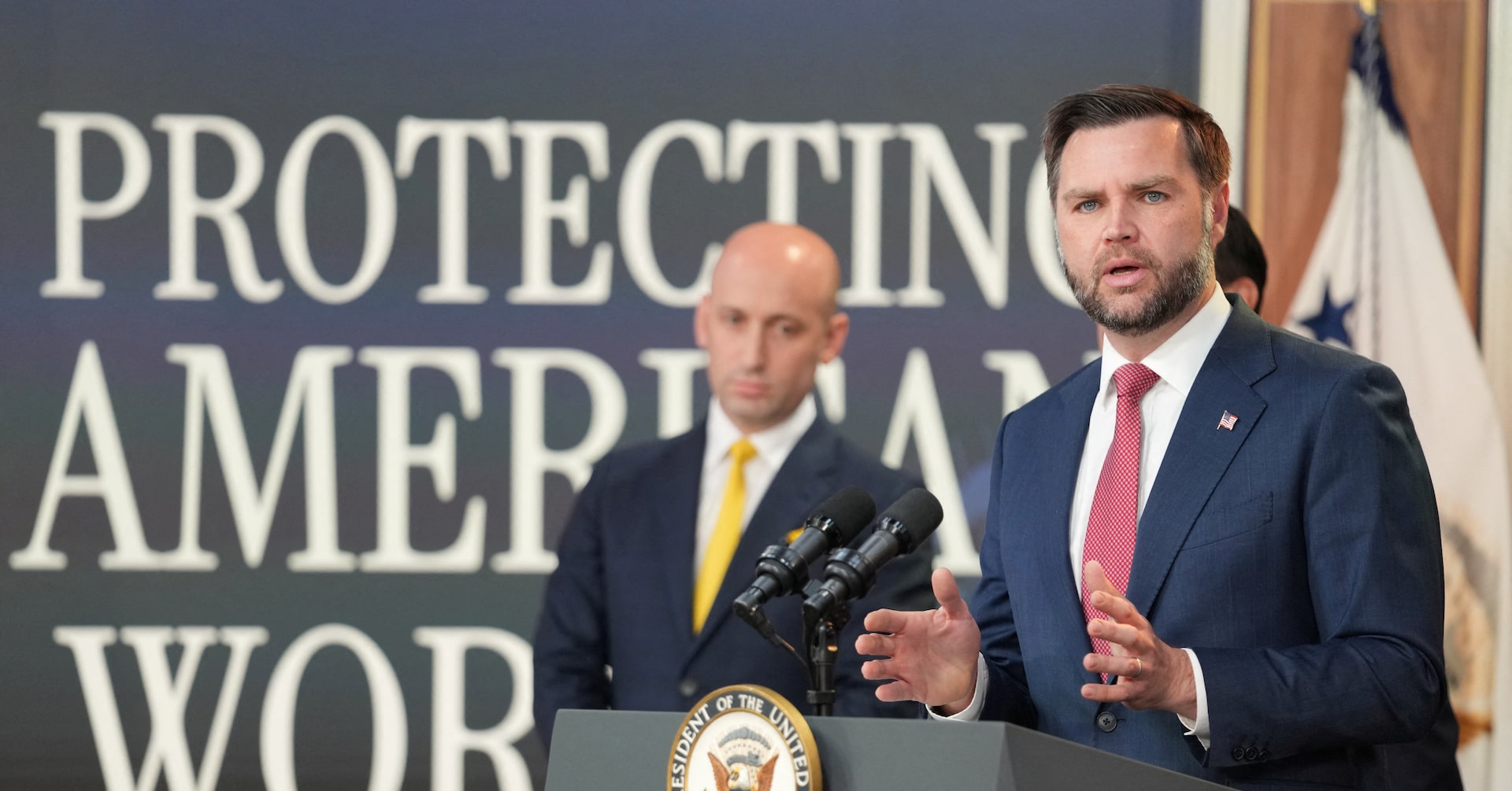
The twin actions mark the broadest strike yet against skilled-worker immigration programs — potentially cutting off a common path to permanent residency for foreign tech workers — while putting some of the country’s top research universities on notice.
Sign up here.
“There has been no company in the United States, unfortunately, that has abused the system more than Microsoft,” Vice President JD Vance said. He said the company laid off 6,000 American workers last year while benefiting from 6,300 H-1B temporary worker visas and nearly 3,000 green cards.
The announcement about the permanent labor certification process — PERM — came hours before Trump was due to give Microsoft CEO Satya Nadella the National Medal of Technology and Innovation. Under PERM, required for most employment-based green cards, employers must show that hiring a foreign worker will not harm US workers’ wages or job opportunities.
Microsoft is the largest filer of PERM applications, according to data from the US labor department.
The company said in a statement that about 80% of the H-1B applications it filed in the last fiscal year were to extend or change the status of current employees, not to hire new workers. In July, the company said it would cut 4,800 jobs, or about 2.1% of its global workforce.
He said these companies had since 2009 sought almost three million foreign workers, and had received over 230,000 H-1B visa approvals and over 100,000 permanent labor certifications.
Amazon.com was the largest employer of approved H-1B beneficiaries in fiscal 2026, followed by Tata Consultancy Services, Infosys, Apple and Microsoft, according to US immigration data.
Vance said the suspensions would last “as long as it needs to,” adding that the administration wants the companies to change how they hire. He said some companies post ineffective job ads, then cite a lack of applicants to justify hiring lower-paid foreign workers.
Microsoft said in its statement that it pays its H-1B employees the same as any other employees doing comparable work.
“The immediate financial impact on major technology companies may be relatively limited at this moment, but the longer-term implications for innovation and competitiveness could be much more significant,” said Ken Mahoney, CEO of Mahoney Asset Management.
Adobe, Cognizant, Infosys, HCL Technologies, Wipro and Capgemini did not immediately respond to requests for comment. Tata Consultancy Services declined to comment.
Nasscom, India’s IT industry body, said Indian tech companies in the US had significantly reduced their reliance on H-1B visas, and relatively few of their workers sought green cards through the PERM process.
CRACKDOWN WIDENS
The suspensions are the latest in a series of steps against skilled-worker programs. In September last year, the Labor Department launched an enforcement drive called “Project Firewall” as a White House proclamation imposed a one-time $100,000 fee on new H-1B petitions for workers hired from abroad.
During President Donald Trump’s second term, companies have faced growing pressure to keep jobs and production in the United States rather than move them overseas.
The action comes despite closer ties between the administration and tech leaders, who are lobbying for lighter AI regulation.
UNIVERSITIES UNDER SCRUTINY
Vance also said nine universities, including Harvard, Yale and Stanford, would be investigated for what the administration called the misuse of exchange-visitor visas to undercut American wages.
The nine schools also include Brown and the Massachusetts Institute of Technology. Labor Inspector General Anthony D’Esposito said subpoenas had already been served.
D’Esposito said investigators would examine whether foreign influence, improper financial relationships or visa abuse were compromising federally funded research.
“It could have an enormous economic impact on the whole US economy,” said Sarah Spreitzer, a vice president at the American Council on Education, which represents college and university presidents. International students historically spent $40 billion a year while in the US, she said.
The probe deepens the administration’s long-running fight with Harvard over foreign students. Last year, the Department of Homeland Security subpoenaed the university over alleged misconduct by international students and its compliance with immigration law. Harvard called that subpoena “unfounded retribution” but said it would comply as far as the law requires.
Adds details, background and analyst quotes throughout
Reporting by Dan Rosenzweig-Ziff, Doina Chiacu in Washington and Prathik Jayaprakash in Bengaluru; Editing by Mark Porter, Sayantani Ghosh and Sanjeev Miglani
Business
Google brings agentic AI to Gemini, starting with businesses
At a Google Cloud event on Thursday, the company announced it’s bringing its Gemini AI into the agentic age, with the launch of a unified agent that can not only answer questions but also get things done on the user’s behalf, all from a single interface.
The move comes as AI tools have been moving beyond being just conversational experiences to those that can take ownership of assigned tasks, generate code, schedule meetings, book appointments and travel, and more. It also follows the rise of consumer-facing agents like Meta’s Muse and those that operate over messaging, like Instinct and others, as well as the recent debut of ChatGPT’s Dots.
The company still has a good shot at achieving scale for its agentic efforts — as Google CEO Sundar Pichai pointed out at the event’s start, Gemini today has over 1 billion monthly active users. He also noted that nearly 90% of Fortune 100 businesses now use Gemini Enterprise at work.
Given Gemini’s adoption in the corporate world, Google will initially focus on bringing the agent to businesses before later rolling it out to consumers.
According to Pichai, this will allow the company to solve the “harder problems around security, scale, and performance,” which come with launching powerful agents such as these.
Thomas Kurian, CEO of Google Cloud, explained that the new agent can be given “objectives, not just instructions.” That means it’s able to plan the work, use custom skills and tools, and connect to businesses’ internal systems to accomplish its goals.
By default, the AI will pick the best model to complete the task, but users can also take over to choose a model — including those from third parties, starting with Anthropic’s Claude models. Google said that it will expand the model picker to include open source models and other private models in the future.
The request can include attachments, like files, folders, or other projects designed for specific workstreams, like those that combine files and skills. The agent can connect to the business’ data and systems, like Google Workspace, Microsoft 365, Slack, Jira, Confluence, Git, BigQuery, Databricks, Postgres, Snowflake, and others.
It can also connect and work securely with any Model Context Protocol (MCP) server inside or outside the company’s network.
Users can keep track of what Gemini is doing from a “tasks inbox” interface, where they can see Gemini’s thinking process, delegation of tasks to subagents, loading of special skills, code, and progress.
Notably, the AI will have its own Workspace account, as if it’s just another co-worker. That means it has its own email address and its own context, Google said. It knows who at the company is on which team, their time zones, who needs to approve items, what’s on people’s calendars, and more. Users can call the agent by tagging it, emailing it, sharing with it, or adding it to a group chat. As it takes action, it writes an audit trail attributed to the agent, instead of a person.
The agent will be accessible from iOS and Android mobile devices, Windows and Mac desktops, the command line interface, Google Workspace, Microsoft 365, ServiceNow, and Slack.
The agent’s early testers included sportswear brand On, Shopify, and PayPal, and noted that Gemini Enterprise customers include large businesses like BNP Paribas, Bradesco, Merck, Orange Spain, Santee Cooper, SOMPO, Ulta Beauty, and Wesfarmers.
Google said new flexible spending options, including multi-model orchestration, smart routing, and real-time spend caps, will help businesses keep their enterprise AI costs under better control.
Business
Nvidia, Oracle, other AI stocks sink on OpenAI revenue report

Shares of Nvidia , Oracle , CoreWeave and other artificial intelligence names sank lower on Thursday after the market learned more details about OpenAI’s revenue.
OpenAI told investors that it hit roughly $50 billion in annualized revenue at the end of September, CNBC confirmed, lower than the the $68 billion figure that was widely reported late last month. A person familiar with the matter said the $68 billion figure included gross revenue from OpenAI’s partners, which helps investors make a more direct comparison with its chief rival, Anthropic .
The Financial Times was first to report the $50 billion figure.
OpenAI shared an update about its finances in an investor presentation, said the person, who asked not to be named in order to discuss the numbers. In addition to the $50 billion in annualized revenue, OpenAI touted 77% total run rate growth during its third quarter, as well as 107% run rate growth for its enterprise business during the same period, the person said.
The company is under pressure to justify its $852 billion valuation to investors as it gears up for what is widely expected to be a blockbuster IPO. OpenAI confidentially filed its prospectus with regulators in June, and executives have signaled that the company is eyeing a 2027 debut.
In the interim, OpenAI is engaging in early stage discussions with investors about a potential new funding round. The company could raise around $30 billion, as CNBC previously reported, but that figure could change. The round is being driven by investor demand and no term sheet has been finalized yet.


Feds get ready to rewrite car headlight rules
One of the regulations that make vehicles in the US different from those in Europe or Japan is our headlight...


Study reveals whether diet soda or water is better for weight loss
Diet drinks containing sugar substitutes were found to be as effective as water for supporting weight loss in overweight or...


Tech stocks drop after report that OpenAI’s revenue is lower than expected
Tech stocks dropped on Thursday after a news report that OpenAI’s annualized revenue is about $20 billion less than previously...


US freezes Microsoft, Adobe, Infosys green-card applications over alleged fraud
The twin actions mark the broadest strike yet against skilled-worker immigration programs — potentially cutting off a common path to...


Karen Read Series Starring Elizabeth Banks Ordered at Amazon
True crime fans, this is the best news you’ll (Karen) Read all day. Amazon Prime Video has officially ordered the...


Cardi B Cancels BZR WKND Jamaica 2026 Headlining Performance
Cardi B is no longer performing at BZR WKND Jamaica this month, her rep told Billboard on Thursday (Oct. 8)....


Google brings agentic AI to Gemini, starting with businesses
At a Google Cloud event on Thursday, the company announced it’s bringing its Gemini AI into the agentic age, with...


Nvidia, Oracle, other AI stocks sink on OpenAI revenue report
Shares of Nvidia , Oracle , CoreWeave and other artificial intelligence names sank lower on Thursday after the market learned...
Why its DEI lending policies are under fire
The Trump administration is investigating a Wells Fargo program to increase the homeownership rate of Black Americans, signaling a sharp...
Micron Stock Drops. Why Samsung’s Record Profit Didn’t Give It a Lift.
You are now leaving Barron’s website By clicking on the “Proceed” button below, you will be redirected to a third-party...
-

 Sports1 week ago
The Case Keenum game? Veteran QB delivers for Chicago. Bears vs. Eagles takeaways
-

 Entertainment6 days ago
‘Verity’ Posts $4.5M Previews, ‘Digger’ $1.2M
-

 Business2 weeks ago
A 46-foot tunnel boring machine grinding 110 feet under a Virginia harbor chewed a mastodon loose from the seabed and pumped it toward land as slurry, and an operator watching the mud for metal spotte
-

 Entertainment7 days ago
Rick Devens Wins In Season 28 Finale
-

 Video7 days ago
Meta's Muse: Cute AI Agent Or 'AI Trojan Horse'? | BBC News
-

 Business5 days ago
Tesla Cybercab pressure to expand after rocky first month in Austin
-
Business6 days ago
Leaked Anthropic IPO prospectus: The US government could hurt our business
-
 Business5 days ago
OpenAI safety employee resigns, claiming the company’s ‘culture is broken’