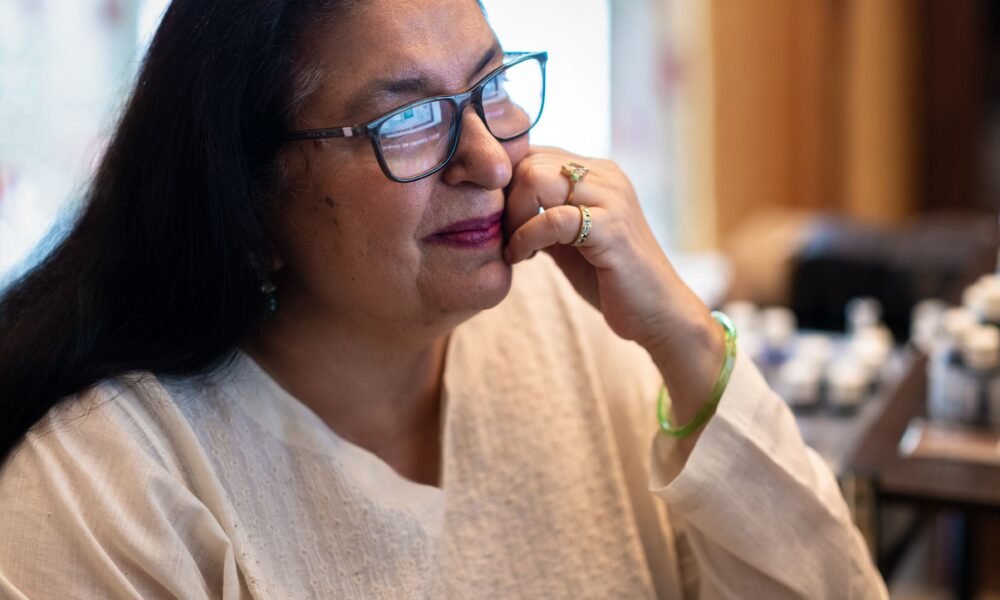
Anita Lal, founder of Good Earth, began her skincare journey as many others do: with a disaster. A woman at a counter made a comment that was not well timed, and she bought a cream that she probably shouldn’t have. She was in her mid-30s when she was told by a beauty adviser at Selfridges that she was “already acquiring wrinkles”. Lal purchased the cream, which cost PS200 at that time. “This is what we go through, the panic,” says Lal. She spent almost a year without using anything on her skin after her skin had reacted badly a few days later. She read Absolute Beauty, by Pratima Raiichur, at her home in the hills. This book pushed her to look beyond what beauty counters offered. She began to make her own preparations, using rosewater, pure oils and simple ubtans. It began as a way for Lal to recuperate, but soon became something she returned to, both for herself and for family and friends who wanted to do the same. ITI by Good Earth was the public face of the private practice Lal carried for many years. It expands the sensory vocabulary of Good Earth, which has been defined for years: scent, color, texture, and an emphasis on material quality. She says, “I live for my senses.” This time, the same sensibility is applied to the skin. Lal is blunt: “The place’s full.” Lal says that the overabundance of information is not about products but rather about information. The sheer amount of advice, routines, and supposed fixes have made skincare feel more complicated, even burdensome. Her response is to step back, not reject, but to stop the urgency that often comes with it. She says to stop thinking about magic bullets. Do it for the long-term. This long-term view has shaped how ITI was built. Lal’s characteristic practicality justifies the choice to launch the line as a complete system, rather than a set of tightly edited hero products. She points out that skin is not uniform. It changes with age, environmental factors, and sensitivity. Any attempt to reduce this to a few products feels incomplete. “There are so many different skin types that I can’t have just four products,” she says.