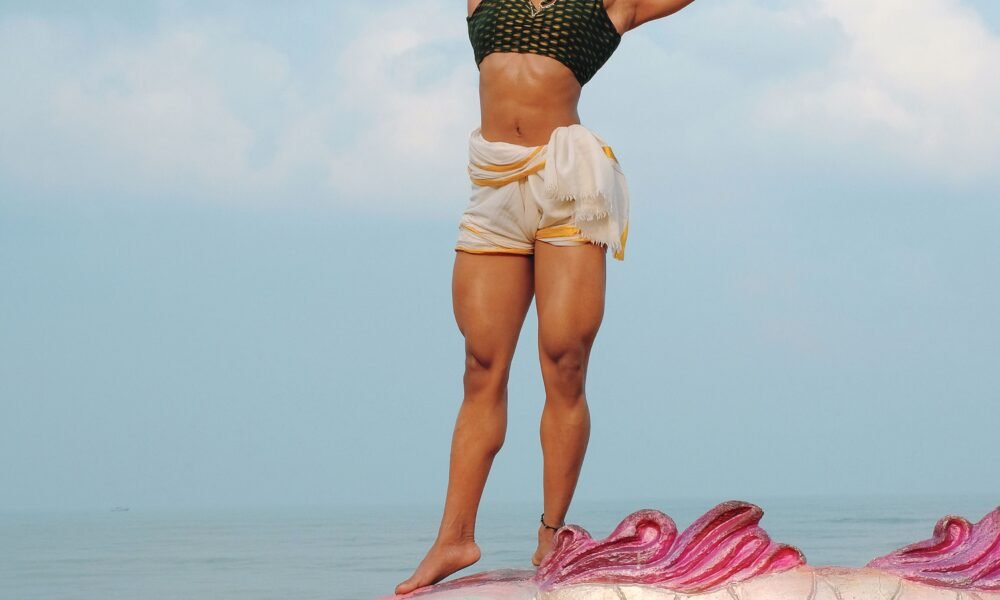
Rohit Mane’s fascination with clothing began when he watched his mother buy saris at Satara, Maharashtra. He was originally destined for a medical career, but he convinced his parents to let him study fashion design in Delhi before moving to Nottingham Trent University on an exchange. Keerthana Kunnath also made a similar journey. She left her hometown of Kozhikode in Kerala to study fashion, lifestyle accessory design, and image-making at the London College of Fashion. Both live in London today and have developed practices that challenge the norms around women’s body through fashion and photography. Mane’s work, which fuses South Asian references and dystopian aesthetics with his Indian heritage, uses his body as a canvas for his hyperfeminine designs. Kunnath’s ongoing project Not What You Seen focuses on female bodybuilders from South India. She documents the female form outside of conventional notions of femininity. Together, they ask how the rules surrounding women’s bodies can be resisted and remade. The two London-based creatives explore the origins of this preoccupation in a conversation that alternates between bantering and heartfelt confessions. Vogue India: Your practices focus on the female body, but from very different angles. What inspired you to explore this?RohitMane: I was raised in Satara, India with my mother and sister. We spent a lot of our time together in a culture that was very controlling when it came to what women wore. I’ve always been a rebel. I wanted to create a look that would represent my art, but also make a statement against these standards. This look is from Rohit Mane’s Queens of the Cosmos Collection, and it channels the rhythm of ocean wave, as if the entire body were caught in mid-tide. SIMRAN KAURKeerthana KUNNATH: I grew in Kerala and watched Malayalam films and read local magazines. Many of the narratives were demeaning to women. They gave us a template of what they thought a “good woman” should be. This was not in line with my understanding of womanhood. The medium of photography became the way I explored these questions. As I was scrolling down Instagram, I came across a woman bodybuilder from Kerala. You are supposed to feel radical when you come from an environment like that and push against everything. I wanted to learn more about their experiences, so this series was born.Vogue India asked: How do you balance the line between appreciation of the female body and objectification?