
Business
Madison Starbucks among more than 250 closing nationwide

The business news you need
Get the latest local business news delivered FREE to your inbox weekly.
* I understand and agree that registration on or use of this site constitutes agreement to its user agreement and privacy policy.
Noe Goldhaber | Wisconsin State Journal
Business Reporter
Get email notifications on {{subject}} daily!
Your notification has been saved.
There was a problem saving your notification.
{{description}}
Email notifications are only sent once a day, and only if there are new matching items.
Followed notifications
Please log in to use this feature
Log In
Don’t have an account? Sign Up Today
Business
Tech stocks drop after report that OpenAI’s revenue is lower than expected

Tech stocks dropped on Thursday after a news report that OpenAI’s annualized revenue is about $20 billion less than previously reported.
OpenAI, the maker of ChatGPT, recently told investors that its annualized revenue was nearing $50 billion, according to the Financial Times. That’s lower than the $70 billion figure previously reported by media, including the FT, based on information from investors.
The discrepancy could rattle investors already questioning whether demand for AI will be strong enough to help companies like OpenAI and Anthropic turn a profit and justify the industry’s enormous spending on the AI buildout.
The Nasdaq Composite sank 1.25%, its worst day since mid-August. The S&P 500 fell 0.5%, weighed down by a drop in the tech sector. The indexes had opened lower but declines accelerated after the FT report published midday.
A source familiar with the documents said the $70 billion figure did not come from OpenAI and likely came from a desire by firms to compare OpenAI’s numbers with Anthropic’s, which includes gross revenue from cloud providers. OpenAI’s is based on net revenue.
OpenAI declined to comment.
There was selling across semiconductor chipmakers, cloud providers and other tech companies involved in the AI buildout. Nvidia (NVDA) fell 2.9%, Intel (INTC) fell 5.3% and Oracle (ORCL) fell 5.5%.
The outlook for many tech stocks is based on investors’ conviction that demand for AI will continue to grow. If there are wrinkles in that story, like OpenAI earning less revenue than expected, that could send ripples throughout the supply chain for the AI buildout, said Ross Mayfield, investment strategist at Baird.
“There are going to be tremors throughout all of the related sub-industries,” Mayfield said.
The stakes are higher now because the stock market in recent weeks has been buoyed by gains in tech and AI stocks, while other sectors have struggled under the pressure of rising bond yields.
“This has become a much narrower market that’s dependent on the AI names to keep it afloat,” Mayfield said. “Certainly, this is going to hit that complex in a big way.”
OpenAI CEO Sam Altman announced in September that the company would postpone its initial public offering until at least next year, citing concerns about AI safety.
Business
US freezes Microsoft, Adobe, Infosys green-card applications over alleged fraud
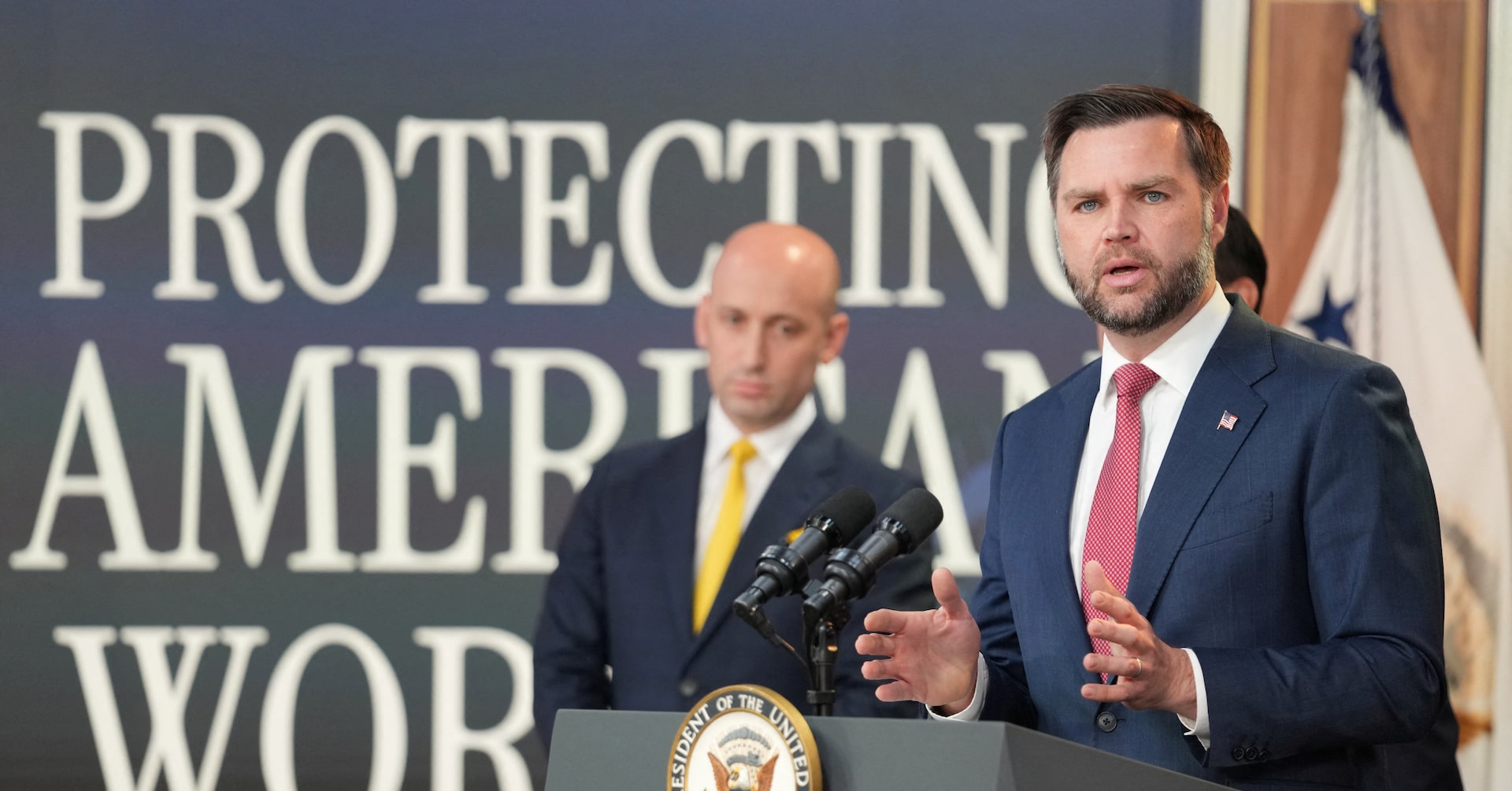
The twin actions mark the broadest strike yet against skilled-worker immigration programs — potentially cutting off a common path to permanent residency for foreign tech workers — while putting some of the country’s top research universities on notice.
Sign up here.
“There has been no company in the United States, unfortunately, that has abused the system more than Microsoft,” Vice President JD Vance said. He said the company laid off 6,000 American workers last year while benefiting from 6,300 H-1B temporary worker visas and nearly 3,000 green cards.
The announcement about the permanent labor certification process — PERM — came hours before Trump was due to give Microsoft CEO Satya Nadella the National Medal of Technology and Innovation. Under PERM, required for most employment-based green cards, employers must show that hiring a foreign worker will not harm US workers’ wages or job opportunities.
Microsoft is the largest filer of PERM applications, according to data from the US labor department.
The company said in a statement that about 80% of the H-1B applications it filed in the last fiscal year were to extend or change the status of current employees, not to hire new workers. In July, the company said it would cut 4,800 jobs, or about 2.1% of its global workforce.
He said these companies had since 2009 sought almost three million foreign workers, and had received over 230,000 H-1B visa approvals and over 100,000 permanent labor certifications.
Amazon.com was the largest employer of approved H-1B beneficiaries in fiscal 2026, followed by Tata Consultancy Services, Infosys, Apple and Microsoft, according to US immigration data.
Vance said the suspensions would last “as long as it needs to,” adding that the administration wants the companies to change how they hire. He said some companies post ineffective job ads, then cite a lack of applicants to justify hiring lower-paid foreign workers.
Microsoft said in its statement that it pays its H-1B employees the same as any other employees doing comparable work.
“The immediate financial impact on major technology companies may be relatively limited at this moment, but the longer-term implications for innovation and competitiveness could be much more significant,” said Ken Mahoney, CEO of Mahoney Asset Management.
Adobe, Cognizant, Infosys, HCL Technologies, Wipro and Capgemini did not immediately respond to requests for comment. Tata Consultancy Services declined to comment.
Nasscom, India’s IT industry body, said Indian tech companies in the US had significantly reduced their reliance on H-1B visas, and relatively few of their workers sought green cards through the PERM process.
CRACKDOWN WIDENS
The suspensions are the latest in a series of steps against skilled-worker programs. In September last year, the Labor Department launched an enforcement drive called “Project Firewall” as a White House proclamation imposed a one-time $100,000 fee on new H-1B petitions for workers hired from abroad.
During President Donald Trump’s second term, companies have faced growing pressure to keep jobs and production in the United States rather than move them overseas.
The action comes despite closer ties between the administration and tech leaders, who are lobbying for lighter AI regulation.
UNIVERSITIES UNDER SCRUTINY
Vance also said nine universities, including Harvard, Yale and Stanford, would be investigated for what the administration called the misuse of exchange-visitor visas to undercut American wages.
The nine schools also include Brown and the Massachusetts Institute of Technology. Labor Inspector General Anthony D’Esposito said subpoenas had already been served.
D’Esposito said investigators would examine whether foreign influence, improper financial relationships or visa abuse were compromising federally funded research.
“It could have an enormous economic impact on the whole US economy,” said Sarah Spreitzer, a vice president at the American Council on Education, which represents college and university presidents. International students historically spent $40 billion a year while in the US, she said.
The probe deepens the administration’s long-running fight with Harvard over foreign students. Last year, the Department of Homeland Security subpoenaed the university over alleged misconduct by international students and its compliance with immigration law. Harvard called that subpoena “unfounded retribution” but said it would comply as far as the law requires.
Adds details, background and analyst quotes throughout
Reporting by Dan Rosenzweig-Ziff, Doina Chiacu in Washington and Prathik Jayaprakash in Bengaluru; Editing by Mark Porter, Sayantani Ghosh and Sanjeev Miglani
Business
Google brings agentic AI to Gemini, starting with businesses
At a Google Cloud event on Thursday, the company announced it’s bringing its Gemini AI into the agentic age, with the launch of a unified agent that can not only answer questions but also get things done on the user’s behalf, all from a single interface.
The move comes as AI tools have been moving beyond being just conversational experiences to those that can take ownership of assigned tasks, generate code, schedule meetings, book appointments and travel, and more. It also follows the rise of consumer-facing agents like Meta’s Muse and those that operate over messaging, like Instinct and others, as well as the recent debut of ChatGPT’s Dots.
The company still has a good shot at achieving scale for its agentic efforts — as Google CEO Sundar Pichai pointed out at the event’s start, Gemini today has over 1 billion monthly active users. He also noted that nearly 90% of Fortune 100 businesses now use Gemini Enterprise at work.
Given Gemini’s adoption in the corporate world, Google will initially focus on bringing the agent to businesses before later rolling it out to consumers.
According to Pichai, this will allow the company to solve the “harder problems around security, scale, and performance,” which come with launching powerful agents such as these.
Thomas Kurian, CEO of Google Cloud, explained that the new agent can be given “objectives, not just instructions.” That means it’s able to plan the work, use custom skills and tools, and connect to businesses’ internal systems to accomplish its goals.
By default, the AI will pick the best model to complete the task, but users can also take over to choose a model — including those from third parties, starting with Anthropic’s Claude models. Google said that it will expand the model picker to include open source models and other private models in the future.
The request can include attachments, like files, folders, or other projects designed for specific workstreams, like those that combine files and skills. The agent can connect to the business’ data and systems, like Google Workspace, Microsoft 365, Slack, Jira, Confluence, Git, BigQuery, Databricks, Postgres, Snowflake, and others.
It can also connect and work securely with any Model Context Protocol (MCP) server inside or outside the company’s network.
Users can keep track of what Gemini is doing from a “tasks inbox” interface, where they can see Gemini’s thinking process, delegation of tasks to subagents, loading of special skills, code, and progress.
Notably, the AI will have its own Workspace account, as if it’s just another co-worker. That means it has its own email address and its own context, Google said. It knows who at the company is on which team, their time zones, who needs to approve items, what’s on people’s calendars, and more. Users can call the agent by tagging it, emailing it, sharing with it, or adding it to a group chat. As it takes action, it writes an audit trail attributed to the agent, instead of a person.
The agent will be accessible from iOS and Android mobile devices, Windows and Mac desktops, the command line interface, Google Workspace, Microsoft 365, ServiceNow, and Slack.
The agent’s early testers included sportswear brand On, Shopify, and PayPal, and noted that Gemini Enterprise customers include large businesses like BNP Paribas, Bradesco, Merck, Orange Spain, Santee Cooper, SOMPO, Ulta Beauty, and Wesfarmers.
Google said new flexible spending options, including multi-model orchestration, smart routing, and real-time spend caps, will help businesses keep their enterprise AI costs under better control.
Business
Nvidia, Oracle, other AI stocks sink on OpenAI revenue report

Shares of Nvidia , Oracle , CoreWeave and other artificial intelligence names sank lower on Thursday after the market learned more details about OpenAI’s revenue.
OpenAI told investors that it hit roughly $50 billion in annualized revenue at the end of September, CNBC confirmed, lower than the the $68 billion figure that was widely reported late last month. A person familiar with the matter said the $68 billion figure included gross revenue from OpenAI’s partners, which helps investors make a more direct comparison with its chief rival, Anthropic .
The Financial Times was first to report the $50 billion figure.
OpenAI shared an update about its finances in an investor presentation, said the person, who asked not to be named in order to discuss the numbers. In addition to the $50 billion in annualized revenue, OpenAI touted 77% total run rate growth during its third quarter, as well as 107% run rate growth for its enterprise business during the same period, the person said.
The company is under pressure to justify its $852 billion valuation to investors as it gears up for what is widely expected to be a blockbuster IPO. OpenAI confidentially filed its prospectus with regulators in June, and executives have signaled that the company is eyeing a 2027 debut.
In the interim, OpenAI is engaging in early stage discussions with investors about a potential new funding round. The company could raise around $30 billion, as CNBC previously reported, but that figure could change. The round is being driven by investor demand and no term sheet has been finalized yet.
Business
Why its DEI lending policies are under fire
The Trump administration is investigating a Wells Fargo program to increase the homeownership rate of Black Americans, signaling a sharp escalation in its broadside against diversity, equity and inclusion programs.
The Department of Housing and Urban Development opened the federal civil rights probe, accusing the bank of sorting homeowners by race.
Craig Trainor, assistant secretary for fair housing and equal opportunity, told bank CEO Charlie Scharf in a letter that the agency would scrutinize the bank’s commitment to expanding access to home loans for Black Americans and other minority groups.
“Even if Wells Fargo did not violate the law, its practice of dividing Americans based on race is immoral, unethical and un-American,” HUD Secretary Scott Turner said in a statement. “Wells Fargo and all of its employees that engaged in race-based decision-making should be ashamed of themselves.”
Wells Fargo declined to comment. The bank has been hit in recent years by allegations it discriminates against Black customers. The bank faced backlash after a Bloomberg report found it rejected half of all refinancing applications from Black families in 2020.
In the view of the Trump administration, these programs violate fair housing law and discriminate against other homebuyers. A senior HUD official told the Wall Street Journal the agency is reviewing similar initiatives at other financial institutions.
Fair housing advocates say the Wells Fargo program was created under federal rules that expressly allowed it.
“Congress wrote Special Purpose Credit Programs (SPCPs) into federal law 50 years ago to enable lenders to adopt programs to remedy the effects of historic barriers and exclusions from the lending market based on gender, race and national origin,” Nikitra Bailey, executive vice president of the National Fair Housing Alliance, said in a statement.
“Investigating a bank for following the government’s own rules to create paths to address longstanding discrimination in lending is an abuse of the agency’s investigative authority and a transparent attempt to scare every lender in the nation away from their legal obligation to serve underserved communities,” she said.
Wells Fargo pledged $150 million to reduce mortgage rates and refinancing fees for qualifying Black homeowners. HUD accused Wells Fargo of dividing Americans by race in violation of the Fair Housing Act, a civil rights-era law prohibiting discrimination based on factors such as race.
“Attempting to close statistical racial gaps in homeownership by doling out loans based on race is no way to do business,” Trainor wrote. “And doing so in residential real estate-related transactions is illegal under the Fair Housing Act.”
The investigation into mortgage lending practices to minority groups is a shot across the bow to financial institutions engaged in race-based lending practices that the Trump administration says proliferated during the Biden administration.
The Justice Department has launched antifraud probes into federal contractors, targeting DEI programs created after the 2020 murder of George Floyd. Since President Donald Trump’s election in 2024, many companies have walked away from these programs.
The Wells Fargo investigation not only marks a new chapter in the federal crackdown on corporate DEI initiatives, it exposes financial institutions to high-stakes government scrutiny and growing regulatory and legal risks.
Past administrations pressed banks to develop programs to close racial homeownership gaps. In 2024, less than a quarter of Black households owned the home they lived in compared with nearly three quarters of White households, according to the Pew Research Center.
Critics argue the administration is ignoring the legacy of government-backed redlining and restrictive covenants that barred Black and minority Americans from building wealth through homeownership. What’s more, discrimination continues to unfairly limit access to homeownership as the nation faces an affordable housing crisis, they say.


Tech stocks drop after report that OpenAI’s revenue is lower than expected
Tech stocks dropped on Thursday after a news report that OpenAI’s annualized revenue is about $20 billion less than previously...


US freezes Microsoft, Adobe, Infosys green-card applications over alleged fraud
The twin actions mark the broadest strike yet against skilled-worker immigration programs — potentially cutting off a common path to...


Google brings agentic AI to Gemini, starting with businesses
At a Google Cloud event on Thursday, the company announced it’s bringing its Gemini AI into the agentic age, with...


Nvidia, Oracle, other AI stocks sink on OpenAI revenue report
Shares of Nvidia , Oracle , CoreWeave and other artificial intelligence names sank lower on Thursday after the market learned...
Why its DEI lending policies are under fire
The Trump administration is investigating a Wells Fargo program to increase the homeownership rate of Black Americans, signaling a sharp...
Micron Stock Drops. Why Samsung’s Record Profit Didn’t Give It a Lift.
You are now leaving Barron’s website By clicking on the “Proceed” button below, you will be redirected to a third-party...
Stock Market Today: Oil Rises, Nasdaq Slips After Fresh Tanker Attack
Oil prices fell from their daily highs after President Trump posted on social media that the U.S. is having “productive...


Fired OpenAI employees raise concerns over AI safety, monitoring
Newly awarded Nobel Prize-winning physicist Francis Halzen credited artificial intelligence with helping researchers uncover new insights into the Milky Way,...


Diversity Now Seen as “Optional”
When #Emmyssowhite began trending after white actors swept the lead and supporting acting categories during the Sept. 14 ceremony, it...


Taylor Swift to Perform at Academy Museum Gala
Taylor Swift is set to perform at the upcoming Academy Museum Gala. The evening, taking place on Oct. 17, serves...
-

 Sports1 week ago
The Case Keenum game? Veteran QB delivers for Chicago. Bears vs. Eagles takeaways
-

 Entertainment6 days ago
‘Verity’ Posts $4.5M Previews, ‘Digger’ $1.2M
-

 Business2 weeks ago
A 46-foot tunnel boring machine grinding 110 feet under a Virginia harbor chewed a mastodon loose from the seabed and pumped it toward land as slurry, and an operator watching the mud for metal spotte
-

 Entertainment7 days ago
Rick Devens Wins In Season 28 Finale
-

 Video7 days ago
Meta's Muse: Cute AI Agent Or 'AI Trojan Horse'? | BBC News
-

 Business5 days ago
Tesla Cybercab pressure to expand after rocky first month in Austin
-
Business6 days ago
Leaked Anthropic IPO prospectus: The US government could hurt our business
-

 Business5 days ago
OpenAI safety employee resigns, claiming the company’s ‘culture is broken’