Politics
Man offered Ukrainians money to carry out Starmer arson attacks, court hears
Man offered Ukrainians money to carry out Starmer arson attacks, court hears

A Russian speaker recruited and offered money to Ukrainian men to carry out arson attacks on properties connected to Prime Minister Sir Keir Starmer, a court has heard.
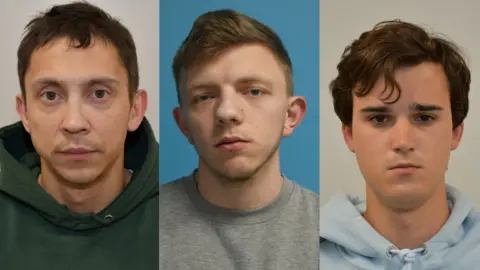
Ukrainian nationals Roman Lavrynovych 22, and Petro Pochynok, 35, are accused of targeting two properties and a car linked to the PM, along with Ukrainian-born Romanian national Stanislav Carpiuc, 27. They deny all the charges.
All three, who live in London, are charged with conspiring together – and “with others” – to damage property by fire between 1 April and 13 May 2025.
Lavrynovych is also charged with damaging property by fire with intent to endanger life on 11 and 12 May 2025 at two properties in north London connected to Sir Keir.
He faces alternate counts of damaging property by fire being reckless as to whether life is endangered.
On 8 May 2025, a car previously owned by the prime minister was found on fire on a street he previously lived on in Kentish Town, north London. Three days later, a fire was discovered at flats linked to Sir Keir in nearby Islington.
On 12 May 2025, a fire was discovered at the entrance to Sir Keir’s Kentish Town home, which was being rented out.
Prosecutor Duncan Atkinson KC said: “This case concerns a series of three fires that were deliberately set in a residential area of North London over three nights in May last year.”
He said “three fires in the same area within five days would be pretty unusual” but that “fires all involving property linked to the same person were beyond a coincidence”.

He said in this case, the car had once belonged to Sir Keir, one house was managed by a company of which the prime minister had once been director and shareholder, and the other house still belonged to the prime minister and was occupied by his sister-in-law.
He added: “The evidence demonstrated that there was here no coincidence. Rather, the vehicle and properties in question had been targeted, and the acts of arson at these locations had been planned and directed, with those involved promised payment for their participation.”
The prosecutor said analysis of messages from phones recovered from, and connected with, the defendants showed “communication between them before and during the relevant period”.
He said Lavrynovych was offered payment to set the fires by a contact using the name or pseudonym “El Money” on the Telegram messaging app. He said Carpiuc also communicated with El Money.
Atkinson said that El Money communicated in Russian, in contrast to the Ukrainian otherwise used by the defendants.
He told jurors that it was “no part of your considerations” to decide who El Money was and what reason he might have had for co-ordinating the alleged actions of the defendants.
He said that was because jurors did not have to decide what motivated the three defendants.
He said the defendants had not demonstrated any particular political or ideological motivation, as opposed to a financial one, and that it did not matter whether they knew that the property they were allegedly targeting was connected to the prime minister or whether that formed part of their motivation.
Atkinson said that messages from May 2025 showed Lavrynovych had been discussing a “job” with El Money and Carpiuc.
He said the conversations were an “obvious reference” to a plan to target Sir Keir’s former Toyota car, already identified in October 2024 when Lavrynovych sent the location and image of the car to an Instagram user.
The jury was played CCTV footage of Lavrynovych in a south London B&Q on 6 May 2025 buying white spirit, which Atkinson described an “accelerant”.
He said fragments of evidence found on Lavrynovych’s phone suggested that he may have sent a “targeting pack, explaining where to go and what to do, together with a means or promise of payment in cryptocurrency”.
Atkinson added that in the early hours of the morning on 7 May – 24 hours before the car was set on fire – Lavrynovych travelled from home to north London and back.
Lavrynovych was caught on bus CCTV and his phone data shows that he went to the area where the car was parked. An image of the car, timed at 03:08 BST, was found on Lavrynovych’s phone, Atkinson said.
“He was making a reconnaissance trip to prepare for the following night,” Atkinson claimed.
The jury were also read a series of messages between Lavryovych and Pochynok, which prosecutors say shows arrangements being made for the arson attack on the Toyota car.
Shortly before 22:00 BST on 7 May, Lavryovych sent Pochynok a message on Telegram saying: “Look, we won’t talk much on the phone. At that address, there’ll be a car, need to check if it’s there. If it is there then basically today we’ll do the job. We’ll have money. And this week, if we plan everything well today, tomorrow there may be another one, we’ll make more money.”
At 22:09, Lavryovych sent a voice message on Telegram: “We’ll meet on the main street basically.”
Then, soon after midnight on 8 May, Lavryovych sent Pochynok messages saying “hello” and “it’s on”, before leaving home in Sydenham and travelling to north London.
Atkinson said CCTV images showed the two defendants travelling across London to meet at the “burn site”.
Lavryovych sent Pochynok a message at 02:13 saying: “On my way quietly we’ll do it and that’s it tomorrow money.”
Atkinson said the evidence showed the two men arrived soon after, with Lavryovych writing he was at “at the address” and Pochynok replying he was a minute away.
Images from Lavyrynovych’s phone show the car itself on the road, with one final image showing the car burning and someone looking on.
Atkinson said this image was Pochynok recording Lavryovych as he set the car on fire.
Neighbours called the fire brigade after seeing the car burning.

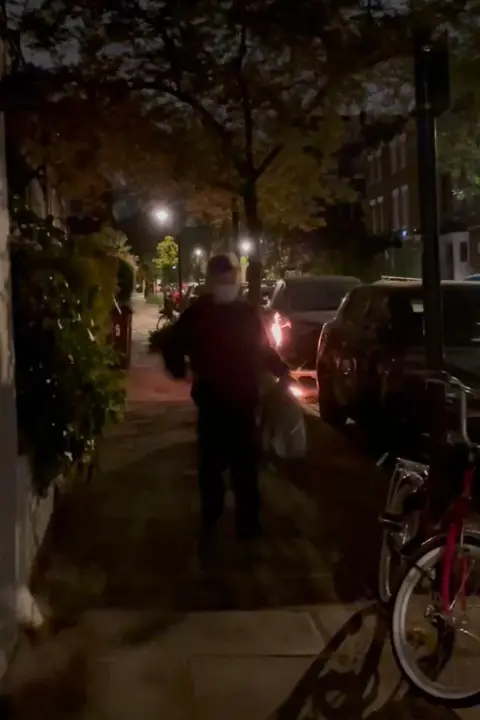
The jury were also shown CCTV footage from the early hours of 11 May in which Atkinson said Lavrynovych could be seen on the north London road where the PM used to live.
He said a video from Lavrynoych’s phone, which was played to jurors, showed a front door on this road being set on fire.
According to Atkinson, after a further exchange of messages with El Money, Lavrynovych returned to the road, where he started a fire at the front door of a property that the prime minister had been renting out to his sister-in-law.
El Money sent messages to Lavrynovych on 12 May, which included “there is news, you’ll get crypto” and “you need to throw away the clothes”, Atkinson said.
The prosecutor said that El Money then offered Lavrynovych advice in a message that read: “Look, you attacked the home of a very high-ranking person in Britain. I’ll send you money, you need to leave the city.
“If the police detain you, secretly write the word, ‘geranium’ and I’ll send a lawyer to you, I’ll give you money for a week and a new phone. We won’t be in touch for a week.”
Lavrynovych later sent messages to El money “chasing payment”, said Atkinson.
The trial continues and is expected to last three weeks.