Connect with us

BBC News World

Shot in school uniform: BBC reveals police order led to Gen Z protest killings in Nepal

New evidence reveals what happened when 19 people were shot dead in Kathmandu last September.​New evidence reveals what happened when 19 people were shot dead in Kathmandu last September. 

Shot in school uniform: BBC reveals police order led to Gen Z protest killings
Subina Shrestha,BBC Eye Investigationsand
Deepak Kharel,BBC Eye Investigations
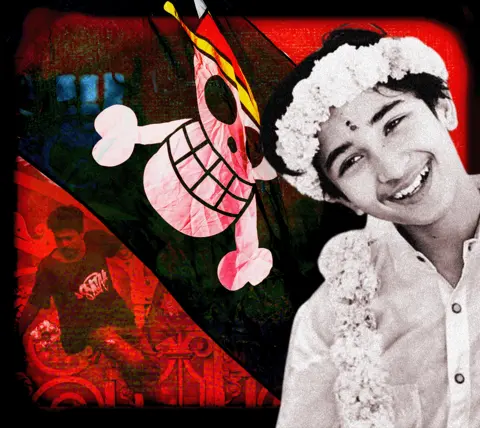
BBC A digitally edited collage featuring three main elements: on the left, a person in motion wearing a black shirt with stylised white text against an ornate red background; in the centre, a large black pirate flag displaying the Straw Hat Pirates’ Jolly Roger from manga series One Piece with a skull wearing a straw hat; and on the right, a black-and-white photo of a smiling teenage boy wearing a white shirt and floral garlands. The overall colour scheme is dominated by red and black tones.BBC

An order allowing the use of lethal fire against thousands of young, unarmed protesters in Nepal was issued by the country’s former police chief, a BBC investigation reveals.

Among the 19 people killed in the capital, Kathmandu, on 8 September last year was a teenager in school uniform, who had been walking away from the crowd when he was shot in the back of the head. Dozens more were injured.

The events at the so-called Gen Z demonstrations – which had followed weeks of simmering anger about political corruption – sparked further protests leading to the resignation of Nepal’s prime minister and the collapse of its government a day later.

The BBC World Service team has seen an internal police document detailing events on 8 September. It reveals someone using the call sign “Peter 1” told his officers to “deploy necessary force” 10 minutes after a curfew had come into effect, and after repeated requests by officers on the ground to use lethal force.

Peter 1 was the call sign used by Nepal’s former police inspector general, Chandra Kuber Khapung, sources have told BBC Eye Investigations.

Khapung has not denied that he issued the order, but Nepal Police says that this was only after he was given authorisation by a government security committee and once all other forms of force had been used, in line with Nepali law.

Khapung – who retired in November – has not replied to the BBC’s request for comment.

Video evidence examined by the BBC reveals that 17-year-old Shreeyam Chaulagain – the youngest of the 19 victims – had been unarmed and was trying to leave the scene when he died.

The events of 8 September are now being examined by a public inquiry, which has yet to report. So far, no-one has been held accountable – and general elections are set to take place on 5 March.

The BBC has established the chain of events, detailed by the leaked police log and supported by insider accounts from serving officers, that led to the shootings.

By analysing visual evidence, including more than 4,000 videos and photos, and details from those on the streets and in the command centre where security officials were monitoring events, we have pieced together the most comprehensive account so far of one of the most dramatic and bloody days in Nepal’s recent history.

Warning: This story contains images of dead bodies

Nepal is a young democracy. It became a republic in 2008, after a civil war that killed more than 17,000 people and lasted 10 years.

A decade after a new constitution promised a fresh start, many young people say those hopes remain unmet. By some estimates, about one in five young Nepalis is out of work.

Much of the frustration has been voiced online, particularly among Generation Z – those currently aged between 14 and 29.

Last August, Gen Z activists began to share terms on social media such as “nepo baby”, to describe the privileged children of the Nepalese elite. On 4 September, the government banned some platforms, including Facebook, YouTube, Instagram and X.

Activists moved onto the gaming chat platform Discord, which became a hub for organising.

In one forum, Youth Against Corruption, members planned the protest outside parliament on 8 September.
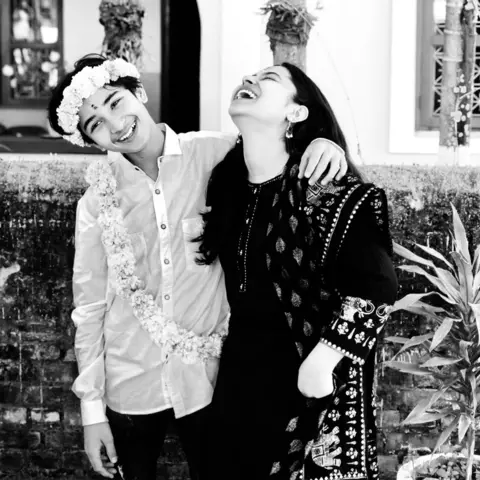
A black‑and‑white photo showing a teenage boy and a woman standing close together outdoors, one with an arm around the other. He is smiling, and she is laughing, her head back in the air. He is wearing a light-colored button‑up shirt and a long floral garland draped across the torso. She is wearing a dark, patterned outfit with embroidered details on the sleeves and a matching draped fabric. They stand in front of a textured brick wall, with plants and parts of a building visible in the background.

Shreeyam Chaulagain’s mother did not want him to go.

“I told him not to participate. Things can happen at protests,” she told the BBC. But Shreeyam was deeply engaged with politics, his father said. “He said corruption had hollowed out [Nepal]. He was far more informed than I was.”

Shreeyam reassured his mother the protesters would not be targeted because they were young, and in school uniforms.

“He was so curious – he wanted to know what was going on in the world,” she said.

The hours that led to bloodshed

09:00: Young people begin gathering at Maitighar Mandala, a busy intersection in central Kathmandu where demonstrations are often held.

A barricade stands several hundred metres from parliament.

Security officials “hugely underestimated the crowd”, says Basanta Basnet, editor of Nepal’s daily online news portal Online Khabar. “I spoke to security personnel, and also to members of the political class – they said that ‘children’ were joining.”
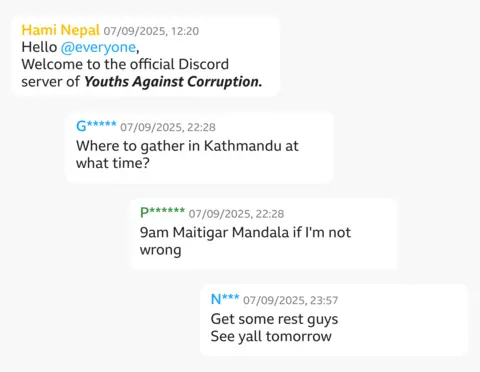
A screenshot of a Discord conversation featuring several chat bubbles. The first message, from a user labelled “Hami Nepal” dated 07/09/2025 at 12:20, welcomes everyone to the official Discord server of Youths Against Corruption. A later message from a user labelled “G*****” on 07/09/2025 at 22:28 asks where and when to gather in Kathmandu. Another user, “P******”, replies at the same timestamp saying: “9am Maitigar Mandala if I'm not wrong.” The final message, from “N***” at 23:57, says: “Get some rest guys. See yall tomorrow.”

About 30,000 people arrive to protest – 10 times the number anticipated by police.

“We have an expected behaviour pattern [for protests],” one police officer has told the BBC anonymously. “But with this new generation, we do not understand their social media or how they mobilise on the ground.”

The protesters begin moving towards parliament, but are stopped by the police barricade.

11:47: A group of demonstrators finds a way around the cordon – the police, taken by surprise, abandon the barricade.

The crowds surge past and protesters reach the gates of parliament.

12:15: One group of protesters breaches the walls of the parliament compound. Police fire tear gas and use batons. The crowd does not retreat, even as organisers urge people on Discord to pull back.

Video footage shows Shreeyam outside the gates. Wearing a green school jumper and carrying a backpack, he holds a banner reading: “Youths Against Corruption”.

Elsewhere, the protests are becoming more violent.

Inside the situation room

Senior security officials are gathered in a control room almost 3km (1.9 miles) away, near a complex of government offices.

Representatives of the civilian police, army, armed police and intelligence officials are present. The security committee is chaired by the capital’s chief district officer, senior civil servant Chhabi Lal Rijal.

Within the command centre, officials work to obtain live visual feeds from CCTV cameras positioned around the parliamentary complex. According to one anonymous officer, they have a TV but no dedicated internet line, and that when they attempt to establish a connection, it is “not stable”.

No individual or unit has a comprehensive understanding of the overall situation, according to police officers we speak to who were there on the day.

12:30: The chief district officer imposes an immediate curfew, making the protests illegal. Officers use loudhailers to order people home.

Rather than obeying, some protesters surround a police unit and pelt them with bricks and stones.

About the same time, footage shows the parliament gatehouse on fire.

According to multiple police sources and the police log, panicked officers in and around parliament radio the command centre for help. “Some of us were badly hurt. One of us asked to be rescued,” one anonymous police source tells us.

They repeatedly ask their superiors for permission to use live ammunition, after batons, water cannons and rubber bullets fail to disperse the crowd.

12:40: That authorisation is given now, according to the log we’ve seen, as well as several police sources.
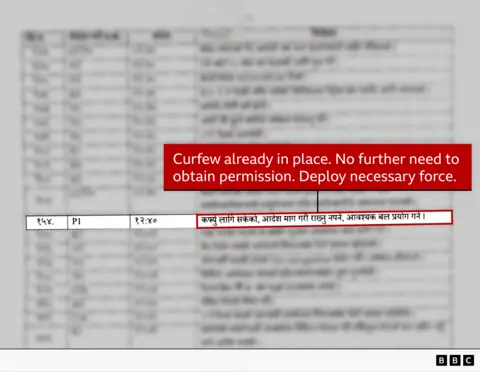
A blurred photo of a document with four columns and many rows; all the entries are written in Nepalese. One row is highlighted, with an English translation provided: "Curfew already in place. No further need to obtain permission. Deploy necessary force."

They pinpoint the source of the approval to one call sign: Peter 1.

The instruction from Peter 1 is recorded in the police log: “Curfew already in place. No further need to obtain permission. Deploy necessary force.”

Peter 1 is Chandra Kuber Khapung, then inspector general of police.

In a filing to the supreme court of Nepal, Khapung later denied responsibility, and Nepal Police told the BBC that the decision to give the order to fire was made by the committee that Rijal headed up. In a letter, the force said that Khapung “did not issue the order to use force ahead of the committee’s decision”.

In public order situations, the security committee – rather than the police – has legal authority over decisions concerning escalation of force.

However, its then chair, Rijal, has denied in court that he authorised live rounds.

Some police officers we spoke to have since acknowledged failures in intelligence, planning and command. Several said they had been unprepared for a crowd rapidly mobilised on Discord. Others questioned why military support did not arrive sooner.

Many say they are still struggling with the memory of that day.

“Our officers fired on them like they were enemies,” one says.
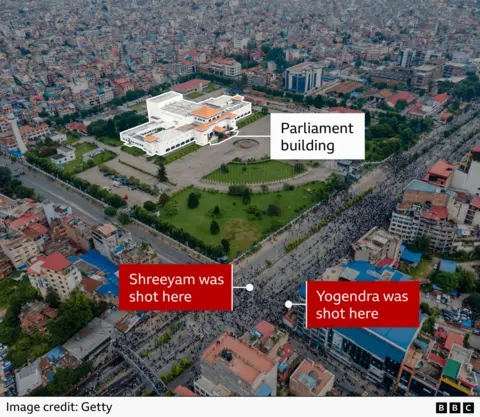
Aerial view of Kathmandu with a prominent white parliamentary building set within a green square at the centre. Surrounding the square are dense urban buildings and wide roads. Two red labels mark locations along a road crowded with people: one label on the left reads “Shreeyam was shot here,” and another on the right reads “Yogendra was shot here.” A white label above the central complex identifies the “Parliament building.”

13:15: The first death from live fire is recorded by the BBC. Video evidence shows one protester, 34-year-old Binod Maharjan, being carried away with a wound to the head. He died later in hospital.

The BBC has been able to analyse six shootings after the curfew order. In the footage we examined, we have not seen any of the victims engaging in violence.

14:09: Shreeyam – the youngest victim of the shootings that day – is seen peacefully walking away from the front line, where other protesters are pelting police with stones. Still carrying his school bag, he claps his hands – a gesture that appears calm.

A bullet strikes the back of his head, and he falls to the ground.
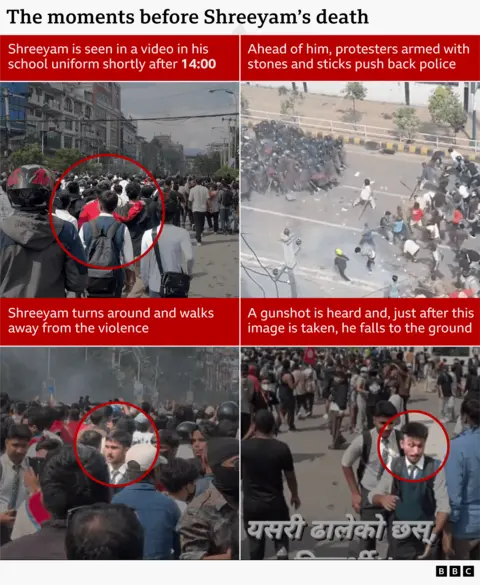
A graphic divided into four quarters, each of which consists of a photo and a caption. The top left shows a crowd, with their backs to the camera. One person is circled in the photo, Shreeyam - he is wearing a white shirt, a green tank top and a plain black rucksack. The caption reads: "Shreeyam is seen in a video in his school uniform shortly after 14:00." The next image, top right, is shot from the air and shows a group of police officers in riot gear walking towards the left; a crowd of protesters armed with sticks is following them. The caption reads: "Ahead of him, protesters armed with stones and sticks push back police." The image in the bottom left shows a crowd - Shreeyam is circled, in the centre, walking away from the protests. The caption reads: "Shreeyam turns around and walks away from the violence." The final image, bottom right, shows Shreeyam, circled, as he jolts forward. The caption reads: "A gunshot is heard and, just after this image is taken, he falls to the ground."

14:21: Video evidence obtained by the BBC shows police firing at protesters from inside the parliamentary complex. We have been able to establish that police fired seven shots at the crowd.

Protesters scatter, ducking into the gaps between buildings and pavement. Some simply cover their heads for protection. Yogendra Nyaupane, 24, is hit and fatally wounded.

The last shooting recorded by the BBC takes place at about 16:00, and the protest outside parliament dies down at dusk. But smaller sporadic protests continue through the night.
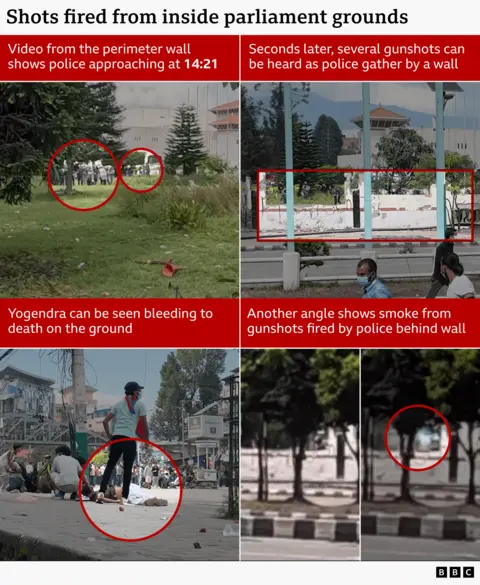
A graphic divided into four quarters, each of which consists of a photo and a caption. The heading reads "Shots fired from inside parliament grounds". The top left shows a grassy area, inside the parliament compound. In the distance, there is a group of police officers in riot gear, circled in red. The caption reads: "Video from the perimeter wall shows police approaching at 14:21". The next image, top right, shows a group of police officers in riot gear just behind the parliament wall. The caption reads: "Seconds later, several gunshots can be heard as police gather by a wall." The image in the bottom left shows a group gathered around a person lying on the pavement. The caption reads: "Yogendra can be seen bleeding to death on the ground." The final image, bottom right, is split into two. Both show trees in front of the parliament walls - on the right, smoke can be seen. The caption reads: "Another angle shows smoke from gunshots fired by police behind wall."

Angered by the killings at the gates of parliament on 8 September, Nepalis of all ages took to the streets the following day. What had begun as protest rapidly hardened into mob violence, and police became immediate targets. Police stations were set ablaze, officers were assaulted, and three were killed.

There were arson attacks on the parliamentary compound, the supreme court and other government buildings. In total, 77 people were killed during the unrest.

Although it has been widely alleged – by politicians, police and protesters – that organised groups and infiltrators acting on behalf of political interests helped drive the destruction, we have found no evidence to substantiate the claim.

At about 14:30 on 9 September, Prime Minister KP Sharma Oli resigned and Nepal’s government collapsed. By nightfall, buildings were burning across Kathmandu, and at least 50 more people were reported dead.

The army took control at 21:00.

No-one has yet taken responsibility for what happened.

Ramesh Lekhak, the then home minister, and former Prime Minister Oli, have denied responsibility as well as Khapung and Rijal.

Nepal Police told the BBC that they “were faced with an overwhelming situation where we had to respond to multiple incidents simultaneously”.

Meanwhile, families of all the victims are waiting for justice. Shreeyam’s mother, Karki, says she has not been able to cry.

“I don’t feel he’s gone yet – I still feel he’ll be back soon,” she tells us. “In my mind, he’s in his school uniform. He’ll return, swinging his bag.”


Continue Reading
Click to comment

Leave a Reply

Your email address will not be published. Required fields are marked *

BBC News World

Five Iranian footballers granted Australian visas after anthem protest

​ Five Iranian footballers granted Australian visas after anthem protest. 2 hours ago. Katy Watsonand. Simon Atkinson,reporting from the Gold Coast. Five members of the Iranian women’s football team have been granted humanitarian visas in Australia after their elimination in the Asian Cup, the government in Canberra says.. Immigration Minister Tony Burke said the women “were moved to a safe location” by Australian police. He said other squad members had been told they are welcome to stay in the country.. The women had been due to fly home, but supporters had raised fears for their safety after the team declined to sing the national anthem ahead of their match against South Korea last week.. This prompted criticism in Iran, with one conservative commentator accusing the team of being “wartime traitors” and pushing for harsh punishment.. Australia’s humanitarian visa programme grants permanent protection to refugees and people in humanitarian need. Visa holders can live, work and study in the country.. The remainder of the team has been taken to Gold Coast Airport and is expected to fly to Sydney later this evening.. The team’s coach was briefly stopped by dozens of activists who tried to persuade the other players to stay in Australia. Some protesters lay on the ground in an attempt to block the coach from moving forward. The players watched from inside the bus.. Speaking early on Tuesday, Burke said the five players were happy for their names to be confirmed as Fatemeh Pasandideh, Zahra Ghanbari, Zahra Sarbali, Atefeh Ramazanzadeh, and Mona Hamoudi.. “They want to be clear they are not political activists. They are athletes who want to be safe,” he said, adding that talks had been going on over several days.. He said that on Monday “it was made clear that there were five women who wanted to be able to stay in Australia”.. The group left their hotel the same day and were moved to a safe location by police. Shortly after they left the BBC witnessed some of their minders running across the hotel to try to find them – but they had already gone.. Follow live updates. Burke said he met the women at the safe location and then signed off for their applications to go onto humanitarian visas – a process completed at about 01:30 local time on Tuesday (15:30 GMT Monday).. It’s unclear what repercussions there might be for the players’ families as a result.. “I say to the other members of the team, the same opportunity is there. Australia has taken the Iranian women’s soccer team into our hearts. These women are tremendously popular in Australia.. “But we realise they are in a terribly difficult situation with the decisions that they’re making,” Burke said.. Reuters. Australian Prime Minister Anthony Albanese later confirmed that the five players had been given humanitarian visas.. On Sunday evening, hundreds of supporters surrounded the Iranian Lionesses’ coach as it left the stadium on the Gold Coast, with chants of “save our girls”.. On Monday, US Presiden  

Continue Reading

BBC News World

China exports surge despite Trump tariffs

​ China exports surge in first two months of the year despite Trump tariffs. 19 minutes ago. Osmond ChiaBusiness reporter. Getty Images. China’s exports surged in the first two months of this year despite trade tensions with the US.. Official figures show exports jumped by more than 20% in January and February, which is almost three times the rate predicted by economists. It puts the country on track to top the record-breaking annual trade surplus it saw in 2025.. The announcement comes as US President Donald Trump is expected to visit China in early April to meet his Chinese counterpart Xi Jinping.. The world’s second largest economy is heavily reliant on exports as it faces a number of issues including weak consumer spending, a shrinking population and a property market crisis.. Beijing typically combines January and February trade data to adjust for distortions caused by the Lunar New Year holiday, which falls on different dates each year.. China’s exports were boosted by strong demand for electronics while shipments of agricultural and manufactured goods also rose.. Trade with European countries grew by 27.8%, while exports to Asean countries – a group of South East Asian nations including Thailand, Singapore and Philippines – climbed by nearly 30%.. But China’s exports to America fell more than 10% as Trump imposed tariffs and other measures to address trade imbalances between the two countries.. Last week, China set an annual economic growth target of 4.5%-5%, down from its 5% goal in 2025, which had been met largely due to exports.. Exports have been the key driver of China’s economy, lifting it in spite of poor domestic spending and a property slump.. The meeting between Trump and Xi come as China, like many country’s in Asia, is dealing with the economic impact of the US-Israeli war with Iran, which has disrupted the global energy market.. China sets lowest economic growth target since 1991. ‘What is the game plan?’: The Iran war is unsettling China and its ambitions. International Business. Economics. China. Global trade. Donald Trump  

Continue Reading

BBC News World

Two men charged with terror offences after homemade bomb thrown outside NYC mayor’s home
​ Two men charged with terror offences after homemade bomb thrown outside NYC mayor’s home. 6 hours ago. Brandon Drenonand. Madeline Halpert,New York City. Two men have been charged with terror offences after police said they attempted to bomb a protest outside the New York City mayor’s home in an attack allegedly inspired by the Islamic State group (IS).. The suspects, 18-year-old Emir Balat and 19-year-old Ibrahim Kayumi, allegedly told police that they aimed for the Saturday attack to be “even larger” than the Boston Marathon bombing in 2013 that left three dead.. New York police say the pair attempted to detonate two explosives outside Gracie Mansion, where Mayor Zohran Mamdani lives. Authorities found a third bomb in their car.. The incident happened during an anti-Islam protest. None of the explosives went off as intended.. Footage of the incident shows one of the suspects being detained just seconds after igniting one of the explosives, which did not detonate.. New York City Police Commissioner Jessica Tisch said the two suspect had admitted to being inspired by IS and had watched IS propaganda videos. The two did not have any previous criminal history, she said.. They are facing charges, including attempting to provide material support to IS and using a weapon of mass destruction.. “We were fortunate that the devices used this weekend did not cause the kind of harm that they were certainly capable of causing,” Tischsaid during a news conference on Monday. “But luck is never a strategy. Devices like these have the potential to cause devastating harm.”. Tisch said one of the defendants, Balat, made several statements about IS while being transported to the police station, including saying: “If I didn’t do it, someone else will come and do it”.. Later, she said, Balat allegedly said he hoped the attack would be “even bigger than the Boston Marathon bombing, which he noted resulted in only three deaths”.. That attack, which happened in 2013 as runners were crossing the finish line of the Boston Marathon, left three people dead and hundreds of runners and spectators injured, including many who lost limbs.. During their first court appearance on Monday, the two wore prison jumpsuits and a federal magistrate judge ordered them to be detained until their next court appearance on 8 April.. Following the hearing, Balat’s lawyer said his client is a high school senior and a US citizen with no prior arrests and that he has “complicated stuff going on” in his personal life, the New York Times and Associated Press said.. The BBC has contacted both Balat and Kayumi’s lawyers for comment.. According to court documents, both waived their constitutional rights to remain silent after their arrest.. Balat requested a piece of paper and wrote on it that he pledges allegiance to IS and called for death of nonbelievers or infidels, according to the criminal complaint obtained by the BBC.. Kayumi stated that he was affiliated with IS, watched IS propaganda on his  

Continue Reading

BBC News World

Rising prices, mixed messages: Iran war is fraught with political risk for Trump

​ Rising prices, mixed messages: Iran war is fraught with political risk for Trump. 3 hours ago. Anthony ZurcherNorth America correspondent. President Donald Trump and his administration have so far offered mixed messages and contradictory explanations on the joint US-Israeli military campaign against Iran. And Monday – the 10th day of an operation that has rattled allies and shaken markets – typified this confusion around the war’s timeline and ultimate goals.. After a tumultuous morning during which US stock market indexes dropped and oil prices surged, the American president began speed-dialing reporters in an apparent effort to soothe nerves. His comments, however, were lacking in clarity even when he was pushed for more detail.. “I have a plan for everything, okay?” he told a reporter from the New York Post when asked about spiking oil prices. “I have a plan for everything. You’ll be very happy.”. To CBS News, he said the war “is very complete, pretty much”.. “We’re very far ahead of schedule,” he added. When asked whether the operation could therefore end soon, Trump said: “I don’t know, it depends. Wrapping up is all in my mind, nobody else’s.”. His telephone spree, at least in an economic sense, had the desired effect. Stock markets rallied, and the price of a barrel of oil – which had reached $120 earlier in the day – dropped below $90.. Just days ago, Trump said that he would not stop the war until Iran’s “unconditional surrender”. But after his comments on Monday, it appeared as though an end to a military operation that has roiled the Middle East and led to the near complete shutdown of shipping traffic through the Straits of Hormuz could be in sight.. Follow live updates. Why the price of oil matters more than you might think. In maps: Ten days of strikes across the Middle East. Iran’s new leader has never been tested. He now faces an existential battle. By evening, however, Trump was walking back those comments.. “We could call it a tremendous success right now,” he said. “Or we could go further. And we’re going to go further.”. He said the US was “very close to finishing” what he called an “excursion”, but warned that the US would intensify its strikes if Iran continued to threaten oil tankers exiting the Persian Gulf.. “We will hit them so hard that it will not be possible for them or anybody else helping them to recover that section of the world,” he said.. Trump also laid out an expansive mission for the war. His goal, he said, was to ensure that Iran could not develop weaponry to target the US, Israel or any American allies “for a very long time”.. That ultimately might require the kind regime change that Trump has been unable to secure so far, as the late Ayatollah Ali Khamenei has been replaced as leader by his son.. Within a space of hours, the messaging from the president had been dizzying. Those looking for signs of when this massive military operation could end or clues as to its concrete goals were left with more questio  

Continue Reading

BBC News World

High-profile real estate brothers convicted in sex trafficking case
​ High-profile real estate brothers convicted in sex trafficking case. 6 hours ago. Reuters. Two famous brothers who worked as real estate brokers have been convicted of drugging and raping dozens of women over the course of decades.. Tal Alexander, 39, and Oren Alexander, 38, rose to prominence from their sales of luxury real-estate properties in New York and Miami. Along with a third brother Alon, 38, a jury found all three guilty of sex trafficking by a jury in New York.. Prosecutors had accused the brothers of using their wealth to lure women to parties and luxury homes, then taking advantage of them. But their attorneys argued the women were willing participants.. They were found guilty on all 10 criminal counts, including sex trafficking and sexual exploitation of a minor.. Sentencing in the case is scheduled for 6 August and the brothers could face up to life in prison.. In closing arguments, Assistant US Attorney Andrew Jones said the brothers committed crimes without remorse and with “callousness” and “a perverse sense of pride”.. Lawyers for the brothers had argued they were womanisers – but not rapists.. “They’re not drugging them, they’re not raping them, but they’re certainly pursuing them,” said Marc Agnifilo, a lawyer for Oren Alexander. Agnifilo had previously represented rapper Sean “Diddy” Combs in his sex trafficking trial last year.. During the five-week trial, 11 women – including several who said they were minors at the time of the incidents – testified against the brothers, alleging they gave them gifts and flew them to locations and parties where they fed them drugs before assaulting them.. Prosecutors said the brothers “surreptitiously” put drugs in women’s drinks, and told jurors that they “physically restrained and held down their victims during the rapes and sexual assaults and ignored screams and explicit requests to stop”.. Jurors were shown a video during the trial of Oren Alexander allegedly raping a drugged 17-year-old at his Manhattan apartment in 2009.. During the trial, a new allegation surfaced as part of a separate lawsuit, when reality television star and top real estate agent Tracy Tutor accused Oren Alexander of drugging and sexually assaulting her in New York City in 2024.. A lawyer for Alexander called the civil suit a “demonstrably false lawsuit for maximum media impact”.. US Attorney Jay Clayton, whose office in the Southern District of New York prosecuted the case, said the verdict is “an important step in our fight against sex trafficking”.. “The jury saw the Alexander’s [sic] conduct for what it was—calculated, brutal sexual abuse that, unimaginably, the defendants celebrated,” Clayton said in a statement.. “This verdict cannot undo the effects of heinous abuse the Alexanders’ many victims endured, but it does send a message: New Yorkers want to bring an end to sex trafficking in all our communities.”. Agnifilo said that that it was “not the verdict we were looking for, but we’re going to keep fight  

Continue Reading

Latest News

HealthNews26 minutes ago

More Kids Are in ERs for Tooth Pain. Trump Cuts and RFK Jr.’s Anti-Fluoride Fight Aren’t Helping.

​Eight-year-old Jonah woke up one May morning with a swollen face and a toothache. He refused the pain medication that...

Politics32 minutes ago

Delhi HC refuses to stay proceedings against TMC MP’s ex-partner over pet custody

 The Delhi High Court on Tuesday declined to immediately stay the trial court proceedings initiated by All India Trinamool Congress...
Politics32 minutes ago

Delhi HC refuses to stay proceedings against TMC MP’s ex-partner over pet custody

 The Delhi High Court on Tuesday declined to immediately stay the trial court proceedings initiated by All India Trinamool Congress...

Politics32 minutes ago

Delhi HC refuses to stay proceedings against TMC MP’s ex-partner over pet custody

 The Delhi High Court on Tuesday declined to immediately stay the trial court proceedings initiated by All India Trinamool Congress...

Video54 minutes ago

Oil prices dip as Trump says Iran war will end ‘very soon’ | BBC News 

[embedded content] 

LifestyleNews56 minutes ago

Daisy Shah reveals her morning herbal drink for glowing skin, strong hair, and better digestion: ‘Boil it’

 ​Hate Story 3 actor Daisy Shah, 41, recently opened up about her morning drink for her hair, skin and digestive...

Fashion1 hour ago

13 foods with more potassium than a banana

​In the world of wellness, bananas are known for one thing: potassium. Potassium rich foods are key to heart, muscle...

Politics1 hour ago

Goa govt to frame policy to tackle human-wildlife conflict: Minister

 Panaji, The Goa government will draft a human-animal wildlife conflict management policy after studying the models adopted by states like...

India Top Stories Feeds1 hour ago

Bizarre Turn In Bhopal ‘Beef’ Case: 3 Tests, 3 Results, No More Samples

​ Less than two months after an alleged beef transport case raised a political storm in Madhya Pradesh, the investigation has...

India Top Stories Feeds2 hours ago

“1st Project Of Its Kind”: Minister Jitendra Singh To NDTV On New Ocean-Powered Plant In Lakshadweep

​ Union Minister of State Jitendra Singh said India is building a unique ocean based facility in Lakshadweep that will generate...

Trending News

Join Our Newsletter

Stay updated with breaking news and exclusive content.