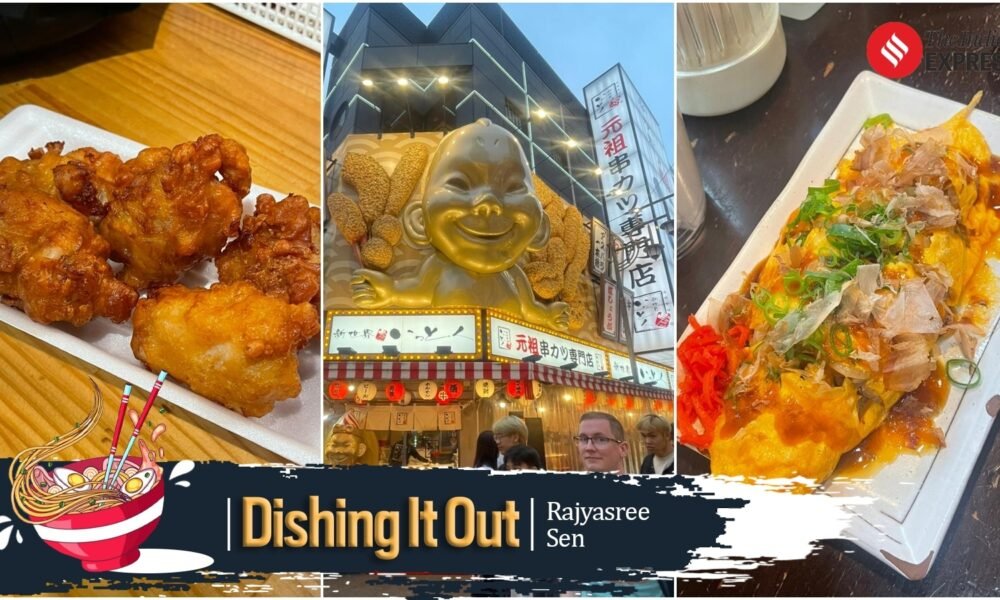
Okonomiyaki. Nikudoufu. Takoyaki. I have eaten in many Japanese restaurants in India, but especially in Gurgaon. This is because of the large Japanese expat population, including diplomats and workers. I have never seen these dishes on menus. Osaka is not a culturally rich city, but it’s a great place to go for a food tour. I had only one evening free in the city, so I took advantage of that to do a walking food tour. Before I take you to the kitschy lanes in Shinkensai, Osaka’s home to some of its finest street food, let’s delve into the history. When Japan’s defacto ruler Toyotomi Hideyoshi, known for unifying Japan built Osaka Castle, he attracted traders from Sakai, Fushimi, and other parts of Japan to Osaka. The city was transformed into a commercial and distribution centre. Osaka’s beautiful, wide canals are a result of the fact that boats were the primary mode of transportation in the city at the time. Canals were built across the city for easier movement. Osaka, a city of traders, was influenced by many culinary traditions. Frugality was part of the lifestyle of merchants, and this led to simple, wasteless meals. On the other hand high-end cuisine is cultivated in traditional Japanese restaurants, where business is conducted over food. On my first evening in Osaka I made my way to Shinkensai, a kitschy neon-lit open-air market filled with archery shops and eateries of every size and shape. There were many small food stalls that served only one dish, as well as “family restaurants” which had indoor seating and chic bars. I was able to join a group of 12 people on a guided tour for Rs 7,500 each. The majority were Americans (two young scientists and their artist wives, a young teacher at a public school and his wife, and a retired real-estate agent and former advertising executive). Some of the people were originally from Mexico, while another was from the Philippines. One person had Indian roots. All were interested in learning more about Osaka’s cuisine. Our guide, Bernie, was a Kiwi who moved to Osaka from New Zealand 15 years ago, and teaches English by day. The tour was so popular that it was featured in Netflix’s Somebody Feed Phil. This was the noisiest area of Japan that I’d ever been to. It was full of young people walking around arcades eating, chatting and not making a fuss. We started our tour in a noodle stand run by a woman. You could either sit at the open counter in the market or stand at a rickety table to eat your soup. The noodles were served with beef mince or a huge slice of tofu in a beef broth. I had never seen the tofu cooked this way before, lightly sauteed and then added to soup. It was the perfect broth. At the next restaurant, we sat outside on wooden benches and I tried my first takoyaki (battered octopus ball). It was the only dish that I didn’t like, but the locals loved it. The octopus meat is mixed together with other ingredients and then fried into balls. They are served with sauce and Umeshu, or plum wine. Story continues below this advertisementWe then visited an Izakaya and ate authentic Osakan Kitsune Udon, which is a noodle broth with thick udon noodle in a savoury, dashi-based broth. It’s topped with sweet and savoury, fried tofu bags or We also tried yakitori which is a Japanese term for only chicken skewers. In India, beef skewers would be called yakitori. Kushikatsu is another local creation, which is lightly deep-fried meat and vegetable skewers. We also had some very interesting and simple sweet potato wedges, drizzled with honey. Shinkensai was also where I tried the Osaka-version of Hiroshima’s okonomiyaki. Tonpeiyaki was another delight, a thin, omelette filled with sauteed pork and vegetables. Another delight was the freshly made karaage, or Japanese fried poultry, which is double fried (much as KFC), after being marinated with spices, ginger and mirin. It is simply divine.Hiroshima-style okonomiyaki, served on a hot conveyor belt (left); Another must-try is the fresh oysters at Miyajima. (Photos by Rajyasree Sen).I also learned that Japan’s people still drink whisky. Gin is a brand new concept that Japan has mastered. We ended the meal by eating fried ice-cream on a stick. You could choose between chocolate, honey, or caramel. The okonomiyaki served on a conveyor belt in Hiroshima is a Hiroshima style okonomiyaki. The fresh oysters in Miyajima are another must-try. Hiroshima and Miyajima produce at least 60% of Japan’s oysters. You must stop in Miyajima to eat a plate of oysters, whether they are steamed, fried or fresh. I’m still unsure, after the wonderful meals I had in Tokyo. Maybe I should visit the country again before I make a decision. Next week, to celebrate the West Bengal Assembly Elections, I will write about more local food and my favourite East Bengali and West Bengali delicacies.