
Tech
Special session: What Iowa lawmakers are considering for $15B steel mill

DES MOINES, Iowa —
Iowa Gov. Kim Reynolds signed legislation that would allow the state to offer a larger package of tax incentives for a proposed $15 billion steel mill in southeast Iowa.
The Senate passed the bill 28-19 Friday evening, just hours after it cleared the Iowa House. The measure would expand Iowa’s MEGA economic development program to allow the state to offer additional incentives for a project of this size. The steel mill’s incentive package could be worth roughly $1.36 billion, though the state would still need to approve the project’s full application and negotiate a final agreement with Mesabi Metallics.
Reynolds signed the bill into law just before 9 p.m. Friday.
WATCH: Gov. Kim Reynolds signs Mesabi Metallics tax incentives bill into law
Reynolds called lawmakers back to the Statehouse for a special legislative session Friday to consider “reasonable and limited updates” to the state’s economic development program, which she said are needed to advance the project proposed by Mesabi Metallics, a Minnesota company owned by the India-based conglomerate Essar Group.
The terms of an agreement between the state and Mesabi Metallics have been outlined in a memorandum of understanding; neither provided a copy when asked for one.
The legislation would expand Iowa’s Major Economic Growth Attraction program, which offers tax incentives to businesses making more than $1 billion in qualifying investments in the state.
The biggest change would allow the Iowa Economic Development Authority to offer one qualifying project in a rural county an investment tax credit worth up to 10% of its qualifying investment. Current law allows credits of up to 5%.
While the specific location remains undisclosed, elected officials have indicated the project is set for Lee County, which has a population of about 32,000. The bill defines a rural county as one with 50,000 or fewer people. The new credit would be paid out over 10 years.
The legislation does not automatically award the steel project a credit equal to 10% of its entire $15 billion price tag. The credit would be based on the project’s qualifying investment, which can include land, site preparation, infrastructure, construction and certain business assets. The Iowa Economic Development Authority would determine how much of the credit to authorize, up to the 10% limit.
The company would also have to meet certain requirements before receiving the credit. The project, or a designated portion of it, would have to be operating, and at least half of the jobs associated with that portion of the project would have to be added to the company’s payroll. Those jobs would have to pay at least 140% of the state’s qualifying wage threshold.
The credit would be refundable and, with state approval, could be transferred to another person or business. The ability to transfer the credit would apply only to agreements entered into by the end of 2027.
WATCH: What we know about the company behind proposed $15 billion Iowa steel plant
The bill also includes provisions allowing the state to recover incentives if a company violates its agreement or program requirements, including through fraud, misrepresentation or claiming credits for expenses that do not qualify. For projects receiving the new 10-year credit, the state could also recover a portion of the tax savings if the company sells or makes the qualifying property unusable within 10 years.
Businesses participating in the MEGA program can also qualify for other incentives, including sales and use tax refunds, withholding tax credits, and locally granted property tax exemptions.
If approved by lawmakers and signed by the governor, the changes would take effect immediately.
Senate minority leader questions special session
Sen. Minority Leader Janice Weiner spoke on the Senate floor early Friday and questioned the special session and its timing.
Weiner released this statement:
“We all want to see good-paying jobs and investment come to our state. But, in less than one week, we’ve hurtled from rumors and speculation to a special session. We all saw the presentation in the Oval Office that claimed this was a done deal, but clearly this resolution proves those claims false.
“Why are we leaving regular Iowans out of this conversation? Why are we tripping over ourselves to approve a corporate tax giveaway for a foreign corporation?” Sen. Weiner said. “This does nothing to help Iowans who are hurting now. It doesn’t lower prescription drug prices, it doesn’t re-open local clinics, it doesn’t clean up our water, it doesn’t address our cancer epidemic, and it doesn’t help with record high diesel prices.
“Statehouse Republicans have run back-to-back billion-dollar budget deficits and now this piece of corporate welfare is moving forward before it’s been appropriately vetted or Iowans have had a chance to weigh in.”
The pivot to Iowa seems to have moved quickly
Iowa state Rep. Matthew Rinker said he joined conversations on a potential project in his district several months ago, according to the Associated Press.
Still, as recently as July, job listings on Mesabi’s website for the steel plant were based in Paducah, Kentucky, according to a version saved in the web archive. Jobs are now listed for Iowa, though the job responsibilities for a government relations manager still include interfacing with Kentucky’s economic development team.
While the company had been in discussion with Kentucky officials, the scale of the project “more than doubled over the negotiation period,” spokesperson Brandon Mattingly said in an email.
Iowa “did get kind of into the mix late,” said Rinker, a Republican. “I think once they got here, they realized this is where they needed to be.”
First, though, changes in state law are necessary for Iowa to compete against other states for the project, Reynolds said in her proclamation. She is asking lawmakers to modify the economic development program so that tax credits on eligible projects can be worth up to 10% of investments, an increase from the current 5%, and paid out over 10 years instead of five.
For a $15 billion project, that could mean up to $1.5 billion in kickbacks payable over 10 years once the plant is running and contingent on jobs.
A major investment opportunity could carry risks for local communities
Lee County does not have any zoning or permitting ordinances that would be required for the project itself. The company would need a permit for hauling on the county’s secondary roads.
The scale of an investment such as this one is asymmetrical with the legal and administrative capacity of a small, rural community, said Anthony Pipa, a senior fellow at the Brookings Institution who studies development and policy in rural areas.
While there’s a lot of potential upside to a project of this scale, that asymmetry also leaves those communities vulnerable and without significant leverage, he said. Pipa also pointed to examples of massive proposed investments that didn’t come to fruition.
In neighboring Wisconsin, for example, Trump announced a Foxconn Technology Group display screen manufacturing facility and its promise of 13,000 jobs, saying it would be the “eighth wonder of the world.” The state Legislature, at the urging of then-Republican Gov. Scott Walker, approved up to $3 billion in state tax breaks for the Taiwanese manufacturing company if it hit employment and investment benchmarks, though those were significantly scaled back by Walker’s successor, Democratic Gov. Tony Evers.
Foxconn has since dramatically reduced the scope of the project and now says it will employ about 2,600 people by the end of 2029.
Wisconsin Democrat Gordon Hintz, a leading opponent of the Foxconn project when he was a state lawmaker, said he sees parallels with what’s promised in Iowa.
“The idea of having domestic production in an Upper Midwest, post-industrial economy has a lot of appeal,” said Hintz, who is now a county executive. “The devil’s in the details.”
The Lee County Economic Development Board, which Rinker said was pivotal in bringing the Mesabi project to Iowa, said the plant brings “extraordinary opportunity,” while acknowledging the ongoing questions that need to be addressed “about workforce, infrastructure, housing, and community services.”
“We take both seriously,” board CEO and President Emily Benjamin said in a statement. “Our job is to help make sure growth like this benefits the people who live and work here.”
Information from the Associated Press was used in this article.
Tech
OpenAI engineer arrested by FBI for allegedly bugging office had booked one-way flight to Saudi Arabia

The OpenAI engineer who was fired after being charged this week with bugging a conference room at the AI giant was nabbed by the FBI only three days before his one-way flight to Saudi Arabia was set to take off, according to court papers.
Abdulrahman Alfozan, a 35 year-old Saudi national, said he helped advise Saudi Arabia government agencies on technology and gushed in a recent podcast interview about meeting Crown Prince Mohammed bin Salman, then the deputy crown prince, during the prince’s 2016 visit to Silicon Valley.
Alfozan said he had been looking for guidance on whether to return to his homeland. In response, the prince advised young Saudis in Silicon Valley to hone their skills at premier tech companies before bringing that expertise home, Alfozan said in an Arabic podcast interview last month.
“You learn from the source and then, God willing, bring that experience and knowledge back to the homeland,” Alfozan said.
Alfozan – who had also worked at Meta and an Andreessen Horowitz-backed startup – was listed as a venture partner at RAED Ventures in Riyadh alongside Prince Khalid bin Bader Al Saud, a member of the Saudi royal family.
The revelations from the podcast come this week as OpenAI discovered a “surreptitious audio recording device” stuffed into a USB port on the back of a TV in a conference room — wrapped in toilet paper in an attempt to conceal the device, according to a complaint filed by federal prosecutors.
The alleged espionage highlights the cutthroat global race by governments to develop advanced AI. OpenAI has been competing with other leading AI labs including Anthropic and Elon Musk’s xAI along with numerous Chinese companies and the US government has said developing the most elite AI tools is a national security imperative.
“This arrest highlights our relentless efforts in partnership with the FBI to identify and prosecute those who seek to steal our technology,” said US Attorney for the Northern District of California Craig Missakian. “For us, it is a matter of national security.”
William Pernik, a lawyer representing Alfozan, said his client was charged with violating a federal recording statute, “not stealing trade secrets or working as a foreign agent,” and asked for “everyone to withhold judgment until full facts become known.”
Alfozan “came to this country years ago as a young person with a dream,” Pernik said. “He spent years studying, working and contributing to an American technological sector that leads the world, a sector built in large part by immigrants like him.”
A photo in the court document shows an oddly placed object on the back of a TV in an OpenAI conference room. Another photo shows the alleged device with the branding of Seeed Studio, a company that appears to offer AI recording products.
Meetings in that conference room apparently involved high-level discussions of the company’s confidential plans, such as proprietary research, OpenAI’s technical capabilities, its government relationships and more.
The Sam Altman-led company traced the device to Alfozan. Footage showed Alfozan appearing near the conference room multiple times, even though he had no authority to access the room or participate in those meetings, the Department of Justice said in its complaint.
Alfozan also used chatbots to plot the alleged recording efforts, asking about OpenAI’s building addresses, meeting room capacities and calendars, federal prosecutors allege.
He even requested information about the locations of “leadership and exec,” per the complaint.
Another chatbot account associated with his wife allegedly included queries on ways to install and hide audio recording devices.
On Oct. 5, a photo allegedly captured Alfozan entering the conference room to get a sneak peek at the recording device. Around that same time, OpenAI security workers found a similar recording device in Alfozan’s unattended bag, the DOJ said.
OpenAI fired Alfozan earlier this week after having worked for the San Francisco-based AI company since July 2025. Alfozan studied computer science and engineering at the Massachusetts Institute of Technology.
Tech
SpaceX Stock Drops: Starlink Ukraine Risks Are a Problem for Musk
You are now leaving Barron’s website
By clicking on the “Proceed” button below, you will be redirected to a third-party website owned and operated by Hong Kong Tiimoot Information Technology Co., Limited. (“HKT”), which is located in Hong Kong. That website operates independently from Barron’s and Barron’s does not control the website. The privacy practices of HKT are subject to its Privacy Statement, so please read it closely. We are not responsible for HKT’s privacy or other data-related practices.
Tech
Quantum sensor could measure how Earth drags spacetime

Einstein’s theory of general relativity describes gravity as the bending of spacetime, a mathematical model that combines three-dimensional space and time into a single, four-dimensional continuum. The theory also predicts that a rotating object, such as Earth, slightly drags the surrounding spacetime as it rotates, a phenomenon known as frame-dragging.
Researchers at the University of California, Berkeley (UC Berkeley), the Austrian Academy of Sciences and the California Institute of Technology (Caltech) recently introduced the idea of a quantum sensor that could measure this tiny effect in a laboratory setting. Their proposed experiment, described in a paper published in Physical Review Letters, would use helium cooled until it enters a special phase known as the superfluid state inside a gyrometer, an instrument that measures rotation.
“The inspiration for this project came when Birgitta Whaley and I were visiting Markus Aspelmeyer at the Institute for Quantum Optics and Quantum Information (IQOQI) in Vienna, Austria, during a sabbatical of Birgitta,” Kai-Isaak Ellers, first author of the paper, told Phys.org.
“We were introduced to Marios Christodoulou, who was interested in new ideas for applications of superfluid helium in precision gravity experiments. Since Birgitta has a lot of background working on superfluidity in helium droplets and nanoaperture arrays and since I was working with Birgitta on ideas for tabletop gravity tests, it was a natural connection.”
When discussing the possibility of using superfluid helium for precision gravity experiments, the researchers realized that it could potentially be used to collect frame-dragging measurements. As Ellers, Whaley and Christodoulou are theorists, they contacted an experimental physicist who leads a lab at Caltech to explore their idea further.
“We reached out to Keith Schwab, who builds superfluid devices,” said Ellers. “Keith knew Birgitta from his Ph.D. work at Berkeley in Richard Packard’s group and was enthusiastic to work with us to make sure our proposal would be grounded in reality.”
Using superfluid helium to sense rotation
The gravitational frame-dragging effect predicted by Einstein’s general theory of relativity is backed by real-world observations. For instance, Earth’s rotation drags the surrounding spacetime, contributing to a slow change in the direction of nearby gyroscopes’ spin axes relative to distant stars, a motion called precession.
“Essentially, the Earth drags local gyroscopes along with it very slightly as it spins,” explained Ellers. “One can detect this tiny frame-dragging effect in several ways. In our paper, we propose a rotation sensor, or gyrometer, based on superfluid helium.”
When it is cooled below 2.17 Kelvin, about −271°C (−456°F), helium-4 (the most common form of helium) becomes a superfluid. This is essentially a liquid that can flow without friction.
The researchers propose creating a rotation sensor by filling a doughnut-shaped tube with superfluid helium-4, then detecting changes in its flow via a specially designed barrier with tiny holes or nanopores (i.e., a Josephson junction).
“The experimental signature is a quantum mechanical phase difference that appears across the Josephson junction when the device is rotating,” said Ellers. “This phase difference is measured by tracking the motion of a mechanical diaphragm connected to the loop of superfluid.”
Notably, similar sensors have already been demonstrated by a research team at UC Berkeley led by professor Packard and used to measure the Earth’s rotation. However, the small rotational signatures associated with the Earth’s frame-dragging effect have so far proved very difficult to measure with these sensors.
“The additional phase deriving from the Earth’s frame-dragging effect is extremely small and its contribution can be overwhelmed by random phases due to thermal noise,” explained Ellers.
“Therefore, to assess the feasibility and potential sensitivity of this experiment, we performed a novel analysis of the thermal noise properties of the proposed device. This was guided by Keith’s long experience working with superfluids and what is known about their noise properties over a range of temperatures.”
Toward the sensor’s experimental realization and testing
This study suggests that cooling superfluid rotation sensors far below the temperature at which helium becomes a superfluid could greatly reduce disturbances caused by heat. This could ultimately allow them to precisely detect extremely small rotations, including those linked with the Earth’s frame-dragging effect.
“Our results show that, based on our current best understanding of thermal noise processes in superfluid helium at temperatures well below the superfluid transition (2.17 K), a superfluid gyrometer operating at, for example, 10 mK, has the potential to match or even exceed the sensitivity of the best frame-dragging measurements to date, with significantly less measurement time,” said Ellers.
“In contrast to previous measurements, our proposal also has the advantage that it could be performed in a laboratory here on Earth, rather than in space.”
The researchers also calculated that changes in the helium could reveal extraordinarily tiny differences in how much time passes along different paths around the sensor’s loop. This could offer another way to study how gravity affects time and test Einstein’s general theory of relativity.
“For instance, one could imagine probing physical processes occurring on time scales only a few orders of magnitude larger than the Planck time, which is thought to be an important time scale in quantum gravity,” said Ellers.
“Finally, another interesting feature of our proposal is that it presents an opportunity to observe a truly general relativistic effect in a macroscopic quantum system, since frame-dragging is not predicted by Newtonian gravity.”
Ellers and his colleagues are now planning new studies aimed at testing their proposed sensor. To realize their sensor experimentally, they will first need to develop Josephson junctions for superfluid helium-4 that can operate at millikelvin temperatures, just thousandths of a degree above absolute zero, rather than close to the superfluid transition temperature (as was required in previous related experiments).
“Work in that direction is underway in Keith’s lab at Caltech,” added Ellers. “On the theoretical side, we are starting to think about what kind of new physics we could have access to if we could probe time scales as short as a few orders of magnitude above the Planck time.
“We are especially curious about whether there could be some effects deriving from quantum gravity or other beyond-Einsteinian gravitational interactions that would leave signatures in a superfluid gyrometer experiment, like the one we have proposed.”
© 2026 Science X Network
Tech
Red Magic 12 Pro+ gaming phone launches with Snapdragon 8 Elite Extreme Gen 6, liquid

Add GIZMOCHINA as Preferred Source on Google
As an Amazon Associate, Gizmochina earns from qualifying purchases. Links on this page may earn us a commission at no extra cost to you.
Red Magic 12 Pro+ has officially launched in China with a range of hardware upgrades aimed at mobile gamers. The new flagship combines high-refresh-rate visuals with advanced cooling technology and a large battery. It also retains several gaming-focused features, including a 3.5mm headphone jack and dedicated shoulder triggers. Here’s everything you need to know about Red Magic’s newest gaming phone.
Red Magic 12 Pro+ specifications and features
Starting from the front, the Red Magic 12 Pro+ features a 6.85-inch BOE X11 OLED display with a 2,688 × 1,216-pixel resolution, a 185Hz refresh rate and ultra-narrow 0.96mm bezels. Since it does not have a camera punch-hole, it offers a truly full-screen viewing experience.
The panel supports a 500Hz touch sampling rate and up to 5,000Hz instantaneous touch sampling, alongside 10-bit colors, 1,900 nits of global brightness and 5,000 nits of local peak brightness. It also offers 2,592Hz PWM dimming at low brightness and DC-like dimming at higher brightness.
Performance comes from Qualcomm’s Snapdragon 8 Elite Extreme Gen 6 chipset, paired with RedCore R5 gaming and G1 display control chips. The phone supports LPDDR5T memory running at up to 10,667Mbps and UFS 4.1 Pro storage. Red Magic also supports simultaneous super-resolution and frame interpolation at up to 2K resolution and 185Hz in compatible games.
The device packs an 8,400mAh battery with 120W wired charging, 80W wireless charging, and bypass charging for powering the phone directly during gaming. Its ICE cooling system combines an active cooling fan with a liquid-cooling setup, alongside additional thermal materials. The built-in fan reaches 25,500rpm and carries an IPX8 water-resistance rating, while the phone itself is rated IP68 and IP69 for dust and water resistance.
The rear camera setup comprises a 50-megapixel primary camera with optical image stabilization and a 50-megapixel ultra-wide camera. A 16-megapixel OmniVision sensor sits beneath the display for selfies and video calls.
The phone runs Android 17-based RedMagic OS 12 and features an ultrasonic in-screen fingerprint sensor. Other features include 700Hz shoulder triggers, dual 1115E linear speakers, three microphones, an X-axis linear motor, Wi-Fi 7, Bluetooth 5.3, NFC, an IR blaster, USB 3.2 Gen 2 and a 3.5mm headphone jack.
Red Magic 12 Pro+ price and availability
In China, the Red Magic 12 Pro+ is available in Dark Night Transparent, Silver Wing Transparent and Ice Blue Transparent finishes. The 12GB+256GB model is priced at 6,999 Yuan (~$1,050), while the 16GB+512GB and 16GB+1TB variants cost 7,999 Yuan (~$1,200) and 8,999 Yuan (~$1,350), respectively.
Red Magic also previewed a limited-edition Golden Saga model with 24GB of RAM and 1TB of storage, featuring a forged-carbon cooling design. Its price and exact release date have yet to be announced. There is no confirmed international availability yet.
What’s your opinion about the Red Magic 12 Pro+ gaming phone’s specs and price? Let us know in the comments.
For daily updates, please visit our News Section.
Tech
Clock ticking for leap second: Why timekeeping could change forever

The world’s timekeepers are meeting on Thursday near Paris to decide whether to scrap the “leap second”, which could disconnect the clocks we use from the Earth’s rotation and realign timescales.
The world’s clocks are designed on the idea that the Earth completes one rotation on its axis in exactly 24 hours. But it actually wobbles, making the time the Earth takes to rotate less exact. And over time, the Earth’s rotation is gradually slowing.
Recommended Stories
list of 3 items
list 1 of 3Scientists urge tighter AI controls to prevent global cyber risks
list 2 of 3Chinese hackers impersonated AI experts to target US policy minds
list 3 of 3Which countries have sent people to space?
end of list
To compensate for that, since 1972, timekeepers have added a leap second every few years – the last one was added in 2016 – to keep clocks and Earth’s rotation in synchronisation.
But pressure has been mounting to scrap the leap second since it complicates matters for financial markets and data centres, which rely on precise timing down to milliseconds.
So what is a leap second? Could it be scrapped? And how might it change our understanding of time?
Here’s what we know:
What is a leap second?
Clocks work based on Coordinated Universal Time (UTC), the global standard that has been based on high-precision atomic clocks for more than seven decades. Atomic clocks mark time by observing the vibration of atoms.
But the Earth’s rotation works independently of atomic clocks.
A leap second is a second added periodically to UTC to make it synchronise with the Earth’s rotation. The first leap second was added to world clocks in 1972.
There have been 27 leap seconds added so far with the previous leap second being added on December 31, 2016. No further leap seconds have been added since.
According to the National Institute of Standards and Technology (NIST), a nonregulatory federal agency of the United States Department of Commerce, leap seconds occur at the end of December or the end of June. The NIST also cites differences between the precision of the atomic second and the Earth’s rotation to explain the need for a leap second.
“The speed of the Earth’s rotation is not constant. …. This gradual decrease in the rotational rate is causing the duration of the mean solar second to gradually increase with respect to the atomic second,” the NIST added.
Why is pressure mounting to scrap leap seconds?
While leap seconds close the discrepancy between the Earth’s rotation and UTC, their addition has posed challenges for technology companies, financial markets and other businesses that depend on precise timings.
In 2012, LinkedIn and Reddit crashed after the addition of a leap second. The same year, ticket bookings for Qantas, the Australian airline, collapsed after the leap second was added.
Three years later, the Australian Securities and Investments Commission also issued a warning against it. And in July 2022, engineers at Meta said: “Every leap second is a major source of pain for people who manage hardware infrastructures.”
With pressure mounting, the International Bureau of Weights and Measures, which has the French acronym BIPM, voted in 2022 to scrap the leap second by 2035. But countries like Russia have wanted to push the implementation date back to 2040. Russia incorporates leap seconds directly into its GLONASS satellite-navigation system, so delaying the scrapping of leap seconds would buy Russia time to update its satellite systems.
Despite Moscow’s concern, the 69 member states of BIPM are now meeting on Thursday in Versailles outside Paris to debate and vote on a resolution to scrap the leap second by 2027.
What’s up for debate on Thursday?
According to the BIPM, the timekeeping authorities of countries around the world will discuss three proposals at Versailles.
First, they will consider whether atomic clocks are still the most accurate device when it comes to measuring what constitutes a second. Optical frequencies are now in fact more precise than atomic clocks. If a proposal to change how time is measured is accepted, the second might have a new definition, characterised by optical frequencies rather than the vibrations of atoms.
The second, most significant proposal pertains to dumping the leap second.
And finally, the third proposal on the table is a pitch to synchronise time measurements on Earth with a new time standard that NASA is developing for the moon.
Proposals that are accepted are expected to come into effect from May 20, 2027, World Metrology Day.
What happens if the leap second is scrapped?
If the leap second is scrapped, then it means our clocks will no longer be tied to the Earth’s rotation.
According to the NIST, if this happens, “then adjustments would have to be made to time stamps and legacy equipment and software which synchronise to UTC for astronomical observations.”
“Some proposals have been made to implement larger corrections like leap hours, which would occur much less often than leap seconds,” it added.
Scientists said human routines will not be impacted and software glitches, data server crashes and network failures for financial markets will be eliminated with the abandonment of leap seconds.
But over a period of centuries, the gap between the Earth’s cycle and our clocks will become more apparent: By 2100, clocks will be ahead of the Earth by 54 seconds. In another two millennia, that gap would have widened to several hours. The result? Sunrise and sunset times that would feel out of sync with people’s natural rhythms today.


Steven Soderbergh To Help Finish ‘The Batman Part II’ Production
EXCLUSIVE: As director Matt Reeves continues to attend to an ongoing family matter, Steven Soderbergh is coming on to help...


Netflix’s Chief Content Officer Bela Bajaria Exiting
Bela Bajaria is out at Netflix. The news comes only 24 hours after the streamer underwent a massive cull, laying...


Netflix’s Bela Bajaria Leaving After 10 Years Amid Layoffs
In a major executive shakeup, Bela Bajaria is out at Netflix after 10 years at the streamer, most recently serving...


Violet & Xaden Have Been Cast In Prime Video’s ‘Fourth Wing’ TV Show
Lightning strikes as Prime Video has found its leading stars for the upcoming TV series Fourth Wing, the small-screen adaptation...


Targeted ads delivered 0-click exploits to install mercenary malware
Researchers say that mercenary hackers laced ads with zero-click exploits that installed sophisticated malware on the devices of targeted individuals...


Will the Fed raise interest rates? Kevin Warsh could offer clues
When Federal Reserve Chairman Kevin Warsh strides onstage in Bangkok on Friday morning, it will be after 11 p.m. on...


Ilhan Omar’s husband Tim Mynett speaks out as HSI fraud probe grows
While Ilhan Omar, D-Minn., has not been seen publicly since federal agents raided her Washington, D.C., residence on Monday, her...
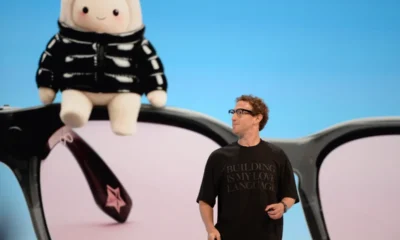

Meta launches an open-weight AI model that runs on Macs
Meta has launched what it calls the “most capable” open-weight model in the United States. Dubbed Muse Spark Open, the...


Disney Inks Dude Perfect to Deal for Original Content
The Walt Disney Co. is cutting another major creator deal, this time with the prolific sports-focused Dude Perfect, The Hollywood...
NASA Images Reveal 10,000 Young Faults on the Moon. That’s a Problem
Seen from Earth, the Moon looks so bright and peaceful. But on closer inspection, the lunar surface is etched with...
-

 Entertainment2 weeks ago
‘Verity’ Posts $4.5M Previews, ‘Digger’ $1.2M
-

 Entertainment2 weeks ago
Rick Devens Wins In Season 28 Finale
-

 Business2 weeks ago
Tesla Cybercab pressure to expand after rocky first month in Austin
-

 Business2 weeks ago
OpenAI safety employee resigns, claiming the company’s ‘culture is broken’
-

 Entertainment1 week ago
Travis Barker reveals why he underwent surgery after concerning hospital photos
-

 Business2 weeks ago
Energy Secretary Chris Wright says Trump was “well aware of the risks to energy flows” before launching Iran war
-
Business2 weeks ago
Leaked Anthropic IPO prospectus: The US government could hurt our business
-

 HealthNews1 week ago
Des Moines clinics stumped by unidentified virus