
PM office canada
Von der Leyen’s Canada ‘associate membership’ spurs battle of words with EU capitals
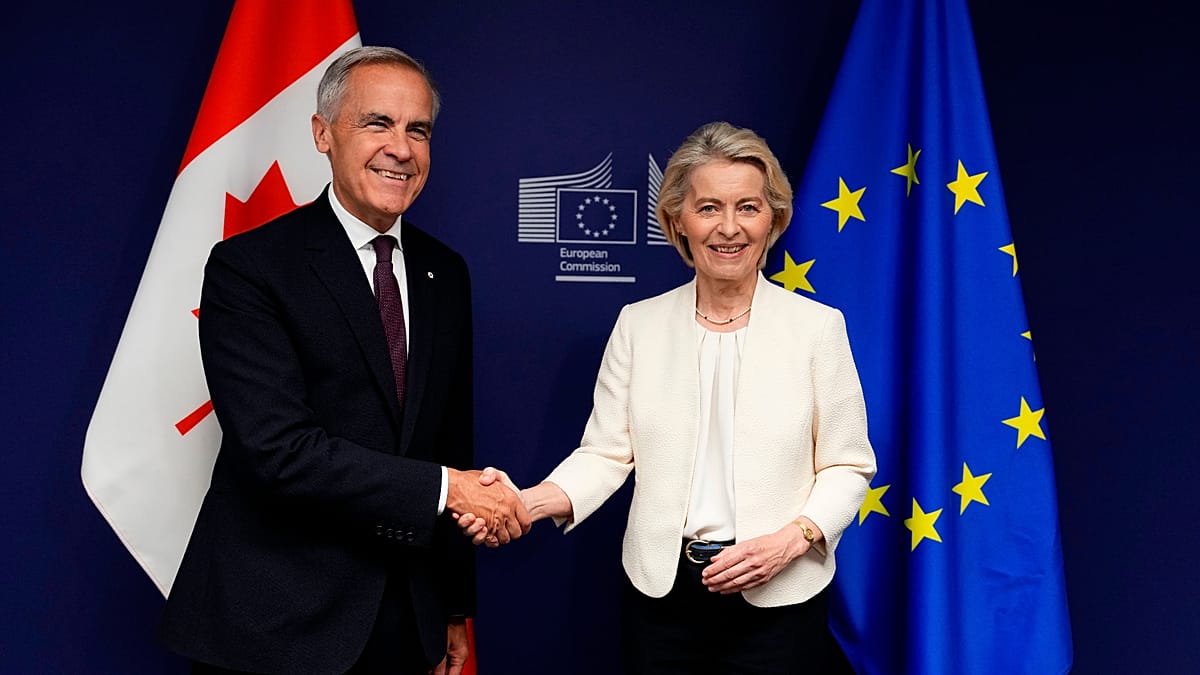
Last month, European Commission President Ursula von der Leyen made a bombshell offer to Canada: to become the first EU “associate member”. Now the term is proving hard to swallow for several member states, including her own Germany.
Ahead of the EU-Canada summit, meant to chart what many see as the closest partnership between the bloc and a non-member country, European capitals led by Berlin have pushed back against a term that has yet to be clearly defined, five EU diplomats told Euronews.
“The main concern is that this is unknown terminology, it might bring up legal uncertainty and expectations from other third countries,” one of the diplomats said. “This was not communicated previously from the Commission. We don’t know what we are talking about.”
Last week, a revised draft of the joint declaration explicitly mentioned the notion, vowing regular exchanges with Canadian authorities on major policy and regulatory initiatives and to define the full scope of the partnership at the 2027 summit.
Naming the term outright in what would be the first EU official document of major political significance to include it has drawn strong pushback from Germany, Italy and Greece, and scepticism from other countries, including France.
A new draft circulated on Monday evening added wording that distanced member states from the concept, specifying that it was “put forward by the European Commission”.
The text was due to be adopted on Tuesday through the so-called silent procedure, under which a document passes unless a member state objects. Germany, Italy, France and Greece all raised objections before the deadline.
The office of European Council President António Costa is now expected to circulate a new version, with another round of talks at ambassador level on Wednesday, before the summit opens in Montreal on Thursday.
Von der Leyen floated the idea of offering associate membership to Canada in her annual State of the Union speech to the European Parliament in September, with Prime Minister Mark Carney as guest of honour.
The idea had been put to the Canadians before, but it was never discussed with member states or within the Commission, catching capitals including Paris and Berlin off guard.
Even Carney did not seem fully sold on the nomenclature, preferring to call it an “alliance of the future”. “What matters is the substance,” he said when asked whether he was comfortable with the term.
With governments now finalising the joint declaration, to be adopted at the summit on Thursday and Friday, that initial lack of consultation is coming back to haunt the bid.
For Berlin, the main issue is that member states should first define what the cooperation package contains, and only then agree the terms for the declaration, not the other way around.
There is broad consensus on seeking closer cooperation with Canada in areas such as defence, critical raw materials, energy, trade and border security. It is the associate membership label that has drawn scrutiny.
Others took aim at its legal implications, arguing these must be carefully studied before the term enters a political declaration.
“It does not mean anything, it is not in the treaties,” a second EU diplomat said, adding that “we want to find a way to make the concept work.”
Von der Leyen is not new to launching new ideas and forging ahead with initiatives without consulting with the member states. In 2023, she announced a migration deal with Tunisia and was criticised for lacking a formal mandate to do so.
“In the case of Tunisia, member states fully agreed with the objective of reducing arrivals, but they had to say that they did not 100% agree with the way it was done. It is a bit the same case here,” a third diplomat told Euronews.
For this diplomat, the EU should not view the label as merely institutional, but as a way of packaging what would otherwise inevitably look like a sector-by-sector technical exercise in bringing Canada closer to the bloc.
For von der Leyen’s critics, she has a habit of making grand announcements before figuring out the implications. For her supporters, her strength is staying ahead of the curve, setting out a political vision and letting the bureaucratic machinery do the rest.
German Chancellor Friedrich Merz was the first to propose associate membership, but pitched it as a way to anchor Ukraine to the EU, with security guarantees, as Kyiv progressed through the accession process.
Applying it to Canada carries a very different connotation: it would offer a blueprint for the closest possible partnership with a non-European country that could never join the bloc.
“A lot of other countries want to come closer to the EU, but we don’t know what to offer them. Whatever deal we reach with Canada might be an important motivator for others,” an EU official told Euronews.
This story was updated with additional information.
PM office canada
Carney says he’s yet to talk to Democrats on tariffs: ‘Short answer is no’

Prime Minister Mark Carney said he has not spoken with Democrats in the U.S. about whether the party — which is set to take control of Congress in January after the midterm blue wave — could pursue legislation to get rid of tariffs on Canada.
“The short answer is no, I haven’t,” he told reporters at an unrelated news conference Friday.
“Obviously we welcome any moves to restore a free trading arrangement between Canada and the United States, which is in the interests of American families struggling with affordability, in the interest of American workers looking for good high-paying jobs and stability. And it’s fundamentally in the interests of Canadians and we will continue to work with the Americans to get a deal for Canada.”
The Section 232 and Section 338 tariffs imposed by U.S. President Donald Trump on Canada are done under executive orders, not legislation, however, meaning even with Democratic control of Congress, that power remains with Trump who has shown no inclination to remove them.
The Democrats took the House and the Senate in a sweeping win of the midterms Tuesday, reigniting questions around the U.S.-Canada trade relationship.
Since his win of the Senate seat in Michigan, senator-elect Abdul El-Sayed has not been shy to share his feelings on the trade war between Canada and the U.S., calling it “insane” in a post-win media interview.
El-Sayed is not the only newly elected Democrat who is seeking to change the American trade agenda. Representatives in Oregon, Massachusetts and Vermont have publicly spoken about wanting to see the tariffs on Canada repealed.
But these promises are just “symbolic,” Carlo Dade, the director of international policy and New North America Initiative at the University of Calgary, told Global News.
Trump will soon be considered a lame duck president as the legislative powers are overtaken by the Democrats, but he still holds executive powers.
The sweeping 50 per cent Section 338 tariffs on more than $20 billion of Canadian products were imposed via executive order, not Congress.
In April 2025, the Senate voted 51 to 48 to pass a joint resolution aimed at ending the national emergency declaration used to justify the tariffs on Canada, but ultimately that did nothing.
“There’s a lot of theatrical stuff that [the Democrats] can do like hearings, etc., but in terms of real things, nothing. You need 67 votes in the Senate,” Dade said, referencing the threshold needed to overcome a presidential veto.
The Democrats have 54 seats in the U.S. Senate.
Dade said the other question is whether the newly elected Democrats would end the tariffs on Canada even if they could.
“When we think about Democrats, we’re also thinking about Democrats as we understand them. We’re thinking about Bill Clinton, thinking about Hillary Clinton, Obama,” he said.
But that might not be the type of Democrats that will soon hold some powers, he added.
Dade said there could be up to 10 Democrats who are also members of the external organization Democratic Socialists of America, which is a progressive populist group which endorses candidates running for political office who align with the group’s goals and values like seeking universal healthcare.
He said some DSA members oppose tariffs, but they remain “America first” and are likely to favour protectionist policies, as many members of the Democrats already do.
“Protect jobs, protect workers, be the working class in the U.S.,” he said.
“The shift in Democrats may be good for us in some issues, but not all.”
PM office canada
Immigration levels updated in new plan

OTTAWA — The government’s updated immigration plan looks to maintain broad targets for permanent and temporary resident admissions while offering permanent status to up to 200,000 longtime temporary residents who have already applied.
The government says its 2027-2029 immigration levels plan will admit 380,000 permanent residents and 370,000 temporary residents each year. New temporary resident targets are split between 220,000 workers and 150,000 students for each year of the plan.
Those targets for 2027 and 2028 are the same as they were in the plan released last year.
The goal is for more than 64 per cent of new permanent resident admissions to be economic immigrants, according to a document provided by the department.
The 2026 federal budget, released Thursday, says the government plans to reform the Temporary Foreign Worker Program. The stated goal of the reform is to ensure the program lines up with regional labour market needs, improve processing times and strengthen employer compliance.
Details of the program review are scarce at this point, although the budget sets aside $151.5 million to implement the reforms. The federal government says it will work on the program reform with the provinces and territories.
Read more: Carney government adds $142B in new spending to spur economic growth, address affordability
A spokesperson for Immigration Minister Lena Diab said early Thursday she had no plans for a press conference to explain the changes at her department.
During an embargoed media briefing before the budget was released, Finance Minister Francois-Philippe Champagne said the issue of temporary workers varies significantly by region and sector.
“Depending where you are, there’s more pressure, the unemployment rate is not the same,” Champagne said.
“In a nutshell, we’re trying to be more bespoke, to respond to our market needs in a way that would support our businesses who need these temporary workers without putting pressure on places where the unemployment level is high.”
Between the broad target, the new program to grant permanent status to 200,000 temporary residents and the final year of a two-year program to give permanent residency to about 140,000 temporary residents, Canada could add more than 600,000 new permanent residents next year.
The government’s stated goal is to reduce the temporary resident population to five per cent of the total population by the end of 2027. The temporary resident population peaked at 7.4 per cent of the total population in October 2024 before dropping to 6.7 per cent, according to a Statistics Canada estimate released on July 1.
The government says it intends to work closely with the provinces and territories on the plan to give permanent status to 200,000 people. This work will include finding 100,000 temporary workers who are eligible for either Express Entry or the Provincial Nominee Program.
A backgrounder briefing document supplied by the minister’s office says the other 100,000 temporary residents will come from humanitarian programs. They include people who came to Canada through the Hong Kong permanent residence pathway and the Ukraine Family Reunification Pathway that started after Russia launched its full-scale invasion.
The department’s background briefing document says this humanitarian permanent residency plan will also allow it to process family sponsorships of permanent residents already living in Canada, and get those wait times closer to the 12-month target.
The current humanitarian and compassionate permanent residency application wait time is listed at more than 10 years.
Ottawa also plans to increase permanent residency spaces in the Provincial Nominee Program to give the provinces and territories greater ability to nominate people for permanent residency based on local labour market needs.
The Rural Community Immigration Pilot will also be made permanent. This pilot, which involved 14 communities, connected local employers with skilled migrants and opened a permanent residency pathway.
Immigration has become an increasingly fraught political topic in recent years, and has been blamed by the government and others for affordability and housing challenges.
Numerous polls, including the federal government’s own research, suggest that about half of Canadians think too many immigrants are coming here.
Michelle Rempel Garner, the Conservative immigration critic, suggested before the budget’s release that the government would “cook the books” by not including all new permanent residents in the broader target. She pointed out that the plan to grant permanent residency to temporary residents was not included in the broad target last year.
After the budget’s release, Rempel Garner accused the Carney government of structuring immigration intake numbers “to benefit wealthy corporate interests, at the expense of Canadian and newcomer workers alike.”
“Canadians were told to expect a sustainable plan,” she said. “But based on today’s numbers, what Mr. Carney meant by `sustainable’ is sustainable for corporate profit models, not for workers or Canada’s social infrastructure.”
Prime Minister Mark Carney has said immigration is back under control, citing significant reductions in the number of temporary workers and students coming to Canada since 2024.
The Bank of Canada published an article last month saying an aging population, a lower birthrate and lower immigration will all reshape the economy.
The bank said Canada’s population grew 0.5 per cent in 2025 — the slowest growth rate in more than a century, down from a historic annual average of 1.2 per cent. The bank said it expects that slower growth rate to continue for the foreseeable future.
The bank said this economic shift is being driven by multiple factors: more retirees and fewer young workers replacing them, changing consumer habits and changes in the housing market as people downsize their dwellings as they age.
The immigration annual report, also tabled Thursday, shows Canada welcomed about 393,000 new permanent residents in 2025, in line with the broad target of 395,000.
Almost 324,000 new permanent residents arrived in 2025, well below the target in that year’s levels plan of almost 674,000.
More than 3.3 million people held permits to work or study in Canada throughout 2025. This figure includes new arrivals and those who received a permit extension.
This report by The Canadian Press was first published Nov. 5, 2026.
PM office canada
Budget 2026: Ottawa plans to merge federal financing agencies, set up standalone sovereign wealth fund

The Carney government plans to merge two major federal financing agencies and set up a standalone $25-billion sovereign wealth fund, outlining in Thursday’s federal budget an ambitious effort to create a simpler, more muscular ecosystem to support companies and investment in Canada.
The plan proposes to combine the Business Development Bank of Canada (BDC) and Export Development Canada (EDC), Crown corporations with a combined 5,100 employees and $128-billion of assets, creating a single development bank backing small and medium-sized businesses at home and abroad.
Accountability for a third key financing body, the Canada Infrastructure Bank – the government’s main tool to provide loans to finance major infrastructure projects – will shift from the Housing and Infrastructure Minister to the Minister of Finance. The infrastructure bank will also assume responsibility for the Canada Indigenous Loan Program. And the Canada Growth Fund, a $15-billion subsidiary of the PSP Investments pension fund that focuses on clean and low-carbon investments, will get a broader mandate.
The budget also promises legislation to set up the Canada Strong Fund, announced in April as the country’s “first national sovereign wealth fund,” as a standalone, arm’s-length Crown corporation, with its own chief executive officer and board of directors.
Taken together, the proposed changes mark the most significant attempt in years at overhauling a collection of financing agencies that has expanded in number and scope, creating confusion among businesses and investors, as well as overlap and inefficiencies in delivering billions of dollars of federal funding.
A more effective financing cluster could help Ottawa reach the targets set in the 2025 budget to attract $500-billion in new private-sector investment to Canada, and $1-trillion in total investment, over five years.
Ottawa bets spending boost will deliver future economic gains
Ottawa’s most significant incentive to boost investment was revealed in September when Prime Minister Mark Carney announced the Productivity Mega Deduction at the Canada Investment Summit. Business groups have praised the measure, which lets companies immediately write off investments in an expanded list of capital assets, at a $36-billion cost to government coffers over five years.
Thursday’s budget adds another, less sweeping pair of tax perks called the Canada Growth Incentive that increase the exemptions and deferrals that Canadian entrepreneurs can claim on taxes for capital gains up to $15-million, including when they roll over proceeds from one investment into another small business. The incentive “will help level the playing field with the United States,” which already has similar tax breaks, the budget document says.
The budget also aims to simplify or remove several nuisance items in the corporate tax system, such as restrictions on transfers of tax losses between subsidiaries of the same corporate entity.
The proposed changes to federal financing agencies stop short of calls from some business leaders to combine all of them into a single entity. But the government is trying to refashion a system that has been criticized as too complex and conservative, to make it more nimble and willing to take risks.
The combined development bank will be responsible for offering low-cost financing and other supports to businesses expanding at home and abroad. The consolidated infrastructure bank will be a hub for debt financing, and securing Indigenous support for major projects. The Canada Growth Fund will be asked to expand its scope beyond low-carbon investments.
And the sovereign wealth fund will take minority equity stakes in strategically important projects and companies, often through co-investments on deals that already have federal backing.
“The main thing the government now needs to do is be extremely clear in communicating, who is the party that a port terminal operator needs to go to, versus who is the party that a refinery that wants to put a carbon capture project in place needs to go to?” Jordan Eizenga, Deloitte infrastructure partner, said in an interview. “They just need to be super clear.”
From a new tax deadline to a revamped RRSP, six ways Ottawa’s plan could affect your wallet
The budget plan also earmarks money for a previously announced retooling of Invest in Canada, a federal agency in charge of attracting foreign investment that has a new board chair, Dominic Barton, and CEO, Gurinder Grewal. It is expected to play a central role in the government’s efforts to draw more foreign capital from major asset managers, pension funds and sovereign wealth funds.
Starting in 2027-28, Ottawa will spend $181-million over four years so Invest in Canada can hire financial-sector experts and establish a presence “in key global markets” to attract foreign capital, the budget document says.
Invest in Canada will also organize future investment summits, the budget says, suggesting the government will hold another gathering like the September summit that attracted about 250 senior executives who manage more than $100-trillion to Toronto.
In general, the revised suite of financing agencies is intended to be more aggressive. Ottawa “expects financing Crown corporations to have a greater risk tolerance than private-sector peers,” the budget document says. “It is important that government-backed financing complements, rather than simply replicates investments available from private-sector capital market actors.”
The Canada Strong Fund is the one exception, with marching orders to pursue the same commercial terms, and expected risk and return, as private-sector investors.
Thursday’s budget provides more details about how the sovereign wealth fund, first announced in Ottawa’s spring economic update in April, will work.
It will start as a subsidiary of the Canada Development Investment Corporation for an interim period, until legislation passes to establish it as a separate Crown entity. Its seven-member board will include the fund’s CEO, the deputy minister of the Finance Ministry and five independent directors.
The fund will make two main types of investments. Where a project already has federal support from a financing agency or the Major Projects Office, the sovereign wealth fund will typically have an option to make a minority co-investment on the same terms as private investors.
The fund will also make “selective investments” in projects and companies flagged as having high potential to produce returns and support key sectors in Canada. Ottawa’s recent pledge to invest up to $1.6-billion to own part of Canadian AI company Cohere Inc. is an example of this type of strategic investment, the budget document says.
Ottawa will draw from general revenues to launch the sovereign wealth fund with $25-billion over three years, relying largely on borrowed money to get it started.
Budget highlights: Tax support for artists, entrepreneurs and billions for new housing
The budget document also adds details about how Ottawa will invite individual Canadians to invest in the Canada Strong Fund. The government aims to offer Canada Strong Notes next year, sold through participating financial institutions such as banks and their financial advisers.
The notes will have set maturities – five, seven or 10 years, for example – and the investor’s principal will be fully protected. The notes will pay regular interest like a bond, and a share of the fund’s investment gains if it performs well, when notes mature. The money raised from selling the notes is expected to add to the Canada Strong Fund’s overall funding pool.
As Ottawa prepares to partly privatize major airports in Toronto, Vancouver, Montreal and Calgary, the Canada Strong Fund also appears poised to join investor groups that will pay billions to take over airport operations. The fund would be a passive investor with a minority stake, and could receive a share of the proceeds.
The government plans to offer long-term concession agreements to private investors, but keep ownership of the underlying land and assets.
Investors such as Canada’s major pension funds could operate the airports for 40 to 50 years, the budget suggests, though the concession details have not yet been decided. Investors would receive revenue streams from airport operations such as food, retail and parking, and take on responsibility for upgrading airport facilities and processes.
The budget earmarks $37.6-million over three years to launch the first airport operating concession, build a framework, do due diligence, obtain legal advice and run a competitive process to choose an airport operator by 2029.
The Globe and Mail has reported that Vancouver International Airport is poised to be the first major Canadian airports to be partly privatized, but parallel processes for other major airports could start before the first concession is finalized.
Proceeds from the partial privatization are expected to support upgrades to smaller regional airports and the development of a traveller biometrics strategy, among other priorities.
PM office canada
What to watch for as Carney introduces his 2nd federal budget
Prime Minister Mark Carney will deliver his second federal budget on Thursday as the Liberal government reveals next steps in its plan to support the country through an affordability crunch and the trade war.
Carney has spent much of the first 20 months of his prime ministership retooling the Canadian economy with an eye toward growth. Finance Minister François-Philippe Champagne is promising more details on what’s to come next to further boost economic expansion.
Speaking to reporters on Wednesday while helping make his own shoes — continuing the budget tradition of finance ministers getting a new pair before delivering an economic update — Champagne said this document will reveal how Canada will become “masters of our destiny.”
“You need to invest in growth, you need to invest alongside businesses. You also need to invest in sovereignty,” he said.
Some indicators suggest those investments are paying off: the Bank of Canada and the International Monetary Fund are projecting roughly two per cent GDP growth next year. The OECD expects growth to be lower than that, but still higher than all other G7 countries except the U.S.
The unemployment rate, which has seen some relatively wild swings amid the trade uncertainty, is lower than it was a year ago.
Foreign direct investment into Canada is high and the government’s recently announced “productivity mega-deduction,” a big ticket item that lets companies write off investments in a tax-advantaged way, is designed to spur things along even more.
Canadians will also get a chance to take some ownership in the projected growth: the budget may include details on how individual investors could eventually buy into the Canada Growth Fund, a new Crown-controlled sovereign wealth fund that will take ownership stakes in some major projects and businesses.
Affordability measures
Still, Champagne suggested more work is needed on the issue many voters tell pollsters they care about most: the rising cost of living, which worsened late last month when the Bank of Canada raised interest rates to tame inflation.
“Mark Carney remains one of the most popular prime ministers we’ve ever had. And all of that is happening in the context of people still saying that affordability is the top issue,” Abacus Data pollster David Coletto said in an interview.
“But it doesn’t mean that that immunity lasts forever. People still need to feel that this government cares about those day-to-day issues.”
The most recent Statistics Canada jobs data also shows that while average hourly wages rose about 2.3 per cent year-over-year as of September, that fell short of the three per cent climb in consumer prices reported over the same period.
Canadian food bank usage hit record highs this year as some people struggle to buy the groceries they need.
The government has kept a lid on immigration since coming into office, dramatically dialling back the number of temporary migrants to tamp down housing prices.
That may have worked to some extent: national average home sale prices are 22 per cent lower than they were at the March 2022 peak while rent has dropped about nine per cent from its all-time high in May 2024, according to the latest industry figures.
The budget will reveal immigration targets for the coming two years.
The Conservatives have hammered the government for rising prices, demanding Carney do more to help consumers shoulder energy price increases largely driven by the U.S. and Israel-Iran war.
They also want Ottawa to cut immigration levels further, framing it as part of the affordability agenda.
“Save you money — that’s our mission as Conservatives, and it’s our demand for the budget,” Conservative Leader Pierre Poilievre told reporters on Wednesday, reiterating his call for further tax relief on energy products.
“After a year and a half of Mark Carney, everything’s worse.”
NDP Leader Avi Lewis, meanwhile, wants Ottawa to create a wealth tax, build 50 government-run grocery stores and make “a nation-building investment in health care.”
The government is sensitive to the charge that it hasn’t done enough to address affordability concerns, routinely pointing to last year’s income tax cut, the move to scrap the consumer carbon tax and temporarily lifting federal levies on gas as ways it has helped.
But after U.S. voters handed Trump’s Republican Party a shellacking in this week’s midterms, partly due to higher prices, politicians in this country are clearly attuned to demands that more needs to be done to avoid a voter backlash.
“We need to take care of Canadians, make life more affordable,” Champagne said.
“We’ve already taken a number of measures to support Canadians, but at the same time we understand we need to support them now.”
Deficit management
While Ottawa rolls out new initiatives it’s also mindful of the deficit, which could be smaller than expected thanks to higher oil prices that have been a huge boon to government coffers.
Even if smaller than planned, the figure is still expected to be higher than the historical norm before the 2020s — and the parliamentary budget officer expects those figures to remain elevated for years.
The spring economic update pegged the deficit at $75 billion for the 2026-27 fiscal year.
This number will almost certainly change after accounting for energy-related revenue spikes and increased spending on initiatives like propping up tariff-hit industries like autos and steel.
The PBO projects the deficit will be about $63 billion this year before rising to $70 billion in the next, further adding to the federal debt, which is increasingly costly as interest rates rise.
Carney has rejigged how the government reports its spending, dividing federal outlays into two buckets: day-to-day operational spending and capital infrastructure. The government is expected to lay out its plan to balance the operational budget by 2027-28.
Canadians will also learn more details in this budget about the government’s plan to privatize some of Canada’s major airport operations. Those sales would result in a cash windfall, which could then be used to spend more on other planned capital-intensive infrastructure projects or pay down debt.
Whatever comes about, Poilievre isn’t buying it: “Mark Carney is out of touch. His spending is out of control. Canadians are out of money.”
Defence spending
Canadians will likely get a better sense in the budget of how much the Carney government’s defence buildup is costing, where the money is going and where it will be coming from.
Tens of billions of dollars have been poured into national defence over the last year and a half to meet the old NATO benchmark of two per cent of the gross domestic product.
The Western military alliance is now asking members to increase spending further to five per cent of GDP (3.5 per cent direct military expenditures and 1.5 per cent on defence infrastructure) by 2035.
At the conclusion of the recent NATO summit in Turkey, Carney pledged his government would offer a full accounting for taxpayers.
“We will lay out in the budget an update with the decisions we’re taking, where the fiscal track is, where the defence spending is, how we’re spending the one-and-a-half per cent on defence-related expenditures, resilience expenditures, and that’s the right time to do it,” Carney said.
Defence analyst Dave Perry of the Canadian Global Affairs Institute said details on how Canada met the two per cent target and what the pathway is to five per cent are long overdue.
He said there were 215 words devoted to defence spending in last year’s budget, which was a disappointment in terms of explanation and justification.
The government, he said, needs to be more specific about what equipment it intends to buy and how it will pay for it.
PM office canada
Trump strategy unchanged after Democrats’ midterm landslide, says Canada-U.S. trade minister
Canada’s point man on the Canada-U.S. trade file says the federal government’s strategy isn’t changing in the short term despite American voters handing a seismic win to Democrats in Tuesday night’s midterm elections.
While the results are widely seen as a strong repudiation of U.S. President Donald Trump and his economic policies, Canada-U.S. Trade Minister Dominic LeBlanc wouldn’t weigh in ahead of a caucus meeting on Wednesday morning in Ottawa.
“It’s not particularly constructive for Canadians to interpret results in a foreign country’s election,” he said. “Our job is to focus on what we can control, and that’s to work with the people that Americans have elected.”
LeBlanc noted the trade talks are conducted with Trump and his cabinet.
“They remain in office today. And those are the people with whom we’ll be having those conversations,” he said.
Canada has been seeking a trade deal with the U.S. in hopes of lowering steep tariffs on Canadian goods, including targeted sectors like autos, steel, aluminum and softwood.
One of the big questions for the Canadian side is how the infamously volatile U.S. president reacts to the midterm shellacking, one that delivered control of both the House and Senate to Democrats, and whether it gives Prime Minister Mark Carney’s government more leverage.
Trump was already signalling some movement on the file, telling Fox News on Tuesday morning he was close to a deal.
Carney didn’t go quite as far but told reporters that afternoon that the White House has shifted its stance on some of what he called Canada’s “red lines,” including language requirements and Canada’s ability to strike trade deals with other countries.
“They’re asking less and they’re offering more,” the prime minister said, adding the two leaders will meet in China later this month.
He said there is still work to be done before a deal is inked. Autos are expected to be a key sticking point, as they were in August before talks collapsed — triggering new tariffs on both sides.
Trump still has his veto powers
A blue Congress doesn’t necessarily mean it’s clear sailing for Canada.
The new crop of representatives and senators won’t be sworn in until January, and even after that Trump will still be able to lean on his executive authority.
After the results came Trump posted an image of a red MAGA-style hat with the word “VETO,” although he also told Politico “I don’t want to be just sitting there for two years vetoing everything.”
LeBlanc said “what the new Congress might decide to do when they’re seated two months from now is an interesting discussion,” but that’s “not going to change the work that we have to do in the next two weeks.”
“The American Congress will act in the interests of the American Congress. Our work will be focused on what we can do here at home,” he said.
Conservative Leader Pierre Poilievre said it’s on Carney and his government to leverage the results to land a tariff-free trade deal with the U.S. administration.
“Americans hate these tariffs,” he said. “Let’s leverage that goodwill to pressure the administration and Congress to remove all the tariffs, lower the cost of living for Americans but also boost jobs and business for long-struggling Canadians.”
NDP Leader Avi Lewis pointed out not all Democrats are against tariffs.
“We do see certain elements within the Democratic Party that have supported the tariffs or have been silent on that,” he said.
“If the prime minister were to channel the progressive Carney that we saw in the last election campaign, it would be a great time to build relationships with those Democrats and start laying the seeds for a lasting trade deal that really reduces those tariffs.”
Ford ‘doing cartwheels’
Ontario Premier Doug Ford, one of the most colourful critics of Trump’s tariffs at the premiers’ table, said he “was doing cartwheels down the street” as the votes were being tallied.
“You ever seen a big guy like me doing cartwheels? I was jumping up and down when the results were coming in. But it’s very simple, the American people spoke,” he said.
Ford said he’ll be reaching out to governors and is instructing his cabinet to reach out to U.S. Congress members and senators.
“The war is not over. We have to continue making sure that we move faster, quicker, immediate on everything across the board,” he said.
Former ambo urging caution
Canada’s former ambassador to the U.S., Kirsten Hillman, cautioned the federal government against making any sudden changes.
“If they’re having constructive conversations that are heading towards some kind of arrangement that would work for Canada, we wouldn’t want them to stop that,” Hillman said during election night coverage on CBC News.
Former Conservative cabinet minister James Moore suggested Carney shouldn’t accept a deal with tariffs now.
“Americans don’t want tariffs. The polls and voters are clear. Do not make a deal with a repudiated and departing president that normalizes tariffs that Americans and Canadians don’t want,” he posted on X.
“Do not put Canada at an economic disadvantage with a tariff-accepting deal.”


Texas Senator-Elect James Talarico Crashes Donald Trump
Newly elected Texas Sen. James Talarico crashed this week’s “Saturday Night Live” cold open in order to ask the question...
College football scores, results: No. 11 Notre Dame knocks off No. 1 Miami, No. 3 Utah topples No. 9 BYU in ‘Holy War’
The most epic weekend of the 2026 college football season has came and went. Week 10 featured seven matchups between...


Trump offers UFC CEO Dana White press secretary job
President Donald Trump offered UFC CEO Dana White the role of White House press secretary, but White declined, according to...


Democrats at Crooked Con reflect on a historic week
CNN's Donie O'Sullivan talks to Democrats and progressive activists who have gathered in Washington, DC, this weekend for …


NASA unveils $10B Moon base contract as SpaceX, Blue Origin join lunar gold rush
NASA announced Saturday that Elon Musk’s SpaceX, Jeff Bezos’ Blue Origin and six other aerospace companies are eligible to compete...


Trump’s Recent Warning Is Sending Shockwaves Through Wall Street. Here’s What It Could Mean for Your Retirement Savings.
Love him or hate him, President Donald Trump’s time in the White House has historically correlated with strong stock market...


Jason Kelce’s Wife Kylie Kelce Weighs In on Idea of Baby No. 5
Kylie Kelce is not gonna lie about her thoughts on adding another player to her team. The 34-year-old—who shares daughters...


Stephen Colbert rushed out of Harvard event, accosted by union protesters
Liberal former late-night host Stephen Colbert had to be rushed out of an event at Harvard after someone pulled a...


Josh Brolin renews vows with wife Kathryn in Vegas for 10th anniversary
Josh Brolin renewed his wedding vows with wife Kathryn in a conspicuously unbuttoned shirt. In a joint social media upload...


Alabama finally puts it all together, dominates LSU and leaves Lane Kiffin staring at $40 million CFP disaster
Alabama spent the past five days taking heat from across the country over its No. 5 ranking in the initial...
-

 HealthNews2 weeks ago
E. coli cases possibly linked to Bengtson’s Pumpkin Farm, Will County health officials say
-

 Business2 weeks ago
AI agents are roaming around consumers’ bank accounts, and banks aren’t happy about it
-

 HealthNews2 weeks ago
RFK Jr.’s vaccine injury clinic could damage NIH hospital, board warns
-

 HealthNews2 weeks ago
First 2 flu-related deaths of 2026 season confirmed in Los Angeles County
-

 Entertainment2 weeks ago
Why Elizabeth Holmes’ movie ‘villain’ fiance is calling high-powered lawyers in Hollywood: sources
-

 Entertainment2 weeks ago
Janet Jackson Makes Rare Public Appearance In An Outfit That’s ‘Nasty’ In The Best Way
-

 Entertainment2 weeks ago
Tom Brady and Supermodel Candice Swanepoel Are Dating
-

 HealthNews2 weeks ago
Petting Zoo Closed After E. Coli Investigation At Bengtson’s Pumpkin Farm