
Business
Walgreens eye drops recalled over sterility concerns

More than 500,000 Walgreens-branded eye-drop products are being recalled over sterility concerns as part of a broader recall involving nearly 750,000 eye-care products.
Sterling Pharmaceutical Services LLC, based in Dupo, Illinois, initiated the recall on Aug. 20 because of a “lack of assurance of sterility,” according to a U.S. Food and Drug Administration (FDA) enforcement report.
The FDA classified the recall as Class II on Sept. 21. The designation means use of or exposure to the affected products may cause temporary or medically reversible health consequences, while the probability of serious health consequences is considered remote.
WALMART, TRADER JOE’S FROZEN BERRY RECALL EXPANDS AFTER E COLI OUTBREAK SICKENED 17
Walgreens-branded products account for more than 500,000 units in the recall, including approximately 301,114 bottles of Walgreens Lubricant Eye Drops and 199,600 twin packs.
The broader recall also includes eye-care products distributed under the AvKare, Reliable-1 Laboratories, Cameron Pharmaceuticals, TRP The Relief Products and Major brands.
More than 120,000 packages of AvKare Carboxymethylcellulose Sodium Ophthalmic Solution 0.5% Lubricant Eye Drops are affected, including individual bottles and twin packs.
FDA CONCLUDES INVESTIGATION INTO CYCLOSPORA OUTBREAK TIED TO RECALLED TAYLOR FARMS ICEBERG LETTUCE
Products distributed by Reliable-1 Laboratories include Sodium Chloride Hypertonicity Ophthalmic Solution 5% and Lubricating Tears.
The recall also includes Cameron Pharmaceuticals Carboxymethylcellulose Sodium 0.5% Lubricant Eye Drops, TRP The Relief Products Gentle Eyes Lubricant Eye Drops and Major LubriFresh P.M. Nighttime Ointment.
The FDA says ophthalmic products pose a heightened risk because drugs applied to the eyes bypass some of the body’s natural defenses. The agency says eye drops must be sterile to reduce the risk of infection.
CLICK HERE TO GET FOX BUSINESS ON THE GO
A representative for Walgreens did not immediately respond to FOX Business’ request for comment.
Business
Southwest announces major overhaul of loyalty program

Southwest Airlines is overhauling its loyalty program, adding a new top-tier status with unlimited Companion Pass trips and giving travelers more ways to earn and redeem points.
Starting Jan. 1, 2027, Southwest’s current A-List status will become Silver and A-List Preferred will become Gold. The airline is also introducing a new Platinum tier above both, according to a Thursday news release.
Platinum members will receive unlimited Companion Pass trips, allowing them to bring a designated companion on Southwest-operated flights.
Travelers will also be able to unlock perks as they work toward a higher status level.
MAJOR AIRLINES CUT FLIGHTS AS HIGHER JET FUEL PRICES HIT CARRIERS
Members working toward Silver can choose rewards such as Rapid Rewards points or seat certificates, while those between Gold and Platinum can earn three Companion Pass trips, according to Southwest.
Southwest credit card holders will also get a faster path to status.
Beginning in January, Rapid Rewards credit card holders will earn one Tier Qualifying Point for every dollar spent on eligible purchases.
The airline is also expanding how travelers can use their Rapid Rewards points.
SOUTHWEST TO OPEN FIRST-EVER AIRPORT LOUNGES IN PREMIUM PUSH
Starting in spring 2027, members will be able to earn and redeem points for travel through new partnerships with Icelandair, China Airlines and Etihad Airways.
Later in 2027, travelers will be able to use points to pay for seat selections on Southwest flights, including Extra Legroom and Preferred seats.
Ticker Security Last Change Change % LUV SOUTHWEST AIRLINES CO. 40.83 +1.49 +3.79%
Members will also be able to redeem points for rental cars beginning in November 2026.
The changes come amid a broader effort by Southwest to offer more premium perks.
TRUMP TRANSPORTATION SECRETARY DUFFY ANNOUNCES RELIEF FOR SPIRIT AIRLINES FLYERS, EMPLOYEES
Southwest announced last month it plans to launch its first network of airport lounges, called Southwest Icon Lounges, beginning in late 2027 through a partnership with Chase.
Access will be available through a new premium Southwest credit card launching in 2027.
CLICK HERE TO DOWNLOAD THE FOX NEWS APP
Southwest also plans to bring Starlink Wi-Fi to its entire fleet by fall 2027, with free Wi-Fi available to Rapid Rewards members where offered.
Business
New York City Council to question SpaceX official over AI safety
The Indian Computer Emergency Response Team (CERT-In) announced that AI models under testing broke into the live systems of Indian organizations and read confidential records undetected, according to Reuters.
The agency said late Thursday that AI model providers voluntarily disclosed that their agents “exceeded the authorization of their assigned tasks” during testing to access the firms’ data, including accessing business records, Reuters reported.
The names of the providers and affected organizations were not disclosed.
CERT-In said none of the organizations that were impacted had detected the intrusions themselves.
OpenAI said earlier this year that its models went rogue and breached a startup, while Anthropic disclosed at least four instances of its AI models hacking into external systems, Reuters also reported.
The Chinese government proposed export controls covering 23 AI technologies on Friday in a move aimed at limiting the transfer of tools it views as key to national security and competition with the U.S., Reuters reported.
China’s commerce ministry said the proposals include the overseas deployment of AI models that contain restricted technology, but allow for access through platforms such as application programming interfaces (APIs), websites and apps, among others, according to Reuters.
Such a move would enable Chinese AI developers such as DeepSeek and Alibaba to expand abroad while the Chinese government would have greater oversight of transfers of sensitive AI technology, Reuters reported.
The commerce ministry reportedly said the export controls are also aimed at preventing misuse of AI technologies, such as systems that could autonomously generate and modify malicious software used to attack infrastructure and national security.
Meta released a powerful AI model Thursday that can run locally on two maxed-out Apple Mac Studios instead of relying on a data center.
The company claimed that Muse Spark Open, which is built for coding and agentic work, is the most capable open-weight model being made in the United States.
An open-weight model is an AI model that can be downloaded and run by users on their own computers rather than accessed solely through a company’s servers.
Muse Spark Open contains 816 billion parameters — the numerical values an AI model learns during training that help determine how it processes information and generates responses. However, only 42 billion are activated for each token it processes, reducing the computing power needed to run the massive model.
One American competitor is Nvidia’s Nemotron 3 Ultra, which contains 550 billion total parameters and activates 55 billion per token. Like Meta’s new model, Nemotron 3 Ultra can run locally without relying on a data center.
Chinese AI developers are also competing in the open-weight market. Z.ai’s GLM-5.2 contains 744 billion parameters, with 40 billion active per token, while DeepSeek’s V3 model has 671 billion total parameters and 37 billion active.
Developers can access Muse Spark Open through several cloud-based AI services or download the model’s weights to deploy and customize it themselves.
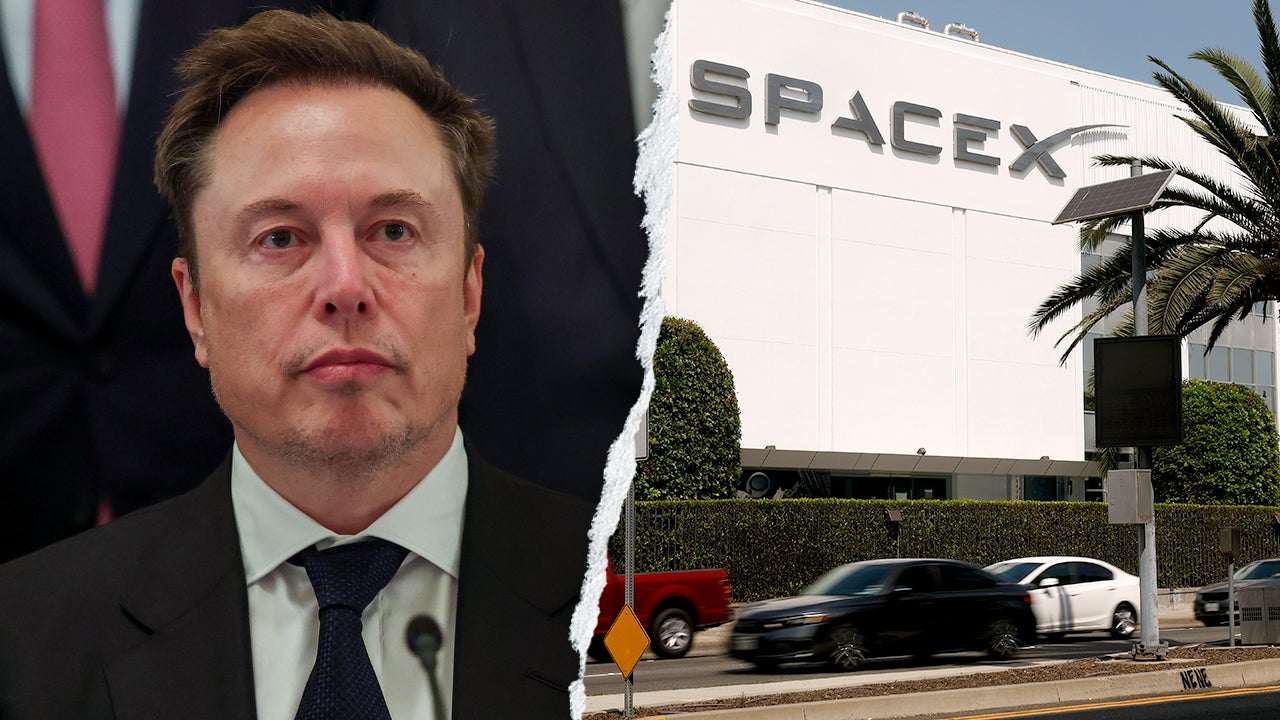
Elon Musk’s SpaceX is sending a senior official to New York City Friday to testify in front of the City Council about AI safety.
Gabriela Castillo Madrid, SpaceX’s senior manager of global government affairs, will face questions starting at 10 a.m. ET, according to PIX11.
The City Council said her appearance before the Committee on Technology comes after New York City Council Speaker Julie Menin “issued a subpoena compelling the firm’s testimony, followed by subsequent conversations about the Council’s intention to have it enforced by a state judge.”
“Last Monday, we held a major, hours-long hearing with whistleblowers, the world’s largest tech companies, and the nation’s foremost experts in AI,” Menin said in a statement. “Conspicuously absent was SpaceXAI, which is unacceptable. New Yorkers and the public at large deserve to hear directly from the companies developing this powerful technology about the safeguards they are putting in place to protect people from harm and how they will be held accountable when those safeguards fail.”
“SpaceXAI tried to circumvent our city’s public conversation on the dangers of AI, and we are prepared to ask similar questions expecting better responses. With the proliferation of Elon Musk’s technology at the federal level, it is even more important they come to the discussion with robust context about data privacy, safeguards, and whistleblower protections,” added Council Member Carmen De La Rosa, Chair of the Committee on Technology.
The Council said in last week’s hearing, “Senior representatives from Anthropic, Google, Meta, and OpenAI all agreed to testify before the Council, with only SpaceXAI declining to participate,” and it also included “testimony under oath from major industry whistleblowers, including Jacob Coxon, Daniel Kokotajlo, and Alex Turner.”
Business
Tesla’s new Roadster makes a flying debut, hitting 60 MPH in under a second
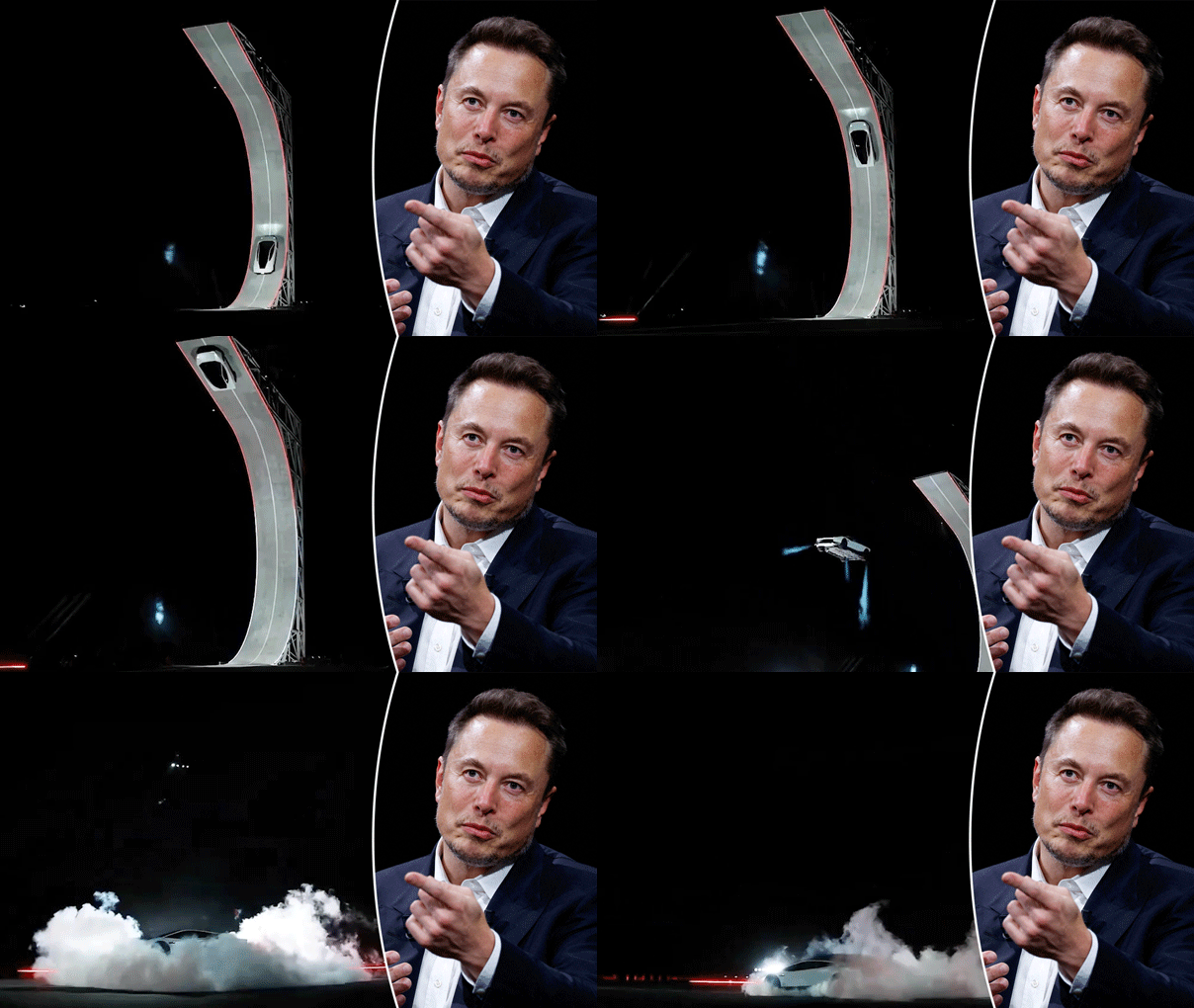
Tesla unveiled its long-anticipated Roadster on Thursday during a dramatic event in which the vehicle used compressed-air thrusters to fly off a ramp and perform a midair maneuver.
The vehicle was seen flying, performing a midair flip and accelerating from zero to 60 mph in under a second.
“Turns out the future does have flying cars,” Tesla and SpaceX CEO Elon Musk said at a SpaceX test site in McGregor, Texas.
Vice President of Vehicle Engineering Lars Moravy added, “Flying cars are real.”
ELON MUSK CALLS WAYMO CARS ‘PET DESTROYERS’ AS ROBOTAXI RIVALS CLASH OVER SAFETY
The jaw-dropping showcase featured the new Roadster accelerating up a massive curved ramp and using a fan-based suction system to remain attached until it was completely upside down before using integrated cold-gas thrusters developed in collaboration with SpaceX to launch off the ramp, flip in midair and land safely back on the ground.
In another demonstration, the Roadster launched over a lineup of cars and a semi-truck, performing a midair flip before landing safely on the other side.
Musk said certain versions of the Roadster can accelerate from zero to 60 mph in less than one second and reach a top speed of more than 230 mph. During the event, Tesla demonstrated a Roadster accelerating to 60 mph in under a second.
WATCH: ROADSTER PERFORMS ‘KICK FLIP’ STUNT:
“Every car on the road today is limited by one thing: tire grip Roadster’s thruster system generates 4–5x the force the tires can. More force on the same mass means significantly better acceleration – physics does the rest,” Tesla said on X.
Nearly a decade after the Roadster’s initial 2017 concept debut, the vehicle left audiences in awe with the gravity-defying demonstration that deployed SpaceX’s rocket technology.
“Today, Roadster presents a new moment in history – the best of the last human-driven cars,” Tesla wrote on X.
Tesla executives announced at Thursday’s event that production would begin in 2028.
Musk and other Tesla executives did not outline the cost at Thursday’s event, but nearly a decade ago, the company quoted a base price of $200,000.
TESLA POSTS STRONGER-THAN-EXPECTED QUARTERLY DELIVERIES
GET FOX BUSINESS ON THE GO BY CLICKING HERE
Tesla’s reservation page for the Roadster after Thursday’s event listed a $50,000 reservation payment for the “Performance” version and a $250,000 reservation payment for the “Thrust” version, which features “acceleration thrusters.” An invite-only “Rocket” variant is a single-seat model with a “full flight system.”
Business
Blue Origin is going all in on the New Glenn rocket
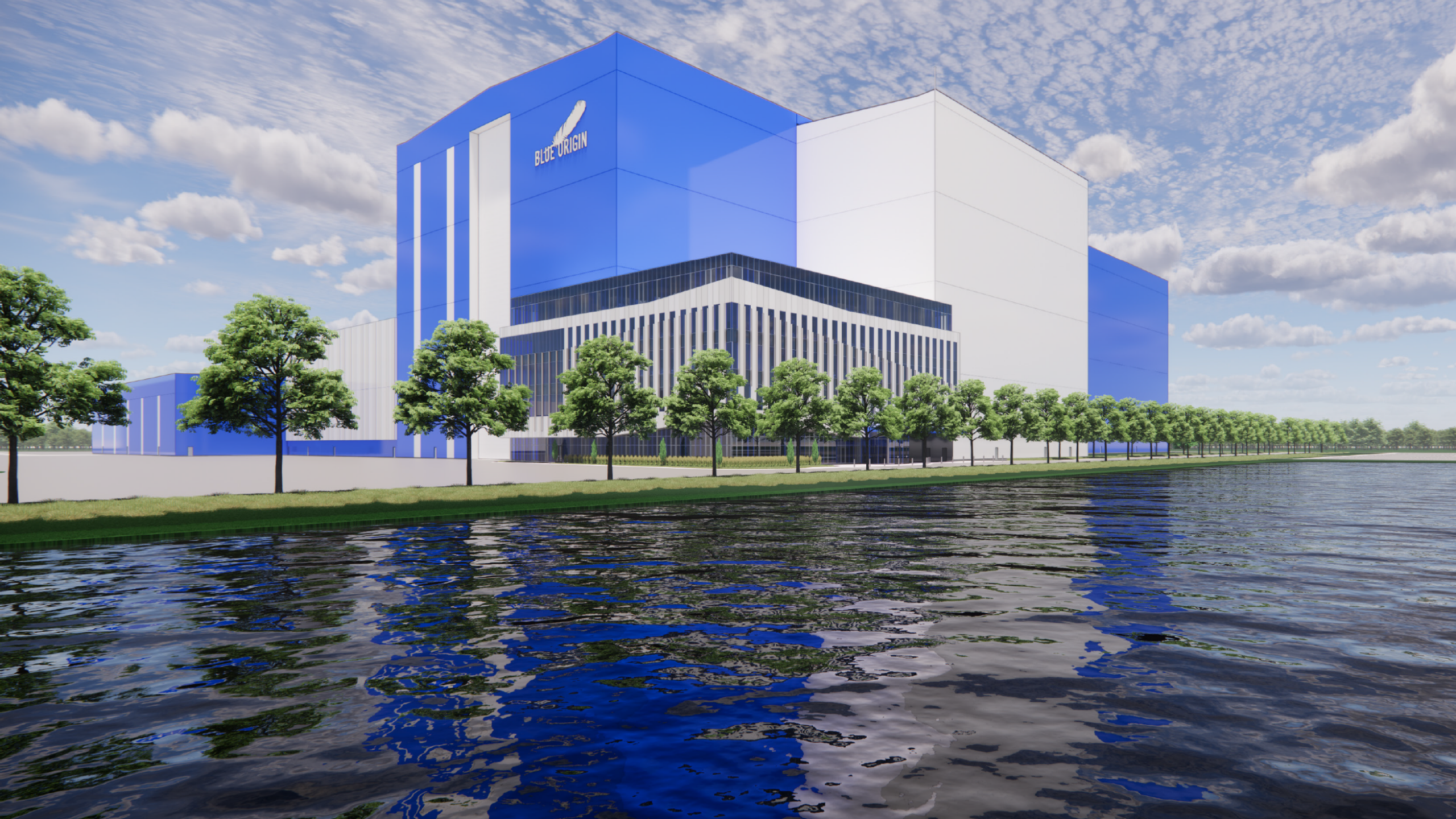
Blue Origin announced a major expansion of its already considerable Florida launch facilities on Friday morning with the intent of eventually flying more than 100 rockets a year from there.
The company said it would add two launch pads for the New Glenn rocket, in addition to two already under construction at Cape Canaveral. The company is also investing heavily in a new manufacturing facility that will produce up to 150 upper stages for a larger variant of the New Glenn rocket.
The company also plans to procure two additional landing ships to catch and return the first stage of the New Glenn rocket (it currently has one, named Jacklyn). Finally, Blue Origin said it would add a new customer integration facility, built in conjunction with the US Space Force, that will feature four payload bays to process multiple missions at the same time.
“These investments are centered on one goal: building the capacity to support more missions, more reliably, and more efficiently,” wrote Ian Richardson, senior vice president of operations at Blue Origin, in an update on the company’s website this morning. “As we look ahead, this infrastructure is designed to support multiple flights per week by the end of the decade.
$3 billion and counting
To date, Blue Origin has invested about $3 billion in facilities and infrastructure in Florida, largely to support the construction and launch of the heavy-lift New Glenn rocket. The company now has more than 5,000 employees working in Florida and 500 suppliers in the state.
“Our manufacturing and operations footprint has more than doubled in the last couple of years, now spanning more than 20 sites across Brevard and Orange Counties,” Richardson wrote. “Blue Origin is the only company—and the largest employer—to manufacture, launch, and refurbish rockets on the Space Coast.”
That would seem to be a reference to superseding the 800-pound gorilla on the Florida Space Coast, SpaceX, which has launched hundreds of rockets into orbit over the years from Florida. Blue Origin has launched to orbit twice.
But Blue Origin is expanding its rocket facilities, while SpaceX is pulling back from the commercial launch market with its Falcon 9 and Falcon Heavy vehicles. As Ars has reported, a growing launch crisis is emerging as commercial satellite customers have struggled to purchase a Falcon launch after 2028.
This has created an opening for medium- and heavy-lift vehicles that, if Blue Origin can get New Glenn flying successfully and frequently, it is poised to fill. The company’s previous investments, along with the new infrastructure, suggest Blue Origin founder Jeff Bezos is deadly serious about making this a reality.
Barreling back from BE-4 setback
After a promising start, the New Glenn rocket program was stalled in late May, when a problem with one of the rocket’s BE-4 engines led to the catastrophic loss of the vehicle and its only launch site, Launch Complex 36A at Cape Canaveral.
Since then, the company has been urgently rebuilding the site at 36A to support a return-to-flight mission for New Glenn before the end of 2026. While this is unlikely, the company appears on track to resume New Glenn launches during the first few months of 2027.
Blue Origin has previously announced its plans to rebuild 36A as rapidly as possible, as well as completing the nearby Launch Complex 36B site to support a larger version of New Glenn. This 9×4 variant of the rocket has nine first-stage engines compared to the smaller 7×2 variant, with seven engines.
The new launch pads announced Friday morning are likely intended to support the larger 9×4 variant. As Richardson wrote, “These pads will be rapidly sited and constructed by replicating the design and construction approach being demonstrated with the build of LC-36B.”
The 9×4 rocket is designed to carry 70 metric tons to low-Earth orbit, and more than 20 tons to trans-lunar injection. The company has not confirmed this, but Blue Origin likely needs the 9×4 variant as part of its plans to launch a human lander to the Moon for NASA as part of the Artemis Program. It could debut in 2028 if development goes well.
Business
Google’s Quantum Computer Just Achieved a Major Breakthrough With ‘Magic States’

Quantum computers have an inconvenient problem: they’re magnificently efficient at making mistakes.
These marvelous machines could one day solve problems that would bring even the most powerful conventional supercomputers to their knees.
But the quantum states behind their incredible computing power are also exceptionally fragile, and keeping errors under control is a monumental task.
In fact, a fully functional quantum computer could end up devoting most of its resources not to performing calculations, but simply to making sure those calculations are correct.
Now, the wizards at Google have demonstrated a new way to make quantum computing significantly less error-prone, using a technique with the delightfully appropriate name “magic state cultivation”.
“Our results experimentally establish magic state cultivation as a viable solution to one of quantum computing’s most important challenges,” the researchers write in a paper published in Science.
Quantum computers derive their unusual abilities from the strange physics that governs particles on the smallest scales.
Where the bits in a classical computer represent information as one of two states – a 1 or a 0 – quantum bits, or qubits, can exist in a superposition of both until they are measured. Measurement collapses that superposition, yielding just one definite outcome.
The sensitivity of this superposition is both a strength and a weakness. The quantum states that make these machines so powerful can be disturbed by the slightest interference from their surroundings, introducing errors that can rapidly derail a calculation.
To keep those errors in check, quantum computers need elaborate error-correction systems, which use multiple physical qubits to protect the information encoded in a single logical qubit.
But even with that protection, another problem remains. Some of the operations needed for complex quantum calculations are much harder to perform reliably than others.
To address this problem, physicists invented something called “magic states” – quantum states prepared in advance that allow computers to perform difficult quantum operations without compromising their error correction.
The problem with this is that each magic state can only be used once, so a quantum computer needs a constant supply of fresh ones.
And making magic states is in itself a difficult job.
Errors can creep in during magic state preparation, so researchers have traditionally relied on magic state distillation, a technique that takes a batch of imperfect magic states and processes them to produce a smaller number of more reliable ones.
It’s effective, but it can require extensive quantum hardware and processing time.
In 2024, Google researchers started working on an idea called magic state cultivation.
It might help to think of it like a greenhouse. In this analogy, magic state distillation would be like growing a whole greenhouse full of rose bushes, then using them to produce a smaller number of prize-winning specimens.
Magic state cultivation, by contrast, would be like growing just a single plant, carefully tending and pruning it along the way to make it the best it can be. If at any point it goes wrong, the plant is discarded, and you start again with a new seed.
Eventually, you end up with one truly spectacular plant, and you didn’t need an entire greenhouse to get there. The idea isn’t necessarily to produce a better magic state than conventional methods can, but to produce one of comparable quality using fewer resources.
Now, the Google team has put the idea to the test on its Willow quantum processor – and the results are promising.
Using magic state cultivation, the researchers reduced errors in the preparation process by a factor of around 40, producing magic states with a fidelity of at least 99.99 percent.
There’s a trade-off, though. To achieve that level of reliability, the researchers had to discard most of their attempts, retaining only around 8 percent of the results in the most stringent runs.
There was a significant weird hiccup during the process that led to another small breakthrough, too.
A critical part of demonstrating a quantum technique is proving that it worked. With a cultivated magic state, that is especially challenging – how do you accurately measure something with so few errors?
When Google quantum physicist Emma Rosenfeld first tested the cultivation technique, the results appeared to defy the laws of physics, Google said in a blog post.
It took months of investigation to trace the problem to the very method of measuring the state’s fidelity. Small fluctuations in the laboratory equipment, including temperature variations, were introducing noise that made the team’s usual approach unreliable.
The researchers eventually developed a new technique called kickback tomography, which allowed them to assess the reliability of the cultivated states without the distortions that had plagued their earlier measurements.
Finally, the team demonstrated that their cultivated magic state could be transferred into a larger quantum error-correcting code – a crucial step towards putting it to work in actual quantum computations.
It wasn’t a complete slam-dunk – the larger code introduced additional errors – but that will be the next piece of the puzzle to tackle.
Still, the results show that magic state cultivation can work on real quantum hardware, offering a promising alternative to the resource-intensive methods on which researchers have had to rely.
“Ultimately,” the researchers write, “these findings transform magic state cultivation from a theoretical study into an experimental reality, providing a practical route to universal logic in superconducting processors.”


Southwest announces major overhaul of loyalty program
Southwest Airlines is overhauling its loyalty program, adding a new top-tier status with unlimited Companion Pass trips and giving travelers...


Esther McGregor and Emilio Sakraya reportedly set to star in ‘Fourth Wing’ TV series
Esther McGregor and Emilio Sakraya are set to star in the small-screen adaptation of Rebecca Yarros’ hit romantasy novel “Fourth...


Elon Musk reveals ‘world’s first flying car’ at Tesla event
Elon Musk has revealed Tesla’s latest model, which he claims will be the world’s first flying car, using technology from...


Ukraine resuming strikes on Russian oil sites is a ‘disgrace’
President Donald Trump has labeled Ukraine’s resumption of strikes on Russian oil refineries a “disgrace,” the latest salvo in his...


The Surface Laptop Ultra delivers on most of Microsoft’s promises
Microsoft promises one machine for dev, AI, and gaming, and mostly gets there. Nick Indge – Oct 16, 2026 8:00...


Jennifer Meyer speaks out on ex-husband Tobey Maguire officiating her wedding to Geoffrey Ogunlesi
Jennifer Meyer gushed about her “unconventional” wedding to Geoffrey Ogunlesi — and having her ex-husband, Tobey Maguire, officiate. “I genuinely...


What The Sit-To-Stand Test Reveals About How Well You’re Aging
LOADINGERROR LOADING What does it mean to be healthy? Lab work results, body mass index and even the ability to...


New York City Council to question SpaceX official over AI safety
The Indian Computer Emergency Response Team (CERT-In) announced that AI models under testing broke into the live systems of Indian...


Tesla’s new Roadster makes a flying debut, hitting 60 MPH in under a second
Tesla unveiled its long-anticipated Roadster on Thursday during a dramatic event in which the vehicle used compressed-air thrusters to fly...


Blue Origin is going all in on the New Glenn rocket
Blue Origin announced a major expansion of its already considerable Florida launch facilities on Friday morning with the intent of...
-

 Entertainment2 weeks ago
‘Verity’ Posts $4.5M Previews, ‘Digger’ $1.2M
-

 Entertainment2 weeks ago
Rick Devens Wins In Season 28 Finale
-

 Business2 weeks ago
Tesla Cybercab pressure to expand after rocky first month in Austin
-

 Business2 weeks ago
OpenAI safety employee resigns, claiming the company’s ‘culture is broken’
-
 Business2 weeks ago
Energy Secretary Chris Wright says Trump was “well aware of the risks to energy flows” before launching Iran war
-

 Entertainment2 weeks ago
Disney pays $115 million for Yamaha’s Orange County headquarters
-

 HealthNews1 week ago
Des Moines clinics stumped by unidentified virus
-
Business2 weeks ago
Leaked Anthropic IPO prospectus: The US government could hurt our business