
Business
Who is Ynon Kreiz, David Ellison’s co-CEO at Skydance?

Richard Bord | Wireimage | Getty Images
David Ellison has spent two years fighting to build his media empire. Now, he’s bringing in a heavyweight to help him run it.
Ynon Kreiz, outgoing CEO of Mattel , will serve as co-CEO of the combined Paramount Skydance and Warner Bros. Discovery , to be named simply Skydance, when the merger closes on Tuesday.
The new entity will unite the storied film studios of Paramount and Warner Bros.; the CBS broadcast network; a sprawling portfolio of pay-TV networks that include CNN, TNT, MTV and BET; and streaming services Paramount+ and HBO Max, all under one roof.
The appointment of Kreiz to a top executive position alongside Ellison speaks to a governance question that has surrounded Ellison’s aggressive pursuit of the legacy media assets: The tech executive and son of billionaire Larry Ellison can buy it, but can he lead it?
Not even 18 months ago, Ellison was the CEO of film production company Skydance with a limited portfolio of hits, namely the Tom Cruise-led Mission: Impossible franchise and “Top Gun: Maverick.”
Patrick T. Fallon | Afp | Getty Images
By August 2025, he was successfully closing an acquisition of Paramount, a deal worth around $8 billion. Roughly a month later, he started his campaign for WBD, spurring a back-and-forth bidding war that would ultimately result in a deal worth roughly $110 billion on an enterprise basis to merge two of Hollywood’s biggest media companies.
Kreiz is a 30-year veteran of the media space, arguably best known for ushering “Barbie” to the big screen in 2023. He’s earned a reputation as a turnaround man, with roots in entertainment despite his more recent stint in consumer goods.
He joins Paramount Skydance on Monday, and becomes co-CEO on Tuesday upon closing.
Many on Wall Street have lauded Kreiz for reviving toymaker Mattel through various cost-cutting measures, though others question if his previous entertainment experience is enough to help navigate Skydance through this merger — and how successfully he and Ellison will share the duties.
“We view the appointment of Ynon Kreiz positively, as his operating experience and brand/IP focus uniquely position him to help lead the integration of Paramount Skydance and WBD and build the combined business into a best-in-class content and IP platform,” said Matthew Condon, analyst at Citizens Bank, in a research note published this week.
Ellison’s focus will be on the company’s long-term strategy, creative vision, technology and capital allocation, and Kreiz will be responsible for the company’s day-to-day management and the integration of the combined businesses, the company said in announcing his role.
“Kreiz has extensive experience in media and entertainment from before his time at Mattel,” Matthew Dolgin, senior equity analyst at Morningstar, wrote in a research note this week. However, “We don’t necessarily think he is the best conceivable choice to handle this task.”
“He undoubtedly is an experienced hand who fills a void that had been present, leaving the firm better positioned with him, in our view, than it was without him,” Dolgin wrote. “Though his title is co-CEO, we view Kreiz as a chief operating officer.”
Mattel turnaround
Prior to his eight-year stint as Mattel CEO, Kreiz was chief executive and chairman of Maker Studios, which was sold to The Walt Disney Co. in 2014. Before that he was the chairman and CEO of Endemol Group, one of the world’s largest independent television production companies. Earlier in his career, Kreiz co-founded Fox Kids Group Europe, a children’s entertainment company, which was also acquired by Disney in 2002.
“It’s an excellent choice for Paramount,” Eric Handler, managing director and senior media and entertainment analyst at Roth Capital Partners, told CNBC.
When Kreiz took the helm at Mattel in 2018, he was the fourth CEO in four years to take control of the toy company. At that time, the company’s Fisher-Price, Barbie and American Girl brands were struggling to connect with changing consumer tastes and Mattel was reeling from the recent bankruptcy of Toys R Us.
David Grogan | CNBC
“Mattel had like a four-year revenue downturn, gone from being quite profitable to losing money, and he turned that around in like two years,” Handler said.
Wall Street analysts told CNBC that Kreiz’s experience righting the ship at Mattel will help Skydance navigate a sprawling and complex merger.
“He got off to a really great start [at Mattel] because he did some structural improvements,” said Gerrick Johnson, equity research analyst at Seaport Research Partners. “They eliminated a lot of SKUs, rationalized the business lines … They did a great job of cutting like $1 billion worth of cost right out of the gate, becoming more flexible, quicker to market.”
As part of these cost-cutting measures, Kreiz restructured Mattel’s supply chain, reduced the number of toys it produced, closed several manufacturing facilities and reduced the overall workforce by 2,200 employees. He prioritized creating free cash flow and deleveraging the company’s balance sheet.
“Net-net, we believe Mr. Kreiz’s operational experience restructuring and turning around Mattel, coupled with his focus on developing world-class IP, uniquely positions him for the co-CEO role and to lead the integration of Paramount Skydance and WBD — an integration largely predicated on high expense synergies, and ultimately, building a best-in-class content and IP platform,” wrote Citizens’ Condon.
Film strategy
One of the first major initiatives Kreiz instituted upon taking over Mattel was the launch of an in-house film division. The strategy was to use the box office as a catalyst for toy sales.
Through this venture, Mattel partnered with the Warner Bros. studio to bring Barbie to the big screen. The film, directed by Greta Gerwig and starring Margot Robbie and Ryan Gosling, generated more than $1.4 billion at the global box office and revitalized the Barbie brand.
While “Barbie” was a box office hit, most of the revenue from the film went to Warner Bros. and theatrical partners. Mattel reported it received just a $150 million revenue boost in fiscal 2023, the year the film was released.
Courtesy: Warner Bros.
“You can’t argue that Barbie wasn’t anything but a tremendous success,” Johnson said. “But for Mattel, it didn’t translate to the bottom line. Mattel that year generated an incremental $90 million in operating profit, so that’s like 13% growth on a consolidated basis with the ‘Barbie’ movie. Barbie revenue was up 3% that year, but Barbie revenue since is down 22%. … So, a massive deterioration of that Barbie brand since.”
Some Wall Street analysts suggested Kreiz became too focused on the entertainment side of Mattel’s business, leading to stagnation in toy innovation and slower sales.
“Post-Covid, earnings have been very stagnant,” Johnson said. “The top line has flatlined. Margin growth has stalled. Innovation has stalled, and it just seems like a classic, you know, taking the eye off the ball.”
Mattel’s stock has also “done a round trip under Kreiz’s tenure,” Jaime Katz, senior analyst at Morningstar, wrote in a research note published Tuesday. While shares roughly doubled to the mid-$20 range during his time as CEO, they ultimately fell back to around $15 apiece.
“Kreiz’s strategy to establish Mattel as an IP-driven, high-performing toy company has largely fallen flat,” Katz said.
Stock Chart IconStock chart icon
Merging Paramount and WBD
Still, analysts see Kreiz as an asset to Skydance and Ellison as the company begins a lengthy merger process.
The combination of Paramount and Warner Bros. Discovery into Skydance could take between two and three years in total, Laura Martin, analyst at Needham, wrote in a note to investors published Thursday.
Paramount Skydance has said it intends to realize $6 billion in cost savings through the merger within three years of closing. At the same time, Ellison and Kreiz will be facing around $79 billion in debt once the transaction is complete.
“Over time, we expect cost synergies to be higher than the $6 billion promised,” Martin wrote.
While Paramount executives have said the majority of that savings target will be found in nonlabor costs, exactly where the savings will come from remains to be seen.
Ellison has previously said he intends to combine the Paramount+ and HBO Max streaming services into one platform for consumers. That could naturally result in shrinking the infrastructure around those businesses.
In film, Skydance will now be home to the Warner Bros. and Paramount studios in addition to its DC studio — and it will have lofty production targets to meet.
In order to settle a lawsuit by a group of state attorneys general seeking to block the deal over antitrust concerns, Paramount Skydance agreed to release at least 30 films per year into theaters in 2027 and 2028 and at least 32 films annually in 2029, 2030 and 2031. It’s unclear how much cost cutting the studios could absorb and still achieve these quotas.
Over at CBS, Skydance has agreed to prohibit writer layoffs on the broadcast team for at least five years.
Yet, a report from the Department of Economic Opportunity in Los Angeles suggests that 4,500 film and TV jobs in the county are at risk over a three-year period when the companies combine operations.
“[Kreiz has] got a big task ahead of him,” Handler said. “You know, there’s a huge amount of debt, a massive integration situation that he’s facing. But I think he’ll do a great job with it.”
Business
SpaceX takes aim at US wireless carriers with spectrum acquisition
While Starlink Mobile’s existing global 2 GHz mid-band spectrum will provide high-bandwidth capacity, the new spectrum will enable its signal to pass through obstacles. Financial terms of the agreement were not disclosed.
Sign up here.
Low-band frequencies are prized for their ability to travel longer distances and penetrate dense structures such as walls and tree cover, addressing a major technical hurdle previously faced by satellite-based mobile networks.
By pairing nationwide low-band airwaves with high-frequency space capacity, SpaceX is positioning Starlink Mobile to bypass conventional cell towers entirely and challenge the wireless oligopoly on both broad coverage and in-building reliability.
The deal also raises the stakes for legacy carriers, transforming satellite direct-to-device connectivity from a supplementary safety feature for remote dead zones into a full-scale commercial rival capable of unseating terrestrial cellular networks.
The transaction, which involves acquiring 100% of private-equity firm Grain Management’s nationwide 800 MHz spectrum portfolio, remains subject to regulatory approval by the Federal Communications Commission. Grain had acquired the airwaves from T-Mobile earlier this year.
Crucially, most existing, unmodified mobile handsets already support the 800 MHz frequency band, eliminating the need for consumers to purchase proprietary satellite phones.
The Federal Communications Commission also approved Starlink Mobile’s Gen2 constellation application this week, authorizing SpaceX to launch 15,000 satellites that are optimized for 2 GHz spectrum globally.
The new orbital fleet will operate in very low Earth orbit, delivering expanded bandwidth and low-latency connections to standard handsets.
Adds details, background throughout
Reporting by Akash Sriram in Bengaluru; Editing by Shilpi Majumdar
Business
SpaceX Buys Wireless Spectrum For Starlink; Verizon, AT&T, T-Mobile Tumble

Information in Investor’s Business Daily is for informational and educational purposes only and should not be construed as an offer, recommendation, solicitation, or rating to buy or sell securities. The information has been obtained from sources we believe to be reliable, but we make no guarantee as to its accuracy, timeliness, or suitability, including with respect to information that appears in closed captioning. Historical investment performances are no indication or guarantee of future success or performance. Authors/presenters may own the stocks they discuss. We make no representations or warranties regarding the advisability of investing in any particular securities or utilizing any specific investment strategies. Information is subject to change without notice. For information on use of our services, please see our Terms of Use.
*Real-time prices by Nasdaq Last Sale. Real-time quote and/or trade prices are not sourced from all markets. Ownership data provided by LSEG and Estimate data provided by FactSet.
IBD, IBD Digital, IBD Live, IBD Weekly, Investor’s Business Daily, Leaderboard, MarketDiem, MarketSurge and other marks are trademarks owned by Investor’s Business Daily, LLC.
©2026 Investor’s Business Daily, LLC. All Rights Reserved.
Business
Feds get ready to rewrite car headlight rules

One of the regulations that make vehicles in the US different from those in Europe or Japan is our headlight rules. They’re laid out in the Federal Motor Vehicle Safety Standards (FMVSS), and changing them is—or used to be—a lengthy, laborious process, which is a major reason automotive lighting technology has lagged in the US. But the current administration says it’s time for “bolstering driver safety, slashing red tape, and embracing new technologies,” so it’s going to start a negotiated rulemaking process to rewrite the regulations to suit 2026.
“Today’s standards do not allow automakers to deploy the latest safety-improving lighting technologies, so we are bringing key experts and stakeholders together to modernize our standards and address potential causes of glare,” the National Highway Traffic Safety Administration’s Jonathan Morrison said. “This collaborative approach will allow us to update outdated regulations, foster innovation, and keep everyone on our roads safer.”
While it is fair to be skeptical of the government’s efforts to streamline bureaucracy, it is also fair to say US headlight regulations really could use an update.
When Ars started covering cars, automakers like Audi, BMW, Mercedes, Toyota, and Volvo were trying to import adaptive headlight technology. At the time, the FMVSS only allowed for “dumb” high- and low-beams, nothing else. Meanwhile, lighting technology evolved, adopting first lasers and then LEDs with addressable pixels that can block out those that would otherwise illuminate oncoming cars.
In 2013, in response to Toyota’s petition, NHTSA said it would start the rulemaking process. It took another five years before a rule was published for consideration; in the interim, the NHTSA was considering adopting Europe’s rules before deciding that if a car with adaptive beam lights “does not have a long preview of another vehicle, such as in an intersection scenario or when two vehicles are oncoming on a curved road, ADB does not have enough time to react to adapt its beam pattern.”
One key difference is how vehicles are regulated. In Europe, cars are homologated for type approval; manufacturers submit examples to authorities for testing to ensure they conform to the rules, and then the authorities approve the car for sale. In the US, OEMs tell NHTSA their cars comply with the FMVSS, or face sanctions if that turns out to be false later. At the time, NHTSA felt that Europe’s glare tests were too subjective for a self-certification regime and decided instead to write its own.
In 2022, that final rule was ready. Since then, cars with active beam matrix LED headlights have gone on sale in the US; Audi’s big new SUVs are a good example, although they are limited in functionality compared with the same technology fitted to European-spec cars.
Among NHTSA’s goals for an updated FMVSS 108 are harmonizing US standards with their global counterparts, updating the rules for technologies like LEDs, ambient light sensors, automatic high beams, and replaceable light sources, improving test procedures for lenses and optics, understanding how to better aim headlights, and making sure that none of this blinds anyone else on the road with glare.
Business
Tech stocks drop after report that OpenAI’s revenue is lower than expected

Tech stocks dropped on Thursday after a news report that OpenAI’s annualized revenue is about $20 billion less than previously reported.
OpenAI, the maker of ChatGPT, recently told investors that its annualized revenue was nearing $50 billion, according to the Financial Times. That’s lower than the $70 billion figure previously reported by media, including the FT, based on information from investors.
The discrepancy could rattle investors already questioning whether demand for AI will be strong enough to help companies like OpenAI and Anthropic turn a profit and justify the industry’s enormous spending on the AI buildout.
The Nasdaq Composite sank 1.25%, its worst day since mid-August. The S&P 500 fell 0.5%, weighed down by a drop in the tech sector. The indexes had opened lower but declines accelerated after the FT report published midday.
A source familiar with the documents said the $70 billion figure did not come from OpenAI and likely came from a desire by firms to compare OpenAI’s numbers with Anthropic’s, which includes gross revenue from cloud providers. OpenAI’s is based on net revenue.
OpenAI declined to comment.
There was selling across semiconductor chipmakers, cloud providers and other tech companies involved in the AI buildout. Nvidia (NVDA) fell 2.9%, Intel (INTC) fell 5.3% and Oracle (ORCL) fell 5.5%.
The outlook for many tech stocks is based on investors’ conviction that demand for AI will continue to grow. If there are wrinkles in that story, like OpenAI earning less revenue than expected, that could send ripples throughout the supply chain for the AI buildout, said Ross Mayfield, investment strategist at Baird.
“There are going to be tremors throughout all of the related sub-industries,” Mayfield said.
The stakes are higher now because the stock market in recent weeks has been buoyed by gains in tech and AI stocks, while other sectors have struggled under the pressure of rising bond yields.
“This has become a much narrower market that’s dependent on the AI names to keep it afloat,” Mayfield said. “Certainly, this is going to hit that complex in a big way.”
OpenAI CEO Sam Altman announced in September that the company would postpone its initial public offering until at least next year, citing concerns about AI safety.
Business
US freezes Microsoft, Adobe, Infosys green-card applications over alleged fraud
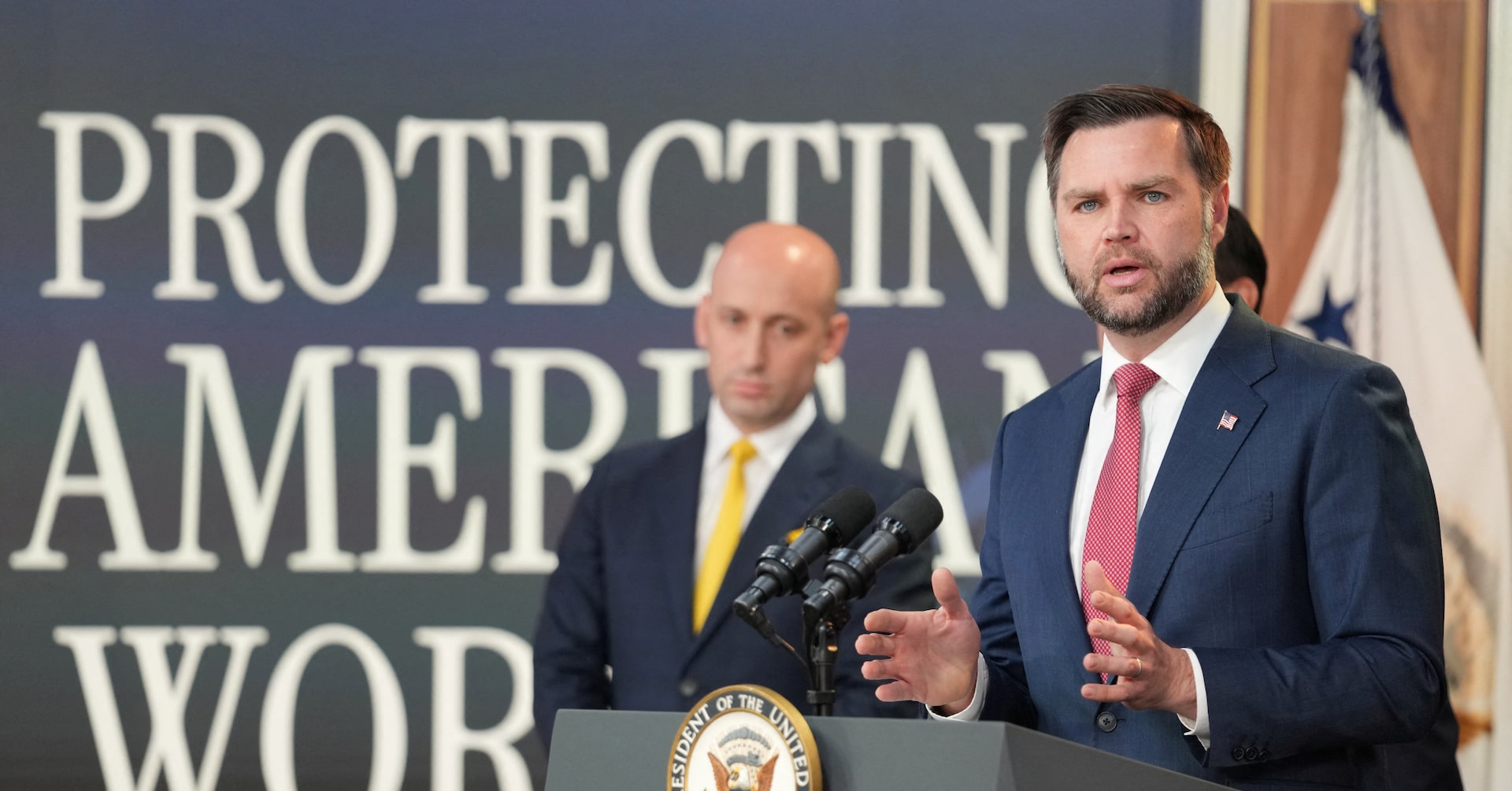
The twin actions mark the broadest strike yet against skilled-worker immigration programs — potentially cutting off a common path to permanent residency for foreign tech workers — while putting some of the country’s top research universities on notice.
Sign up here.
“There has been no company in the United States, unfortunately, that has abused the system more than Microsoft,” Vice President JD Vance said. He said the company laid off 6,000 American workers last year while benefiting from 6,300 H-1B temporary worker visas and nearly 3,000 green cards.
The announcement about the permanent labor certification process — PERM — came hours before Trump was due to give Microsoft CEO Satya Nadella the National Medal of Technology and Innovation. Under PERM, required for most employment-based green cards, employers must show that hiring a foreign worker will not harm US workers’ wages or job opportunities.
Microsoft is the largest filer of PERM applications, according to data from the US labor department.
The company said in a statement that about 80% of the H-1B applications it filed in the last fiscal year were to extend or change the status of current employees, not to hire new workers. In July, the company said it would cut 4,800 jobs, or about 2.1% of its global workforce.
He said these companies had since 2009 sought almost three million foreign workers, and had received over 230,000 H-1B visa approvals and over 100,000 permanent labor certifications.
Amazon.com was the largest employer of approved H-1B beneficiaries in fiscal 2026, followed by Tata Consultancy Services, Infosys, Apple and Microsoft, according to US immigration data.
Vance said the suspensions would last “as long as it needs to,” adding that the administration wants the companies to change how they hire. He said some companies post ineffective job ads, then cite a lack of applicants to justify hiring lower-paid foreign workers.
Microsoft said in its statement that it pays its H-1B employees the same as any other employees doing comparable work.
“The immediate financial impact on major technology companies may be relatively limited at this moment, but the longer-term implications for innovation and competitiveness could be much more significant,” said Ken Mahoney, CEO of Mahoney Asset Management.
Adobe, Cognizant, Infosys, HCL Technologies, Wipro and Capgemini did not immediately respond to requests for comment. Tata Consultancy Services declined to comment.
Nasscom, India’s IT industry body, said Indian tech companies in the US had significantly reduced their reliance on H-1B visas, and relatively few of their workers sought green cards through the PERM process.
CRACKDOWN WIDENS
The suspensions are the latest in a series of steps against skilled-worker programs. In September last year, the Labor Department launched an enforcement drive called “Project Firewall” as a White House proclamation imposed a one-time $100,000 fee on new H-1B petitions for workers hired from abroad.
During President Donald Trump’s second term, companies have faced growing pressure to keep jobs and production in the United States rather than move them overseas.
The action comes despite closer ties between the administration and tech leaders, who are lobbying for lighter AI regulation.
UNIVERSITIES UNDER SCRUTINY
Vance also said nine universities, including Harvard, Yale and Stanford, would be investigated for what the administration called the misuse of exchange-visitor visas to undercut American wages.
The nine schools also include Brown and the Massachusetts Institute of Technology. Labor Inspector General Anthony D’Esposito said subpoenas had already been served.
D’Esposito said investigators would examine whether foreign influence, improper financial relationships or visa abuse were compromising federally funded research.
“It could have an enormous economic impact on the whole US economy,” said Sarah Spreitzer, a vice president at the American Council on Education, which represents college and university presidents. International students historically spent $40 billion a year while in the US, she said.
The probe deepens the administration’s long-running fight with Harvard over foreign students. Last year, the Department of Homeland Security subpoenaed the university over alleged misconduct by international students and its compliance with immigration law. Harvard called that subpoena “unfounded retribution” but said it would comply as far as the law requires.
Adds details, background and analyst quotes throughout
Reporting by Dan Rosenzweig-Ziff, Doina Chiacu in Washington and Prathik Jayaprakash in Bengaluru; Editing by Mark Porter, Sayantani Ghosh and Sanjeev Miglani


I watched the damning 4-hour Elon Musk doc so you don’t have to
The new four-hour documentary “Musk” opens with a view of Earth from outer space. The planet gleams against the dark...


SpaceX takes aim at US wireless carriers with spectrum acquisition
While Starlink Mobile’s existing global 2 GHz mid-band spectrum will provide high-bandwidth capacity, the new spectrum will enable its signal...


SpaceX Buys Wireless Spectrum For Starlink; Verizon, AT&T, T-Mobile Tumble
Information in Investor’s Business Daily is for informational and educational purposes only and should not be construed as an offer,...


Marvel Sets New Live-Action Spy Thriller Series ‘Zodiac’ For 2028
Marvel Television announced a new live-action television series titled Zodiac. The series, revealed at New York Comic-Con on Thursday, is...


Feds get ready to rewrite car headlight rules
One of the regulations that make vehicles in the US different from those in Europe or Japan is our headlight...


Study reveals whether diet soda or water is better for weight loss
Diet drinks containing sugar substitutes were found to be as effective as water for supporting weight loss in overweight or...


Skydance’s JB Perrette Makes First Moves After Re-Upping Contract
JB Perrette has moved quickly to put together the executives that will report to him at Skydance. Perrette, who is...


Tech stocks drop after report that OpenAI’s revenue is lower than expected
Tech stocks dropped on Thursday after a news report that OpenAI’s annualized revenue is about $20 billion less than previously...


US freezes Microsoft, Adobe, Infosys green-card applications over alleged fraud
The twin actions mark the broadest strike yet against skilled-worker immigration programs — potentially cutting off a common path to...


Crystal Hefner Asks Jessica Biel Not to Play Hugh Hefner’s Wife in New Movie
Crystal Hefner is begging Jessica Biel to think twice before playing Hugh Hefner’s wife in an upcoming movie … warning...
-

 Sports1 week ago
The Case Keenum game? Veteran QB delivers for Chicago. Bears vs. Eagles takeaways
-

 Entertainment6 days ago
‘Verity’ Posts $4.5M Previews, ‘Digger’ $1.2M
-

 Business2 weeks ago
A 46-foot tunnel boring machine grinding 110 feet under a Virginia harbor chewed a mastodon loose from the seabed and pumped it toward land as slurry, and an operator watching the mud for metal spotte
-

 Entertainment7 days ago
Rick Devens Wins In Season 28 Finale
-

 Video7 days ago
Meta's Muse: Cute AI Agent Or 'AI Trojan Horse'? | BBC News
-

 Business6 days ago
Tesla Cybercab pressure to expand after rocky first month in Austin
-
Business7 days ago
Leaked Anthropic IPO prospectus: The US government could hurt our business
-

 Business5 days ago
OpenAI safety employee resigns, claiming the company’s ‘culture is broken’