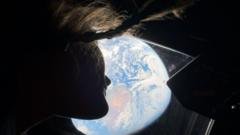
Are Artemis’s breathtaking Moon images scientific or just vacation snaps? One day ago. Georgina Rannard, Science Reporter. NASA is steadily releasing breathtaking images of the Moon and Earth, captured by astronauts aboard its Artemis II lunar mission. These high-definition photos, showcasing the celestial bodies from rare perspectives, are garnering millions of likes on social media. The excitement is undeniable: four astronauts are venturing farther from Earth than any humans since 1963. But do these images offer distinct scientific merit, or are they merely akin to vacation snapshots? NASA. NASA seeks the American public’s support for the mission. They’re live-streaming their 26-day journey, with the four astronauts providing regular video updates that describe their progress in triumphant tones. NASA reports the crew has been so thrilled watching Earth and the Moon pass by that the Orion spacecraft’s window got dirty, prompting instructions for the astronauts to clean it. This marks the first time digital cameras have ventured this far into space. Orion features 22,019 cameras and devices—21,968 mounted on the spacecraft and 17 handheld by the crew. According to NASA, the astronauts are using standard 10-year-old cameras like the Nikon D5, along with GoPros and smartphones. NASA’s Flickr photostream even specifies the device used for each published photo. On Friday, the first fruits of their intensive observations appeared. “Hello, World” was captured by Commander Reid Wiseman when the mission was roughly equidistant from the Moon and Earth—142,000 miles (228,201 km) from Earth and 132,000 miles from the Moon. The image depicts two auroras as Earth eclipses the Sun, with planet Venus shining at the bottom. NASA/Reid Wiseman. The Earth looks upside down in the image, showing the Sahara Desert and Iberian Peninsula on the left and eastern South America on the right. It’s a beautiful photo, but not groundbreaking scientifically. NASA’s Deep Space Climate Observatory satellite features the Earth Polychromatic Imaging Camera (EPIC) that captures such views. Launched in 2015, it often photographs Earth from nearly a million miles away—farther than Artemis II. On Saturday, NASA shared another image captioned “history in the making.” The photo depicts the Orientale basin, a massive crater on the Moon’s far side featuring a thicker crust and numerous impact craters. It was released before Monday’s lunar fly-by, when the crew will orbit this enigmatic far side, coming within 4,066 miles of the surface. NASA.