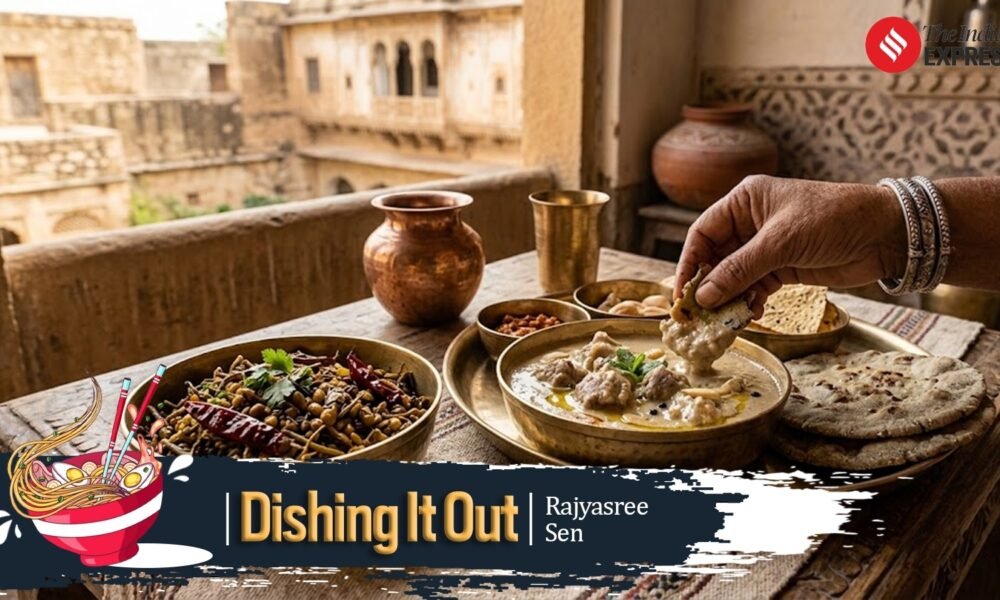
This week, I spent two days at a beautiful palace on the way to Jaipur. Patan Mahal is not only a balm for the senses—given that we were there in the middle of the week and there was no one in sight—it is also a great place to ease your taste buds into the world of Rajasthani cuisine.. While I became well-acquainted with vegetarian Marwari cuisine because I lived in Calcutta and had friends in the right places, Rajasthani cuisine was something I encountered only when I travelled to the state for the first time in my teens. Rich, earthy, and exotic – thanks to the desert vegetables that form a part of the daily fare – it also boasts of some of the most delicious meat preparations I have ever had. This trip was no different.. Traditional Rajasthani cuisine embodies the hardships of living in a desert and the desire to eat tasty food. I want to start with one of my favourite preparations, the underrated Safed Maas. Everyone talks about Lal Maas, but the subtlety of Safed Maas is not to be dismissed. Unlike Lal Maas, which is fiery in appearance and which I will discuss later, Safed Maas is cooked in a nutty, creamy sauce and has a slight sweetness that acts as a perfect foil to the spice. Slow-cooked, velvety, and rich, this is as celebratory as it gets.. For the more herbivorous inclined, the Ker Sangri is a must-try. This dish is innovation at its best. Rajasthanis prepare a sturdy, hearty vegetable using dried sangri beans and ker berries that grow in the desert. No European or even non-Rajasthani vegetable resembles the sangri bean’s thick, grass-like structure. It is cooked in a yoghurt gravy or as a dry vegetable with potatoes and berries. Easily available in the desert, this is a staple in Rajasthani homes.. Rajasthanis prepare a sturdy, hearty vegetable using dried sangri beans and ker berries that grow in the desert. (Wikimedia Commons). Another common preparation, and quite the delicacy, is Gaanth—a porridge made from wheat, milk, and sugar. Breads are usually made from makki (corn) or bajra (pearl millet), and generously slathered with butter or ghee, and topped with mushti khand, a raw, unprocessed sugar unique to the region that tastes of honey and caramel.. Even the ingredients used in Rajasthani cuisine are evocative of the desert they come from and the one they survive in. Mathania red chillies impart flavour and colour but very little heat, kachri powder made from dried and powdered wild melon—used to tenderise meats—fresh cumin, turmeric root, aniseed, and coriander seeds carry the stamp of the desert.. Another popular Rajasthani preparation is Gatte ki Sabji, where soft gram flour dumplings are simmered in a lightly flavoured yoghurt gravy. The gram flour is mixed with spices, oil, and yoghurt.. Story continues below this ad. A dessert I tried for the first time on this trip was the Rajasthani Lapsiisa. It resembled a finer version of the Bengali Bondey, but was made with daliya (broken wheat), ghee, and jaggery (o