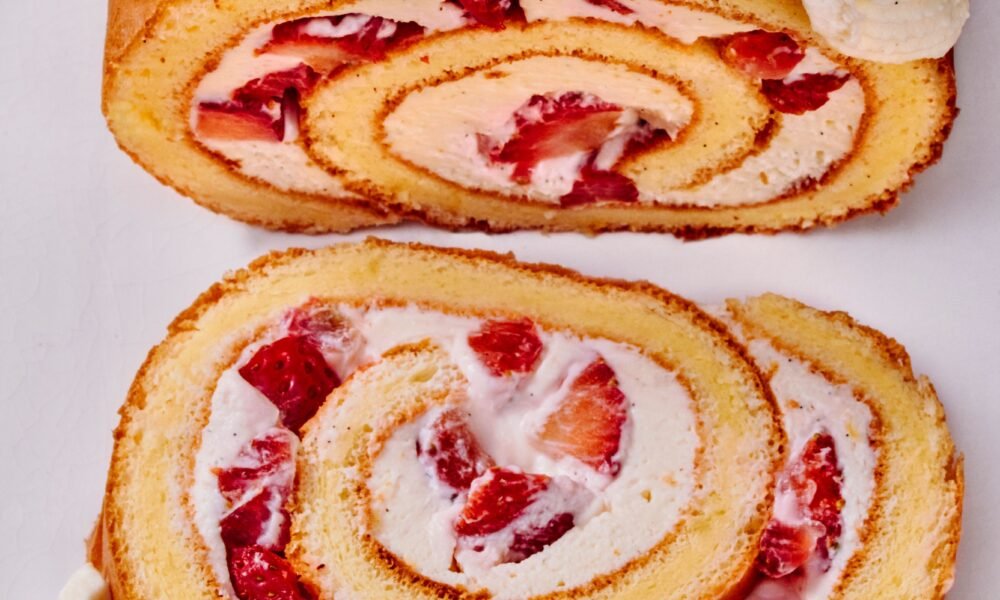
Welcome to Bon Appétit Bake Club, a community of curious bakers. Each month senior Test Kitchen editors Jesse Szewczyk and Shilpa Uskokovic share a must-make recipe and dive deep on why it works. Come bake and learn with us—and don’t forget to join the Bake Club Group chat over on Substack.. Jesse and I didn’t intend to run two cake recipes back to back in Bake Club, but in hindsight it is the happiest coincidence. Both cakes—last month, chocolate Guinness; this month, strawberry roll—illustrate two diametrically opposite styles that I’m very excited to dive into.. A lesson in cake lineage. All cakes descend from one of two methods: creaming (like Jesse’s Chocolate Guinness Cake) or foaming (like my Strawberry Shortcake Roll).. Creamed cakes start with the fat. You beat butter—or oil, or butter and oil—with sugar (or flour in the case of reverse creaming), then add the remaining ingredients from there. The result is a hefty cake with a moist, tender crumb that needs little to no frosting (think of pound cake or banana bread).. Foamed cakes, on the other hand, start with the eggs. You whip either whole or separated eggs with some or all of the sugar, until aerated and voluminous, then incorporate the other ingredients. Because the eggs act as the main source of structure and height, these cakes are light and delicate, with an enjoyably soft, springy texture.. The curious case of chiffon. Of all the sponge-style cakes out there—genoise, dacquoise, angel food, joconde, biscuit (pronounced the French way: bees-qwee)—chiffon is my absolute favorite. Chiffon cake’s origin story is fascinating, starting with an insurance salesman who moved to Hollywood, and ending in classic capitalism (the inventor ultimately sold his formula to General Mills). Made with whipped egg (whites) just like its other spongy siblings, but containing a percentage of fat (in the form of egg yolks and oil) which rivals that of a butter cake, chiffon is the golden child that unites our two noble cake families.. It is exactly this hybrid that makes chiffon particularly well-suited to rolling. The high ratio of whipped egg white provides structure and lightness, and the egg proteins make the cake surprisingly strong, despite its featherweight nature implying otherwise. The yolks and oil (it’s always oil in chiffon cakes) provide moisture and richness, keeping the cake pliable even after it has fully cooled, allowing it to flex under your palms into a perfect coil. (That means no need to pre-shape the hot cake with a kitchen towel, as most roll cake recipes tend to instruct. ). We don’t often encounter sponge-style cakes in modern American baking. They’re often dismissed as dry and underwhelming. But within their bouncy, porous interior lies a world of possibility. A sponge cake’s ability to support vast quantities of syrup, juicy fruit, or creamy, mousse-like fillings makes it a sterling foundation for architectural cakes that feel luxurious but are