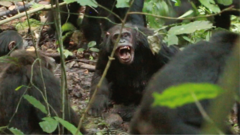
Researchers say Uganda’s chimpanzees are trapped in a brutal ‘civil war’. 3 days and 7 hours ago. Hafsa Khalil. Aaron Sandel berichtet für Reuters. Researchers report that the world’s largest known group of wild chimpanzees, the Ngogo community in Uganda’s Kibale National Park, has divided and been embroiled in a brutal “civil war” for the past eight years. The precise cause of the rift among this formerly tight-knit group remains unclear, but since 2018, scientists have documented 24 deaths, including 17 infants. “These were chimps that would hold hands,” said lead author Aaron Sandel. Now they are attempting to kill one another. According to a study published in the journal Science, the intensity and duration of the violence could provide insights into the evolution of early human conflict. Wild chimpanzees filmed using forest ‘first aid’. Sandel, an anthropologist at the University of Texas in the US and co-director of the Ngogo Chimpanzee Project, describes chimpanzees as “very territorial” with “hostile interactions” toward those from other groups. “It’s like a fear of strangers,” he told the Science podcast. However, over several decades, the roughly 200 Ngogo chimpanzees had lived peacefully. They were split into two subgroups—known to researchers as Western and Central—but overall functioned as a unified community. Sandel first observed them dividing in June 2015, when the Western chimpanzees fled from pursuit by the Central group. “Chimpanzees are sort of melodramatic,” he explained, noting that disputes typically involved “screaming and chasing” followed by grooming and cooperation. After the 2015 incident, however, the two subgroups avoided each other for six weeks, with interactions growing rarer. When they did happen, Sandel said they were “a little more intense, a little more aggressive.” After the groups fully separated in 2018, Western members began assaulting Central chimpanzees. The study documented 24 targeted attacks since the split, killing at least seven adult Central males and 17 infants, though researchers suspect the true death toll is higher. The team attributes this to factors like group size, resource competition, and “male-male competition” for mating opportunities. But they identify three likely triggers: