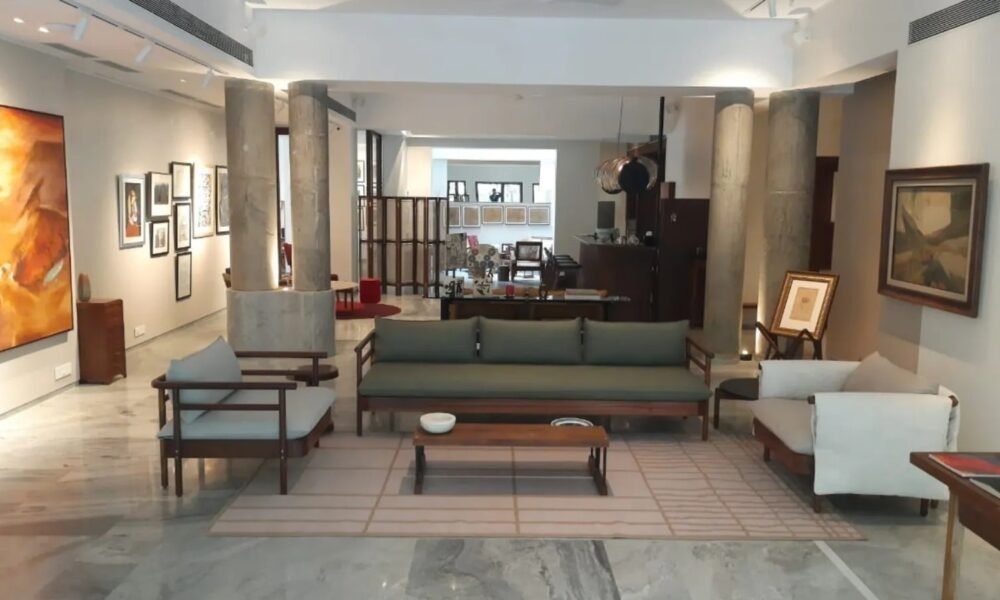
Tucked inside a quiet lane in Mumbai’s Worli, the Kathiwada City House has for at least three generations served as a point where heritage, art, culture, and ideas quietly converge. The low-slung Art Deco structure, with its curved balconies, pastel façade and leafy garden, was originally named West More in the 1940s by the man who built it, the celebrated art collector and former city sheriff Jehangir Nicholson. Since then, the bungalow, possibly one of the few surviving privately owned Art Deco residences of its kind in Mumbai, has undergone several transformations.. Under the stewardship of its present owner, Digvijay Singh Kathiwada, the house has now entered a new chapter. The Kathiwada City House has been opened to the wider public for art and cultural initiatives, paired with a curated dine-in experience. “The idea is for people to dine with the arts,” says Digvijay, whose family traces its lineage to the former princely state of Kathiwada in present-day Madhya Pradesh.. Jehangir Nicholson’s legacy. The house’s association with the arts dates back to its founding. Nicholson, who conceived the bungalow, was one of Bombay’s most influential private art collectors. “A true patron of the arts”, as Digvijay describes him in an interview with indianexpress.com.. Under the stewardship of its present owner, Digvijay Singh Kathiwada, the house has now entered a new chapter.. Nicholson’s belief that art should be accessible to the public ultimately led him to donate his entire collection of over 800 artworks through his estate. Today, this collection forms the basis of the Jehangir Nicholson Art Foundation and is housed at the Chhatrapati Shivaji Maharaj Vastu Sangrahalaya in Mumbai.. When it came to his own home, however, Nicholson was far more protective. He built the bungalow at a time when Bombay saw a wave of elegant low-rise Art Deco residences commissioned by wealthy patrons of art and business.. His house carries many classic elements of the style, including rounded balconies, geometric railings, and clean horizontal lines. These features echo the design language that reshaped much of Mumbai’s seafront architecture in the 1930s and 40s.. Towards the end of his life, Nicholson lived alone in the four-storey bungalow. Digvijay recounts that “Jangu, as his friends lovingly called him, was known for not selling anything till his dying breath”.. A turning point. Story continues below this ad. Nicholson’s connection with the Kathiwada family began through Digvijay’s mother, Sangita Devi Kathiwada, whom he knew through the Willingdon Club. Recognising her interest in the arts, Nicholson eventually agreed to allow her to use part of the house for cultural programming.. An internal understanding was reached. Nicholson would continue to live on the upper floors, while the ground floor would be made available to Sangita Devi for her artistic and cultural initiatives.. “My mother was very excited about this,” recollects