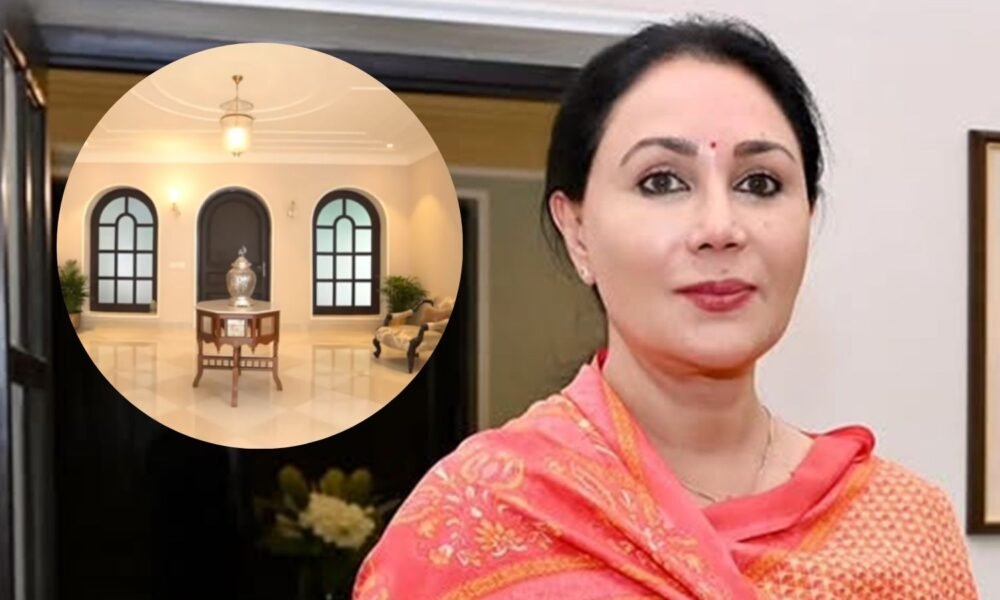
At the official residence of Rajasthan’s Deputy Chief Minister, the boundaries between governance, legacy, and personal memory dissolve seamlessly. Stepping inside Diya Kumari’s Jaipur home feels less like entering a political address and more like being welcomed into a living archive of Rajasthan’s cultural memory.. From miniature paintings and blue pottery to heirloom sarees and sunlit corners that double as moments of reflection, the residence reflects a careful blending of heritage and individuality. While the house itself is a government-allotted space, Kumari has layered it with artefacts and objects that root it firmly in the artistic traditions of Rajasthan and beyond.. A home that begins with tradition. Hospitality, as it turns out, is the first design element. Guests entering the residence are welcomed with a ceremonial gesture deeply embedded in Rajasthani culture.. “This is the Rajasthani traditional welcome,” Kumari says, during a conversation with Curly Tales. “Our guest is like a God to us.”. The residence reflects a careful blending of heritage and individuality. (Source: YouTube/Curly Tales). The ethos of “atithi devo bhava” isn’t just symbolic here; it sets the tone for the home’s aesthetic. Cultural pride is evident even in the smallest details, from the food served to the artworks on the walls.. Such environments often shape how people emotionally experience their homes. “From a psychological standpoint, the spaces we inhabit significantly shape how we perceive ourselves and our place in the world. When a home reflects cultural heritage through traditional art, architecture, or craft, it becomes more than a living space; it turns into a repository of memory and identity,” says Neha Cadabam, senior psychologist and executive director at Cadabam’s Hospitals.. “Being surrounded by elements that represent one’s history and cultural roots can reinforce a sense of belonging and emotional grounding.”. Story continues below this ad. Walls that narrate Rajasthan’s history. One of the first artworks that catches the eye is a painting of Amber Fort, known locally as Amer Fort. For Kumari, such imagery is not decorative alone; it carries the weight of history.. “First, Amer was our capital. After that, Jaipur was established,” she explains. The conversation around the painting quickly expands into a broader reflection on the state’s architectural heritage. Rajasthan’s forts, she says, each tell a different story of their past, from the ramparts of Kumbhalgarh Fort to the monumental presence of Chittorgarh Fort and the striking desert citadel of Jaisalmer Fort.. “Our glorious history of Rajasthan is connected to those forts and monuments,” she says, noting that after the Great Wall of China, “the longest wall is of Kumbhalgarh Fort.”. For someone who has represented multiple constituencies, the connection between landscape and identity runs deep. “Every region of Rajasthan has a distinc