Connect with us

BBC News World

Israeli soldiers shot a Palestinian boy and stood around as he bled to death, video shows

Israeli forces blocked Palestinian ambulances while a 14-year-old lay bleeding for at least 45 minutes.​Israeli forces blocked Palestinian ambulances while a 14-year-old lay bleeding for at least 45 minutes. 

Israeli soldiers shot a Palestinian boy and stood around as he bled to death, video shows
Joel GunterReporting from the occupied West Bank
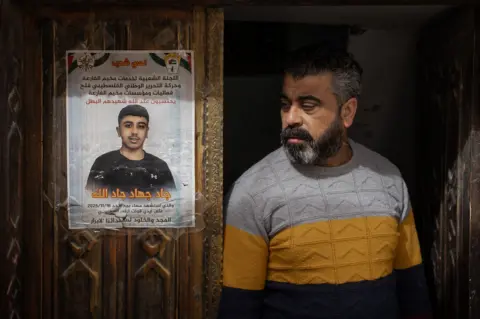
BBC Jad's father stands next to a memorial poster of his son, taped to the family's carved wooden front door in al-Far'a refugee camp, in the occupied West BankBBC

This story contains details and video that some readers may find distressing.

Last November, a 14-year-old Palestinian boy named Jad Jadallah was shot at close range by Israeli soldiers in a refugee camp in the occupied West Bank.

As Jad lay collapsed in an alley, the soldiers created a cordon around him and blocked two Palestinian ambulances from reaching him.

According to video footage and eyewitness testimony, the soldiers – 14 in total – then stood around Jad casually for at least 45 minutes while he bled from one or more gunshot wounds.

All Israeli soldiers receive training in trauma treatment, and any Israeli combat unit should contain a specifically trained medic, but none of the soldiers appeared to give Jad life-saving medical aid. At points, they appeared to ignore repeated attempts from Jad to get their attention.

The Israel Defence Forces (IDF) told the BBC that soldiers had provided “initial medical treatment”, but a spokesperson refused to give any details about the nature or timing of the treatment.

The IDF has also accused Jad of throwing a rock, which, under their rules of engagement, can permit soldiers to use lethal force.

But the footage of the incident shows an IDF soldier dropping an object next to Jad after he was shot, then taking a photograph of it – an action Jad’s family and a leading human rights group say appears to be an attempt to frame him.

The soldiers eventually loaded Jad into the back of an Israeli military vehicle, but at some point, either before or after they did, he died. It is still unclear where on his body or how many times he was shot, because the Israeli military has refused to return his body to the family and declined to answer any questions about his injuries.
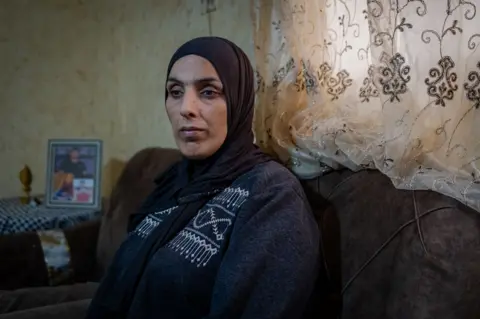
A close up of Jad's mother looking forlorn, sitting in the family living room in al-Far'a refugee camp, in the occupied West Bank. Behind her on the table is a framed picture of Jad.

Shot from close range

Jad was born and raised in al-Far’a, a refugee camp in the West Bank that is home to about 10,000 Palestinians. Along with other similar camps in the occupied territories, it is subject to frequent Israeli military raids, which Israel says are necessary to counter armed groups operating there.

In many respects, Jad’s death was not unusual. According to the UN, 55 children were killed by Israeli forces in the West Bank last year and 227 have been killed there since the 7 October 2023 Hamas attack on Israel.

But two things stand out about this case. The first is that Jad lay on the ground untreated for so long, with so many soldiers around him, while he died. The second is the emergence of a significant amount of video footage of the incident, which the BBC has verified.

The exact moment of the shooting was captured by a CCTV camera in the camp. The footage shows three boys standing on the corner of an alley. First they peek to their right, where, according to eyewitnesses, Israeli military vehicles had moments earlier driven away towards the exit of the camp.

One of the two friends with Jad at that moment told the BBC the boys had gone outside after a post on a messaging group for the camp said the Israeli units were leaving, and the boys were peeking around the corner to check.

Unknown to Jad and his friends, a group of four Israeli soldiers had waited behind and were standing just metres away, to their left, tucked behind the wall. Jad’s friends spotted the soldiers first and ran away up the alley. Jad either didn’t see them or saw them too late.

The CCTV footage shows the lead soldier enter the frame less than three metres from Jad, then appear to raise his rifle and open fire. Jad makes a movement that suggests this is the moment he is hit. In the camp, bullet holes can be found raking the wall in this exact spot.

Jad, likely already wounded, then runs up the alley and the Israeli soldier appears to turn, arcing his or her rifle after Jad. The CCTV footage shows dust being kicked up in the alley ahead, suggesting that the IDF soldier kept firing at Jad from behind as he ran away.
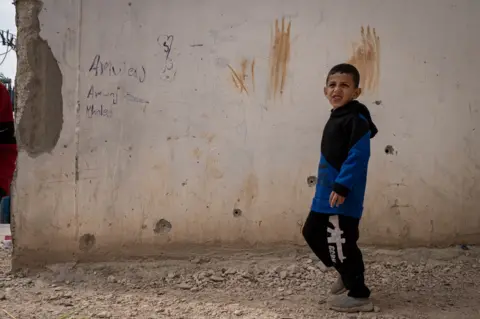
Bullet holes rake the wall in al-Far'a refugee camp, in the occupied West Bank, at the place CCTV shows Jad being shot from close range by an Israeli soldier. A young boy stands in the foreground of the image.

In the footage, you see Jad collapse after just a few metres, disappearing out of the frame as he falls. Shortly after, bystander footage, discreetly filmed by a camp resident, picks up from the other direction to the CCTV. This footage would capture some of the final moments of Jad’s life.

It shows the teenager appear to make repeated attempts to get the soldiers’ attention, by waving his arms and throwing his hat towards them. The soldiers appear to ignore his efforts and kick the hat back.

Alerted to the shooting, Jad’s mother attempted to reach him on foot but was blocked by the Israeli soldiers, she and other eyewitnesses said. Another resident made an emergency call and an ambulance was dispatched immediately, arriving at the scene eight minutes later, according to call logs provided to the BBC by the Palestinian Red Crescent.

The lead paramedic, Hassan Fouqha, said his team was stopped by Israeli soldiers at gunpoint and prevented from reaching Jad, who was just a hundred yards or so away, in their sight.
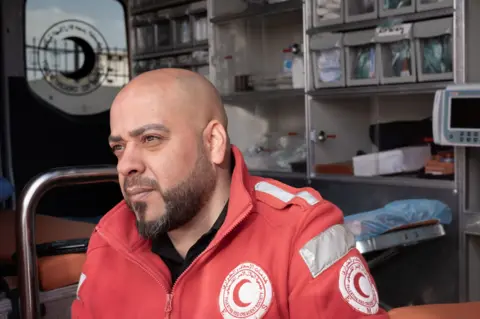
Paramedic Hassan Fouqha sits on the edge of his open ambulance bay door in a red medic jacket, looking straight ahead.

Fouqha and his ambulance crew were then forced to watch on helplessly as Jad lay bleeding from his wounds. The paramedic said they watched for at least 35 minutes, unable to do anything. Fouqha called a second ambulance to come from a different direction, but it was also stopped by the soldiers.

“​​We tried to advance several times, tried signalling to them to let us reach the child, but we were completely blocked,” Fouqha said. “We could have reached him and provided medical aid but we were prevented. The purpose of this, we do not know, but this is what happened.”

The IDF told the BBC that it had provided “initial medical treatment” to Jad after verifying that he was not wearing a hidden explosive device. Footage of the incident, as well as separate close-up CCTV footage of Jad leaving home beforehand, shows that he was wearing only a T-shirt and jeans.

Asked to explain what wounds Jad sustained and what medical treatment was provided, the IDF declined to answer.

Accused of planting a rock

The IDF has said that Jad threw a rock and was a “terrorist” who “attempted to attack the force”.

But Jad’s family has accused the soldiers of trying to frame her son, after footage emerged showing one of the soldiers entering the scene from out of shot, dropping a heavy object next to Jad, then taking a picture of the object next to him.

“They dropped a stone next to him so they could frame him, and make it look like he threw stones at them,” Jad’s mother, Safa, said. “You can see it in the video,” she said. “Anyone who watches the video will see.”

Human rights groups say that Israeli soldiers in the West Bank operate with a permissive “open fire” policy under which they frequently shoot people who do not pose an immediate threat to their lives, including children who throw stones in their direction.

Shai Parnes, from the Israeli human rights group B’Tselem, told the BBC that the footage of Jad appeared to show a soldier planting a rock next to him in order to justify the shooting.

“It is hard to determine for certain what we’re seeing – whether it’s a rock and whether they are trying to frame him with it,” Parnes said. “But I think anyone who watches it with an open mind will probably come to that conclusion.”

Such an action would be “abysmal”, Parnes added. “But we have found other cases where Israeli forces, in one way or another, tried after the action to frame a Palestinian. It would not be the first time we’ve seen that on camera.”

When asked specifically about the allegation that the soldier had planted a rock next to Jad, the IDF ignored the question.
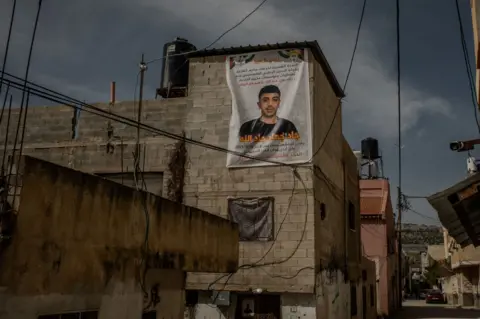
A large poster of Jad hangs from the ceiling of his family home in in al-Far'a refugee camp, in the occupied West Bank

Many of the exact circumstances of Jad’s death, including how many times he was shot and when and where he died, remain unclear, because the IDF has refused to return the body and to answer detailed questions about the incident.

It is not uncommon for Israel to refuse to return the bodies of people killed by the IDF – Israeli authorities are reportedly currently withholding the bodies of 776 Palestinians or other nationals accused or suspected of committing attacks.

When asked by the BBC, the IDF declined to say why it was withholding Jad’s body. Jad’s mother, Safa, said the force was either trying to hide something, or simply exercising a form of deliberate cruelty.

“Maybe it is only to provoke our nerves, to exhaust us, to kill our patience,” she said. “But we are patient, and we have hope, and we will keep waiting. Today, tomorrow, or after a hundred years, we will get him back. God willing, we will get him back.”

Alaa Badarna contributed to this report. Photographs by Joel Gunter.


Continue Reading
Click to comment

Leave a Reply

Your email address will not be published. Required fields are marked *

BBC News World

Iran will continue to defend itself against aggression, ambassador to UK says
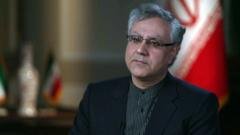
​ Iran will continue to defend itself against aggression, ambassador to UK says. 35 minutes ago. Laura KuenssbergPresenter, Sunday with Laura Kuenssberg. Iran will continue to defend itself if the “aggression from the American and Israeli side continues”, the Iranian ambassador to the UK has told the BBC.. While Iran’s president on Saturday apologised to its Gulf neighbours and promised to stop attacks, Seyed Ali Mousavi told Sunday with Laura Kuenssberg their policy remained to “defend themselves”.. After days of strikes across the Middle East caused enormous disruption and damage in many different countries, Mousavi said that “if facilities or properties or bases are used against the Iranian nation”, they would be considered “legitimate targets”.. In the last few hours, Gulf countries including Qatar and the UAE have been hit by Iran, while the US and Israel have continued their attacks as the war enters a second week.. Follow live updates. Military chief defends UK response to Middle East conflict. We’ve been speaking to Iranians during one week of war. Here’s what they said. Trump wants to pick Iran’s new leader – will a hostile regime under fire agree?. In an exclusive interview with the BBC to be broadcast on Sunday, Mousavi was asked if Iran would stop its attacks on military bases outside Israel in other parts of the Middle East.. He said there is “willingness from the Iranian side not to strike, not to attack our neighbours”.. But he maintained that Iran had the right to continue striking targets across the whole region where there were military bases.. Mousavi said Iran’s response “depends on the activities of the Americans and the Israeli regime”.. “If the aggression… continues there is no doubt we will defend ourselves,” he said. “And if they want to use these military bases – although we don’t want to do that – there is no doubt we will defend ourselves accordingly.”. It has been more than seven days since the US and Israel began strikes on Iran, which led Tehran to retaliate with its own attacks across the region.. Kuwait, the United Arab Emirates, Saudi Arabia, Bahrain, Oman and Iraq have all been hit, as has an RAF base in Cyprus.. It is rare for the leadership of a country like Iran to apologise, let alone in public.. And it is rare for a representative of Iran to agree to be interviewed.. But in the wake of President Masoud Pezeshkian’s apology, Iran’s ambassador to the UK agreed to our request to speak to him, and even more unusually, invited us to speak to him in Iran’s embassy in London, a building that tells the story of the fraught and troubled history between Iran and the West.. The building, on the edge of London’s Hyde Park, is where five Iranian gunmen were killed after a dramatic siege that was brought to an end by SAS commandos in 1980.. Nineteen hostages were set free, but one died and two were injured in the crossfire.. The gunmen belonged to a dissident Iranian group opposed to Ayatollah Khomeini, the religious lea  

Continue Reading

BBC News World

Heavy rains and flooding kills at least 23 in Nairobi
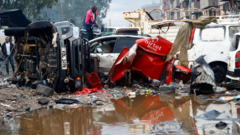
​ Heavy rains and flooding kills at least 23 in Nairobi. 38 minutes ago. Thomas Mackintosh. Reuters. At least 23 people have been killed in Nairobi after heavy rain overnight caised severe flooding in Kenya’s capital city.. Police said about 30 people had been rescued but many others drowned after being swept into rivers – some have been electrocuted.. Kenya’s military has been deployed to help people trapped inside their cars as police described widespread damage to properties as well as road closures.. Several flights bound for Nairobi Airport had to be cancelled or diverted to the coastal city of Mombasa.. “The torrential rains have led to significant flooding, unfortunately resulting in 23 fatalities so far, the destruction of property, road closures, and the displacement of residents,” police said in a statement on Saturday afternoon.. EPA/Shutterstock. Earlier, security guard John Lomayan, 34, described seeing someone he recognised in the industrial neighbourhood of Grogan who was trapped beneath a car that had been washed away when the Nairobi River burst its banks.. “I saw him being carried by the water from up there,” he told Reuters news agency, gesturing up the road.. “We didn’t know where he had gone. It is only now that we see him under the car.”. Key roads in the capital city, including Mombasa Road, Uhuru Highway, Kirinyaga Road, and parts of the Westlands district, have been submerged underwater.. Stalled vehicles and fast-moving floodwaters created havoc, Reuters said.. EPA. Kenyan authorities advised residents to avoid flooded streets and drainage channels while emergency responders assisted stranded motorists and pedestrians.. Earlier, the Kenya Meteorological Department warned of prolonged heavy rainfall, cautioning about urban flooding, poor visibility.. River levels are expected to rise through to 9 March.. Nairobi, along with regions such as the Central Highlands, Lake Victoria Basin, and the coastal areas, remains under heightened alert for peak rainfall in the coming days, it added.. Last year, hundreds of Kenyans were killed after heavy rains caused severe flooding and landslides across the country and neighbouring Tanzania.. Kenyans drop flowers for Valentine’s bouquets of cash. Not everyone is impressed. Strike deal reached after two days of chaos at Kenya’s main airport. Getty Images/BBC. Go to BBCAfrica.com for more news from the African continent.. Follow us on Twitter @BBCAfrica, on Facebook at BBC Africa or on Instagram at bbcafrica. BBC Africa podcasts. Focus on Africa. This Is Africa. Floods. Kenya. Nairobi. Africa. Severe weather  

Continue Reading

BBC News World

Russian strike on Kharkiv apartment block kills ten
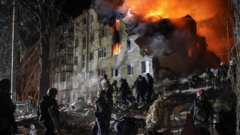
​ Russian strike on Kharkiv apartment block kills seven. 5 hours ago. Thomas Mackintosh. Reuters. At least seven people including children have been killed and several others injured after a Russian airstrike hit an apartment block in Kharkiv, Ukraine’s President Volodymyr Zelensky has said.. Regional governor Oleg Synegubov said the missile damaged a five-storey residential building on Saturday morning. He added that rescue workers are clearing up debris.. The latest overnight attacks triggered air alerts across Ukraine – including in Dnipropetrovsk and in Zaporizhzhia.. Russia’s defence ministry confirmed it used drones to carry out strikes on Ukrainian targets – adding its forces struck Ukrainian military compounds, airfields and energy facilities, the Interfax news agency said.. Separately, the Polish air force said it had scrambled military jets to protect its airspace in regions bordering Ukraine, as it usually does in the event of large scale Russian strikes.. Detailing the aftermath of the strikes, Synegubov said that in Kharkiv, a 65-year-old woman, a 40-year-old man, and a 13-year-old girl were among those killed.. The bodies of four more people were found, including a nine-year-old boy, he later said on Telegram.. Synegubov said seven apartment buildings were damaged as were power grids and an administrative building in the city.. Armed robots take to the battlefield in Ukraine war. Bowen: Why Ukraine remains defiant and does not feel close to defeat. Zelensky said at least ten more people – including children – have been injured.. “There may still be people under the rubble,” Zelensky said.. “All necessary services are working at the scene to rescue them.”. Reuters. Zelensky added that overnight Russia used 29 missiles and 480 drones which he said “targeted energy facilities” in Kyiv, Khmelnytskyi and Chernivtsi regions, and the railway in Zhytomyr region.. “There must be a response from partners to these brutal attacks on life,” Zelensky said.. Reuters. Elsewhere, Oleksandr Ganzha, head of the Dnipropetrovsk Regional Military Administration, said one person had been killed and another wounded in a Russian attack overnight in the Nikopol district.. Ganzha said on Telegram that the Russian army targeted the area around 20 times using drones, artillery, and rockets.. A separate strike wounded a baby in Zaporizhzhia, while in Chuguiv in the Kharkiv region, Mayor Halyna Minayeva said two people were injured in a drone attack on a house in the city’s centre.. Ukraine in maps: Tracking the war with Russia. Four years into its full-scale war in Ukraine, Russia is feeling the effects. Food prices are surging in Russia. Is the war hitting Russians in the pocket?. Europe. War in Ukraine. Volodymyr Zelensky. Russia. Ukraine  

Continue Reading

BBC News World

We’ve been speaking to Iranians during one week of war. Here’s what they said
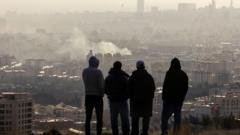
​ We’ve been speaking to Iranians during one week of war. Here’s what they said. 6 hours ago. Caroline HawleyWorld affairs correspondent. Getty Images. When Hamid heard news of the death of Iran’s Supreme Leader Ayatollah Ali Khamenei a week ago today, he felt a wave of euphoria and took his wife and daughter into the street outside his home in Tehran to celebrate.. For the next few days, as US and Israeli bombs slammed into buildings across the capital, the family went onto the roof of the house to watch the airstrikes coming in, cheering every time a regime target was hit.. “Try to find anywhere else on this earth where the population would be happy with an external attack on their country,” he told me, via a cousin in the UK.. “But we now have hope that the regime will soon be gone. We are happy.”. Hamid – not his real name – is not alone.. Alongside colleagues from BBC Persian, we have been hearing from people inside and outside Iran on a momentous week for them, for the future of their country and for the entire region.. BBC Persian is the Persian language service of BBC News, used by 24 million people around the world – the majority in Iran – despite being blocked and routinely jammed by Iranian authorities.. In a police state under bombardment, with severe internet restrictions in place, it is impossible to fully gauge the mood across a vast nation of 90 million people.. Residents of Tehran have received messages warning: “If your connection to the internet continues in the coming days, your line will be blocked and you will be referred to judicial authorities.”. AFP via Getty Images. Trump demands Iran’s ‘unconditional surrender’ as Israel says it hit leadership bunker ‘with 50 jets’. The regime still instils fear and no one who voices any opposition to it is willing to give their name for fear of the repercussions on them or their family.. But a week on, while some people are still celebrating every strike on the regime, others are increasingly frightened, questioning the motives and endgame of the war.. “The goal of this war isn’t to bring about freedom or democracy for the Iranian people,” Ali told us.. “It’s for the geopolitical benefit of Israel, the US and Arab countries in the region.”. Mohammad, who is in his 30s and lives in Tehran, said that he had wanted a deal between the US and Iran that would have avoided the war.. “Deep down, I always hoped an agreement would be made,” he said.. He had thought that he would be happy at Khamenei’s death, but in the end “felt nothing”.. He told my colleague Soroush Pakzad that he is now filled with uncertainty about the future – and, with regime checkpoints everywhere on the ground and bombardments from the sky, he is afraid.. Others Iranians speak of feeling a mix of fear, stress and hope.. One woman told me that I would have to live in Iran for 40 years to understand the complexity of what she and other Iranians are now feeling.. “We laugh and are happy when the regime is hit, but when childr  

Continue Reading

BBC News World

Swiss to vote on right-wing push to slash licence fee for public broadcaster
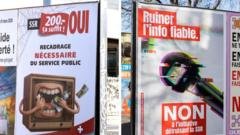
​ Swiss to vote on right-wing push to slash licence fee for public broadcaster. 13 hours ago. Imogen FoulkesIn Bern. Reuters. Swiss voters go to the polls this weekend to decide whether to reduce sharply the annual licence fee for their national broadcaster.. The fee for the Swiss Broadcasting Corporation has already been cut in recent years but currently costs 335 Swiss francs (£320; $435) per household a year. That is higher than in neighbouring Germany (£190) and Austria (£160).. If the proposal is passed, the Swiss fee would decrease to 200 francs (£190; $260), annually, and businesses would be exempt.. The move is backed by the right-wing Swiss People’s Party, which argues the current cost is unjustified when Swiss citizens are struggling with the cost of living crisis.. The party also questions SBC’s efficiency. “In the 21st Century, programmes can be produced much more cheaply than 30 or 40 years ago,” People’s Party member of parliament Manfred Bühler told Swiss media. “Two hundred francs really is enough.”. With younger people in particular turning to streaming companies, early opinion polls pointed to a close vote, with many Swiss asking whether their national broadcaster needs to do as much as it does.. But opponents of the move say much of the licence fee goes on ensuring all four Swiss languages – German, French, Italian and Romantsch – are represented.. All four have their own radio and television channels, and each broadcasts national and local news daily.. Fabian Molina, member of parliament for the Social Democrats, fears cuts to the licence fee would undermine Switzerland’s “national cohesion”, where all regions and linguistic communities are supposed to be treated equally.. Daniela Porcelli/Getty Images. He also worries about the impact on SBC’s coverage of foreign news. The broadcaster maintains correspondents in the US, Russia, China, the Middle East and Latin America, as well as in Brussels, Berlin, Paris, Rome and London.. “As a neutral country we have a unique perspective on the world, and only our correspondents can bring that back home to people,” Molina said.. The SBC has warned of hundreds of job losses if a cut to the licence fee is approved, and said the organisation’s coverage of news and sport would be reduced dramatically.. Unlike many other European countries, including the UK, where top league football has switched to private broadcasters requiring subscription fees, the SBC still broadcasts plenty of football, as well as all the winter sports at which the Swiss excel.. Until just a few weeks ago, it looked as if voters might be ready to back the cut.. Then came intervention from an unexpected source. Writing in the German version of Russian state-backed news outlet RT, someone calling himself Hans-Ueli Läppli called on the Swiss to back cutting the licence fee. The name is so cliched as to be almost certainly a pseudonym.. The writer accused SBC of “Russophobia… selective reporting, moralising on politica  

Continue Reading

Latest News

Politics57 minutes ago

Delhi heads to summers with hottest March day in 50 yrs, mercury up in north India

 The transition in Delhi from freezing winters to hot summers has been rather abrupt this year as the national capital...

Politics4 hours ago

Amid conflicts, NHRC chief pitches for ‘complete overhaul’ of Paris Principles

 New Delhi, In the backdrop of multiple ongoing conflicts in the world, NHRC chairperson Justice V Ramasubramanian on Saturday pitched...

Politics4 hours ago

Amid conflicts, NHRC chief pitches for ‘complete overhaul’ of Paris Principles

 New Delhi, In the backdrop of multiple ongoing conflicts in the world, NHRC chairperson Justice V Ramasubramanian on Saturday pitched...

Politics4 hours ago

Over 52,000 Indians returned home from crisis-hit Middle East since March 1, says MEA

 More than 52,000 Indians stranded in West Asia have returned on commercial flights during March 1-7 and more flights are...

Politics5 hours ago

‘Fake claim’: Centre denies reports of planning ‘new UT with Bihar, Bengal districts’, fact-checks X posts

 The central government on Saturday called out a ‘fake’ social media post claiming that a new Union Territory comprising districts...

Politics5 hours ago

‘Fake claim’: Centre denies reports of planning ‘new UT with Bihar, Bengal districts’, fact-checks X posts

 The central government on Saturday called out a ‘fake’ social media post claiming that a new Union Territory comprising districts...

Politics5 hours ago

‘Fake claim’: Centre denies reports of planning ‘new UT with Bihar, Bengal districts’, fact-checks X posts

 The central government on Saturday called out a ‘fake’ social media post claiming that a new Union Territory comprising districts...

Politics6 hours ago

Delhi woman’s Uttarakhand solo trip turns into a night of horror: How she hid in jungle, escaped rape bid by taxi driver

 A solo trip in Uttarakhand turned into a nightmare for a Delhi woman who had to spend an entire night...

Politics7 hours ago

ED to move Delhi HC against interim bail to Al-Falah chairman Siddiqui

 The Enforcement Directorate (ED) on Saturday decided to move the Delhi High Court hours after a Delhi court granted interim...

Food8 hours ago

41 Gluten-Free Desserts Everyone Will Love

​Gluten-free desserts should be just as thrilling, delicious, and fun to eat as any other. Many desserts—like ice cream, flan,...

Trending News

Join Our Newsletter

Stay updated with breaking news and exclusive content.