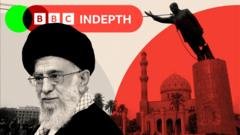
Mission accomplished? The 2003 boast that haunts today’s Iran conflict. 7 hours ago. Gordon CoreraSecurity Analyst. BBC. On 9 April 2003 a statue of the leader of Iraq, Saddam Hussein, was pulled down in the centre of Baghdad. The metal plaque at the base of the statue was torn off and the statue’s marble plinth attacked with a sledgehammer. Iraqi civilians initially tried to pull it down, scaling the statue to secure a noose around its neck, but were unable to dismantle it. It took help from American troops using an armoured vehicle to finally topple it.. It was a moment that symbolised regime change. US and allied forces had launched their attack on Iraq only 20 days earlier, opening with an intense bombing campaign and an attempted decapitation strike using cruise missiles that targeted the Iraqi leader.. Gamma – Rapho via Getty Images. Three weeks on from the statue coming down, America’s President, George W Bush, stood aboard a US aircraft carrier, anchored off the Californian coast, behind a banner saying “Mission Accomplished”. Except it was anything but.. The shadow of that Iraq war looms large over the current conflict with Iran. It was a war which left deep scars in Iraq as it set in train a series of events which spiralled out of control in a way no one predicted. It left a trail of death and destruction: it is estimated that 461,000 people died in Iraq from war-related causes between 2003 and 2011 and that the war cost the US $3 trillion (£2.24 trillion).. The war reshaped the Middle East and also had a profound effect on the public’s trust in politicians in the countries that launched the war.. Gamma – Rapho via Getty Images. Today, the US has embarked on what many see as another “war of choice” in the region, this time against Iraq’s neighbour, Iran. The echoes and parallels between the two conflicts are certainly there but there are also profound differences which tell us much about how the world has changed since and whether or not a repeat of the failures of Iraq can be avoided.. The motive. There were many overlapping motives for Washington to invade Iraq, some not acknowledged publicly at the time. But at the core was the desire for regime change. For some around US President George W Bush there was a feeling of unfinished business from the 1991 Gulf War when Saddam Hussein had been ejected from Kuwait but remained in power.. For President Bush it may also have been even more personal since his father, President George HW Bush, had led that campaign and Hussein had plotted to kill him after. Meanwhile, some believed regime change was justified on human rights grounds. They wanted Hussein’s overthrow because of the way he had inflicted terrible violence on his own people – even using chemical weapons against Kurdish civilians back in the 1980s.. Getty Images. This fitted in with the era of liberal interventionism that the UK had backed from the 1990s under Tony Blair, intervening in the Balkans to prevent bloodshed in Kosovo.