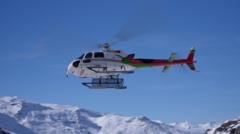
Rescuers blame weather and ‘underprepared skiers’ for rise in Alps avalanche deaths. Just now. James WaterhouseEurope correspondent, Val Thorens in the French Alps. BBC. From the vantage point of our helicopter above the Alps, you can make out scars and dimples from recent avalanches.. More than 100 people have died across the mountains this season so far, according to the European Avalanche Warning Services – a ballpark figure not seen for eight years.. As our pilot throws his rescue helicopter over one of the jagged ridges below us, we see ant-like skiers queueing at lifts or weaving down various pistes.. There is an enthralling beauty about the dense snow that sits atop the Tarentaise, an imposing network of valleys here in the heart of the French Alps.. “As with all around the world, the climate is changing,” says Frédéric Bonnevie, our guide and a mountain patroller for 32 years.. He points to shorter winters, and the best powder now being found at a higher altitude.. And although thick, this season’s snow covering has been unstable, contributing to a steep rise in the number of people killed by alpine avalanches.. Bonnevie explains they can control the conditions on the pistes, but not off them, and that’s where skiers have been getting into perilous difficulties.. BBC/Paul Pradier. “A lot of the victims are skiers who come here often, are technically skilled, but aren’t necessarily connoisseurs of the mountain environment,” suggests Stéphane Bornet, the director of Anena, a French snow safety association.. Several, he says, didn’t have safety kits, such as a transceiver to reveal their location or a shovel. Bornet claims they also didn’t carry out basic research on the routes they wanted to take.. The statistics are sobering; if you’re carrying a transceiver there is a 70% chance you’ll survive an avalanche, according to emergency crews. The first 16 minutes after being buried are seen as crucial.. If you don’t have one, the rescue operation can take longer, needing dozens of people and more equipment, and the survival rate drops to 20%.. “Most of the time when we’re coming, it can be too late,” says Pierre Boulonnais, who has patrolled the slopes of Val Thorens for 17 years. With his weathered face, he is a man of the mountain, and knows his snow.. “That’s why you need to have all the rescue equipment on you, and to be in a group, but sometimes you can just be in the wrong place at the wrong time,” he adds.. We talk as he digs a small hole off-piste. Our short journey there is exhausting, as you have to keep moving to not sink into the soft powder.. After patiently waiting for me to get my breath back, Boulonnais explains the difference between wet and dry snow.. He runs a metal ruler through 60cm (2ft) of the soft upper layer, before hitting the dense, compressed snow underneath. It’s invisible to the eye.. “If you are trapped under just 50cm of snow of this density, you already have more than a quarter of a tonne on top of you,” ex