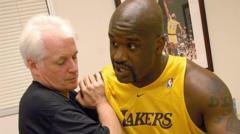
ByMark Woods. BBC Sport. Alex McKechnie chuckles at the leap of faith he took when he packed up almost all his belongings in Glasgow and booked a one-way flight to Vancouver, Canada on 7 September 1974.. “I had $300 in my pocket,” he recounts. “And no job.”. At that point it might have been hard for the newly qualified physiotherapist to imagine he would one day be telling basketball great Shaquille O’Neal – with his full entourage in tow – to wait his turn to see him.. Or that an idea he had when looking at a children’s playground would spark a novel way to improve recovery from knee injuries.. His pioneering methods would make him one of sport’s most sought-after physios and even earn him a small slice of British sporting history as the only Briton to win an NBA championship ring as either a player or member of the sideline staff.. He has now won six, and at the age of 74 the man credited with bringing players back from career-threatening injuries is still very much in demand.. Image source, Getty Images. Darting with a football in his youth around the mean Scottish streets of Easterhouse – at the time the centre of Glasgow’s notorious ganglands – McKechnie dreamed of playing for Rangers.. But a car crash that injured his father and brother provided his introduction to a different career path.. Watching them recover steadily fascinated a young McKechnie. It persuaded him to study physiotherapy at a technical college in Leeds before heading to North America in search of a job.. Within a week he secured a temporary role at a hospital, and within a month he was working at a university with athletes from many sports. It sparked a fascination with an area of sports science that was under-researched – anterior cruciate ligament (ACL) injuries.. When he first started practising there was no surgery that offered a certain cure.. “It was basically an ACL tear, and your career was basically over,” says McKechnie.. Working with athletes, he started to notice a link between cruciate injuries, core strength and pelvic control, and so devised a rehabilitation process based on this.. He got his patients to wear elastic bands – which simulated resistance – while doing a series of exercises that would strengthen their core.. This approach is now common, but back then it was innovative.. Image source, Getty Images. His next Eureka moment came while walking his dog through a park in which children were rocking on spring-mounted horses.. It sowed the seed for the idea of a wobble board which could heighten core strength through muscle movement, training the body to learn healthy patterns which promote overall stability.. The first prototype was “built with a large engineering spring” and Reebok subsequently licensed the idea in 1999, turning it into a mass-market product sold worldwide.. Word was already spreading about the physio who was piloting new approaches and saving careers.. In 1997, when LA Lakers star O’Neal, then the most dominant centre in the NBA, sus