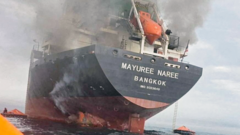
‘There’s no hiding place on a ship’: The sailors stranded near Iran. 5 hours ago. Mohammad Zubair Khan,BBC News Urdu,. Aye Thu San,BBC News Burmese,. Hyojung Kim,BBC News Korean,. Andrew Webband. Grace Tsoi,BBC World Service. Royal Thai Navy. Drones, cruise missiles and fighter jets have become a common sight for many sailors stranded on oil tankers and freight ships in the Gulf, after Iran threatened to open fire on any vessels trying to cross the Strait of Hormuz, in response to US-Israeli attacks.. In recent days there has been a growing number of reported attacks on ships in the Gulf region, as Iran responded to attacks by the US and Israel by threatening to open fire on any vessels trying to cross the Strait of Hormuz.. The Strait is a key artery for shipping, both for energy supplies and vessels carrying other goods. The sudden outbreak of war has left many ships – and their sailors stranded at sea as they watch strikes play out on land around them and overhead.. “I have seen Iranian drones and cruise missiles flying at low altitude,” says Amir, a Pakistani sailor aboard an oil tanker in the United Arab Emirates that cannot leave the area. “I also hear the sound of fighter jets, but we can’t identify which country they belong to.”. What scares him the most is the thought of an intercepted drone or missile falling on his vessel.. Hein, a sailor from Myanmar, sees skirmishes every day. “Just this morning, two fighter jets fired at each other while we were still working,” he says. “There’s no specific hiding place on the ship for this, and we just had to run inside.”. We have changed the names to Amir and Hein, along with those of the other sailors at sea and their families, to protect their safety.. Sailor provided to BBC News. While it is difficult to get an accurate figure for how many sailors are stranded on ships in the Middle East, Capt Anam Chowdhury, president of the Bangladesh Merchant Marine Officers’ Association, estimates that the number is around 20,000.. Some are at sea and some are stuck in port, but he says it is difficult to assess which is the more dangerous position.. “Inside the port, people might think it’s safe, but there have been ships which have been bombarded when they were anchored,” he explains.. Sailor provided to BBC News. His organisation has tracked at least seven ships it says have been hit by projectiles and damaged in the war so far.. He says on 1 March, a sailor was killed on board the Skylark, a tanker registered to the Republic of Palau.. Chowdhury says the surviving sailors have been “traumatised” by the attack, during which the engine room caught fire and the crew evacuated.. Other mariners agree. Capt M Mansoor Saeed sails oil tankers, and tells BBC News he believes that when it comes to avoiding attack, there is little difference between being at port or sea: “If they want to target my ship they will target it.”. But, he says, generally large ships can be safer away from the coast. “In heavy weather