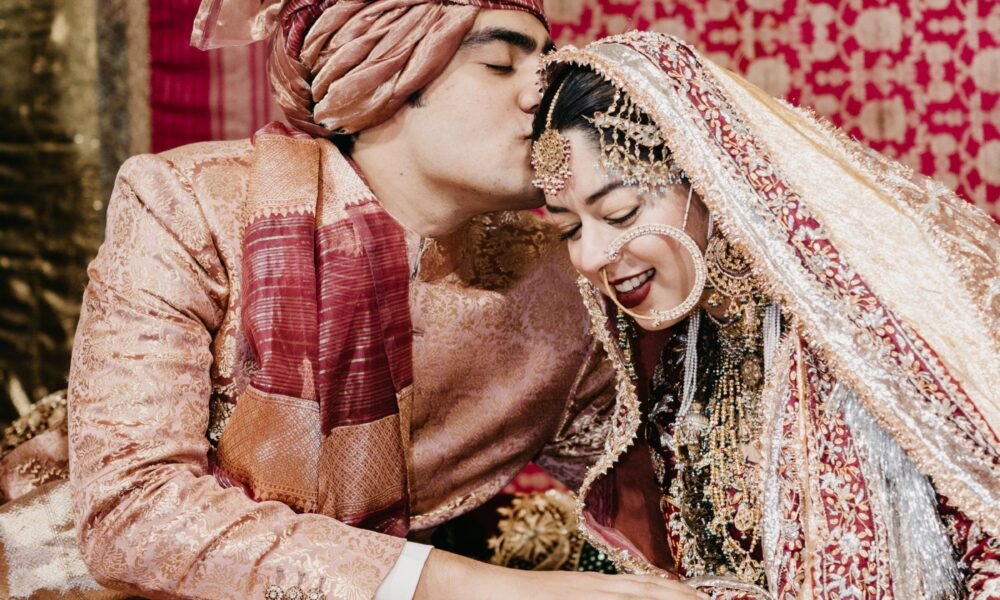
Even the invitation cards reflected that careful attention and involvement by the family. More than a thousand were sent out, each personalised with titles. Ashraf typed many of the names herself. “If it was a married couple, the invite said Janab so and so, and Begum so and so. If it was a single woman, for example, we wrote Bibi so and so,” says Ashraf.. The ceremonies began with the Mayo where guests arrived dressed in shades of bougainvillaea that filled the space, while Ashraf wore yellow. Later that evening a smaller qawwali gathering followed, attended by close friends and family with classical musicians who had travelled from Rampur to perform. The next day began with Afroze’s manjha ceremony, where married women from the family placed mehendi on a betel leaf resting in the groom’s palm to ward off nazar and give their blessings. Ashraf’s mehendi followed that evening; traditional mirasi singers from Lucknow performed wedding songs, along with a Sufi performance by Zila Khan and an after-party with a DJ.. Rather than relying on a single caterer, the families brought in khansamas from Rampur, Lucknow and Hyderabad to make their regional specialities. “We wanted people to remember the food,” says Ashraf. Guests moved between dishes, from Hyderabadi mutton soup and Rampuri taar korma to kebabs, nihari and more.. Guests also left the celebrations with small keepsakes assembled by the family. Handmade potlis filled with coriander mukhwas, pocket squares, bangles and laungeen necklaces.. The bride’s ensembles had been designed almost entirely by her mother through her label Sihali Jageer, drawing on heirloom jewellery, archival silhouettes and textiles revived through working with artisans in Lucknow and Varanasi. The wardrobe had been developed over months in conversation with stylist Devanshi Tuli, who had known the family for years through her work with Sihali Jageer.. “Styling a bride always begins with understanding who she is,” Tuli says. “You have to think about how she walks, how she sits, how she dances through the day.” For Ashraf’s wedding, the process meant working with beautiful heirloom jewellery, archival garments preserved by her mother and references drawn from vintage portraits. Tuli says, “Our aim was to honour that heritage while making the garments practical enough for her to celebrate freely.”. For Ayesha Ashraf, creating the garments meant revisiting traditions she had grown up with and translating them into pieces her daughter could inhabit comfortably. “These are silhouettes our Pathan brides used to wear,” she says. “I wanted them to feel alive again.” For the Mayo ceremony, Ashraf wore a peshwas constructed from cotton jaali and layered with mukaish, where flattened silver wire is hand-worked into tiny dots across the fabric. The garment required more than twenty metres of fabric, creating a sweeping ghera that moved easily as the bride walked through the ceremony. “All the jeweller