
Fashion
Female mountaineers like Lhakpa Sherpa deserve flowers. But more importantly, they deserve funding

As a child, I once heard someone on the radio talking about how, when they died, they wanted their ashes scattered over the Himalayas. I remember thinking, What must it be like up there, that a person wants to go even in death? I wanted to see it while I was still alive,” shares Jyoti Ratre, who was 55 when she broke the record of being the oldest Indian woman to summit Mount Everest in 2024.
Born in Bhopal, Ratre first saw the snow-capped peaks of Himachal Pradesh’s Dhauladhar range in 2017—an encounter she describes as “love at first sight”. Soon after, with minimal training, she completed the Pin Parvati Pass trek, also in Himachal Pradesh. “It was 5,300 metres. I thought if I worked on my fitness, then I could do Everest.”

Ratre’s first attempt was in 2023. A week before she set out, a stomach ache took her to the doctor, where she discovered a severe urinary tract condition that required immediate surgery. “You usually need full anaesthesia for it, but I opted for a localised shot so I could make a quick recovery,” she says. “In my heart, the desire for Everest was so strong that everything else felt small. In India, women think life ends at 50. I wanted to prove to them that that’s when it starts.” The next morning, she was in Kathmandu. Three days later, the climb began.
During the summit push, Ratre’s team was hit by an unexpected storm and forced to turn back to Camp 4, the final base where climbers rest before attempting to reach the summit. When they arrived, one of her companions was missing—he’d lost his way in the storm. “He was unconscious when the Sherpa found him late at night,” she recalls. “I had a choice then. I could either wait and attempt the summit the next day or save my companion’s life. I thought, if I raise the flag tomorrow and he dies, I won’t be able to forgive myself.” Ratre had been just 600 metres from the goal she had spent six years chasing but she knew no peak was worth a human life. She made the call to let her guide descend with her companion, staying back at Camp 4 for two days until he returned for her. “My dream did not come true, but I was happy with my decision,” she says. In May 2024, she finally stood atop the tallest mountain in the world. “I used to cry when I reached a summit. But with Everest, I think I blacked out. I didn’t feel anything. I didn’t feel happy or sad. I just can’t express it in words.”
Fashion
6 classics that belong in every capsule wardrobe

Curating the perfect capsule wardrobe looks a little different for everyone, but there are a handful of staples that will benefit nearly every closet. Having a reliable collection of basics makes getting dressed easier, whether you’re a staunch minimalist who sticks to simplicity or an experimental dresser building looks upon a foundation. True luxury can be found among the classics, whether it’s a perfect white T-shirt, a well-fitting button-up or a pair of jeans.
Versatility and a neutral colour palette will be essential to unlocking your own sense of style, and the following six key clothing items are the essential building blocks for any capsule wardrobe.
The capsule wardrobe essentials
White shirt
A crisp white button-down shirt is the ultimate wardrobe essential, equally at home under a blazer for meetings or on the weekend with leggings, white sneakers and oversized outerwear. Look for cotton poplin or linen styles that breathe and hold their shape.


Fashion
Why its absolutely appropriate for children to attend a funeral

Fashion
GLOBAL JEWELLERY-Handcrafted. Unusual. Unapologetically Indian.
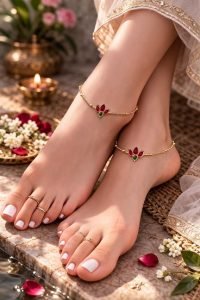
Jewellery has always been an important part of India’s culture, tradition, and identity. Indian jewellery is renowned for its intricate craftsmanship and deep cultural significance, reflecting the country’s rich heritage and diversity. Traditional ornaments not only serve as adornments but also symbolise auspiciousness, social status, and regional identity. Different regions of India have developed unique jewellery styles using materials such as gold, silver, pearls, precious stones, and beads. Among the myriad pieces, certain ornaments hold a special place in classical and contemporary Indian fashion. The Jhoomar, kamarbandh, jhumka, noserings and anklet are especially popular and meaningful. This article is about how, the nose ring, the jhumka & the anklets have become global . Fashion houses around the world are using these pieces to craft interesting styles and new trends.
Popular Indian Jewellery Pieces
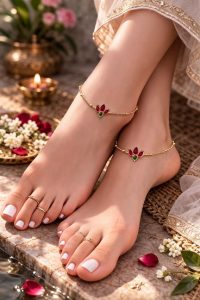
Anklets
Anklets, known as payal or pajeb, are worn around the ankles and often feature delicate chains, bells, or charms. Besides their musical tinkle, anklets hold cultural importance, denoting marital status in some communities and adding a graceful finish to the feet. Anklets are usually made of silver and may include small bells that produce a soft, pleasant sound while walking. They are commonly worn by brides and young women during weddings, festivals, and cultural events. The gunguroo, another form of payal, is a traditional percussive element in Indian classical dance. It has larger tinkling bells that aid the dancers with the beats.
The Parfois SS26 collection uses the gunguroos for rings, belts and on dresses. It is an innovative way to use the tinkling bells.
Nose Ring

The Nose Ring, also known as nath or nathni, is a traditional ornament worn on the nose.In fact, Jean Paul Gaultier 2017 collection included the sari inspired dresses with the nosering or nath.
It is one of the oldest and most culturally significant pieces of jewellery in India.In many parts of India, the nose ring is considered an important part of bridal jewellery. Brides often wear large and decorative nose rings during weddings, sometimes attached to the hair or ear with a delicate chain.
The practice of wearing a nose ring is believed to have become popular in India during the period of the Mughal Empire, when it was introduced from the Middle East and later became an integral part of Indian culture. Over time, different regions developed their own styles of nose rings, varying in size, design, and the side of the nose on which they are worn.Today, nose rings are worn not only for traditional reasons but also as a modern fashion accessory. They come in many forms such as small studs, hoops, and elaborate rings, and are popular among women of different cultures and age groups.
Jhumka
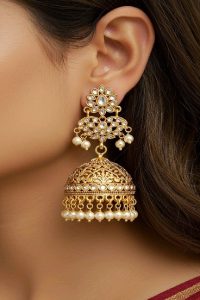
Jhumka
Indian Bridal Jewellery
In the Paris fashion week that was held recently ,Ralph Lauren’s Fall 2026 line featured the jhumkas. They were silver bell shaped earrings closely resembling the jhumka.
The Jhumka is a popular style of traditional Indian earrings known for its bell-shaped design. Jhumkas are worn across India and come in various sizes and designs. They are often crafted from gold or silver and decorated with pearls, beads, or colorful stones. Their swinging shape creates a graceful movement when worn, making them a favourite choice for weddings and festive occasions.
Kamarband
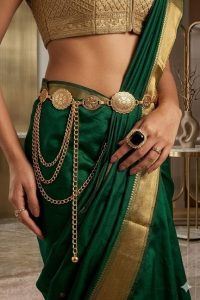
Kamarband
The Kamarband is a beautiful waist belt worn around the waist over a saree, lehenga, or other traditional attire. Historically, it was used by royal women and dancers to accentuate the waistline and keep garments in place. Kamarband are usually made of gold or silver and decorated with gemstones, beads, or intricate carvings. It is an essential Indian bridal Jewellery. It is an essential accessory in classical dance forms like Bharatanatyam and Odissi .
Jhoomar
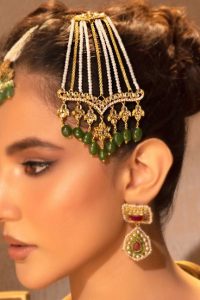
The Jhoomar, also known as a passa, is a decorative head ornament worn on the side of the head. It is usually attached to the hair near the temple and hangs gracefully over the forehead. The Jhoomar is commonly worn by brides, particularly in North India and in Mughal-inspired bridal styles. It is often made of gold and decorated with pearls, kundan stones, or diamonds, adding elegance and royal charm to the bridal look.
Together, these jewellery pieces epitomise the elegance and artistry of Indian ornamentation, continuing to enchant wearers and admirers alike across generations.
In conclusion, Indian jewellery reflects the country’s rich artistic heritage and cultural diversity. Ornaments like the Jhoomar, Kamarbandh, Jhumka, and Anklet are not only decorative but also carry historical and traditional significance. They are integral part of Indian bridal Jewellery .They continue to be cherished as symbols of beauty, elegance, and cultural pride in India. Delhi, Jaipur, Chennai & Kolkata are known for their exquisite jewellery craftsmanship.
Fashion
Bandhani, Batik & Shibori: Bound by Dye, Freed by Design

Bandhini was in the news recently. Ralph Lauren has faced global backlash in April 2026 for selling a (£420) “Bandhani-inspired” printed cotton wrap skirt without explicitly crediting India, the craft’s origin. Critics argue the design mimics Bandhani aesthetics but is machine-printed, stripping away artisanal authenticity and sidelining Indian artisans. The skirt uses printed fabric, not hand-tied Bandhani, which requires painstaking knotting and dyeing.
Bandhini, Batik & Shibori
Across continents and centuries, cloth has carried stories. In India, Bandhani knots find their ways into bridal silks; in Indonesia, Batik’s waxed lines trace royal philosophies; in Japan, Shibori’s indigo folds echo the rhythm of storms and nature. Three traditions, three cultures, one shared language of resistance and release—where dye is held back, beauty emerges, and heritage is written.All three—Bandhani, Batik, and Shibori are textile traditions that share the resist-dyeing principle but express it differently.
Common Thread
- Resist-Dye Principle: Each technique prevents dye from reaching certain parts of the fabric, creating patterns.

- Handcrafted Artistry: All rely onmanual skill and patience, with artisans carefully preparing fabric before dyeing.
- Symbolic Motifs: Designs often carrycultural meaning—whether auspicious dots in Bandhani, royal motifs in Batik, or nature-inspired forms in Shibori.
- Natural Dyes: Traditionally, they used plant-based dyes (indigo, turmeric, madder, etc.), linking the craft to local ecology
It is precision in dotted motifs
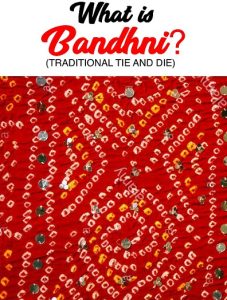
It dates back to the Indus Valley Civilization (~3000 BCE). They are tiny knots tied with thread before dyeing, creating dotted motifs.
They arestrongly identified to weddings and festivals in the States of Gujarat and Rajasthan.
Bandhaniis a type oftie-dyetextile decorated by plucking the cloth with the fingernails into many tiny bindings that form a figurative design.It involvespinching fabric with thumbnails, tying with thread and subsequently dyeing in stages.The motifs include Dots (bindi), waves (leheriya), checks (mothara).Fabrics are silk, cotton or georgette.Texture looks like crinkled surface from knots.
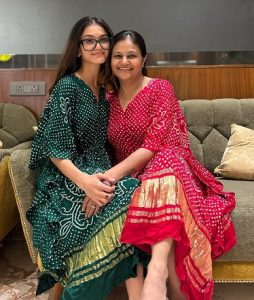
Today, most Bandhani making centers are situated inGujarat,Rajasthan, Sindh,Punjab regionand inTamil Naduwhere it is known asSungudi. It is known as chunri in Pakistan.
Shibori (Japan)
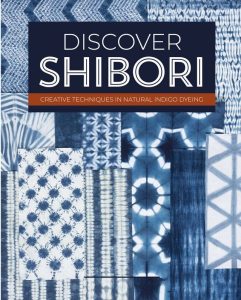
Tie-dye, in fact, has been around for centuries. Take Japan’s shibori technique for instance; it is derived from the Japanese word ‘shiboru’. Shibori which means to wring, squeeze or press. One of the oldest techniques of resist-dyeing; fabrics are bound, tied, sewn, compressed, twisted, knotted and folded to create sections that resist the dye and then form contrasting patterns. It came to Japan 1,300 years ago from China, and found another unique interpretation here.
Origin: Ancient Japan, earliest surviving examples from 756 CE at Tōdai-ji temple.Emerged during the Nara period (~8th century CE).Regions: Nara, Kyoto, later spread globally.

Indigo dye is used predominantly and it symbolized protection, harmony with nature.
Thetechniqueincludes folding, stitching, pleating, clamping, and binding the fabric before dyeing.
Styles:
-
-
- Kanoko (fawn spots, similar to Bandhani dots)
- Arashi (storm, diagonal rain-like lines)
- Kumo (spider web)
- Itajime (clamped geometric shapes).
-
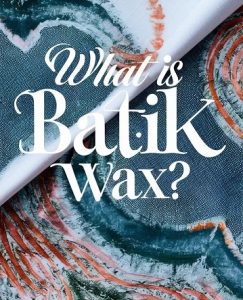
Batik is a wax-resist dyeing technique that originated in Indonesia, particularly on the island of Java, though similar methods appeared in ancient Egypt, China, and India. It became globally recognized in the 19th century when European scholars and traders documented Javanese batik. Batik is Indonesia’s most iconic textile art, blending ancient wax-resist dyeing with deep cultural symbolism. While wax-resist techniques existed globally,Javanese batik achieved unmatched refinement and cultural depth, making it both a national symbol and a global design influence.
It flourished in Java, Indonesia, with evidence from the 13th century; UNESCO- recognized heritage. Archaeological evidence shows batik patterns in 13th-century East Java temple carvings.They use wax-resist dyeing using a canting (pen tool) or copper stamps (tjaps).The word batik comes from Javanese amba (“to write”) and titik (“dot”), referring to the dotted wax patterns.

Motifs are primarily geometric, floral, symbolic designs; some reserved for royalty (parang,kawung). Everyday wear and ceremonial garments, deeply symbolic in Javanese culture use Batik prints.
Process:
Hot wax is applied to fabric using a canting (pen-like tool) or copper stamps (tjaps) .Multiple cycles of waxing and dyeing create intricate, multicoloured designs. Cotton and silk fabrics are most common. for Batik prints.
Cross-Cultural Influence
In modern fashion, Indian designers blend Shibori’s indigo aesthetics with Bandhani’s vibrant colours, creating fusion textiles.
Together, they show how different cultures evolvedresist-dyeinginto unique textile arts, each carrying deep cultural meaning while sharing a common creative foundation.Today, all three are celebrated worldwide, influencing contemporary fashion and design while remaining rooted in tradition
They share several important commonalities despite their different cultural origins. Each textile represents heritage, rituals, and philosophyin its culture.


Security guard 'sacrificed his life' in San Diego mosque shooting
The security guard killed in the shooting at the Islamic Center of San Diego was a father who cared about...


Mark Fuhrman, detective involved in O.J. Simpson murder trial, dies
Former Los Angeles police detective Mark Fuhrman, who was convicted of lying during testimony at the O.J. Simpson murder trial,...


Video captures stovepipe tornado in southeastern Nebraska
A visually striking stovepipe-shaped tornado was captured in Richardson County, Nebraska, as powerful storms broke out in the …


Why are US rappers getting involved in UK politics?
US rappers Nicki Minaj and Azealia Banks have both surprisingly come out in support for British politician and leader of...


Gaza amputees sail boat to Cannes Film Festival
The Gaza Sunbirds, a para-cycling team made up of amputees from Gaza, have sailed a boat to Cannes Film Festival,...


Russian drones attack CNN 14x at Ukraine's 'Road of Life'
On eastern Ukraine’s ‘road of life’, nets hang overhead for protection, robots ferry supplies and troops sprint for cover as...


ICE officer charged with assault in Minneapolis shooting
An ICE agent, Christian Castro, has been charged with four counts of second degree assault and one count of falsely...


Gov. Hochul says a deal has been reached to end the Long Island Rail Road strike. Kathy Hochul
After an incredibly hectic Monday for thousands of Long Island Rail Road passengers trying to enter and exit New York...


Two suspects found dead, three men killed in San Diego mosque shooting | BBC News
Five people have died, including three adult victims and two suspects, police say, after a deadly shooting at the Islamic...


$1.8 billion fund for Trump’s allies may put taxpayers on the hook
The Justice Department on Monday announced the creation of a $1.776 billion fund to compensate President Donald Trump’s …
-
 LifestyleNews1 day ago
Can a pre-diabetic stop taking Metformin by eating garlic instead?
-

 Food2 days ago
Juneteenth Foods: 23 Recipes for a Cookout Celebration
-
Tech1 day ago
Today's NYT Mini Crossword Answers for Monday, May 18
-
Entertainment20 hours ago
Picturehouse Entertainment acquires UK rights to A Town In Nova Scotia
-

 HealthNews2 days ago
Epidemic of Ebola Disease caused by Bundibugyo virus in the Democratic Republic of the Congo and Uganda determined a public health emergency of international concern
-

 Entertainment2 days ago
Adam Driver and Kenneth Lonergan Reunite For ‘Tomorrow Is a Drag’
-

 Sports23 hours ago
Ulster SFC final: Aidan Forker delighted it all came together in Ulster final
-
TravelNews5 days ago
Adani Airport, IHG sign Five-Hotel deal; Kimpton debuts in India