

BBC News World
Backrooms and Obsession: How two low-budget horror films caused a Hollywood earthquake
The last few weeks have been an extraordinary time for cinema – with a pair of indie horrors by Gen Z directors making massive profits, while traditional blockbusters have flopped.


The last few weeks have been an extraordinary time for cinema – with a pair of indie horrors by Gen Z directors making massive profits, while traditional blockbusters have flopped. It could be the start of a new era.
Which film would you expect to be a summer hit – a family-friendly action-adventure which is based on tried-and-tested IP (intellectual property)? Or a creepy low-budget horror film dreamt up by a first-time director? Until very recently, most of us would have put our money on the first option.
But this summer, it’s looking as if low-budget horror will be triumphant, with two indie films, Backrooms and Obsession, vanquishing two megabudget extravaganzas, Masters of the Universe and Star Wars: The Mandalorian and Grogu.
You can feel the foundations of Hollywood shaking. “This is a pivotal moment for the entertainment industry,” Kayla Cobb, Senior Reporter for The Wrap, tells the BBC. “The traditional film industry has focused on reheating the same tired IP, but audiences – particularly Gen-Z audiences – are craving more original movies.”
The difference between the appeal of tired IP and original movies is illustrated by this weekend’s US box office figures. Masters of the Universe, which derives from a 1980s Mattel toy range and cartoon about a loincloth-sporting, perma-tanned warrior prince, is a new release which made just $29m (£21.7m). The Mandalorian and Grogu, which came out in May, is faring poorly for a Star Wars film: this weekend it made $10m (£7.5m).
In contrast, we have Backrooms and Obsession. Both are dark, nasty little films that were shot on a shoestring. And yet both have been momentous hits. Backrooms, with Chiwetel Ejiofor and Renate Reinsve, is a nightmarish and deliberately puzzling peek into a labyrinth of murkily lit rooms and corridors. It doesn’t exactly scream big box-office. But the film, released by hipster indie studio A24, took $81m (£61m) in the US on its opening weekend. It’s total in the US is now $135m (£101m).
Obsession, released by Focus Features, is an even less likely summer hit. Featuring no famous actors at all, it’s the gory cautionary tale of a shy man who wishes that his beautiful friend will love him more than anyone in the world. Not only did it have a healthy opening weekend, but it’s also the first film since ET the Extra Terrestrial in 1982 to have its takings go up rather than down in its second and third weekends in cinemas. Its total take is now $152m (£114m) in the US and $225m (£169m) globally.
This weekend, both Backrooms and Obsession made around $25m at the US box office – not far behind Masters of the Universe and well ahead of The Mandalorian and Grogu, even though they were both released in May. Obsession is now predicted to end up with a total worldwide box office beyond that of both of the conventional sci-fi blockbusters.
Horror has been stunningly profitable recently: it can be made with a small budget, yet still attract viewers who treasure the immersive, communal experience of screaming in a crowd
But it’s not just the box-office tallies that will have prompted emergency meetings all over Hollywood. What’s even more striking is the difference between the money spent and the money made in each case. The budget of The Mandalorian and Grogu is reported to be $165m (£124m), and the budget of Masters of the Universe is reported to be $200m (£150m). Take into account the marketing costs, and those films have to make between $300m and $400m (or £225m and £300m) just to break even.
Along with Joker: Folie à Deux and The Flash, they are part of a disastrous trend for absurdly expensive Hollywood IP fodder. The budget for Backrooms, on the other hand: $10m (£7.5m). And Obsession? $1m (£750,000), tops. Suddenly, spending a fortune to make a fortune no longer seems like a winning formula.
How young people are driving profits
As with so many revolutions, youth is the driving force of this one. The director of Obsession, Curry Barker, is just 26, while Kane Parsons, the director of Backrooms, is turning 21 on 18 June. That means that he was a teenager while he was shooting his debut film. Bewildering, but true.
Both of these Gen Z directors learnt their craft by making YouTube shorts, a method that allowed them to spend years shooting and editing films, getting feedback, and building a following – all without having to apply for a film school, let alone work for a studio. Parsons made his Backrooms web series when he was just 16. The first episode has been viewed 81 million times. In film-making terms, he’s already a master of the universe.
There will now be greater emphasis on films that skew younger to cater to the cinema-going Gen Z crowd – Jeremy Kay
It’s not just the youth of the creators that is crucial, though – it’s the youth of the viewers. Star Wars has been around since 1977, while Masters of the Universe is an IP which was at its most valuable in the mid-1980s, so the films in both franchises are aimed at nostalgic middle-aged fans. That may have been their producers’ fatal mistake.
In April, a survey by Fandango noted that 87% of Gen Zers and 82% of millennials had seen at least one film in cinemas in the past year, compared to 70% of Gen Xers and 58% of baby boomers. Gen Zers and millennials also went to cinemas more regularly than their elders: around seven times a year, compared to 6.1 times for Gen X and 5.7 for baby boomers. There wasn’t a vast readymade audience for Stars Wars and Masters of the Universe, then, whereas a generation of enthusiastic cinemagoers was primed and ready for Backrooms and Obsession.
According to a recent article in The Guardian, films provide Gen Z with a welcome break from doomscrolling, and cinemas provide a place to hang out with friends. “What Gen Z are looking for is a ‘third space’,” said the article, “a social environment away from home and work. And for many, the cinema can fill that role.”
What makes these films click
That’s why it makes sense that both Backrooms and Obsession are horror films. As the success of Sinners and Weapons demonstrated last year, horror has been stunningly profitable in the post-pandemic era: it can be made with a small budget, and yet can still attract viewers who treasure the immersive, communal experience of screaming and gasping in a crowd. Another example is 2022’s chilling Talk To Me, which was made by Danny and Michael Philippou, two Australian YouTubers, while they were in their 20s.
• 10 of the best films to watch this June
• The woman who ‘beat Disney by a decade’
• Why Close Encounters has never been more relevant
What else do Gen-Z audiences want from the cinema? Judging by the discourse on social media, teenage and twentysomething viewers want a film they can discuss and dissect. Take, for example, The Drama, which is reported to have cost $28m (£21m) and raked in about $100m (£75m) more than that. It’s a comedy rather than a horror film, and it has two popular stars – Zendaya and Robert Pattinson – but, like Obsession, it stretches a romantic relationship issue to an uncomfortable extreme. It feels as if it’s actually about something.
Audiences can debate the relative morality of the characters, just as they can debate their own relationship issues online. In the case of Backrooms, they can debate what exactly is going on. Neither Masters of the Universe nor The Mandalorian and Grogu leaves quite as much scope for such post-film analysis.
That doesn’t mean that we’ve seen the last of the old-school blockbuster. The biggest box-office hits of 2026 are bound to include Spider-Man: Brand New Day and Toy Story 5, among other IP-driven sequels and remakes – and similar fare will continue to plop off the production line. “Hollywood is risk-averse and reactive,” Jeremy Kay, Screen International’s US editor, tells the BBC, “and while the studios will now be opportunistically scouring YouTube and the web for all types of IP and creators with large fanbases, by and large the legacy studios will stick to their tentpoles.”
But these studios can no longer assume that such films will get millions of people buying tickets and tie-in popcorn buckets. Nor can they ignore the possibility that some of their would-be blockbusters will be trounced by smaller films that have been made by young directors for young viewers. Kay predicts “greater emphasis on films that skew younger to cater to the cinema-going Gen Z crowd”, especially from “younger, nimble Hollywood studios like A24, Focus Features and Neon”.
Innovative, economically viable films that are their makers’ passion projects, but which cater for an eager audience? It’s a crazy idea, but it might just save cinema.
—
If you liked this story, sign up for The Essential List newsletter– a handpicked selection of features, videos and can’t-miss news, delivered to your inbox twice a week.
For more Culture stories from the BBC, follow us on Facebook and Instagram.
BBC News World
Art world pays tribute to ‘endlessly inventive and unique’ artist
Tate Britain’s director says the “loss to the art world is immense” following Hockney’s death aged 88.


Art world pays tribute to ‘endlessly inventive and unique’ David Hockney
The Tate galleries have led the tributes to David Hockney, one of Britain’s most important and influential artists of the modern era, following his death at the age of 88.
“We are greatly saddened by the news,” said Tate Britain director Alex Farquharson, calling Hockney an “immensely important figure”.
He is “widely regarded as one of the most successful and recognisable artists of our time”, Farquharson added.
Hockney, whose most famous artworks included A Bigger Splash and My Parents, died peacefully at home, one month short of his 89th birthday.
The artist’s career spanned seven decades, and he was known for using painting, printmaking, photography and latterly digital art to depict his native Yorkshire and his adopted home of California.
“David was an endlessly inventive artist, with a unique vision of the world,” Farquharson said.
“He was always completely and courageously himself, both in his work and in life. He taught us about the joy of looking, seeing things the rest of us failed to notice – his witty and sharp observations a constant presence within his work and in person.
“The loss to the art world is immense: David’s passing brings to a close an extraordinary body of work characterised by reinvention.”
“He touched so many, with his astonishing talent, his love for art and life, and his profound and unconventional insights. His work continues to influence our culture, far beyond the art world.”
The Pompidou Centre in Paris, with which Hockney collaborated for two landmark exhibitions, described him as “unquestionably one of the major figures of contemporary art”.
It added that the works he leaves behind remain “dazzling, alive and eternal”.
Art historian Richard Morris posted on X: “His huge achievement was to make serious painting look effortless.
“He carried forward one of the most sustained investigations into vision, space and representation by any post-war artist. British art has lost a giant.”
A statement from Hockney’s representatives said: “The celebrated British artist David Hockney, one of the most important figures in contemporary art in both the 20th and 21st centuries, passed away peacefully at home on 11 June 2026, one month short of his 89th birthday.”
It added that his “enduring legacy reflects his underlying enthusiasm for life, his outstanding sense of humour, his immense generosity, and his investigative curiosity encapsulated by his signature phrase: Love Life”.
The Tate said they would continue to work with Hockney’s team to stage two planned projects next year.
One is a major exhibition at Tate Britain, spanning seven decades of his work, and the other is a multimedia installation in Tate Modern’s Turbine Hall bringing his celebrated designs for opera sets to life.
The statement added that Tate Britain’s Hockney exhibition in 2017 was its most visited in the institution’s history.
Hockney was born in Bradford and learned his craft by pushing a pram containing art materials around the city as he painted on the streets.
After training in at Bradford School of Art, he went on to study at the Royal College of Art, graduating with a gold medal distinction.
After moving to Los Angeles in 1964, his distinctive painting style highlighted life with his swimming pool series of paintings.
His most famous works also included the portrait Mr and Mrs Clark and Percy, of fashion designer Ossie Clark and textile designer Celia Birtwell, in 1971.
He also went on to produce stage designs for theatrical spaces including opera, and in 2024 backed a nationwide drawing project for Bradford’s tenure as UK City of Culture 2025.
Last year he spoke to BBC culture editor Katie Razzall about his his biggest exhibition, at the Fondation Louis Vuitton, Paris. When it was being planned two years earlier, he wasn’t sure he would ever see it, he said.
“I just thought I probably wouldn’t be here,” he said at the time. “I’m still a smoker, a happy smoker fed up of bossy people telling you what to do.”
The exhibition featured a gallery dedicated to his love of spring, after the artist, who lives in Normandy during the pandemic in 2020, used his iPad to paint the trees and flowers blooming as spring arrived.
BBC News World
Why the economics makes this the craziest world cup ever
From trade wars to soaring ticket prices, the 2026 World Cup is unlike any before it. Faisal Islam explores what this tournament reveals about our changing global economy.
Add to that the quite astonishing coincidence of the US, Canada and Mexico, the three co-hosts of the 2026 World Cup, being in the midst of an epic trade war. Indeed, in the period in between the opening ceremony at the Estadio Azteca, and the final in New Jersey’s MetLife Stadium, the three will be renegotiating the USMCA, the North American free trade area.
Donald Trump is extremely focused on the tournament, its sponsors and the impact from his return to the White House last year. The US president has even joked that his loss to Joe Biden in the 2020 election had the great benefit of allowing him to return for this World Cup, and the Los Angeles Olympics in 2028.
After renewed hostilities between Tehran and Tel Aviv, Trump was rather direct in calling for an end to attacks. And as the minutes ticked down towards the tournament’s kick off on Thursday night, he appeared to call off new air strikes and seemingly promised that a deal to end the war was close at hand. Earlier in the day he had vowed to hit Iran “very hard”. As ever with Trump, much can change very quickly.
He has already controversially accepted a Peace Prize from FIFA, before initiating the war with Iran that has led to a significant global energy and economic shock. There is even a chance the US and Iran could play each other in the knockout stage on the weekend of the US’ 250th independence celebrations.
Gianni Infantino, president of FIFA, has previously called for ceasefires during World Cups. If the World Cup helps quicken the pace of moves to de-escalate, there could be a material impact on energy prices, supplies and the world economy.
Whether the World Cup can actually influence the world’s major economic conflict, who knows. But make no mistake – there is another part of the economic jigsaw that is happening right in front of the eyes of football fans worldwide. It’s a complete shakedown of football’s economics and also one of the most visible examples of how some of the world’s major economies increasingly operate.
Squeezed fans
“Football is nothing without the fans,” the legendary late former Scotland World Cup manager Jock Stein once said. Some fans however at the globe’s biggest party will have paid previously unheard-of amounts for what may turn out to be dead rubber games, while forking out roughly the normal ticket price just for the commuter train to get to the stadium. Witness the New Jersey Transit train ticket – normally $12.90 return, but $100 for the tournament.
The fans are being squeezed like never before because this is a very different tournament economic model to what has gone before. For a start, it is largely taking place in borrowed American football stadiums (a quarter of the games are in Canada and Mexico), with the US oval ball sport leaving its mark, perhaps indelibly.
This tournament turns the beautiful game into the bountiful game, for organisers FIFA. This could be the most impactful World Cup ever in economic terms, but not for the conventional reason of driving economic activity among the host nations or sparking feel-good spending among those back home in countries that enjoy a good run.
Instead, it is a case study of what is known as the K-shaped economy within the world’s traditional advanced economies – where different groups within society experience very different financial outcomes – which when plotted on a graph show one line going diagonally upwards (as on the letter K) and another diagonally downwards (again as on the letter K).
And it is based on a type of attempted economic revolution in the pricing mechanism that clearly does value a certain type of fan more – those on the diagonally upwards line of that graph. It’s important to say FIFA has a very different view of things and stresses those bountiful ticket revenues will be redistributed Robin Hood-style to develop football in the world’s poorest nations.
The biggest tournament
This tournament is very, very big. The biggest stadiums, the largest number of games by far because the tournament has been expanded from 32 to 48 teams, it will probably have the highest global TV audience of any event ever, and it occurs across the largest mass of land, from Vancouver to Mexico City, ever seen. It is feasible that the winning team will have had to travel a distance the equivalent to the diameter of the Earth.
Then there are the prices. In comparison to the cost of watching elite level football in any other setting, the prices being charged to attend are beyond astronomical. Five-figure dollar amounts for the final, $1000 being the rough typical price for a ticket for one of the more attractive looking group games at the start of the tournament, and even the “bargains” costing a few hundred dollars, for a non-prestige match.
This is a goldmine of economics.
And it is the largest scale trial of an attempt to change the pricing mechanism for events such as this. The use of dynamic pricing, adjusting prices higher and higher in respect of rising demand, has been seen in music concert tickets, and some sports events, but never on this scale.
They may call the game soccer in America, but this is definitely American Football economics. In the NFL, seat pricing is designed for yield management – revenue maximisation is prized above the act of selling out the stadium. US sport is priced at the luxury top end, and so much so that the stadiums are mostly shrinking in capacity, rebuilt for many billions with hospitality suites and lounges where once there was seating.
The supply of these experiences is limited by the length of the season – in the NFL you have just nine home games, roughly half the number of major European football leagues and so in the NFL every game counts even more.
Dynamic pricing has provided the method for teams to squeeze the revenue hard, especially as under NFL rules, the massive TV revenues have been split more equally than in football. With all 11 US World Cup venues being NFL stadiums, American football is leaving its mark on its rather different namesake.
This is all very different to previous tournaments. An essential part of the logic of hosting had been to help catalyse new infrastructure including transport and stadium builds and rebuilds.
2026 sold itself as an asset-light tournament that would avoid costly white elephants such as Miyagi in Japan, Cape Town’s Green Point in South Africa, and the $300m Manaus stadium in the middle of the Amazon. The costs had often been met by host-country taxpayers’ capital budgets. In turn, those countries had calculated the investments were worthwhile exercises as nation branding in a more global world. But all three stadia struggled to attract enough post-tournament regular use.
2026 has mainly reversed that logic, with a small exception for Mexico. FIFA has rented the stadia, mostly paid for by American Football fans, and then aggressively maximised revenues with US-style pricing. Whereas previous tournaments had large building costs paid for by taxpayers and borrowing, 2026 costs are instead being paid for by the attendees. And the revenues raised will soar, from the increased number of games, size of stadiums and of course these incredible ticket prices.
How much revenue will be raised from tickets and hospitality is unclear. It was initially forecast to more than treble, rising from $929m at the 2022 World Cup in Qatar to more than $3bn. Richard Sheehan, economics professor and sports finance expert at the University of Notre Dame, believes the total ticket and hospitality revenue for this years tournament could top $7bn, a seven fold increase. He assumes ticket revenue per match will not just double from the $15m at the last World Cup, but increase nearly five fold to $71m.
It could be a bonanza for the lucky host cities, the stadium owners, the teams and players, but probably not. Unlike USA ’94, the cities are not sharing in this soaring ticket revenue. The stadiums have been rented for a fixed sum. The prize money is set. The cities face having to fund the costs.
Alan Rothenberg, who led the USA 1994 World Cup organising committee, explained to the BBC World Service: “It’s structurally entirely different. So you really can’t compare it. In 1994, FIFA kept the international marketing and TV revenues and then turned the entire tournament over to the US Soccer Federation, which in turn created a separate entity to run it.
“So we had one entity in this country run by us. We were given some attractive sponsorship categories and licensing opportunities as well as ticket opportunities to sell.”
In 2026, some of the cities have responded by trying to recoup the security and transport costs of hosting the tournament. The price of transit trains from New York was increased tenfold, before being slightly cut to $98. The Boston train link costs $80. Parking a car? Official rates range up to $175, even $225.
It is a world away from the free transport offered to ticket holders at tournaments in Qatar in 2022, Germany in 2010, Japan in 2002 and France in 1998. In Japan, local volunteers lined routes from the bullet train stations to the stadiums with locals bowing to the fans, feeding them, and on a few occasions after last trains had departed, paying for their taxis home.
After a backlash, FIFA points to the release of some tickets, at lower price points, such as $60, to be distributed by national associations. The most remarkable new development has been the attempt to incorporate the secondary market, touting (or scalping as it is known in the US) within the FIFA ticketing system. Almost all fans can relist their tickets for sale with no upper limit at all, with FIFA taking a 15% cut from both seller and buyer. There have also been tickets allocated through a crypto-linked digital collectible system built on FIFA’s blockchain. FIFA says they are extracting the ticket tout or scalpers’ premium and claiming it for itself and the global football community.
The billions of dollars in extra cash are going initially into FIFA’s reserves, with that promise to distribute its funds to the global football family. FIFA points to such grassroots funding helping to allow Cape Verde to qualify for this year’s competition thanks to improved infrastructure and grassroots development of the game. It tends to distribute these development funds equally to the 211 member associations, meaning tiny Montserrat gets a windfall from FIFA worth 2.5% of its annual GDP, or $500 per person. The equal distribution model has existed since the 1990s, and was supercharged by FIFA President Gianni Infantino as part of his election pledge. It is driven by the one-country, one-vote system, which has also been used to select the World Cup hosts from this year on.
All that was before dynamic pricing took off. If Needham’s estimates are correct, FIFA’s average $3.9bn annual revenue now exceeds the World Health Organisation budget and is around the same as the UN’s core budget.
“What you’re seeing now for the World Cup is probably the first real introduction of dynamic pricing at its most dynamic, in its most complete form… basically FIFA is taking all the scalping possibilities and moving them all in-house.”
For now, the pricing means it is unclear exactly how much revenue will come in, but a very large pot of money is being created by the ticket prices. In theory, this money will be welcome by the vast majority of smaller nations who will never qualify for the World Cup or send fans to pay the ticket prices, but who form the electorate for FIFA presidential elections and host nation decisions. The Golden Goose is shimmering right now in terms of value.
But as the World Cup’s doors open, there is a risk from this extreme commercialisation.
Will the stadiums be full? Will there be armies of fans from the 48 nations creating the kind of atmosphere that would have satisfied Jock Stein? Will FIFA have to repeat what happened at its Club World Cup last year, and slash prices for tickets as low as $11 to fill seats? On this note, what isn’t clear is whether the FIFA dynamic pricing model is prioritising maximising revenue or ensuring all tickets are sold.
Last month, Infantino told an economic conference that “we have to apply market rates” and that football had to adapt to this “very special market”. It is obviously, however, a choice to allow unlimited resale prices, and choose repeated aggressive rounds of demand-led price increases.
A very different model
The European model taken by the likes of back-to-back European champions Paris Saint-Germain, is very cheap season tickets at either end of the ground behind the goals, with extraordinary corporate pricing for the seats nearer the halfway line. The idea is that the corporates will be attracted in part by the spectacle and noise of the ultras behind the goals in the cheap seats. The risk for the World Cup is that all that is lost.
There are some signs that the World Cup pricing model is facing a backlash. There have been falls in resale prices for low demand games – two tickets with a face value of $620 (£471) could be bought for £171 on FIFA’s own resale site – 64% cheaper.
Few of those $98 tickets were sold on that New Jersey train. Authorities in New York, New Jersey, California and in the EU began looking at complaints about ticketing strategies. “A gauntlet of confusion, fake scarcity and impossibly high prices,” according to NJ Attorney General Jennifer Davenport, chief prosecutor for the state hosting next month’s final. Whether the state has any jurisdiction over a Swiss-based “non profit” is unclear. FIFA have declined to comment.
The open question is whether FIFA has pushed this experiment in pricing to a breaking point. It seems unlikely that the fans in the host cities of the next World Cup in 2030 in Spain, Portugal and Morocco, will tolerate such prices. British and Irish authorities have already ruled it out when they host Euro 2028, when Europe’s top footballing nations compete against each other. It comes at a time when AI could enable the next big innovation in pricing services – personalised prices for different individuals, based on their data.
Some Premier League clubs are dabbling with pricing a selection of seats dynamically to boost revenues. It cuts across the traditional model of a loyal fan purchasing a fixed price season ticket. If this FIFA experiment appears to succeed, it could embolden the US NFL-linked owners of many European Clubs to attempt to price tickets similarly, especially to fund new stadiums.
The K-shaped economy
The US NFL model has been applied to an event that is owned by the world. The US “K-shaped” economy – with boom for the richest top 10% driving as much as half of all consumer spending, according to analysts Moody’s, but stagnation and retrenchment at other income levels, may be on display in the stadiums. Dynamic pricing is a technology which seeks out that 10% and prices what may have been once a mass experience for ordinary working people to a tech boom fuelled niche.
The wider hope for many host nations is that more traditional feel-good effects boost consumer confidence and investment the football. Research has shown some effects, especially for well-performing host nations, and negative impacts on stock markets when teams are knocked out. There were some signs in the latest US jobs figures of tens of thousands of new jobs being created especially in hospitality, linked to the World Cup. The overall boost to the economy will be limited, however, by the sheer size of the US economy and its AI investment boom. Jordan vs Algeria may struggle to distract San Francisco from its current role birthing multi trillion AI stock market flotations.
Rahm Emanuel, Mayor of Chicago, the major US city that withdrew as a host of the World Cup, appears to feel vindicated by the decision. FIFA took all the ticket revenue from the hosts, and there are grumbles about hotel bookings in some host cities actually being well down. Many of the host stadia would have been full with rock concerts were it not for the football.
On the face of it, the economic impact in the US of a tournament renting existing stadiums, for which the vast increase in ticket revenue is mainly being diverted to FIFA, may be limited. The potential for economic benefit focuses on a boost to consumer confidence. In the UK, decent runs for England and Scotland may be just the tonic after years of never-ending political and economic crises. Retailers and hospitality are certainly preparing for bumper sales.
Around Russia 2018, analysts Kantar calculated that there were an extra 13 million supermarket visits as people stocked up at home. But there is also the possibility that Britain’s productivity challenges will not be helped by the late-night kick-offs. Next Monday has already been announced as a Bank Holiday in Scotland to help the nation with the 2am start for the Tartan Army game against Haiti.
For many it will be a welcome escape from the relentlessness of the news, even if the curiosities of the Trump White House could, in fact, offer a wider economic opportunity.
It is a very different world economy, and this shapes the backdrop to this feast of football. FIFA is conducting a consequential and controversial pricing experiment that could change the game. Meanwhile a highly unusual World Cup might just take the edges of our new world disorder. It’s a hope rather than an expectation, but that is a feeling familiar to any English or Scottish football fan.
Top image credit: IMAGN IMAGES/Reuters Connect
BBC InDepth is the home on the website and app for the best analysis, with fresh perspectives that challenge assumptions and deep reporting on the biggest issues of the day. Emma Barnett and John Simpson bring their pick of the most thought-provoking deep reads and analysis, every Saturday. Sign up for the newsletter here
BBC News World
Ebola figures appear to offer hope as case numbers drop in DR Congo but it’s not that simple
There are now 380 confirmed cases of Ebola in DR Congo, far lower than initial estimates of suspected cases, writes Fergus Walsh.
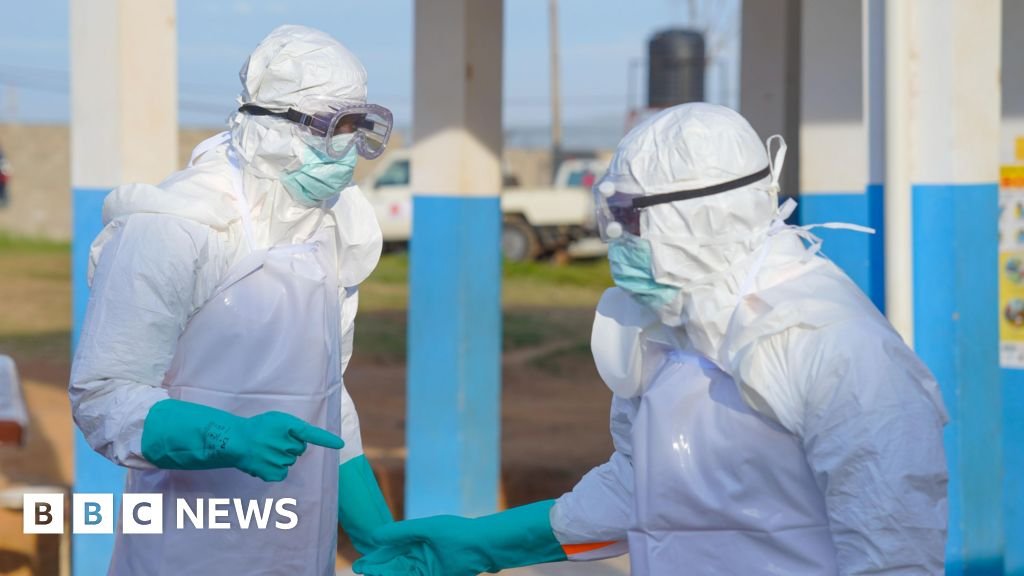
Fall in official Ebola numbers appears to be good news but it’s not that simple
The latest Ebola figures from the Democratic Republic of Congo appear to offer some hope after the number of cases was dramatically scaled back.
At one point the authorities were talking of more than 1,000 suspected cases and nearly 250 suspected deaths.
They are now reporting around 380 confirmed cases in DR Congo, including 60 deaths, plus another 15 confirmed cases and one death in neighbouring Uganda.
However, the key difference is that the authorities are now talking about confirmed, rather than suspected, cases as before.
So it would be a mistake to assume that the fall in numbers means the outbreak is suddenly less dangerous.
The decline reflects better data, as laboratories were able to rule out many patients who had fever but were suffering from other conditions such as malaria which is common in DR Congo.
The director general of the World Health Organization (WHO) Dr Tedros Adhanom Ghebreyesus has said the outbreak had a “big head start” but response teams are now “catching up”.
However, one of the biggest concerns remains contact tracing. Only about 45% of people in direct contact with an Ebola patient are currently being followed up, partly because the epicentre of the latest outbreak is in an area hit by conflict.
The WHO says at least 90% of contacts must be traced to bring an outbreak under control.
Another challenge is mistrust among some communities. An Ebola burial team was reportedly attacked this week in South Kivu province, forcing responders to abandon a coffin and raising fears of further transmission.
Traditional burial practices often involve washing and touching the body, and funerals typically draw large crowds – all high risk for Ebola, which is spread from one person to another by contact with infected bodily fluids.
Tedros said building trust with communities was critical to bringing the outbreak under control.
The Ebola outbreak is concentrated in three provinces of eastern DR Congo, an area roughly the size of the United Kingdom, much of it rural, remote and difficult to reach.
It is also unfolding in one of the most volatile regions in Africa, with many armed groups operating.
The latest outbreak is caused by the Bundibugyo species of Ebola, which has only occurred twice before. Because it is much rarer than other types of Ebola, there is no vaccine or proven treatment, although various teams are trying to develop them.
Speaking on the BBC’s Today programme, Tedros said that earlier this year he had urged foreign ministers planning to increase defence spending not to forget about the “invisible enemy”.
He said the Covid pandemic had resulted in around 20 million deaths – far more than any recent conflict.
However, he stressed that he did not expect Ebola to spread worldwide because the virus is not airborne, unlike coronavirus.
The WHO assesses the risk from Ebola as very high within DR Congo – this is the 17th outbreak in the country where it was first discovered 50 years ago – high in the region, but low globally.
Earlier this week British government officials said they had ruled out introducing temperature checks at UK airports for flights arriving from affected regions because of their limited effectiveness.
More than 12,000 passengers were screened at five UK airports during the 2014 outbreak in West Africa, but these failed to pick up the only case, that of nurse Pauline Cafferkey.
BBC Africa podcasts
BBC News World
Blueprint of a cure: The rare people who are invulnerable to HIV
Scientists are studying the few extraordinary individuals whose bodies seem able to naturally defend themselves from HIV in the hope of finding new cures.

Scientists are studying the few extraordinary individuals whose bodies seem able to naturally defend themselves from HIV in the hope of finding new cures.
For more than three decades, Loreen Willenberg, a 71-year-old landscape designer living in Sacramento, California, was known to HIV scientists as an intriguing anomaly.
Willenberg tested positive for HIV in 1992. Yet, instead of overwhelming her immune system and ultimately killing her, the virus remained suppressed in her body. She was able to live an ordinary life for many decades – despite never receiving any medication for the disease.
“My doctors have always told me that my immune response to HIV was very unique,” she told me in an interview in August 2025. “For many years, they didn’t know for sure, but they knew I was different.”
Willenberg, who passed away in April this year, was arguably the world’s most famous “elite controller”, a term given to a tiny proportion of HIV positive individuals whose bodies somehow keep the virus under wraps without interventions. Approximately 0.5% of all people infected with HIV make up this extraordinary group. And scientists believe they hold the key to helping millions of people around the world beat HIV.
Willenberg’s own survival with the virus was the more remarkable given that, in 2022, she was diagnosed with stage four cancer, which spread from her lungs to her brain. She responded well to treatment: the surgery and intense courses of medication shrank her tumour. By suppressing her immune system to fight the cancer, however, the medication should have allowed the HIV lurking in her body to resurface and spring to life.
But when researchers scoured Willenberg’s cells for the presence of HIV, they still found no detectable trace of the virus.
We analysed billions of cells, there’s really nothing – Xu Yu
That’s why, at the 2025 International Aids Society conference, Xu Yu, a professor of medicine at the Ragon Institute of Mass General Brigham, MIT and Harvard who has hunted extensively for signs of HIV in Willenberg’s body, stood before a room on scientists and made a dramatic statement. Willenberg, she declared, was probably completely rid of HIV.
This remarkable news was bittersweet. A few months later, Willenberg succumbed to the cancer she had been battling, passing away in April 2026. The legacy she has left behind, however, is profound – proof that one of the most devastating infectious diseases to emerge in the past century can be beaten.
“Some elite controllers like Loreen, they just don’t have any viable virus [in their bodies] anymore,” says Yu. “After we analysed billions of cells, there’s really nothing.” This is particularly significant, she says, as it implies that it is possible, in extremely rare circumstances, for the immune system to eventually eradicate HIV on its own.
There is similar optimism surrounding another extensively studied elite controller from Argentina, an anonymous woman in her thirties known as the Esperanza (Spanish for “Hope”) patient, who is also thought to be potentially cured of HIV too.
Buoyed by these remarkable stories, scientists like Yu have been delving deeper into the biology of elite controllers. They believe these people’s remarkable immune systems hold clues to developing next-generation treatments for the 40.8 million people living with HIV.
In the coming years, this may help point towards a cure.
Gene deserts
Typically, when a person is initially infected with HIV – known to science as the Human Immunodeficiency Virus – it begins to spread rapidly through their body. By replicating by splicing its genetic material into the DNA of cells, the virus moves from the bloodstream to the lymph nodes before beginning to shut down the immune system by targeting and destroying white blood cells, which are a key part of the immune system.
If the virus is untreated, patients can go on to develop Aids (Acquired Immune Deficiency Syndrome), where their immune system becomes unable to defend them from other infections.
In the mid 1990s, the development of effective anti-HIV drugs known as antiretrovirals represented a game-changing moment in the fight against Aids. These drugs block HIV from replicating, preventing the complete immune system collapse that ultimately leads to people’s deaths.
This allows millions of people to live relatively normal, healthy lives despite the infection.
In April 2026, a study even revealed that the widespread rollout of antiretrovirals in hotspots of the HIV epidemic, such as KwaZulu-Natal in South Africa, had altered the evolutionary trajectory of the human population. Because the drugs saved so many lives, they prevented changes to the human genome which would otherwise have taken place as a consequence of natural selection.
The intact viruses are there, but they’re parked in an area which doesn’t allow them to do anything anymore
But most of the time, these drugs never completely eliminate the virus. HIV still establishes reservoirs in various tissues, including the blood, lymph nodes, brain and intestines, which allow it to hide out in a dormant state for many years, often mutating to prevent immune cells from finding and killing it.
In elite controllers like Willenberg and the Esperanza patient, though, these rules don’t seem to apply.
Early research results suggest that elite controllers are able to suppress the virus without the assistance of any medication, because they carry unique genes that turbocharge their adaptive immune system – the body’s long-term memory of viruses and other pathogens. Specifically, in elite controllers, it appears that one arm of its defences, called CD8+ T cells, are especially equipped to inhibit the HIV virus.
But that still left the question of how these turbocharged CD8+ T cells can suppress HIV seemingly indefinitely. In 2020, Yu and others carried out a study of 64 elite controllers, which revealed that they appeared to have locked the virus away in vast segments of DNA known as gene deserts, where it can do little harm.
All of us carry gene deserts. They represent swathes of the genome which appear to contain nothing of relevance. It seems that elite controllers’ immune cells are able to push the virus into these regions of genetic code, far away from any active genes that actually have an impact on their bodies. Because of this, HIV is essentially trapped, unable to hijack the genetic machinery it needs to replicate and spread.
“The intact viruses are there, but they’re parked in an area which doesn’t allow them to do anything anymore,” says Yu. “This… really gave us a blueprint of what a functional cure might look like.”
What’s more, research has since shown that the same phenomenon can occur in another special group of HIV-infected individuals called “post-treatment controllers”.
One of the biggest challenges in curing HIV is the virus hiding in reservoirs deep in the body
Unlike elite controllers, these people did require antiretroviral drugs to initially suppress the virus. However, after taking the medications for two decades, they have been able to cease treatment without experiencing any resurgence of HIV.
It is thought that in these cases, the drugs may help to suppress HIV, enabling the immune system to force the virus into gene deserts.
Natural killer cells
The CD8+ T cells may only constitute part of the story, though. In the past few years, further investigations have pinpointed another population of immune cells which may also play a role in herding HIV into gene deserts.
A recent study found clues in a group of patients in France, known as the Visconti cohort, the world’s largest collective of post-treatment controllers. The 30 Visconti individuals were initially treated with antiretrovirals, but have been able to live with the virus without their medication, in some cases for more than 20 years.
The study showed that the Visconti patients carry gene variants influencing the behaviour of their natural killer cells, a type of immune cell which can detect and destroy virus-infected cells. Unlike CD8+ T cells, natural killer cells are part of the innate immune system, the body’s first line of defence against pathogens, which is present from birth.
Elite controllers seem to have especially active natural killer cells too, according to Christina Thobakgale, who heads the immunology division at the University of the Witwatersrand and the National Health Laboratory Service in South Africa. Thobakgale led a study which showed that elite controllers have more natural killer cells expressing a molecule called CD69, a so-called biomarker which indicates that these cells are alert and ready to respond.
• The new wave of effective cures for seasonal allergies
• Scientists are zeroing in on flu’s weak spots
• The new treatments offering hope to migraine patients
“One of the biggest challenges in curing HIV is the virus hiding in reservoirs deep in the body,” says Thobakgale. “Natural killer cells that are highly active and efficient might help flush out and destroy these hidden pockets of HIV.”
The role of women
Initially, it may be that such treatments are most beneficial for women living with HIV, says Yu.
Women comprise the majority of elite controllers, and new research has revealed that the female innate immune system is more likely to have natural killer cells better equipped for tackling HIV. Historically, though, the majority of trials aimed at eradicating the virus have been carried out in men. “We don’t study females enough in cure-related trials and studies,” says Yu. “But females have a two-to-five-fold higher probability of becoming elite controllers.”
Willenberg herself remained eager to see how the insights gleaned from studying elite controllers such as herself can be used to improve outcomes for those still living with the virus.
“I would love to live long enough to see the end of the epidemic,” Willenberg said just a few months before she passed away. “If my contributions have advanced the science, then that has been quite an honour. I will continue to try and be that beacon of hope for people for as long as I’m able.”
She may not have lived long enough to see the epidemic end, but the hope she provided continues.
—
For trusted insights on health and wellbeing, sign up to the Health Fix newsletter by senior health correspondent Melissa Hogenboom who also writes the Live Well For Longer and Six Steps to Calm courses.
For more science, technology, environment and health stories from the BBC, follow us on Facebook and Instagram.


Do not use my music, Ariana Grande tells White House. #ArianaGrande #WhiteHouse #BBCNews


The battle in rural America against AI data centres | BBC Americast
Will opposition to data centres remake the political landscape in America? These enormous buildings are being built to house the...


Why SpaceX IPO isn't about space. #SpaceX #ElonMusk #BBCNews


Download fans say what they love about the festival. #DownloadFestival #BBCNews


Washington National Opera sues to force Kennedy Center to turn over $17M in gifts
The opera filed a lawsuit Thursday alleging the Kennedy Center illegally took years’ worth of donor gifts, bequests and endowment...


The Keir Starmer Interview: The analysis | BBC Newscast
Today, Adam and Chris discuss Chris' interview with the Prime Minister, Sir Keir Starmer. The prime minister sat down for...


Trump (dis)approval ratings, Netanyahu (un)popularity & more | Enten roundup
CNN chief data analyst Harry Enten tackles a slew of President Trump's approval ratings, Israeli opinion on Netanyahu, and more.


US team should play like they're children in opening game, boss says


Amanda Peet: ‘There’s no algorithm for grief’
Both of actress Amanda Peet's parents were in hospice care when she learned she had breast cancer. Her father died...


Defence 'the number one priority' at spending review, says PM Starmer. #UK #KeirStarmer #BBCNews
-

 Politics2 days ago
Political News and Conservative Analysis About Congress, the President, and the Federal Government
-
 BBC News World21 hours ago
Why the economics makes this the craziest world cup ever
-

 Politics24 hours ago
What to know about the stabbing that set off fiery riots in Northern Ireland
-

 LifestyleNews1 week ago
120 minutes of strength training per week may help extend lifespan
-

 Entertainment11 hours ago
Taylor Swift Seems to Brush Off Jimmy Jam at Songwriters Hall of Fame
-

 Food22 hours ago
A Nebraska immigration raid shut businesses down a year ago. The fallout is ongoing, officials say.
-

 UsaLocalNews2 weeks ago
Amex Platinum Users Can Save $200 on New Slimmer Oura Ring
-

 Video2 days ago
Marcello Hernández says he got in trouble in school for talking too much