

Tech
SpaceX soars 23% in Wall Street debut and makes Elon Musk the first trillionaire
NEW YORK (AP) — SpaceX shares shot 23% higher as the rocket maker’s shares soared in their debut on Wall Street and made CEO Elon Musk the first-ever trillionaire.
The shares opened at $150 and kept rising, reaching $166.90 around 12:.20 p.m. ET. That price gave the company a market value of $2.18 trillion. Forbes is now estimating Musk’s net worth at $1.1 trillion.
Institutional and retail investors jumped at the opportunity to buy 555.6 million shares of SpaceX at the offering price of $135 apiece. The $75 billion in proceeds easily topped the previous record IPO from oil giant Saudi Aramco in 2019.
Musk says SpaceX is going public now because it needs money to fund its ambitions of putting satellites and data centers in space and eventually establishing a colony of people on Mars.
Musk earlier marked the opening of trading on Nasdaq, where the company’s are trading under the symbol “SPCX,” by joining a ceremonial bell ringing from Starbase, the South Texas home of SpaceX.
He reiterated his lofty goals “to make life multi-planetary.”
“Not just a few astronauts, I mean literally you,” Musk said. “Whoever you are watching this, SpaceX wants to be able to take you to the moon, take you to Mars and ultimately beyond.”
Known for his brilliant technology breakthroughs, as well as wild claims and missed deadlines, Musk is expected to break that trillion dollar mark in the biggest initial public offering ever as investors place bets on a company with losses as big as its ambitions. Ahead of the first trade in SpaceX, Forbes puts Musk’s net worth at $982.6 billion.
In addition to establishing a one-million person Martian colony, the company has promised to save humanity by establishing other outposts in space, launch data centers the size of football fields into orbit and outdo rivals Anthropic and OpenAI in the race to make money from artificial intelligence.
To reach its goals, SpaceX needs billions more than it currently takes in from its rocket and satellite business. Between the start of 2025 and March 31, 2026, the company lost $8.7 billion.
Wall Street bankers that helped take SpaceX public are enthusiastic about the company — and the big fees they will earn — but not everyone thinks the stock price is justified.
Analysts at research firm Morningstar, which doesn’t earn any investment banking fees, wrote that the IPO is “significantly overvalued” because of SpaceX’s unproven technology and massive capital needs.
They estimate the company is only worth $780 billion — less than half its IPO value.
Still, Musk has pulled off the seemingly impossible before.
The soon-to-be trillionaire — on paper at least — made his fortune by creating two companies, Zip2 and PayPal, that netted him about $200 million at sale. He used that money to start SpaceX and invest in Tesla, and defied the odds by creating a space company that figured out how to reuse rockets and a car company that made electric vehicles cool.
Musk has realized vast sums of wealth for himself, much of it in stock he has yet to cash in or grants for shares he’ll only receive if Tesla or SpaceX hit ambitious performance targets. His recent pay package from Tesla drew criticism from the Vatican. At Tesla, he’s worried shareholders by fighting with regulators or dividing his attention between multiple companies and last year by taking a role in the Trump administration.
But a rising stock price has cured all ills: Since it went public in 2010, Tesla has returned 20,000% for shareholders, or more than $1.2 trillion in investor wealth. That has helped lift Musk’s pre-SpaceX IPO worth to $795 billion, according to Forbes magazine.
SpaceX is the first of three “megacap” companies expected to go public this year, with Anthropic and OpenAI to follow. Nasdaq even revised its rules to allow SpaceX to gain entry into funds tied to its indexes in 15 days, which means investors will end up buying the rocket maker’s shares much earlier.
Not all investors are thrilled about SpaceX potentially showing up in their holdings of index funds. Officials from pension funds for firefighters, teachers and other workers in California and New York sent a letter to SpaceX last month decrying some of the provisions in its IPO, including the “super voting shares,” mandatory arbitration of shareholder claims instead of the possibility of lawsuits and how much power Musk will hold over the company.
__
AP reporters Stan Choe and Wyatte Grantham-Philips contributed from New York.
Tech
David Hockney: Celebrated British artist dies at 88


British painter David Hockney, whose vibrant portraits and sun-drenched depictions of the everyday made him one of contemporary art’s most beloved figures, has died at 88.
The artist died “peacefully at home” on Thursday, one month short of his 89th birthday, according to a statement provided to CNN by his longtime publicist Erica Bolton.
Born in Bradford, UK, in 1937, Hockney attended his local art school before studying at the prestigious Royal College of Art in London. Successful from the earliest stages of his career, he soon relocated to Los Angeles, where he would spend much of the 1960s and eventually settle.
While teaching at various US colleges, he established himself as a key figure in the Pop Art movement. Like many of his contemporaries, Hockney injected his work with bright colors and dancing lines. But while the likes of Andy Warhol (who was just nine years his senior) turned their focus to commercialism and consumer society, Hockney appeared more concerned with his immediate surroundings.
His deeply personal realist style was characterized by self-portraits, still lives and depictions of friends and lovers (and, later, his dachshunds Stanley and Boodgie, whom he immortalized in a series of paintings and an accompanying book). Having come out as gay in his early 20s — a time when homosexuality was still outlawed in England — he also explored sexuality through playfully explicit images and almost mundane snapshots of domestic life: men showering or quietly sitting together.
Among his best-known works from this period are a series of light-filled swimming pool paintings that seemed to freeze a moment in time. But his oeuvre was diverse, spanning photography, printmaking and stage design for ballet and opera productions. He went on to produce photocollages in the 1980s, and many of his later — and often more abstract — landscape paintings were also well received.
Hockney held onto much of his own work, and established an eponymous foundation to manage it. Those paintings that did go to market have soared in value in recent years.
In 2018, “Portrait of an Artist (Pool with Two Figures)” fetched $90.3 million to become (if only briefly) the most expensive work by a living artist ever to sell at auction. The next year, his double portrait “Henry Geldzahler and Christopher Scott” went for $49.5 million at Christie’s, while his 1980 landscape painting “Nichols Canyon” went on to fetch over $41 million.
Yet, Hockney never appeared especially interested in the commercial success of his work. Nor did he reap all the benefits — his record-breaking swimming pool painting was sold by his New York dealer for just $18,000 in 1972. And despite his achievements, he continued working throughout his later years. When CNN visited his California studio in 2017, a then-80-year-old Hockney said he still painted for six or seven hours every day.
“I’m perfectly happy doing this,” he said at the time. “I feel 30 when I’m in the studio, so I come in every day and work, because then I feel 30.”
By this time, Hockney, who was never afraid to experiment with technology, had begun creating art using an iPad. Spending much of the Covid-19 pandemic in Normandy, France, he produced a series of digital renderings of the surrounding countryside that were later printed and exhibited at London’s Royal Academy and the de Young Museum in San Francisco, among others.
With his mop of blond (then gray) hair, large glasses and, oftentimes, a cigarette in hand, Hockney was one of art’s most recognizable figures. During his lifetime he was the subject of several major retrospectives, including one in 2017 that traveled between Tate Britain, the Pompidou Centre in Paris and New York’s Metropolitan Museum of Art.
A statement from Tate Britain director Alex Farquharson praised Hockney for being an “endlessly inventive artist,” who “taught us about the joy of looking, seeing things the rest of us failed to notice — his witty and sharp observations a constant presence in his work and in person.”
He was also among the UK’s most decorated artists, having been invited to join the Royal Academy and, among other honors, awarded the John Moores Painting Prize and the Japan Art Association’s Praemium Imperiale prize for painting.
While he famously turned down a knighthood, he went on in 2012 to accept Queen Elizabeth II’s invitation to the Order of Merit, a group of celebrated public figures that is limited to no more than 24 members at any given time. (In true Hockney style, he turned up to one of the Order’s luncheons at Buckingham Palace in a pair of bright yellow Crocs — to the apparent delight of Elizabeth’s successor, King Charles III.)
In her statement announcing Hockney’s death, Bolton described him as “one of the most important figures in contemporary art in both the 20th and 21st centuries.” The publicist added that his “enduring legacy reflects his underlying enthusiasm for life, his outstanding sense of humor, his immense generosity and his investigative curiosity encapsulated by his signature phrase, ‘love life.’”
Tech
The Great AI Token Price Crash Is Coming
I had lunch with the CEO of an AI infrastructure company recently. I can’t tell you their name, but they said something that really caught my attention: There will be a crop of new AI models later this year that will be a lot better and more efficient.
This will likely make AI tokens more abundant and radically cheaper. (Tokens are the basic units models use to process information, and the standard way AI use is measured and priced).
Hand-wringing about tokenmaxxing could die down. Or, users could go on another bender and burn even more tokens with abandon.
Either way, the price of tokens is probably about to plummet. This is why we already see some AI model providers slashing prices, and other players talking about doing so.
OpenAI CEO Sam Altman recently said AI costs had become a huge issue, adding that the startup will have “a lot of ways we can help people get more value for less spend.”
This trend may already be showing up in the data. A closely watched token spending index run by Silicon Data peaked at around 2.06 in late May and fell to 1.75 as of June 10.
Carmen Li, the CEO of Silicon Data, told me this could mean token prices are dropping across many AI models.
Blackwell finally emerges
The main force driving token prices lower is a new wave of technology that’s sweeping through AI data centers.
Nvidia’s Blackwell GPUs are being installed in huge volumes right now. By the second half of this year, these systems, which are really supercomputers rather than chips, will be operating at scale, helping AI labs train new models and run them more efficiently.
These systems took a while to install properly, partly because they needed to be water-cooled and required other gnarly new data center setups. But the payoff could be huge.
50 x more, 35 x cheaper
SemiAnalysis, a respected AI research firm, compared Nvidia’s top Blackwell system, the GB 300 NVL72, to Nvidia’s previous system, called the Hopper HGX 200.
With the older system, each GPU generated 90 tokens per second, while the new Blackwell system generated 6,000. That’s 65 times more.
These systems consume massive amounts of electricity, and the newer Blackwell offerings use even more. So SemiAnalysis also looked at how many tokens each system generated per megawatt. On this measure, Hopper churned out 54,000 tokens per second, while Blackwell generated 2.8 million. 50 times more.
Electricity prices are rising, due to all these energy-sipping AI data centers. So these days, GPU systems are assessed based on how much it costs to generate one million tokens.
SemiAnalysis tested this, too, and found that the older Hopper system cost $4.20 for every million tokens. The Blackwell system cost 12 cents. That’s 35 times cheaper.
Again, new AI models will be increasingly trained and run on these new Blackwell systems as 2026 progresses. This is very likely to produce a massive increase in the number of cheaply-generated tokens.
This is why AI model providers will probably slash token prices: Because they can.
Tech
US stocks drift as oil falls and Wall Street waits for SpaceX’s debut
NEW YORK (AP) — U.S. stocks are drifting Friday after oil prices fell again and as Wall Street waits for the highly anticipated debut of SpaceX coming later in the day. It’s the first of three gargantuan companies in the artificial-intelligence industry expected to start selling their shares on the U.S. market, and it could show how hungry investors still are for AI stocks following vicious swings and big doubts for them over the last week.
The S&P 500 rose 0.1%. The Dow Jones Industrial Average was up 270 points, or 0.5%, as of 9:35 a.m. Eastern time, and the Nasdaq composite was 0.1% lower.
Stocks got a lift from a 2.2% drop for the price of Brent crude oil to $88.36 per barrel, deepening its loss for the week. Oil prices have come down since President Donald Trump on Thursday called off his threat to launch strikes on Iran and said a potential deal with Iran may be imminent.
A deal to end the war could reopen the Strait of Hormuz and allow oil tankers to once again deliver crude from the Persian Gulf to customers worldwide. Its near closure since the war began has sent the price of Brent up from roughly $70 per barrel and caused a wave of painful inflation for the world.
Of course, financial markets have rallied in the past on hopes that an end to the war with Iran was near, only to get disappointed each time.
The bigger factor for Wall Street over the last week has actually been AI stocks, and how they have gone from roaring to records to suddenly turning lower. The concern is whether such stocks shot too high, too fast because of AI mania, and their careening moves have sometimes reversed direction by the hour.
Several headed back down the roller coaster Friday following Thursday’s climb. Micron Technology fell 2%, and Broadcom slipped 0.8%.
Some of the pressure on AI stocks may be coming from investors pulling their money out in hopes of moving it to SpaceX and other big AI-related initial public offerings.
SpaceX’s stock is set to begin trading on the Nasdaq later in the day for the first time. Elon Musk’s rocket company also has big investments in AI, part of the reason it has built up $29.1 billion in debt, as of the end of March. It’s unknown exactly what time SpaceX’s stock will begin trading.
If SpaceX shares hold at their offering price, the company’s market value would be $1.77 trillion. That would put it close to Broadcom and Meta Platforms, the sixth and seventh most valuable companies on Wall Street.
In the bond market, Treasury yields rose to regain some of their sharp slides the day before, when oil prices dropped following Trump’s announcement. The yield on the 10-year Treasury climbed to 4.48% from 4.45% late Thursday.
High yields can slow entire economies and undercut prices for all kinds of investments, including stocks and cryptocurrencies. They hit investments seen as the most expensive in particular, and some critics are calling the AI industry a bubble where investment inflated too far.
In stock markets abroad, indexes rallied as they caught up to Thursday’s big gains on Wall Street.
South Korea’s Kospi jumped 4.6% and trimmed its losses from earlier this month taken because of sell-offs for AI-related stocks. The Kospi has nearly doubled since the start of the year.
Tokyo’s Nikkei 225 rose 2.8%, and France’s CAC 40 climbed 1.8% for two of the world’s bigger moves.
___
AP Business Writers Chan Ho-him and Matt Ott contributed to this report.
Tech
generation Foundation Models explained

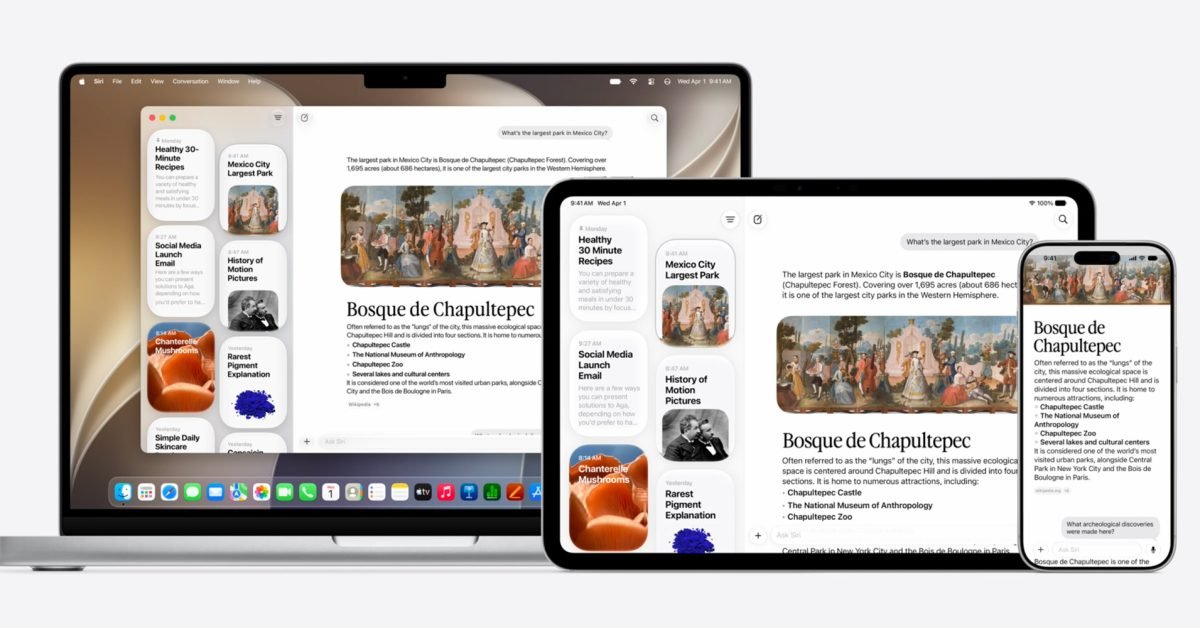
During the WWDC26 keynote, Apple announced its third generation of Apple Foundation Models (AFM), comprising five models, some of which are local, some of which are cloud-based, and one of which lives in Google’s servers running on Nvidia chips. Here’s a breakdown of how that will work.
A bit of background
When Apple first announced its foundation models in 2024, the lineup included an on-device language model with roughly 3 billion parameters, and “a larger server-based language model available with Private Cloud Compute and running on Apple silicon servers,” as the company put it at the time.
Private Cloud Compute was an ambitious undertaking, as it aimed to deliver cloud-based AI capabilities while preserving the same privacy guarantees users expect from on-device processing.
For this reason, keeping everything in-house was essential. Private Cloud Compute ran in Apple data centers, on servers powered by Apple silicon. Even so, its privacy guarantees could be independently verified by third-party security researchers.
However, as Apple struggled to get its AI aspirations off the ground, the company partnered with Google to use Gemini as the backbone of its new AI efforts, the results of which it announced earlier this week during the WWDC26 keynote.
Apple’s new foundation models
The third generation of AFMs includes five models: AFM 3 Core and AFM 3 Code Advanced, which are on-device models, and AFM Cloud, ADM 3 Cloud (Image), and AFM 3 Cloud Pro, which are server-based. The D in ADM 3 Cloud (Image) stands for diffusion, a technology we’ve covered in the past here.
Except for AFM 3 Cloud Pro, all other models were built to run on Apple silicon devices. AFM 3 Cloud Pro, meanwhile, runs on NVIDIA GPUs hosted in Google Cloud.
This was made possible afer Apple extended its Private Cloud Compute architecture to third-party infrastructure for the first time, “while maintaining Apple’s powerful security and privacy protections,” according to the company.
As for the models themselves, here’s a breakdown of each one, as explained by Apple:
AFM 3 Core, the next generation of our 3-billion-parameter dense model that delivers a step up in quality.
AFM 3 Core Advanced, our most powerful on-device model. It’s natively multimodal, enabling helpful features like expressive voices and higher-accuracy dictation. Built on cutting-edge Apple research, this 20-billion-parameter model uses a sparse architecture, activating just 1 to 4 billion parameters at a time depending on the request. AFM 3 Core Advanced is unlocked by and optimized for our most capable Apple silicon systems.
AFM 3 Cloud, our server-side workhorse, optimized for speed, efficiency, and performance.
ADM 3 Cloud (Image), for image generation and editing, which unlocks advanced photo-editing tools, the all-new Image Playground, and more.
AFM 3 Cloud Pro, our most capable server-based model, which powers our most demanding use cases, like agentic tool use and complex reasoning.
The highlights here are AFM 3 Core Advanced and AFM 3 Cloud Pro.
Beginning with AFM 3 Core Advanced, it packs 20 billion parameters into an on-device model, which is no small feat. Most on-device models aimed at the general public tend to stay in the low-single-digit billions of parameters.
To make AFM 3 Core Advanced run well, Apple used a sparse architecture that activates up to 4 billion parameters at a time, depending on the prompt, rather than a dense architecture that would need to keep all 20 billion parameters active for every request.
Although conceptually similar to the Mixture of Experts approach, this selective activation relies on a technique Apple invented and detailed in the interesting study Instruction-Following Pruning for Large Language Models released a year ago.
As for AFM 3 Cloud Pro, this is the one that runs on an external infrastructure. You can read some of the technical details of this expansion in this article published on Apple’s Security blog earlier this week, but here’s the most important part:
On this foundation, Apple and Google collaborated to build capabilities that go far beyond a traditional confidential computing deployment:
We do not rely solely on confidential computing technologies to mitigate attacks that leverage privileged access outside of a confidential VM, including side-channel attacks. We consider every component — from firmware through the host and guest OS stacks to application code — to be part of our trusted computing base, subject to our verifiable transparency and no-privileged-access guarantees.
To mitigate the risk of supply chain attacks, we maintain a cryptographically verifiable, append-only ledger of all Google Cloud hardware that is part of the PCC fleet. For components that could be abused to exfiltrate user data if compromised, our software attestation is rooted in at least two separate roots of trust from independent vendors.
Even when deployed with confidential computing, we believe the inference stack must be designed with privacy and security from the start. PCC on Google Cloud leverages many of the same architectural security patterns as PCC on Apple silicon to implement these layered protections: initial network data parsing for each request happens in a dedicated process within its own namespace, shared inference software is recycled with a short time-to-live duration, and attested keys are held in a separate, dedicated confidential VM isolated from external inputs.
In its Machine Learning Research blog, Apple says that all five models “shared a common initial foundation before specializing for their respective architectures and use cases, adding multimodal capabilities like audio, image understanding, long-context reasoning, and high-quality visual generation.”
The company adds that, to train these models, it used “a mixture of data that includes publicly available information, data licensed or purchased from third parties, open-sourced data, data obtained through dedicated studies, and synthetic data.” Apple also stresses that the training process did not include user data or interactions and that web publishers can opt out of foundation model training.
The results
Apple says it conducted extensive human evaluations of its third-generation foundation models, with in-house reviewers grading responses across categories such as instruction following, truthfulness, presentation, and image understanding.
Models were evaluated against their predecessors (when applicable), and you can see some of the results below:
Fraction of preferred responses in side-by-side human evaluations of general text capabilities, comparing AFM 3 Core and AFM 3 Cloud against our previous generation of models. Results are presented across four distinct locale groups to demonstrate consistent performance across international variants. “English” represents our global English evaluation set, while “PFIGSCJK”, “DNNSTV” and “AFIHHMPRTU” represent our remaining supported global locales.
Fraction of preferred responses in side-by-side human evaluations of image understanding capabilities in English. The results compare AFM 3 Core and AFM 3 Cloud against their 2025 predecessors.
Fraction of preferred responses in side-by-side human evaluations for dictation tasks. The results compare AFM 3 Core Advanced against Apple’s existing production dictation system across seven quality dimensions. AFM 3 Core Advanced demonstrates a positive win rate in overall quality, with preference extending consistently across all individual formatting and comprehension dimensions.
For an even deeper dive into the third-gen Apple Foundation Models, follow this link.
Worth checking out on Amazon
Tech
Apple’s Craig Federighi: Siri Won’t Be Your AI Girlfriend


Apple software engineering chief Craig Federighi and marketing chief Greg Joswiak sat down for an interview with Mostly Human after during WWDC, discussing the iOS 27 Siri changes, Apple’s take on AI, new child safety protections, and more.
Apple set out to deliver an AI utility, not an AI companion. When asked whether users could create an AI boyfriend or girlfriend with the new Siri, Federighi said absolutely not. Siri is meant to help, and Apple didn’t want to focus on engagement like other AI companies. From Federighi:
Quite the opposite, because as you may know, if you use many of the existing chatbots, they’re really focused on engagement to a large degree. And sycophancy, right? They kind of want to pull you in. They might encourage you to reveal things about yourself, and then use that as a basis to establish a connection.
We view it quite the opposite. I mean, the way that we have designed Siri, Siri really wants to say ‘Listen, that’s not what I’m here for, right? I’m here to help you. I can help you get things done. I can help you learn about the world.’ But if you try to engage Siri as a romantic partner, Siri’s not up for that. Siri’s 100 percent not into that.
Joswiak said Apple didn’t want to do AI for AI’s sake, and the company wanted AI to blend in with existing iPhone features.
We like when technology disappears, right? You just focus on what you want to do, or you focus on the content. And it’s the same thing with AI. […] We don’t do AI for AI’s sake. ‘Hey, look at us, we’re doing AI.’ It’s how does AI make everything better? And that makes our products better, our features better.
He went on to say that he doesn’t want iPhone users to have to be “prompt experts” to use AI. “We want to meet them where they’re at,” said Joswiak. “Have the products and features become better, and this is just a really helpful technology in making those features and products better.”
Federighi wanted to make it clear that Apple’s approach to AI is privacy forward.
I think it’s a challenging thing for a lot of people to understand the distinction between what your iPhone knows and what, say, Apple as a company knows. Your iPhone is yours, right? Your data is yours and it stays on your phone and your control and Siri is using it for you. Apple doesn’t get to know any of this stuff, and that is very different than I think most players in the space, and I think super important.




Download fans say what they love about the festival. #DownloadFestival #BBCNews


The Keir Starmer Interview: The analysis | BBC Newscast
Today, Adam and Chris discuss Chris' interview with the Prime Minister, Sir Keir Starmer. The prime minister sat down for...


Trump (dis)approval ratings, Netanyahu (un)popularity & more | Enten roundup
CNN chief data analyst Harry Enten tackles a slew of President Trump's approval ratings, Israeli opinion on Netanyahu, and more.


US team should play like they're children in opening game, boss says


Amanda Peet: ‘There’s no algorithm for grief’
Both of actress Amanda Peet's parents were in hospice care when she learned she had breast cancer. Her father died...


Defence 'the number one priority' at spending review, says PM Starmer. #UK #KeirStarmer #BBCNews


Police officer shot during ‘horseplay’
A police officer in Pasadena, California, was shot after engaging in "horseplay" involving his firearm, according to Pasadena …


Trump claims deal to end Iran war near, but Tehran says 'nothing' finalised | BBC News
Iran has insisted that a final decision on an agreement to end the current conflict with the US has not...


Blake Lively to Have Legal Fees Paid for by Justin Baldoni, Wayfarer
Blake Lively will have her legal fees paid by Justin Baldoni but isn’t entitled to damages for harm caused by...


Elon Musk becomes the world’s first trillionaire with SpaceX’s IPO
Elon Musk has become the first person to cross the trillionaire threshold, at least on paper, after SpaceX priced its...
-

 Politics2 days ago
Political News and Conservative Analysis About Congress, the President, and the Federal Government
-

 BBC News World4 days ago
Backrooms and Obsession: How two low-budget horror films caused a Hollywood earthquake
-
 BBC News World19 hours ago
Why the economics makes this the craziest world cup ever
-

 LifestyleNews1 week ago
120 minutes of strength training per week may help extend lifespan
-

 Politics23 hours ago
What to know about the stabbing that set off fiery riots in Northern Ireland
-

 Food21 hours ago
A Nebraska immigration raid shut businesses down a year ago. The fallout is ongoing, officials say.
-

 UsaLocalNews2 weeks ago
Amex Platinum Users Can Save $200 on New Slimmer Oura Ring
-

 BBC News World9 hours ago
Art world pays tribute to ‘endlessly inventive and unique’ artist