
Food
Ukrainians hit four more Crimea bridges, amid reports of empty shelves in food shops (Ukraine Battlefield update, Day 1,568)
Russian commanders are scrambling to move troops and fuel along ever-riskier routes, while the peninsula’s residents face dry taps, empty shelves, and soaring black‑market petrol prices.


Every day, the Ukraine Battlefield update newsletter offers a clear look at how the war is unfolding on the ground. Subscribe for free here to get the full text delivered to your inbox.
Ukrainians have hit four more bridges leading towards Crimea, this time from the north-west.
A Ukrainian journalist wrote that Russian logistics were essentially cut off.
Where exactly Ukrainians have already hit bridges and what options Russia has.
Ukrainians are quietly advancing near Lyman, but the maps have not yet recorded it.
In the first three months of this year, Russia recruited fewer than one thousand soldiers a day.
Chart of the day: last week Russia advanced by 15 square kms.
Videos of the day: petrol stations without fuel and some food items sold out in Crimea, and a video showing the death of a Russian hero.
Ukrainians are trying to turn the Crimean peninsula into an island. After damaging in recent days two bridges leading from Russian-occupied southern Ukraine to Crimea (near the towns of Chonhar and Henichesk) in the north-east, they hit another four bridges in the north-western part of the peninsula on Thursday night.
The Russian governor of the occupied Kherson region, Vladimir Saldo, reported this.
“During the night, the enemy attacked bridges over the North Crimean Canal near the villages of Preobrazhenka and Myrne, the road bridge between Perekop and Armiansk, and a bridge near the village of Stavky. According to preliminary reports, there was some damage. Experts are inspecting and assessing the condition of these structures,” Saldo wrote.
He added that Russian forces had shot down 45 Ukrainian drones – though clearly not all of them.
Crimea is connected by land to southern Ukraine only in the north-west, via the Perekop Isthmus, which is just 9 kms wide at its narrowest point. There are also several road bridges over the North Crimean Canal here, and putting them out of action would significantly complicate logistics to Crimea.
According to Google Maps, these could be smaller bridges over the North Crimean Canal, including the main bridge leading to the town of Armiansk.
How extensive was the damage, and are the roads cut off? The pro-Ukrainian account Crimean Wind has been monitoring information from Crimea. According to it, residents of Armiansk reported that only private cars were being allowed to cross the bridge into the town. “The bridge itself is being inspected to determine whether it is fit for operation,” the account wrote.
“Next to the road bridge there is a pedestrian bridge carrying two pipes with a diameter of one metre, which supplied water to the town. Because of the explosions, the pipes have been shattered into pieces. Residents of the town are in a panic because they will be left without water,” Crimean Wind added.
Ukrainian journalist Andriy Tsaplienko wrote that, according to Russian public channels, logistics via the land corridor to Crimea were cut. “Ukrainian forces critically damaged three bridges during the night. The passage of military equipment across them is practically impossible,” he wrote.
The Ukrainian account Oko Hora published a map with all the bridges leading to Crimea that Ukrainians have hit over the past week.
They have hit the Chonhar bridge in the north-east of Crimea twice; it was the main entry route to the peninsula. In reality there are two bridges here, but as the account DeepState UA wrote, the old bridge was not suitable for use.
After the second strike, a pontoon bridge again appeared in satellite images.
The Russians had built this pontoon bridge here already in 2023 after the first attacks on the Chonhar bridge. At that time, the Ukrainians used Storm Shadow missiles.
Now they are attacking with FP-2 drones, or with the new Behemoth drone. Even though the Russians shoot many of them down, they have not managed to fully protect the bridges. The drones cause only limited damage, but they allow the bridges to be shelled repeatedly.
A little further north, a road from the town of Henichesk leads onto the Arabat Spit, which can also be used to reach Crimea. And even though on Tuesday we wrote that this was mostly a dirt track for adventurers, as Google Maps also shows, the DeepState account wrote that the Russians had built a new road here and that “the occupiers are using it as an alternative route.”
However, the Ukrainians have now damaged the bridge leading onto the spit, as satellite images also show.
If, in the long term, Russia redirected its logistics routes via the Perekop Isthmus, this would extend transport by at least two hours. It would also bring freight lorries closer to Ukrainian positions, which would, according to the DeepState UA account, create a kind of trap for the Russians.
Of course, the connection via the Crimean bridge still exists. However, Ukrainians have already attacked it in the past, and a similar strike cannot be ruled out again.
Completely cutting Crimea off from southern Ukraine will, however, be difficult. As the account Vitaliy wrote, there are several dams across salt marshes that can be used as backup routes, even if they would be a very limited alternative. It is unclear whether heavy lorries could drive along them.
For the Ukrainians, however, a major success would also be to significantly complicate transport. “Crimea cannot be completely cut off, so the main focus is to make transport less convenient,” Vitaliy wrote.
It is very difficult to put these bridges completely out of action, since the Russians keep repairing them. “Unfortunately, it is not always possible to inflict significant damage that would allow these facilities to be disabled for a long time,” the Oko Hora account stated.
From a military point of view, this may affect operations above all in southern Ukraine, particularly in the Zaporizhzhia region. Russian accounts had previously speculated that Ukrainians were preparing a larger offensive, which, however, still seems rather unlikely for now.
“Extending such a blockade could lead to significant changes in combat operations in the south. We must not succumb to euphoria over the destruction of bridges, because they can be restored, which people in Moscow are already doing. However, the defence forces have demonstrated much more – capabilities that allow them to control everything moving through the southern part of the occupied territory, especially from Crimea,” DeepState UA wrote.
In the meantime, the situation with petrol supplies in Crimea has worsened further. The governor of occupied Sevastopol, Mikhail Razvozhayev, wrote that the QR codes which allowed residents to buy petrol worth up to €20 per week were no longer valid.
“Unfortunately, tanker trucks with fuel were unable to enter the city this evening,” he wrote. “I urge everyone: there is no point in standing in line tomorrow (Thursday – editor’s note) at TES petrol stations. As for the validity of QR codes, all codes issued so far will be deactivated today,” he said, according to Ukrainska pravda.
Apparently, petrol can still be obtained on the black market. The Crimean Wind account published a video showing petrol being sold at 180 roubles per litre, which is roughly €2.1. That is twice the price at which it is normally sold in Russia. According to the account, there were also reports that in some places it costs 250 roubles per litre, or about €3.
The Russians have also restricted and cancelled some bus services in Crimea.
While Russian forces are pushing ever deeper into the town of Kostyantynivka, Ukrainians are also carrying out smaller counterattacks. Less is said about them because the Ukrainian army and pro-Ukrainian analytical accounts are observing operational silence and are not reporting on them.
As French analyst Clément Molin wrote, these are two locations. First of all, Ukrainians have advanced north of the town of Lyman.
In recent days, Andrew Perpetua has recorded advances here. On this map there are two newly liberated “blue” areas between the villages of Lypove and Shandryholove.
Source: Andrew Perpetua
This corresponds with data from the same area published by the Russian account Rybar.
Source: Rybar
“In the Lyman direction, the situation on the northern flank is deteriorating, with the Ukrainian armed forces having occupied several forest belts along the Shandryholove–Lypove line,” the Russian channel Two Majors also wrote.
Expert Andrew Perpetua believes that Ukrainians are also advancing from the west of this salient. This is what the map would look like if he incorporated Russian claims about the Ukrainian advance.
And this is what it would look like if he mapped the most maximalist Russian claims he found.
“Everything suggests that Ukraine has advanced further than current maps show north of Lyman. The Russians claim that Ukraine has captured villages and other areas that were once firmly under their control but are now contested. I try to ensure my map contains only verified facts, so I am much more cautious,” Perpetua wrote.
“Confirmation will probably come soon from official Ukrainian sources (likely from DeepState), so I cannot tell you more for now, but the analysis of satellite imagery suggests that maps in this area are significantly outdated,” French expert Clément Molin also wrote.
The French analyst added that Ukrainians were also advancing further south towards the town of Velyka Novosilka. According to him, they have liberated the villages of Ivanivka and Novopalivka. According to DeepState, the first of these villages has been liberated, while in the second, half of the territory is a grey zone.
According to federal data, Russia recruited 71,216 new soldiers in the first quarter of this year. That works out at about 800 per day.
This is indicated by the amount the finance ministry spent on signing bonuses. German economist Janis Kluge, who has long focused on this topic, reported this.
It is significantly fewer soldiers than in the first quarter of 2025 (89,601), and also fewer than in the same period in 2024.
Data from regional administrations confirm this as well. Signing bonuses for Russian soldiers are paid out by both federal and regional authorities. More or less, this also matches the words of former Russian president Dmitry Medvedev about recruitment in the first quarter.
Average daily recruitment of soldiers according to federal data (dark blue), regional data (blue) and Medvedev’s statements (grey). Source – Janis Kluge
In April, recruitment already increased slightly, at least according to Medvedev and regional data, to around one thousand soldiers per day.
Ukrainians claim that they are currently killing and wounding more Russian soldiers than Russia can recruit. This cannot be definitively confirmed, but the recruitment data indicate problems with replenishing manpower for the Russian army in Ukraine.
Chart of the day
Last week, Russian forces made slight gains of 15 square kms, according to the Oko Hora account. Compared with previous months, this is very little, but at least they are not in the red as they were the week before, when Ukrainians liberated more territory than they lost.
These figures are based on the DeepState UA map. However, this account has recently been updating its maps much less frequently than before.
Russian advance by week
Videos of the day
Footage from Crimea provided by Radio Svoboda shows empty shelves in some supermarkets, limits on the purchase of certain foodstuffs, and petrol stations without fuel. “Putin wanted the return of the Soviet Union, they are almost there,” one user commented jokingly.

Food
Iran says missiles off table in US talks, demands $300 billion in war damages


Iran has not yet given final approval to a draft memorandum of understanding with the United States, Iranian state-affiliated Mehr News Agency reported Friday, adding that Tehran’s ballistic missile program will not be part of any negotiations.
According to the report, discussions with Washington will focus exclusively on Iran’s nuclear program and economic issues, particularly sanctions relief.
Mehr published what it said were the 14 points contained in the draft agreement, although the details have not been confirmed by U.S. officials.
Under the reported framework, the war would end immediately and permanently on all fronts, including Lebanon. The United States would commit to respecting Iran’s sovereignty and refraining from interference in its internal affairs.
The draft also reportedly calls for the lifting of the maritime blockade within 30 days, the withdrawal of U.S. forces from areas near Iran, and the reopening of the Strait of Hormuz under arrangements coordinated with Tehran.
According to the report, sanctions on Iranian oil, petrochemical products and related exports would be suspended, granting Iran access to its financial resources. The United States and its allies would also commit to presenting plans for rebuilding Iran’s economy worth at least $300 billion.
The memorandum would establish a 60-day period of ceasefire and negotiations aimed at reaching a final agreement. During that period, Washington would pledge not to increase its military presence in the region or impose additional sanctions.
Mehr reported that Iran would reaffirm its commitment under the Nuclear Non-Proliferation Treaty not to pursue nuclear weapons. The final agreement, if reached, would focus exclusively on uranium enrichment and enriched material, the removal of sanctions and Iran’s economic recovery.
According to the report, discussion of Iran’s ballistic missile program and support for allied militant groups across the Middle East has been permanently removed from the agenda.
The draft reportedly includes the release of $24 billion in frozen Iranian assets during the 60-day negotiating period, with half of that amount to be made available before talks begin. It also calls for the establishment of a mechanism to monitor implementation and for any final agreement to receive approval from the UN Security Council.
Iranian media said the framework includes reopening the Strait of Hormuz, removing sanctions on Iranian oil exports and unfreezing Iranian assets.
Since the beginning of the conflict, Israeli officials have insisted that any agreement with Tehran must address not only Iran’s nuclear activities but also its ballistic missile program and its network of regional proxy groups.
For that reason, Israeli officials have opposed the emerging framework and continue to hope the talks collapse or that Mojtaba Khamenei, the son of Supreme Leader Ayatollah Ali Khamenei, does not approve the deal.
The precise details of the framework remain unclear. Iranian reports claimed Washington backed away from some of its earlier demands, although it remains uncertain whether President Donald Trump maintained his original conditions.
The proposed memorandum would establish a 60-day window for negotiating a comprehensive nuclear agreement, with the possibility of a further 60-day extension. Analysts note that reaching such a deal within that time frame appears unlikely, given that negotiations leading to the 2015 nuclear agreement lasted roughly 18 months.
One of the main sticking points remains how much financial relief Iran will receive. According to information circulating in Israel, a compromise has been reached under which Iran would not receive direct cash transfers but would instead be allowed to purchase food and medicine using funds held by Qatar.
U.S. officials are reportedly insisting that frozen assets will not be released until issues surrounding Iran’s stockpiles of enriched uranium are addressed, though that issue itself is expected to be part of future negotiations.
Food
iOS 27: All the New Health and Fitness Features
Apple was rumored to be working on an AI health service, but it was scrapped well before the iOS 27 beta came out. It could resurface in the future, but for now, there are a handful of health and fitness changes in the update. Design Apple redesigned the Browse section of the Health app, and it now uses a card-style interface instead of a list. It is more colorful and easier to see the different categories.


Apple was rumored to be working on an AI health service, but it was scrapped well before the iOS 27 beta came out. It could resurface in the future, but for now, there are a handful of health and fitness changes in the update.
Design
Apple redesigned the Browse section of the Health app, and it now uses a card-style interface instead of a list. It is more colorful and easier to see the different categories.
The app also has a single bottom navigation bar that incorporates a search/browse button, instead of a separate search button.
Visual Intelligence
Visual Intelligence has a new nutrition feature that can tell you the nutritional value of what you’re eating. You can open the Camera app to the new Siri mode and take a photo of a food item to get feedback.
It does not give exact calorie counts, but it lets you know if a food is heavily processed, if it has protein, if it’s high in sugar, and more. It gives food a nutritional value ranking between very low and very high. Data does not sync to the Health app, but it’s still useful.
Visual Intelligence requires an iPhone 15 Pro or later.
Cycle Tracking
Cycle Tracking is expanding with perimenopause/menopause support. The Health app now sends notifications when logged cycle patterns are suggestive of perimenopause.
The feature uses long-term cycle data to flag the perimenopause hormonal transition that can begin a decade or more before menopause. Cycle deviation alerts are based on the user’s logged cycle history and are for users age 40 and above.
Users can keep track of symptoms and access educational resources that offer guidance and support.
Apple also added new Fitness+ workouts for perimenopause and menopause.
Data syncs to the Health app quicker than before thanks to performance improvements Apple implemented.
Child Safety
There are several new Child Safety features that give parents more control over the content their children are seeing. Apple is including guidance based on expert health research to help parents make decisions about managing child accounts.
Route and Distance Accuracy
Route maps that populate the Fitness app after workouts are more accurate in iOS 27. During treadmill workouts, distance is also reflected more accurately than before.
Step Count
Step counts will sync between the Health and Fitness apps.
GymKit
GymKit has expanded to the iPhone, which can pair with treadmills, indoor bikes, and other exercise equipment for data syncing. GymKit was previously an Apple Watch feature, but now iPhone users won’t need a watch to use it.
GymKit can sync calories, distance, speed, incline, and pace.
iOS 27 is available to developers, with a public beta planned for July. It will launch to the public this fall.
Food
A Nebraska immigration raid shut businesses down a year ago. The fallout is ongoing, officials say.
Local businesses have taken a hit as families and workers grapple with the effects of the raid last June on the Glenn Valley Foods meatpacking plant, community members said.


It’s been a year since federal immigration authorities detained 76 employees at a meatpacking plant in Nebraska’s second-largest worksite immigration raid.
But the effects are still being felt.
South Omaha’s business district has not fully recovered from the negative economic effects of the raid on the Glenn Valley Foods meatpacking company, city officials and community leaders said at a news conference Tuesday.
Following the raid last June, federal authorities had touted the operation as uncovering “massive identity theft,” accusing the immigrant workers of using stolen Social Security numbers to obtain employment.
Yet, a year later, only one woman has been charged with the crimes federal immigration authorities said drew them to the meatpacking plant in the first place. The person pleaded guilty and was sentenced to a year in prison.
“If they’re meant to make our community safer, they’re not doing that,” Roger Garcia, chairman of the Douglas County Board of Commissioners, said at the news conference about the raid and other subsequent immigration actions in Omaha.
Meanwhile, the people who were detained, their families and the broader community are still dealing with the enforcement action’s ripple effects, leaders noted, as they try to mitigate the effect on local businesses. The community leaders encouraged participation in a “Day of Joy” event Wednesday to support the businesses in the predominantly Latino 24th Street corridor.
Two community surveys of the South Omaha business district show that business health and customer traffic remain low.
Forty local business owners surveyed by the Nebraska Hispanic Chamber of Commerce said uncertainty, misinformation about immigration enforcement actions and ingrained fears have affected consumer behavior so dramatically that it’s hurting businesses’ ability to bounce back.
The businesses surveyed include seven restaurants and food trucks, 18 retail establishments, three construction companies and a variety of other storefronts. Three business owners said they’re planning to transition to online operations to stay afloat.
Challenges in workforce retainment have caused six businesses to shut down, said Irma Villezcas, a grocery store owner and chair of the South Omaha Business Association.
The results echo some of the findings from recent nationwide workforce studies on the economic impact of last year’s immigration raids.
A Brookings Institution study found that last year’s immigration enforcement surge across the nation cost 668,000 jobs, and those losses affected both immigrant and U.S.-born workers. Another study from the University of Colorado Boulder found immigration enforcement didn’t expand opportunities for U.S.-born workers and instead reduced employment for some of them.
‘Unlike anything we had ever seen’
Of the 76 people immigration authorities arrested at Glenn Valley Foods, close to 10 self-deported, Garcia told NBC News on Tuesday. Others who were also detained were eventually granted bond and reunited with their families, though many of them are still facing immigration proceedings.
“They have this constant pressure of being tied up in that system that might ultimately lead to deportation eventually,” said Garcia, who is the first Latino commissioner of Douglas County, where Omaha is located.
Garcia’s family was also among those directly affected by the raids. His wife’s aunt was among the meatpacking workers taken into immigration custody.
The woman, a mother of three U.S.-born children, spent a couple of months in detention before she was released on bond. Garcia said his wife’s aunt was granted a temporary work permit — alongside others who had been detained — while they wait for their next immigration court hearing.
Luis Mejía, 20, said he went to work last June at Glenn Valley Foods “thinking it would be a normal day.” The Nebraska native who was raised in South Omaha said everything changed that morning when immigration officers entered their workplace.
As some ran away in fear, Mejía’s immigrant mother hugged him and told him to take care of his younger siblings. Then, she ran with the others.
Meanwhile, immigration officers asked Mejía to show proof of U.S. citizenship.
“I didn’t know how to do that since I’ve never been asked that before. I looked at the officer with confusion and told him I was born here,” Mejía recalled. The officers cleared him to go after looking him up in their system.
A couple of hours after authorities let him go, Mejía received a call from his mother, telling him she had been detained. After that, Mejía didn’t hear from her for a few days while she was in detention.
She was one of the at least 63 workers who were taken to the Lincoln County Detention Center, four hours away.
The situation forced Mejía and his older brother to provide for their two younger siblings while not knowing if they would get to see their mother again.
“What made this raid especially significant was what happened afterward. Many individuals were held for more than 60 hours before being processed. During those 60 hours, families did not know where their loved ones were being held and we legal service providers did not have access to them,” said Roxana Cortes-Mills, legal director at the Center for Immigrant and Refugee Advancement, an immigrant rights organization in Omaha. “It was unlike anything we had ever seen in Nebraska.”
Lina T. Stover, executive director of the Heartland Workers Center, agrees.
“One day a person may have authorization to work and remain with their family, the next day policy changes, processing delays or court decisions can place their future in jeopardy,” she said at the news conference.
Her organization supports workers in the meatpacking, construction, restaurant and cleaning industries. The group, alongside the Center for Immigrant and Refugee Advancement, was crucial in helping the families directly affected by last year’s raid.
Two other people were sentenced in connection with the events surrounding the raid at Glenn Valley Foods. One man who worked at the plant was sentenced to 14 months in prison after being convicted of wielding a box cutter while attempting to resist an immigration arrest. Another worker who protested the raid was sentenced to 22 months in prison for using a rock to assault and impede a federal officer.
“At the end of the day, only like two or three people were prosecuted with any kind of charge,” Garcia said. “It’s just really quite silly that this huge effort led to like two or three prosecutions.”
Even though Omaha police do not cooperate with ICE to enforce immigration, state police do. Garcia said he gets weekly calls informing him of individuals who have been detained by immigration officials.
“Immigration enforcement did not end a year ago,” Cortes-Mills said.
After the one worker from the Glenn Valley Foods raid was charged with identity fraud last year, Elhrick Cerdan, the assistant special agent in charge of Homeland Security Investigations who led the operation, told NBC News “that number could change.”
The Department of Homeland Security and the U.S. Attorney’s Office-District of Nebraska did not immediately respond to a request for comment regarding the investigation and the workplace raid last year.
U.S. Attorney Lesley Woods said last year that a five-year statute of limitations had expired for much of the Glenn Valley workforce that otherwise would have been similarly charged.
Food
El Niño is officially here, and this one could be a doozy

Prepare for intense heat, drought and some flooding — it’s officially El Niño season, the National Weather Service announced Thursday.
This El Niño event could be on par with some of the strongest documented in the past, according to models from the NWS.
“There is a 63% chance that we’re looking at a very strong El Niño during the November to January time period that could rank amongst the largest El Niño events in the historical record,” Ariel Cohen, a meteorologist for the NWS in Los Angeles, said at a news conference held by the Aquarium of the Pacific in Long Beach, California. “We’re already seeing those warm temperatures lining up.”
El Niño is a natural climate pattern that causes warm surface temperatures in the tropical Pacific Ocean. It’s associated with higher average global temperatures, so its effects exacerbate warming from climate change. The pattern is linked to fewer hurricanes in the Atlantic and more in the Pacific.
In the U.S., El Niño’s influence is most obvious in the winter, as it shifts the typical flow of the jet stream, the ribbon of air that encircles the Northern Hemisphere and drives weather patterns. The pattern typically pushes the jet stream south.
In the Pacific Northwest, that creates dry, warmer-than-usual conditions in winter, which is a concern this year because much of the region is already mired in drought after receiving middling snow. In Southern states, the trend typically brings unusually wet weather in the winter, which could prime the region for flooding.
El Niño can also drive powerful marine heat waves and scramble sea life, causing mass die-offs and bringing unusual tropical fish to coastal waters.
Andrew Leising, a research oceanographer with the National Oceanic and Atmospheric Administration’s Southwest Fisheries Science Center, said two marine heat waves are already affecting the Pacific — one near the coast of California and another farther offshore.
El Niño isn’t causing either of those, but Leising said NOAA’s models suggest that the pattern will drive temperatures in the Pacific up even more drastically this fall, leaving parts of the ocean roasting in back-to-back heat waves.
“One of the most important things for the animals in the ecosystem is not necessarily just how hot it is … but just how long they’re exposed to the heat,” Leising said. “We have a situation in Southern California where we’ve already had this heat wave, and we’re just rolling into a heat wave that’s been brought about by El Niño.”
He added that in the past, extended marine heat waves have caused decreases in plankton at the base of the food web, as well as harmful algal blooms, which can release neurotoxins that harm sea animals. Whale entanglements become more common, too, because the animals tend to move closer to shore, which increases the likelihood that they intersect with boats and fishing gear.
Some animals do benefit from marine heat waves, Leising said: Jellyfish populations boom, and more rockfish tend to convert from larvae into juveniles.
For many species, though, this is bad news.
In 2015, an extreme marine heat wave nicknamed “The Blob” that pushed ocean temperatures about 7 degrees Fahrenheit above normal wreaked havoc on sea life. Seals, sea lions, baleen whales and seabirds all experienced die-offs, likely because of a lack of food and an increase in toxins from algal blooms, Leising said.
The Blob closed West Coast Dungeness crab, sea urchin and salmon fisheries worth millions of dollars. It led to such a proliferation of pyrosomes — creatures that look like cucumbers made of jelly — that they clogged fishing nets.
Leising said the back-to-back heat waves in 2015 were more severe than what’s in the forecast for this year, however.
One other potential sign of El Niño to watch for: Weird fish showing up on the West Coast.
“This may bring unusual visitors,” said Nate Jarros, vice president for animal care at the Aquarium of the Pacific. Past El Niño events, he explained, brought rare visitors to coastal California, including yellowfin tuna, mahi-mahi, yellow-bellied sea snakes, seahorses and whale sharks.
Shark sightings have spiked in Southern California during past marine heat waves, as well.
“Warm waters are attractive to some species of sharks, including makos, blues and white sharks, and this warming trend can expand the range of many species further north,” Jarros said. “During past marine heat waves, coastal species like blues and makos occupied dense populations along the West Coast.”
Food
First global map of mycorrhizal fungi reveals true scale of underground networks across the planet
Mycorrhizal fungi form underground networks that sustain plant life and help regulate Earth’s climate by drawing carbon into soils. In a study published in Science, an international team of researchers produced the first global maps estimating the distribution and mass of the Earth’s arbuscular mycorrhizal fungal networks.

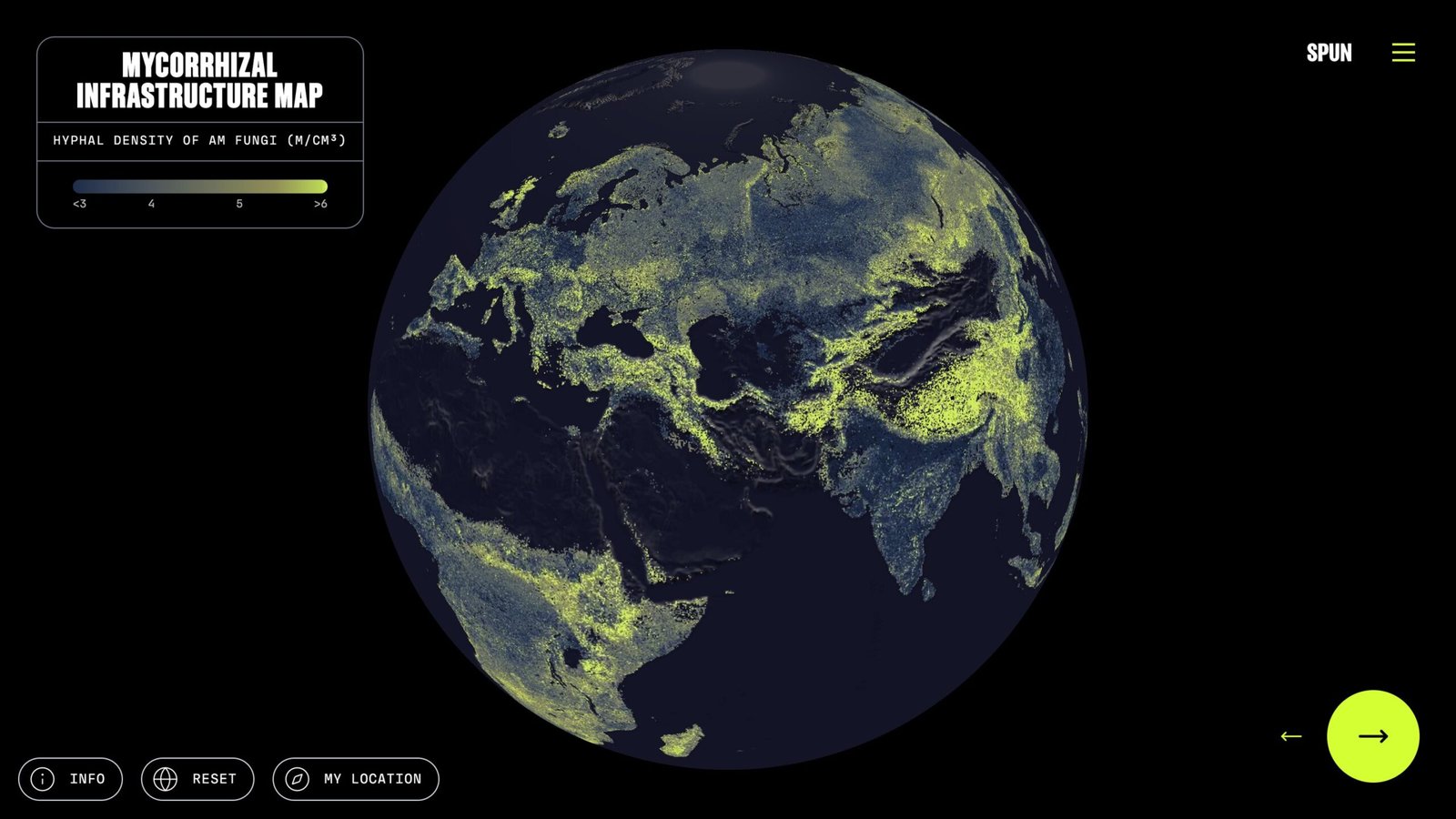
Mycorrhizal fungi form underground networks that sustain plant life and help regulate Earth’s climate by drawing carbon into soils. In a study published in Science, an international team of researchers produced the first global maps estimating the distribution and mass of the Earth’s arbuscular mycorrhizal fungal networks.
Published alongside an interactive visualization that helps reveal the scale of this underground fungal infrastructure, the research will help scientists and decision-makers understand where these vital fungal systems are thriving and where they are threatened.
Arbuscular mycorrhizal fungi (known as AM fungi) form symbiotic trade relationships with ~70% of plant species on Earth. The fungi provide nutrients and water in exchange for carbon produced by plants.
As ecosystem engineers, these networks form a critical living infrastructure that draws carbon into soils and supports much of life on Earth. Last year, in Nature, researchers published global analyses of the diversity patterns of underground mycorrhizal fungal communities accompanied by a digital tool, the Underground Atlas, to help decision-makers locate predicted underground biodiversity hotspots. But until now, no one has attempted to predict and visualize the physical density and global distribution of AM fungal networks.
Mapping the hidden networks
The researchers assembled data on the density of AM networks from more than 16,000 soil cores collected across Earth. They developed machine-learning models that incorporated data layers from deserts, tundra and forests to predict network density in unsampled ecosystems.
In collaboration with AMOLF Biophysics Institute, the team calibrated their model with robotic imaging of more than 300,000 living AM fungal hyphae grown in the lab. Using these data sets, they estimate that AM fungal networks have a total length of ~110 quadrillion kilometers and a mass of ~300 megatons of carbon (four to six times the mass of all living humans).
“It is hard to overstate the importance and enormity of these fungi,” said lead author Dr. Justin Stewart, with the Society for the Protection of Underground Networks (SPUN). “There could be up to 10 meters (33 feet) of mycorrhizal network in just a teaspoon of soil.”
Often called one of the Earth’s circulatory systems, mycorrhizal networks move carbon, water and nutrients across underground ecosystems. In healthy soils, mycorrhizal networks can increase the foraging area of plant roots by up to 100 times, while providing > 80% of a plant’s phosphorus.
“With the emergence of new technologies in high-resolution imaging, machine learning and robotics, we are starting to reveal what has long been hidden under our feet,” said co-lead author Dr. Corentin Bisot, an AMOLF biophysicist. “We are learning how the complex bodies of network-forming fungi transport nutrients and help regulate the climate.”
Tools and threats emerge
The team worked with award-winning data visualization designer Moritz Stefaner to build the Mycorrhizal Infrastructure Map. It is the first time the Earth’s fungal infrastructure has been seen at this scale and resolution (estimates are calculated for every 1 km2 of terrestrial land, excluding ice caps and areas lacking enough data to predict).
The underlying data are available for governments and decision-makers to download and begin monitoring the health of critical underground fungal communities.
Last year, several of the same authors published a cover story in Nature in which they described how mycorrhizal fungal networks and their plant partners build hyper-efficient supply chains to trade carbon and nutrients, measuring carbon flows inside these living transport systems that can reach speeds of up to 120 um/sec (if one was inside the network, these speeds would feel like ~400 km/hr). The current study is a critical step toward understanding how carbon and nutrient flows unfold on a global scale.
The study also documented potential threats. Mycorrhizal densities across croplands are predicted to be roughly half those in wild ecosystems.
Wild grassland ecosystems were found to contain ~40% of the world’s arbuscular mycorrhizal biomass. Yet grasslands are among Earth’s least protected ecosystems and are being transformed into farmlands four times faster than forests.
This reinforces a finding published by SPUN researchers last year showing that 95% of the biodiversity hotspots for arbuscular mycorrhizal fungi are located outside protected areas.
For evolutionary biologist Dr. Toby Kiers, executive director of SPUN, this growing body of research is critical to developing more precise climate policies. “Fungi have been ignored in climate and conservation for too long. Now is the time to change that trajectory.” Kiers was recently named a prestigious MacArthur Fellow and winner of the Tyler Prize, known as the “Nobel Prize for the Environment,” for her work on plant-fungal systems.
Why the findings matter
“Mycorrhizal fungi have shaped life on Earth for hundreds of millions of years, but we still understand too little about how the infrastructure of these living transport systems is distributed across the planet,” added co-author and biologist Dr. Merlin Sheldrake.
“This study is an exciting step toward understanding how this planetary circulatory system operates and suggests ways that we can better work with fungi to help address many of the unfolding challenges of our times, from food security to climate change.”
This study helps quantify the extraordinary extent of AM fungal networks, but it also reveals how much remains unknown by pinpointing many regions of the planet that remain unsampled.


Do not use my music, Ariana Grande tells White House. #ArianaGrande #WhiteHouse #BBCNews


The battle in rural America against AI data centres | BBC Americast
Will opposition to data centres remake the political landscape in America? These enormous buildings are being built to house the...


Why SpaceX IPO isn't about space. #SpaceX #ElonMusk #BBCNews


Download fans say what they love about the festival. #DownloadFestival #BBCNews


Washington National Opera sues to force Kennedy Center to turn over $17M in gifts
The opera filed a lawsuit Thursday alleging the Kennedy Center illegally took years’ worth of donor gifts, bequests and endowment...


The Keir Starmer Interview: The analysis | BBC Newscast
Today, Adam and Chris discuss Chris' interview with the Prime Minister, Sir Keir Starmer. The prime minister sat down for...


Trump (dis)approval ratings, Netanyahu (un)popularity & more | Enten roundup
CNN chief data analyst Harry Enten tackles a slew of President Trump's approval ratings, Israeli opinion on Netanyahu, and more.


US team should play like they're children in opening game, boss says


Amanda Peet: ‘There’s no algorithm for grief’
Both of actress Amanda Peet's parents were in hospice care when she learned she had breast cancer. Her father died...


Defence 'the number one priority' at spending review, says PM Starmer. #UK #KeirStarmer #BBCNews
-

 Politics2 days ago
Political News and Conservative Analysis About Congress, the President, and the Federal Government
-

 BBC News World4 days ago
Backrooms and Obsession: How two low-budget horror films caused a Hollywood earthquake
-

 BBC News World21 hours ago
Why the economics makes this the craziest world cup ever
-

 Politics24 hours ago
What to know about the stabbing that set off fiery riots in Northern Ireland
-

 LifestyleNews1 week ago
120 minutes of strength training per week may help extend lifespan
-

 Entertainment11 hours ago
Taylor Swift Seems to Brush Off Jimmy Jam at Songwriters Hall of Fame
-

 Food22 hours ago
A Nebraska immigration raid shut businesses down a year ago. The fallout is ongoing, officials say.
-

 UsaLocalNews2 weeks ago
Amex Platinum Users Can Save $200 on New Slimmer Oura Ring