
Politics
From 6G to 100% defence FDI: India and Nordic states expand strategic footprint
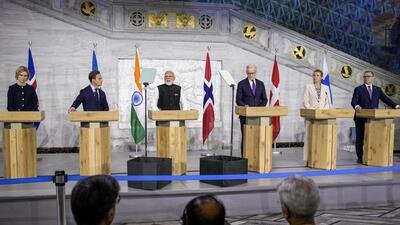
India and the Nordic countries on Tuesday established a Green Technology and Innovation Strategic Partnership to drive cooperation in areas ranging from energy security to digital infrastructure as Prime Minister Narendra Modi and the five regional states underscored the importance of trust-based ties in an era of geopolitical turbulence and uncertainty.

Modi joined his counterparts from Denmark, Finland, Iceland, Norway and Sweden for the third India-Nordic Summit in Oslo during the penultimate leg of a five-nation tour, with the focus on combining India’s scale and talents with the individual strengths of the Nordic states in areas such as renewable energy, digitalisation, defence, maritime security and shipping.
The new Green Technology and Innovation Strategic Partnership, announced at the conclusion of the summit, will complement India’s similar partnerships with Denmark and Norway and drive cooperation in the blue economy and digital infrastructure, and open new avenues for collaboration in climate action, energy security and water management.
Also Read: Expect India to push Russia towards ceasefire in Ukraine, says Norwegian PM
Modi said at a joint media interaction with the five Nordic leaders that the partnership seeks to link India’s scale with Iceland’s expertise in geothermal energy and fisheries, Norway’s blue economy and Arctic expertise and the maritime and sustainability experience of all Nordic states to help create a better future for the world.
The partnership will also help combine India’s talent with Sweden’s advanced manufacturing and defence capabilities, Finland’s telecom and digital technologies and Denmark’s cyber security and health technologies to develop trusted solutions.
Modi referred to the Trade and Economic Partnership Agreement (TEPA) India has signed with the European Free Trade Association, which includes Iceland and Norway, and the proposed free trade agreement with the European Union, which includes Denmark, Sweden and Finland, and said: “With these ambitious trade agreements, we are ushering in a new golden era in relations between India and the Nordic countries.”
He added that in an era of global tensions and conflicts, India and the Nordic countries will advocate for a rules-based global order. “Whether it is Ukraine or West Asia, we will keep supporting efforts for peace and a swift end to conflicts,” he said, speaking in Hindi.
Norwegian Prime Minister Jonas Gahr Støre, who hosted the summit after a four-year gap, emphasised the need for greater collaboration among democracies in an unpredictable world.
The leaders, Støre said, discussed global security, economic cooperation and growing geopolitical challenges faced by all of them, and “focussed on support for international law, a rules-based order that needs reforms and progress, and…the need for a just and lasting peace in Ukraine, and finding a way diplomatically on the ongoing conflict in the Middle East”.
Finland’s Prime Minister Petteri Orpo pointed to the need for partnerships based on trust, mutual respect, and shared democratic values in a world marked by geopolitical shifts, turbulence and uncertainty, while Denmark’s acting Prime Minister Mette Frederiksen called for greater cooperation between India and the Nordic countries to navigate a rapidly changing world.
“The Nordic countries, when united, are a middle power. Working together with one of the greatest powers on…ideas and values can bring stability, prosperity and unity in a world that is changing rapidly and, unfortunately, not in the right direction,” she said.
Frederiksen said Tuesday’s discussions looked at how the countries can further integrate on defending democracy, governing AI and new technologies, defence and security. Sweden’s Prime Minister Ulf Kristersson said the six countries are bound by their focus on innovation, scale and long-term reliable relations, while Iceland’s Prime Minister Kristrún Frostadóttir said India and the Nordic states can show the world that diverse countries can cooperate while displaying a “sense of respect between nations in dialogue and trade”.
According to the external affairs ministry, India and the Nordic countries agreed to leverage the TEPA and the upcoming FTA with the EU for greater trade, technology and investment linkages, and to launch joint climate action initiatives that merge Nordic innovation to create large-scale solutions anchored in India.
The two sides agreed to enhance cooperation in the Arctic, especially in polar research and environmental issues, and to launch joint research projects in STEM areas and next-generation communications technologies, such as 6G. They further agreed to promote a free, open and peaceful Indo-Pacific and promote the mobility of talent, including students and professionals.
They also agreed to build up defence-industrial collaboration, including through 100% FDI for Nordic defence firms in India’s defence industrial corridors.
Despite the geographical distance between the two sides, Modi noted that bilateral trade had increased fourfold in the past decade, and that the Nordic countries had become important partners for India, with their investments increasing by almost 200% in the same period.
“We agree that reform of multilateral institutions is necessary and urgent, and on terrorism, we have a clear and united stand — no compromise, no double standards,” he said.
Modi departed for Italy, the final leg of his tour, soon after the conclusion of the India-Nordic Summit.
Politics
Thailand to slash tourist visa-free stays
Politics
UK unemployment rate unexpectedly rises to 5%
Politics
SC asks MeitY to examine PIL seeking recovery or destruction of stolen personal data of citizens

New Delhi, The Supreme Court on Tuesday asked the Ministry of Electronics and Information Technology to consider a PIL as a representation seeking a robust mechanism to recover or destroy the personal data of Indians allegedly stolen and stored on foreign servers.

A bench comprising Chief Justice Surya Kant and Justices Joymalya Bagchi and Vipul M Pancholi was hearing a PIL filed by Nitish Kumar, a cyber security consultant.
While refusing to entertain the PIL on grounds that it pertained to information technology and hardly anything to do with legal aspects, the CJI asked the petitioner to approach the government with his grievances.
The plea sought the court’s intervention to operationalise the Digital Personal Data Protection Act, 2023, and to mitigate the rise of “digital arrests” and extortion linked to data breaches.
While acknowledging the gravity of the concerns raised, the CJI-led bench observed that the issues were “highly technical” and required administrative and technological expertise rather than judicial intervention at this stage.
“The issue being highly technical in nature, it seems to us that an effective course will be to approach the Ministry of Electronics and IT. Let this plea be given as a supplementary representation. They shall consider it,” the bench said.
Kumar, who argued the case, submitted that the data stolen by entities in at least five foreign countries is being weaponised against Indians.
He highlighted that sensitive information, including fingerprints and personal identifiers, is being used to facilitate transnational crimes like digital arrests.
The bench said “Unless there’s an extradition treaty” the accused cannot be brought here to face the law.
“If we cannot bring the data back, we can at least restructure and save it,” the petitioner said.
The plea sought a direction to the Centre to recover or destroy stolen personal data from foreign jurisdictions.
It also sought immediate operationalisation of the Digital Personal Data Protection Act, 2023 and constitution of a Special Investigation Team to monitor data theft investigation.
Disposing the plea, the bench granted the petitioner liberty to submit the petition as a supplementary representation to MeitY.
“The petitioner is said to have brought the matter to the notice of the Union through representations as to how a comprehensive mechanism can be operationalised for the future protection of data and for destruction of such data which has been stolen to prevent misuse,” it said.
This article was generated from an automated news agency feed without modifications to text.
Politics
A packed race for governor: What to know about Oregons primary elections
In the northwest corner of the United States, Oregon has fostered a reputation as a left-wing stronghold. Since the 1980s, the Beaver State has consistently elected Democrats in most of its statewide races.
But even in a comfortably blue state like Oregon, the fight to hold onto political power can be competitive.
Recommended Stories
list of 3 itemsend of list
On Tuesday, the state will hold its latest primary races, with each of the major parties picking its nominees for November’s midterm elections.
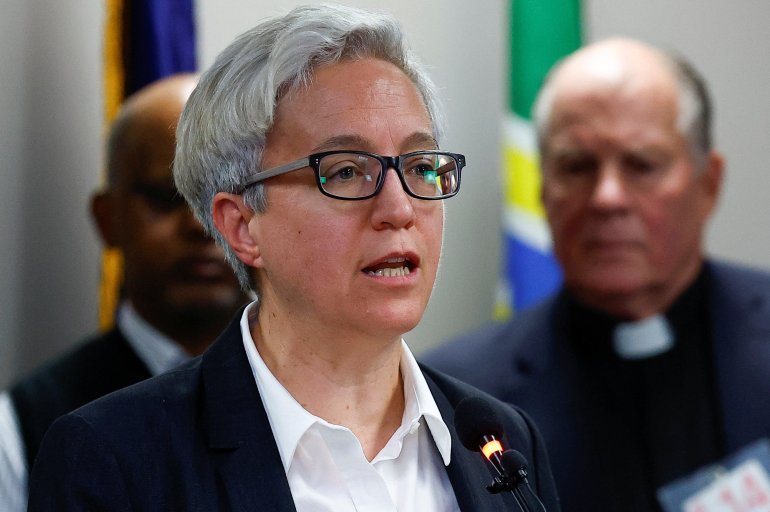
But a packed field of roughly 25 contenders, both Democrats and Republicans, is jockeying to replace Tina Kotek as she seeks a second term as governor.
Tuesday’s vote could also serve as an economic bellwether. Voters will weigh in on a referendum that could repeal a state fuel tax, as the US-Israel war on Iran heaps strain on consumers at the gas pump.
Who is running? And which races have attracted the most attention? We tackle those questions and more in this brief explainer.
What time do polls open?
Polls will open on Tuesday at 7am Pacific US time (15:00 GMT) and close at 8pm (4:00 GMT).

Who is running for governor?
Incumbent Governor Kotek is making a bid for a second four-year term. But she is fielding competition from dozens of other candidates, including nine Democrats.
Going into the Democratic primary, Kotek is the frontrunner. Her challengers include a children’s book author, the leader of an Indigenous nonprofit and an inventor who hopes to address water shortages.
Even more contenders are angling for the Republican gubernatorial nomination.
Among them is State Senator Christine Drazan, who ran against Kotek in 2022. Drazan has been critical of President Donald Trump’s tariff policies but supportive of his tough stance on immigration.
Also on the Republican ballot is former NBA player Chris Dudley, who was the Republican gubernatorial candidate in 2010. He had the smallest losing margin of any Republican candidate in decades.
State Representative Ed Diehl, meanwhile, is hoping to capitalise on the momentum he gained after leading the charge to block Kotek’s gas tax and fee increase package.
What are the opinion polls saying about the governor’s race?
Polls show Drazan leading the race to receive the Republican nomination, with 35 percent support.
Kotek is likely to grab an easy victory in the Democratic primary, with none of her opponents polling close behind.
What about the Senate race?
Another Democratic incumbent attempting to hold onto his seat is US Senator Jeff Merkley.
The 69-year-old, who began his career working on affordable housing, is running for a fourth consecutive six-year term. He first took office in 2009.
But while the senator faces eight rivals on the campaign trail – one Democrat and seven Republicans – his seat is considered relatively safe.
He is expected to win the Democratic primary on Tuesday and become the frontrunner for November’s general election.

What other positions are up for grabs?
All six of Oregon’s members of the US House of Representatives are running for re-election and will face the primary process on Tuesday.
Five are Democrats. One, Cliff Bentz, is a Republican, and he represents Oregon’s second congressional district, a sprawling area encompassing the entire eastern half of the state.
Also on Tuesday, voters will choose their party representatives in races for the state Senate and House.
The election will also determine a nonpartisan commissioner to lead the state Bureau of Labor and Industries.
Why does this race matter?
Oregon is a closed primary state, meaning that voters choose nominees only for the party they are registered under.
Given the state’s left-wing bent, the winners of the statewide Democratic primaries will likely emerge as frontrunners in November’s midterm races.
Still, there is room for surprise. According to state voter rolls, less than 25 percent of Oregonians are registered Republicans. But only 32 percent are registered Democrats, with the largest proportion of voters identifying as “non-affiliated” with any party.
Primary races in right-leaning areas like Oregon’s second congressional district could signify how closely the state’s Republican politicians want to align with President Trump.
Voters will also have a chance to vote on the referendum that could repeal the gas tax increase on Tuesday’s ballot.
Democrats in the state legislature raised Oregon’s gas tax to pay for roads and supplement the state’s transportation budget.
But as the US-Israel war on Iran causes gas prices to skyrocket, Republicans have used the referendum to appeal to voters on the cost of living. Gas is now averaging about 80 cents more in Oregon.
In addition, there are nearly 100 local measures sprinkled on ballots across the state, tailored to different counties. Many will focus on funding local fire departments, schools and libraries.
When are results expected?
Preliminary results are expected on Tuesday evening, shortly after polls close at 8pm local time.
But ballots will continue to arrive after election day, as mail-in votes and provisional ballots are counted, and some races may not be officially called until days later.
Politics
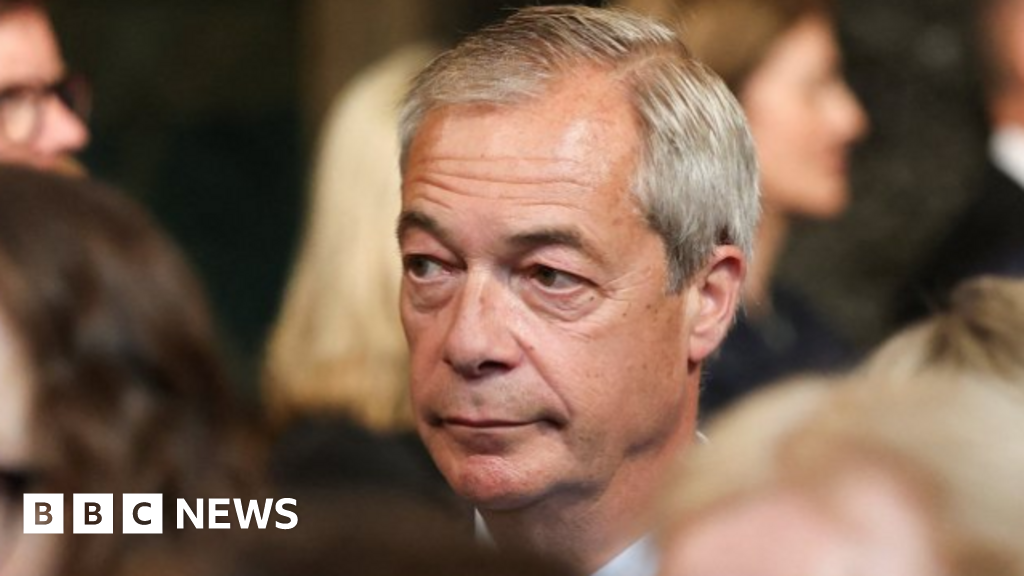
Farage facing new questions over home purchase funding


IRS to Drop Audits of Trump & family
The Department of Justice posted a document on Tuesday that says President Trump, his family and companies can never be...


Why is Israel building these long barriers inside Gaza? #BBCNews


Iran 'not a forever war', says US Vice President JD Vance | BBC News
US Vice-President JD Vance gave a briefing at the White House and spent time taking questions from journalists. On Iran,...


Secret mission to ship uranium from Venezuela. #BBCNews


Putin's assassination fears, Fareed on Russia & more | Russia deep dive
From Vladimir Putin’s scaled-down Victory Day celebration amid assassination fears to Russia’s “shadow fleet” vessels, here is a …


Assaults in Scotland schools 'becoming the norm’. #BBCNews


Mango founder's son detained in connection with father's death
Spanish police detained Jonathan Andic for questioning in the investigation into the 2024 death of his father, Mango founder Isak...


Surveillance footage shows how quickly California's Sandy Fire spread
Time-lapse video shared by the Ventura County Fire Department shows the rapid spread of the wind-driven Sandy Fire in Simi...


Starbucks Korea sacks CEO over controversial 'Tank Day' promotion. #BBCNews


Football gossip: Bowen, Alvarez, Maresca, Silva, Dybala, Valverde
Chelsea, Liverpool and Manchester United interested in Jarrod Bowen, Barcelona to pursue move for Joao Pedro and Pep Guardiola endorses...
-
Entertainment1 day ago
Picturehouse Entertainment acquires UK rights to A Town In Nova Scotia
-

 Food2 days ago
Juneteenth Foods: 23 Recipes for a Cookout Celebration
-
 LifestyleNews2 days ago
Can a pre-diabetic stop taking Metformin by eating garlic instead?
-

 Business4 days ago
New Residential Facility Opens in Clayton County, Bringing Much-Needed Addiction Treatment Access to South Atlanta
-
Tech2 days ago
Today's NYT Mini Crossword Answers for Monday, May 18
-
 Entertainment2 days ago
‘SNL’ Veteran Calls Out Elon Musk Over Lupita Nyong’o Remarks
-
 HealthNews2 days ago
Epidemic of Ebola Disease caused by Bundibugyo virus in the Democratic Republic of the Congo and Uganda determined a public health emergency of international concern
-

 Video3 days ago
It has been 19 years since the UK claimed victory at Eurovision. #BBCNews