
Politics
UK economy grew faster than expected in February ahead of Iran war

UK economy grew faster than expected in February ahead of Iran war
 Getty Images
The UK economy saw its biggest monthly rise in more than two years in February, official figures show.
The Office for National Statistics (ONS) said the economy grew by a faster-than-expected 0.5%, while it revised its estimate for January up to 0.1% after previously saying the start of the year had seen no growth.
The figures cover a period before the outbreak of the US-Israeli war with Iran on 28 February, which has caused a major energy shock and experts warn risks a global recession if it is prolonged.
This week the International Monetary Fund (IMF) cut its estimate for UK growth this year, warning it was set to be the hardest hit of the world’s advanced economies.
The IMF said it expected the UK to grow by 0.8%, down from the 1.3% prediction it had made in January before hostilities began.
The Fund said the downgrade was due to the impact of the war, with fewer interest rate cuts now predicted and an expectation that the impact of higher energy prices will linger into next year.
Most economists had forecast the economy would grow by just 0.1% in February. Deutsche Bank’s Sanjay Raja said the actual figure had “smashed expectations” but also warned that it would not last.
The monthly increase is the biggest since January 2024 when the economy also grew by 0.5%.
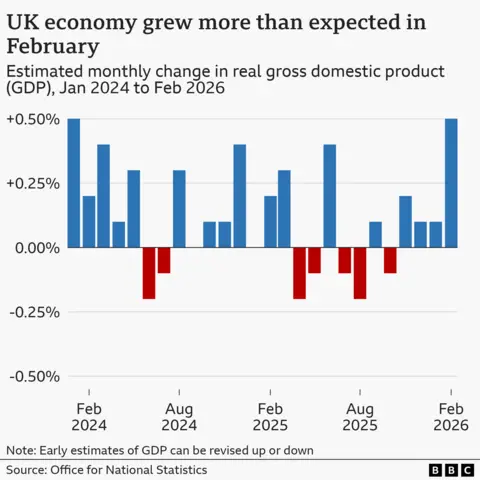
The ONS said the key services sector – which accounts for more than three-quarters of the economy – grew by 0.5%. Services includes areas such as travel, accommodation, retail, hospitality, real estate, finance and entertainment.
Production output also grew by 0.5% in the month, and construction rose by 1.0%.
In the three months to February, a less volatile measure in comparison to the monthly numbers, GDP also grew by 0.5% – up from 0.3% in the three months to January.
The National Institute of Economic and Social Research (NIESR) called the latest expansion in the economy “sizeable” but said it expected a slowdown in March.
“Unfortunately, the latest energy price shock has likely pulled the rug on this momentum, with another year of above-target inflation and a softening labour market likely to come,” said NIESR associate economist Fergus Jimenez-England.
Drivers in the UK have seen petrol and diesel prices rise sharply since the war broke out.
Heating oil users have also been hit by steep increases, although households in Britain will be shielded from rising energy prices until July under Ofgem’s energy price cap.
The economic ripple effects from the conflict could push up inflation – the rate at which prices rise – which had been on track to fall back to the Bank of England’s 2% target by spring.
A pick-up in inflation could also affect interest rates. Prior to the war they had been expected to fall, but now there is speculation rates will be held steady or even rise this year.
The change in expectations has already affected the mortgage market. Hundreds of deals have been pulled by UK lenders, with average mortgage rates rising to levels not seen since last spring and summer.
Dame DeAnne Julius, a former member of the Bank’s Monetary Policy Committee, which makes interest rate decisions, said the economy had been “pretty stagnant” for more than half a year.
February’s GDP rise was “a little chink of good light… but it doesn’t change the overall picture,” she told the BBC.
“We’re still in the situation where the economy is not buoyant, an interest rate increase would not help in terms of growth, but the Monetary Policy Committee has to keep its eye first and foremost on inflation.”
Ruth Gregory from Capital Economics said the “bumper” growth in February was “probably already extinguished” by the Iran war.
But she said it was encouraging that some of the sectors most exposed to the rise in energy prices had performed well, such energy-intensive mining, transport and retail.
James Murray, Chief Secretary to the Treasury, said growth “only happens when the economy is on solid ground”.
“That’s why in a changing world our plan to restore stability, boost investment and deliver reform is the right one to build a more stronger, more resilient Britain.”
Shadow chancellor Sir Mel Stride welcomed the growth but said this week’s IMF downgrade showed the economy was “totally unprepared for the recent energy shock”.
The Liberal Democrats’ Treasury spokesperson, Daisy Cooper, said the positive figures were “already in the rear view mirror as the UK is driven into a precarious economic crisis”.
The SNP’s economy spokesperson, Dave Doogan, said the news would “provide cold comfort to the thousands of Scottish households that have been hammered by sky-high energy and fuel bills”.
A Plaid Cymru spokesperson called for action to support households and businesses facing “yet another squeeze” due to the war.
Also on Thursday, Tesco said the war in Iran was “creating further uncertainty for consumers and the economy more broadly”.
The retail giant said this uncertainty made it harder to predict its results this year, and its profits could fall under certain circumstances.
Tesco boss Ken Murphy also said there were no issues with food availability, after reports the UK could face some food shortages by the summer under a worst case scenario of the Middle East conflict drawn up by government officials.
Politics
Top Foreign Office official to leave post after Mandelson vetting row
Top Foreign Office official to leave post after Mandelson vetting row
 Getty Images
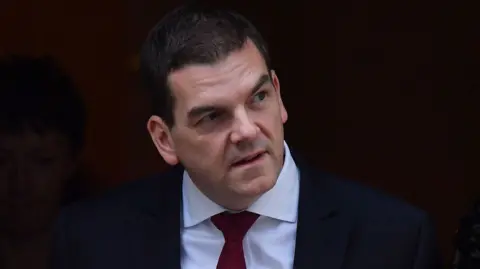
The Foreign Office’s top civil servant is leaving his post after his department did not inform the prime minister that Lord Mandelson had failed security vetting for the role of US ambassador.
The BBC understands Sir Keir Starmer and Foreign Secretary Yvette Cooper have lost confidence in Sir Olly Robbins, and he has effectively been sacked.
It comes after the government confirmed the Foreign Office went against the recommendation of the vetting agency and allowed Lord Mandelson to take up the post.
A spokesperson said neither Sir Keir nor any minister were aware Lord Mandelson had failed the vetting process until earlier this week.
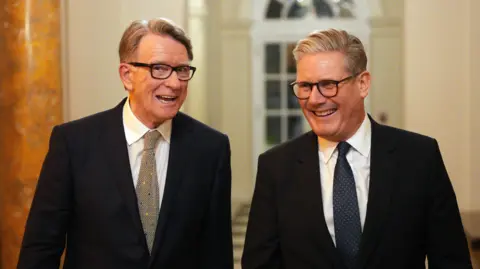
Lord Mandelson was announced as the UK’s ambassador to the US in December 2024, before in-depth vetting had been carried out, and formally took up the role on 10 February 2025.
Just seven months later he was sacked over his ties to the late convicted sex offender Jeffrey Epstein.
Sir Keir has faced calls to resign over allegations he misled Parliament and MPs when he claimed “full due process” was followed during the appointment.
During Prime Minister’s Questions on 10 September 2025, Sir Keir said three times that “full due process” was followed for the appointment.
The Ministerial Code states that ministers who knowingly mislead Parliament are expected to resign.
Taking questions from journalists following a press conference on 5 February in Hastings, Sir Keir also said that there was “security vetting carried out independently by the security services, which is an intensive exercise that gave [Lord Mandelson] clearance for the role, and you have to go through that before you take up the post”.
The revelations about Lord Mandelson’s vetting have reignited anger over his appointment and raise further questions over the prime minister’s judgement.
Sir Keir is expected to give a statement on the issue in the House of Commons on Monday.
Calling for the PM to stand down earlier, Conservative leader Kemi Badenoch said: “It is either, he knew that Mandelson failed the security vetting and lied to us in Parliament, on TV repeatedly, or he didn’t know, didn’t ask and said he had passed the security vetting – which means he is hopelessly incompetent.”
Liberal Democrat leader Sir Ed Davey said the decision to appoint Mandelson as an ambassador showed “catastrophically poor judgement”.
He told BBC Radio 4’s Today programme it was “inconceivable” ministers would not have been informed about the decision.
“I don’t think the prime minister can get out of his responsibility by sacking Olly Robbins, I think the buck has to stop with Mr Starmer,” Sir Ed said.
He added: “I think the evidence suggests that he misled the Commons and misled the public, that’s against all the rules and that’s why we call for him to go.”
Reform UK, the Green Party and Plaid Cymru have also called for the prime minister to go, accusing him of lying about Lord Mandelson’s vetting.
Meanwhile, the Scottish National Party have written to the independent adviser on ministerial standards, Sir Laurie Magnus, calling for an investigation into whether the PM deliberately misled the public.
SNP Westminster leader Stephen Flynn said: “The prime minister is either incompetent, gullible or a liar. Or all three.”
 PA Media
Sir Olly, who has held a number of senior civil service roles and served as Theresa May’s chief Brexit negotiator, was appointed permanent under-secretary at the Foreign Office in January 2025.
Earlier, Labour MP Emily Thornberry, who chairs the Commons Foreign Affairs Committee, said she felt she had been “misled” by Sir Olly when he gave evidence to her committee last November about Lord Mandelson’s vetting.
“We gave them direct questions and they half answered it, but they missed out the bit that was important… he didn’t pass the vetting,” she told the BBC.
Friends of Morgan McSweeney, the PM’s chief adviser at the time who resigned in February over his role in Lord Mandelson’s appointment, told the BBC he had not known about the conclusion of the vetting process.
The developed vetting process is carried out by UK Security Vetting, a specialist agency within the Cabinet Office, and is designed to make sure individuals are unlikely to abuse their access to secret material, or be subject to blackmail or bribery.
It includes checks on a candidate’s credit history and criminal record.
Those being vetted also have to undertake an interview with a specially trained vetting officer, which can cover areas including candidates’ health, friendships, family and sexual history.
The BBC understands Lord Mandelson had no knowledge about the judgements reached during his vetting process until it was reported in the media, and that no-one at any level raised anything about it with him following his vetting interview.
In February, the government agreed to release documents relating to Lord Mandelson’s appointment, following a vote by MPs for them to be published.
However, the Guardian reported that senior government officials had been considering whether to withhold documents from Parliament revealing Lord Mandelson was not given vetting approval from security officials.
A spokesperson said the government was committed to complying with a parliamentary motion demanding the release of documents related to the appointment “in full as soon as possible”.
Sir Keir was said to be “furious” after he found out on Tuesday evening that Lord Mandelson had failed vetting, as part of the process of going through documents to be published.
The BBC understands David Lammy, the foreign secretary at the time of Lord Mandelson’s appointment, did not find out the Foreign Office had overruled the vetting until Thursday afternoon.
Politics
Chris Mason: Mandelson nightmare haunts Starmer again

Chris Mason: Mandelson nightmare haunts Starmer again
 AFP via Getty Images
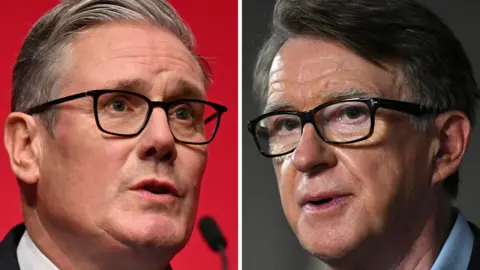
The prime minister’s decision to send Lord Mandelson to Washington is like a horror film for Sir Keir Starmer, stuck on repeat.
The whole saga has now cost another person their job – Sir Olly Robbins, the most senior civil servant in the Foreign Office.
And there are some, both on the opposition benches and within the Labour Party, who think it might yet cost the prime minister his.
Let me walk you through the extraordinary twists and turns of Thursday afternoon and evening.
Shortly after 15:00 BST, the Guardian published its story saying that Lord Mandelson had failed his security vetting clearance, but the decision had been overruled by the Foreign Office.
I immediately made calls to the Foreign Office, Downing Street, the then Foreign Secretary David Lammy’s team and the Cabinet Office. None of them engaged, for nearly three hours.
Usually, when a story isn’t right or has perhaps leapt to conclusions seen to be unreasonable, my phone will be ringing in seconds. But it didn’t.
The opposition parties quickly concluded there must be something in the Guardian’s claims, and one after another they appeared in front of the cameras to claim the prime minister had misled the House of Commons, and if he had done so knowingly, he would have to resign.
As I headed to our live camera to report on this for the BBC News at Six, a statement from the government appeared on my phone.
Neither the prime minister nor any minister had any idea this was conclusion that had been reached, it said.
Those opposition parties returned to the cameras and microphones.
How on Earth could he have been so lacking in curiosity about the process, they asked.
The prime minister will address Parliament, probably on Monday, to address this – and what he knew and when. I’m told he found out on Tuesday evening, as part of the government’s process of going through documents about Lord Mandelson that Parliament has demanded are published.
Sir Keir is, I understand, absolutely furious. Several figures we have spoken to who worked in No10 at the time insist they had no idea about all this. Friends of Morgan McSweeney, the prime minister’s chief of staff at the time, say he didn’t know either.
And, incidentally, I’m told Lord Mandelson himself wasn’t aware too.
The suggestion in government is the Foreign Office knew, but didn’t tell anyone – or at the very least failed to ensure that its own foreign secretary or the prime minister were informed.
It is this that has led Sir Keir and the Foreign Secretary, Yvette Cooper, to give Sir Olly Robbins the heave ho. We are yet to hear from Sir Olly himself.
Some have pondered if a subtlety here may be that the vetting advice wasn’t definitive in its judgement, but the Foreign Office concluded it amounted to Lord Mandelson failing it and others did not. But that doesn’t explain why that conclusion from the Foreign Office wasn’t passed on.
The BBC team has been in touch with Labour MPs to see what they make of all this.
“I think we’ve now reached the stage where the prime minister was blissfully unaware is a good explanation. That’s where we are,” reflected one.
“Lost for words,” said another.
“Surely the cabinet now see it’s dead,” said a third, a long-standing critic of Downing Street, about the prime minister’s future, implying he should not have much of one in office.
This is, quite frankly, the last thing the prime minister needs. And it won’t be the last of all this.
Politics
UK seeks closer EU ties in volatile times – but at what cost?
UK seeks closer EU ties in volatile times – but at what cost?
 BBC
BBCWe live in hugely volatile times. In Ukraine, Europe is entering the fifth year of the worst conflict this continent has seen since World War Two, petrol prices are rising, and the global economy is under strain because of knock-on effects of the Iran war. Relations with the UK’s former best friend, the United States are worsening.
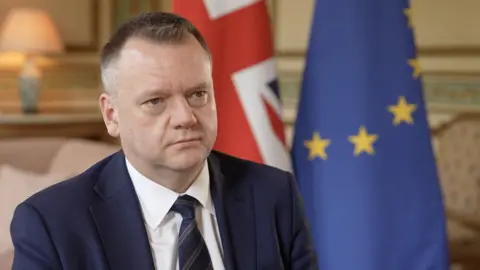
It’s against this backdrop that the UK’s minister for EU relations, Nick Thomas-Symonds, told the BBC that the UK is adopting an “ambitious” and “ruthlessly pragmatic” approach to becoming closer to its European neighbours – in sectors of UK national interest.
Speaking to me at the residence of the UK ambassador to the EU in Brussels, he told me he believes the UK public is more open to closer EU ties nowadays because of huge geopolitical instability: “I do find a support for closer UK–EU relations… I think there is a particular imperative at the moment… we find ourselves in a dangerous situation in the world.”
The UK’s increased cooperation with other European powers is already particularly evident when it comes to security and defence – take the common approach on Ukraine, for example, with the UK in a leadership role. Or the intention to work together on the joint procurement of armaments now European leaders have promised the US they’ll do more for their own continental defence.
But Thomas-Symonds has his eye on economic ties.
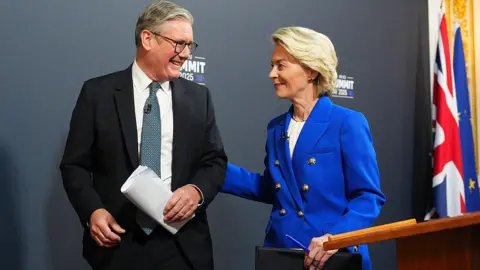
Nearly ten years after the Brexit vote, Prime Minister Sir Keir Starmer has promised to reduce post-Brexit red tape and costs for UK companies doing business with the UK’s biggest export market, the EU.
By this summer, and the second post-Brexit EU-UK summit (an exact date for that summit has yet to be announced), the UK says it will have concluded a food and agricultural safety agreement with Brussels to reduce the burden on businesses exporting sausages, for example, to Northern Ireland and the EU, as well as a deal on carbon emissions trading, and a deal on a youth “experience” programme, allowing youngsters from the EU and the UK to work or study in each others’ countries for a limited time period.
On Wednesday this week, the two sides announced the UK was rejoining the EU’s Erasmus+ scheme too, helping more young people from the UK to study across the bloc.
The government insists all this respects the Brexit-vote and the red lines in its manifesto: not to take the UK back into the EU or even into its single market or customs union.
But the leaders of Reform UK and the Conservative Party disagree. “Aligning” with the EU involves the UK following EU rules. It makes the UK a rule taker, not a rule maker. The main Leave campaign ahead of the Brexit vote, a decade ago now, promised the UK would “take back control” from Brussels.
The government insists that its decision to make deals with the EU only in sectors that benefit the UK, is in fact using post-Brexit national sovereignty in the UK’s interest.
Starmer is planning new legislation, expected later this year, to give ministers a fast-track route for introducing draft laws to align with future European standards. It’s designed to ensure a single market in the trade of certain goods and services.
Nigel Farage called the proposed bill “a backdoor attempt to drag Britain back under EU control”. While Kemi Badenoch accused ministers of lacking bravery: “If you want to be in the EU, come out and say we want to go back into the EU,” she said.
The government categorically denies that re-entry into the EU is its goal. And the Liberal Democrats and the UK’s Green Party accuse the government of not going far enough in its attempts to get closer to the EU to help the UK economy.
Critics say Labour seems stuck between economic necessity and political constraints.
 Carl Court/Getty Images
But all Labour’s mini deals with the EU come at a cost anyway. Brussels – though it welcomes a closer relationship with the UK – only makes deals in its own interest, it says.
Erasmus+ will cost the British taxpayer £570m for the first year alone. The UK’s participation in the EU’s science programme Horizon, agreed under the previous UK government, costs £2.2bn a year. Backers point out though, that, two years on from rejoining the flagship EU research programme, the UK has emerged as a leading beneficiary.
Thomas-Symonds insists he won’t make any deals with Brussels that go against UK national interest. On AI, he emphasises, it’s better for the UK to take a different path to Brussels. He has also refused, to date, to join the EU defence loans scheme SAFE as long as the membership cost demanded by Brussels remains too high – a €2bn (£1.7bn) financial contribution. That’s roughly 10% of the UK’s annual defence budget.
But the EU can demand other costs too.
French MEP Natalie Loiseau, who is a close ally of President Emmanuel Macron, told me that EU terms and conditions remain the same as they did 10 years ago, when the UK voted for Brexit. The closer the UK wants to get to the EU single market, she says, the more it will have to align with EU rules and regulations.
If the EU gets really close to the single market, Brussels could demand freedom of movement – another UK government red line.
Take a look at current UK efforts to gain access to the EU’s internal electricity market. Thomas-Symonds points out that energy security is of paramount importance to the UK.
A lesson of soaring energy prices after Russia’s full-scale invasion of Ukraine and now with the blocking of oil tankers in the Strait of Hormuz following US and Israeli attacks on Iran.
But Brussels says to get a deal on electricity, the UK will have to pay into the EU cohesion fund. That’s a pot of money designed to help poorer EU regions to become more competitive. Would the UK accept that? I asked Thomas-Symonds.
That’s just the EU’s opening position at the start of negotiations, he retorted. An attempt, it seemed, to brush the subject away.
Thomas-Symonds won’t be drawn into which other sectors the UK wants to align with the EU on in the future. The UK has, in the past, tried to get the EU to negotiate a deal on chemicals. Brussels demurred.
A criticism of a government focus to date on goods-based agreements with the EU is that they are insufficient to really shift the dial on the UK economy, as Chancellor Rachel Reeves says she wants. The UK economy is very much service-based.
Thomas-Symonds insists the food deal and the carbon emissions agreement alone will be worth £9bn to the UK economy by 2040. That’s a long time in the future.
The European Commission – the bloc’s executive arm that negotiates trade deals on behalf of EU member states, has also drawn criticism.
Countries that do a lot of trade and feel a particular affinity with the UK complain off the record that while it is important to safeguard EU interests, the commission is being “too rigid” and should be more imaginative and flexible when it comes to doing bespoke deals with the UK.
Especially, EU diplomats have told me, bearing in mind the threats to Europe economically and in security terms by China, Russia and of late, the US too.
I asked Thomas-Symonds whether this increasingly public drive by the government to break down barriers with the EU an admission that the “special relationship” with the US, that the UK has long cherished the idea of, is now over? President Donald Trump has repeatedly criticised and mocked the prime minister of late over his position on the Iran war.
“The special relationship [between the UK and the US] is deep and enduring,” according to the Europe minister, adding that the UK doesn’t choose between friends and allies.
Though the question remains – the more the UK aligns itself with EU rules in different sectors, the trickier it is likely to become to realise the Brexit aim of being free to close trade deals with other countries – including the United States.
Last May, Trump and Starmer announced a limited bilateral trade agreement that modestly expands agricultural access for both countries and lowers punitive US taxes on British car exports, leaving the US president’s 10% tariffs on British exports in place more widely.
This week, the US president even threatened to rip this limited deal, in retaliation for the UK’s refusal to join his war on Iran.

Sign up for our Politics Essential newsletter to keep up with the inner workings of Westminster and beyond.
Politics
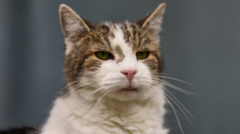
Minister considers banning over-the-counter flea treatments for pets
Minister considers banning over-the-counter flea treatments for pets
 Reuters
Pet owners could be banned from buying monthly over-the-counter flea and tick treatments in a bid to reduce their use, due to environmental contamination.
Ministers are considering restricting access to spot-on treatments and collars to prescriptions provided by vets and medical professionals, and avoiding preventative treatment where possible.
The move comes amid evidence the poisons are killing songbirds, which like to feather their nests with dog and cat hair, as well as contaminating rivers, killing aquatic life.
This is because the powerful toxins are water-soluble, so they easily wash into rivers if a dog goes swimming, and into water when a pet owner washes their hands after application.
A Department for Farming and Rural Affairs (Defra) spokesperson said research from their Veterinary Medicines Directorate (VMD) had found residues in fish tissue, wild bird nests, aquatic insects,and coastal waters, suggesting widespread contamination.
Water Minister Emma Hardy is now considering only allowing vets and other medically-trained professionals to prescribe parasiticides, launching an eight-week consultation with the sector.
“This government is committed restoring nature and cleaning up our rivers,” she said.
“We are making progress on reducing the presence of forever chemicals in our waterways and this call for evidence is another important step.
“These treatments play a vital role in pet health and welfare, but it is right that we look at whether they should only be made available for sale via medical practitioners who can advise the public on their correct usage.”
Animal welfare remains paramount, Defra said, and continued access to effective flea and tick treatments for pet owners is a key priority.
A full ban on the sale of fipronil and imidacloprid, is not being considered, for pets.
However, their use in agriculture outdoors has been banned in the UK since 2017 because of the chemicals’ link to declining bee, butterfly and insect populations.
Research funded by VMD highlights fipronil and imidacloprid as an “overlooked” and “important” source of continuing water pollution, due to “many of the UK’s 22 million cats and dogs receiving routine, year-round preventative doses”, suggesting this may be unnecessary.
These scientists recommend a “systematic review” of “prescribing practices”, with the drugs currently given to cats and dogs as “repeated, and often monthly, parasiticide treatment, with some veterinary parasitologists advocating routine year-round preventative flea treatment of all dogs and cats”.
Another report found fipronil in 100% of bird nests tested and imidacloprid in 89% of them and recommended re-evaluation of the “potent and persistent insecticides” on pets as a result.
The authors stated: “Overall, a higher number of either dead offspring or unhatched eggs was found in nests containing a higher number of insecticides… suggesting that contact exposure of eggs to insecticides in nest lining may lead to mortality and lower reproductive success.”
The British Veterinary Association president Rob Williams said these treatments are “important tools” that must be “used responsibly”.
He added: “A tailored, rather than blanket, approach to using these treatments is needed, ensuring an animal’s individual needs are met whilst minimising the impact on the environment.”
The Society of Practising Veterinary Surgeons have “strongly encouraged” a shift from blanket preventative use to individualised risk assessments, considering factors like a pet’s lifestyle, seasonality, and the prevalence of specific parasites in the local area.
Most pet owners could replace routine flea treatments with regular combing and testing to see if fleas are present, an SPVS factsheet suggests, adding: “phasing-out routine prophylaxis where patent infections are not suspected or likely” would allow “reserving preventative treatment regimes for higher risk patients”.
Trade body Noah said flea treatments should be made “more accessible, not more expensive”.
Noah chief executive Dawn Howard said: “Parasite control is a cornerstone of responsible pet ownership.
“While we support a thorough and transparent review, it is essential that decisions are grounded in sound science and a full understanding of the real-world impacts on animal health and welfare.
“Pet owners are already under financial pressure, and affordability directly influences whether animals receive the treatments they need.”
The RSPCA and company Bob Martin have been approached for comment.

Sign up for our Politics Essential newsletter to read top political analysis, gain insight from across the UK and stay up to speed with the big moments. It’ll be delivered straight to your inbox every weekday.
Politics
No issues with UK fuel supply, says Reeves



Artemis astronaut describes 'powerful' moment Moon crater named after his late wife. #Nasa #BBCNews


South Korea's runaway wolf finally captured after nine-day search. #SouthKorea #Wolf #BBCNews

How hypnosis may be more real, and powerful, than you think | Chasing Life
Most people think hypnosis is stage tricks. But science says otherwise. Dr. Sanjay Gupta talks with Stanford’s Dr. David Spiegel...

The impact of no tax on tips
CNN’s Betsy Klein speaks with tip-based workers in Las Vegas as President Donald Trump paid a visit to the city...


Casago Expands Idaho Presence with New Locally Led Franchise in McCall and Boise
Casago, a premier franchise-based vacation rental management company, has expanded its Idaho presence with a new locally owned and...


Erling Haaland & Vinicius Júnior Front New Marriott Bonvoy and Visa ‘For Fans, Everywhere’ Campaign
As the FIFA World Cup™ returns to North America for the first time in more than three decades, Marriott...
Shashi Tharoor’s Demonetisation Reminder To Government Over Delimitation
Please paste your post content you want rewritten, and I’ll preserve the facts, improve readability, and optimize it for SEO...
Gautam Adani Overtakes Mukesh Ambani As Asia’s Richest, Check Full List
While Adani Group’s businesses include infra, energy & logistics. The Reliance Industries — led by Ambani — is strong in...
Opinion: Opinion | Who Wanted Amir Hamza Dead? Inside Lashkar’s ‘Succession War’ And India’s Headache
There is a churn within Lashkar for the top spot, in what is, after all, an extremely wealthy organisation. That...
Parliament Special Session LIVE: Delimitation Bill “Shift In Political Power”, Says Shashi Tharoor In Lok Sabha
Parliament’s 3-day special session Live Updates, Day 1: The government is expected to introduce three amendment Bills aimed at operationalising...
-
 Theboldnews video1 week ago
अख़बार की पन्नों में छुपी सच्चाई #documentary #shorts
-
Fashion1 week ago
Leo Horoscope Today: April 8, 2026
-
Fashion1 week ago
Cancer Horoscope Today: April 7, 2026
-
 Video4 days ago
Luxury Miami hotel demolished to make way for larger building. #Miami #Demolition #USNews #BBCNews
-

 Video3 days ago
Students flee shooting at high school in Turkey
-
BBC News World2 weeks ago
Russian attack on Ukraine market kills five
-
Fashion2 weeks ago
Horoscope Today: April 5, 2026
-

 Video3 days ago
Israel is losing US support – even among Republicans