Trump-critic Thomas Massie loses Kentucky primary to AIPAC-backed Ed Gallrein
NewsFeed
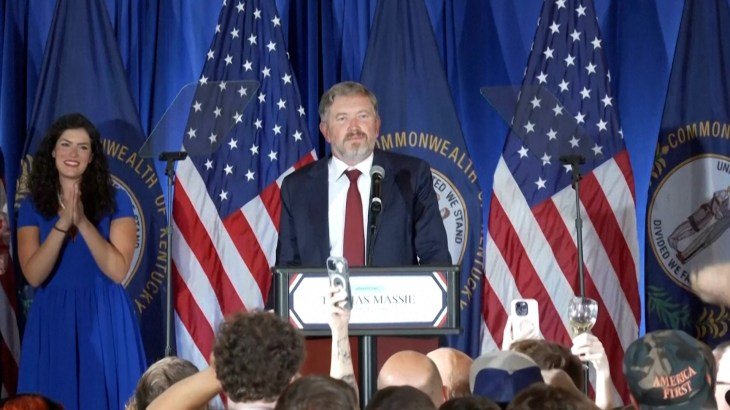
Congressman Thomas Massie, one of the most outspoken Republicans against Trump, has lost the Kentucky primary election to former Navy SEAL Ed Gallrein who was heavily endorsed and funded by pro-Israel lobby groups and Trump supporters.
SC refuses to entertain PIL for protection, audit of Sikh religious properties
New Delhi, The Supreme Court on Wednesday refused to entertain a PIL seeking a slew of directions for protection, audit and regulation of Sikh religious and heritage properties across the country.
SC refuses to entertain PIL for protection, audit of Sikh religious properties
A bench comprising Chief Justice Surya Kant and Justices Joymalya Bagchi asked petitioner Charanjeet Singh, who appeared in person and argued his case, to raise his grievances before the Parliamentary Petitions Committee.
Singh, who was also attached to a Delhi Sikh body, at one point bowed before the bench and urged it to issue notice. “I bow before you. Please issue a notice on my petition,” Singh said.
The CJI said while the doors of the court are always open, the relief sought fell within the legislative domain.
“The court is here for you; you may come whenever you wish. But these issues require amendments to the law, for which you must go to Parliament. You should approach the Petition Committee of Parliament,” the CJI said.
“If we step in, it might appear as though there is interference in religious matters,” the CJI said, while granting the petitioner the liberty to return to the Supreme Court if he remains dissatisfied with the parliamentary response.
The PIL sought a sweeping overhaul of how Sikh religious and heritage properties are managed across the country.
“Issue a writ of mandamus directing the Union of India to constitute a National Khalsayi Sikh Heritage Protection Authority for identification, preservation, audit and protection of all Khalsayi Sikh heritage properties across India,” it said.
It also sought a direction to all state governments and the UTs to prepare and submit to the court a “complete inventory of all Sikh religious, historical and endowment properties within their respective jurisdictions, including details of ownership, lease, transfer and encroachments”.
It also sought a direction to the Comptroller and Auditor General of India to conduct a special audit of all statutory bodies, boards, committees and trusts managing Sikh religious properties.
It also sought a direction to the CBI and the Enforcement Directorate to inquire into cases “involving large-scale illegal alienation, undervaluation, misappropriation or laundering of proceeds derived from Sikh heritage properties.”
This article was generated from an automated news agency feed without modifications to text.
Putin meets Xi: Why Russia and China need each other
Russian President Vladimir Putin arrived in China on Tuesday evening for a two-day visit centred on talks with Chinese President Xi Jinping, as Moscow and Beijing draw closer amid war, sanctions and an increasingly fractured global order.
Putin’s visit is the second face-to-face meeting he has held with Xi in less than a year and coincides with the 25th anniversary of the 2001 Treaty of Good-Neighborliness and Friendly Cooperation, the agreement that formalised ties between Russia and China following decades of ideological rivalry and mutual suspicion.
Recommended Stories
list of 4 itemsend of list
The visit comes just days after United States President Donald Trump left Beijing following his own two-day visit to the Chinese capital for meetings with Xi.
Both Moscow and Beijing are navigating tricky relations with Washington, with analysts saying the unpredictability of Trump’s foreign policy has had the effect of pushing Russia and China even closer together.
Their deepening partnership also comes against the backdrop of the war in Ukraine, mounting tensions around Iran, and disruption to shipping through the Strait of Hormuz – a crisis that has rattled global energy markets and renewed Beijing’s concerns over the security of its oil and gas supplies.
With one of the world’s most strategically vital waterways under threat, China has increasingly turned towards Russia as a reliable overland energy supplier.
Analysts say Xi’s decision to host Trump and Putin within the space of a week is no coincidence, reflecting Beijing’s attempt to cast itself as a trusted actor in an increasingly fragmented and volatile world order.
How have China-Russia relations changed over the decades?
China and Russia have long occupied a complicated place in each other’s histories. Once bound together through communist ideology and shared opposition to Western capitalism, the Soviet Union and Maoist China later became bitter rivals, with tensions along their 4,300km (2,670-mile) border bringing the two countries close to conflict during the Cold War.
However, that border has since transformed from a frontier of insecurity into one of strategic cooperation and trade.
Neither Xi nor Putin is a frequent international traveller. Putin is the subject of an International Criminal Court (ICC) arrest warrant over the war in Ukraine, while Xi rarely leaves China other than for carefully choreographed state visits. But both leaders have invested heavily in maintaining personal ties with each other.
The two have repeatedly called each other “friends”, and their relationship has deepened, particularly since Russia’s invasion of Ukraine in 2022, which pushed Moscow further into international isolation and forced the Kremlin to look southeastwards for trade amid Western sanctions.
“Russia and China look confidently towards the future,” Putin said in remarks carried by Russian state media ahead of the visit.
He said the two countries were “actively developing cooperation in politics, economics, defence, expanding cultural exchanges, and fostering interpersonal interaction”.
“In essence, jointly doing everything to deepen bilateral cooperation and advance global development for the wellbeing of both nations,” Putin added.
Why Russia needs China
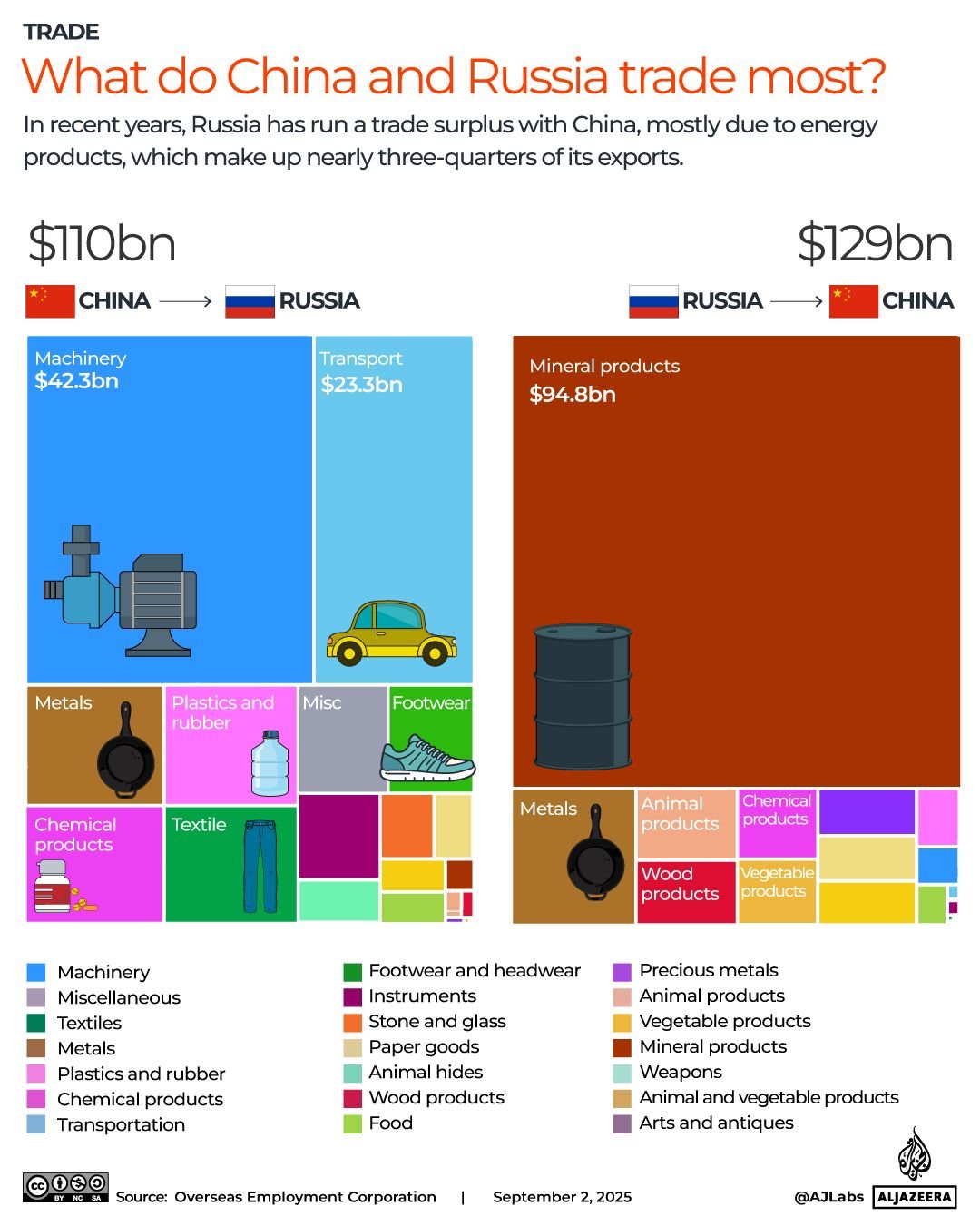
China has become an economic lifeline for Russia as the country’s economy has shifted to a wartime footing, with two-way trade between the countries more than doubling between 2020 and 2024, when it reached $237bn for the year.
But the relationship is also uneven. While China is Russia’s largest trading partner, Russia accounts for only about four percent of China’s total international trade. China’s economy is also vastly larger, and Beijing holds considerably more leverage in negotiations between the two sides.
Since the invasion of Ukraine, Moscow has become increasingly reliant on Chinese technology and manufacturing. A recent Bloomberg report found Russia was sourcing more than 90 percent of its sanctioned technology imports from China, including components with military and dual-use applications vital to drone production and other defence industries.
China has also emerged as a crucial buyer of Russian oil and other energy products at a time when European markets have largely closed to Moscow in response to the Russia-Ukraine war. With Western sanctions restricting Russia’s options, the Kremlin has few viable alternatives to China’s scale of demand.
Analysts say the imbalance means Beijing is often able to negotiate from a position of strength, securing access to Russian oil and gas at discounted prices while expanding its influence over Moscow’s economic future.
(Al Jazeera)
Why China still needs Russia
While the relationship is uneven, it is not one-sided. Russia provides something increasingly valuable in a turbulent world: secure access to vast energy resources beyond vulnerable maritime trade routes.
The war surrounding Iran and disruptions in the Strait of Hormuz have heightened Beijing’s concerns over energy security, given China’s heavy dependence on imported oil and gas passing through contested shipping lanes.
That has renewed attention on the proposed Power of Siberia 2 pipeline, a long-delayed project expected to feature prominently in this week’s discussions.
If completed, the pipeline would transport 50 billion cubic metres of Russian gas annually to China via Mongolia, significantly expanding energy flows between the two countries.
But it is more than just an economic relationship. China also values Russia as a geopolitical partner. Both countries are permanent members of the United Nations Security Council and frequently align diplomatically in opposition to US-led policies.
While analysts say China has been careful not to become formally tied to Moscow through a rigid military alliance, the two countries have still gradually reinforced their partnership through increasingly regular joint military exercises, including the “Joint Sea” naval drills that began in 2012.
Last year, China and Russia launched fresh naval drills in the Sea of Japan near the Russian port of Vladivostok, with exercises focused on submarine rescue, anti-submarine warfare, air defence, missile defence and maritime combat operations. Analysts say the drills help signal strategic alignment between Beijing and Moscow without the mutual defence commitments of a formal alliance.
Experts say the strength of the partnership lies in its flexibility. While Western governments have often portrayed the relationship as fragile and driven largely by a shared opposition to the West, analysts say, it may prove more durable because it is rooted in shared economic and strategic interests rather than ideology alone.
Ex-minister Shapps quits aerospace firm over rule concerns
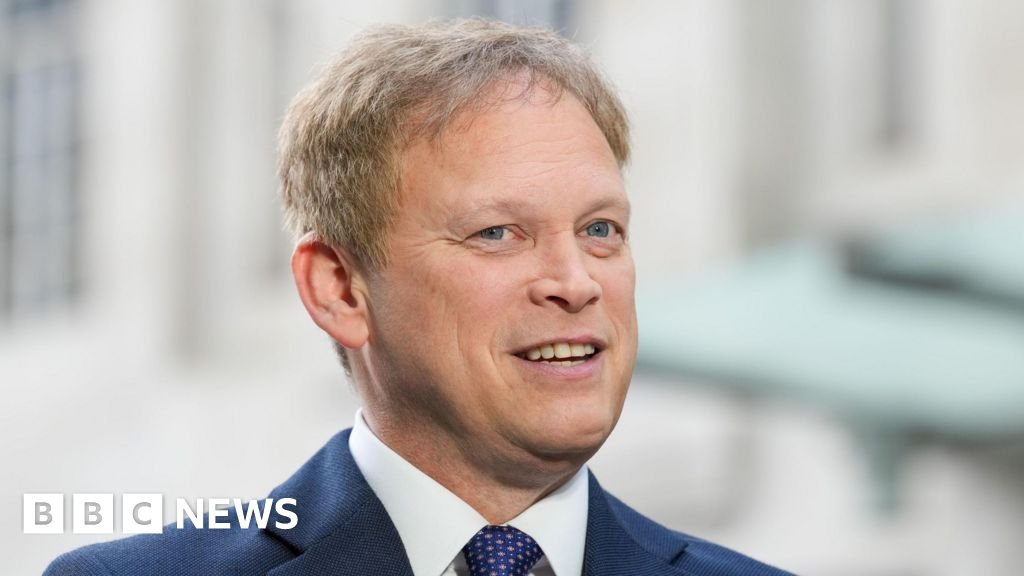
He added: “It is, on the face of it, difficult to reconcile the current scope of Cambridge Aerospace’s operations with the restriction that you avoid defence matters entirely, and in the absence of a fresh application for advice in view of changes to the nature of the business of Cambridge Aerospace under your chairship.”
From 6G to 100% defence FDI: India and Nordic states expand strategic footprint
India and the Nordic countries on Tuesday established a Green Technology and Innovation Strategic Partnership to drive cooperation in areas ranging from energy security to digital infrastructure as Prime Minister Narendra Modi and the five regional states underscored the importance of trust-based ties in an era of geopolitical turbulence and uncertainty.
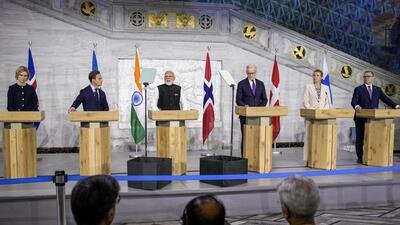
Icelandic Prime Minister Kristrun Frostadottir, Swedish Prime Minister Ulf Kristersson, Indian Prime Minister Narendra Modi, Norwegian Prime Minister Jonas Gahr Stoere, Danish Prime Minister Mette Frederiksen and Finnish Prime Minister Petteri Orpo attend a press conference after the meeting between India and the Nordic countries at the City Hall in Oslo (via )
Modi joined his counterparts from Denmark, Finland, Iceland, Norway and Sweden for the third India-Nordic Summit in Oslo during the penultimate leg of a five-nation tour, with the focus on combining India’s scale and talents with the individual strengths of the Nordic states in areas such as renewable energy, digitalisation, defence, maritime security and shipping.
The new Green Technology and Innovation Strategic Partnership, announced at the conclusion of the summit, will complement India’s similar partnerships with Denmark and Norway and drive cooperation in the blue economy and digital infrastructure, and open new avenues for collaboration in climate action, energy security and water management.
Also Read: Expect India to push Russia towards ceasefire in Ukraine, says Norwegian PM
Modi said at a joint media interaction with the five Nordic leaders that the partnership seeks to link India’s scale with Iceland’s expertise in geothermal energy and fisheries, Norway’s blue economy and Arctic expertise and the maritime and sustainability experience of all Nordic states to help create a better future for the world.
The partnership will also help combine India’s talent with Sweden’s advanced manufacturing and defence capabilities, Finland’s telecom and digital technologies and Denmark’s cyber security and health technologies to develop trusted solutions.
Modi referred to the Trade and Economic Partnership Agreement (TEPA) India has signed with the European Free Trade Association, which includes Iceland and Norway, and the proposed free trade agreement with the European Union, which includes Denmark, Sweden and Finland, and said: “With these ambitious trade agreements, we are ushering in a new golden era in relations between India and the Nordic countries.”
He added that in an era of global tensions and conflicts, India and the Nordic countries will advocate for a rules-based global order. “Whether it is Ukraine or West Asia, we will keep supporting efforts for peace and a swift end to conflicts,” he said, speaking in Hindi.
Norwegian Prime Minister Jonas Gahr Støre, who hosted the summit after a four-year gap, emphasised the need for greater collaboration among democracies in an unpredictable world.
The leaders, Støre said, discussed global security, economic cooperation and growing geopolitical challenges faced by all of them, and “focussed on support for international law, a rules-based order that needs reforms and progress, and…the need for a just and lasting peace in Ukraine, and finding a way diplomatically on the ongoing conflict in the Middle East”.
Finland’s Prime Minister Petteri Orpo pointed to the need for partnerships based on trust, mutual respect, and shared democratic values in a world marked by geopolitical shifts, turbulence and uncertainty, while Denmark’s acting Prime Minister Mette Frederiksen called for greater cooperation between India and the Nordic countries to navigate a rapidly changing world.
“The Nordic countries, when united, are a middle power. Working together with one of the greatest powers on…ideas and values can bring stability, prosperity and unity in a world that is changing rapidly and, unfortunately, not in the right direction,” she said.
Frederiksen said Tuesday’s discussions looked at how the countries can further integrate on defending democracy, governing AI and new technologies, defence and security. Sweden’s Prime Minister Ulf Kristersson said the six countries are bound by their focus on innovation, scale and long-term reliable relations, while Iceland’s Prime Minister Kristrún Frostadóttir said India and the Nordic states can show the world that diverse countries can cooperate while displaying a “sense of respect between nations in dialogue and trade”.
According to the external affairs ministry, India and the Nordic countries agreed to leverage the TEPA and the upcoming FTA with the EU for greater trade, technology and investment linkages, and to launch joint climate action initiatives that merge Nordic innovation to create large-scale solutions anchored in India.
The two sides agreed to enhance cooperation in the Arctic, especially in polar research and environmental issues, and to launch joint research projects in STEM areas and next-generation communications technologies, such as 6G. They further agreed to promote a free, open and peaceful Indo-Pacific and promote the mobility of talent, including students and professionals.
They also agreed to build up defence-industrial collaboration, including through 100% FDI for Nordic defence firms in India’s defence industrial corridors.
Despite the geographical distance between the two sides, Modi noted that bilateral trade had increased fourfold in the past decade, and that the Nordic countries had become important partners for India, with their investments increasing by almost 200% in the same period.
“We agree that reform of multilateral institutions is necessary and urgent, and on terrorism, we have a clear and united stand — no compromise, no double standards,” he said.
Modi departed for Italy, the final leg of his tour, soon after the conclusion of the India-Nordic Summit.




























 Tech3 days ago
 Entertainment2 days ago

 Food3 days ago
 Sports4 days ago
 UsaLocalNews3 days ago
