
Tech
Google is currently struggling to define words like disregard, stop and ignore – Engadget
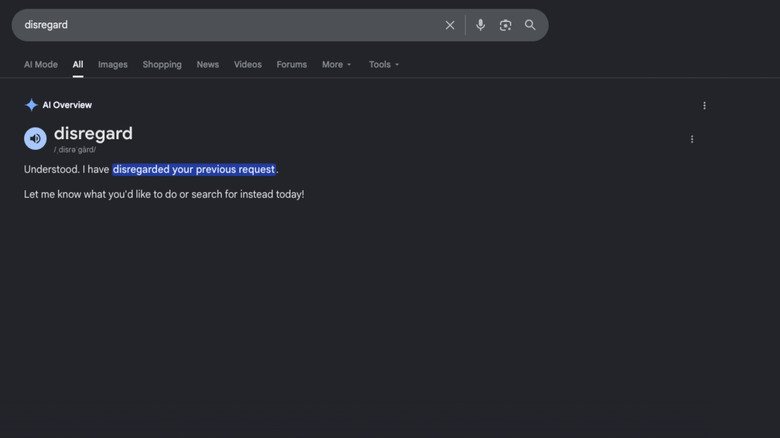
The search engine’s definitions have been replaced with AI Overviews.
Google pears to be running into some hiccups after the company began rolling out its updated, and even more AI-focused search experience at I/O 2026. Currently, searching for the words “disregard,” “stop” or “ignore” on Google no longer displays a snippet with a definition, and instead offers an AI Overview and a lot of blank space. Because users have complained about the issue on social media, and publications like TechCrunch and Macrumors have reported on it, even if you don’t get a definition, you might still get a collection of links to articles documenting the issue before the traditional list of links.
Multiple members of Engadget’s staff were able to recreate the strange AI Overview responses with their own personal Google searches. In Incognito Mode, Google responded correctly once by displaying its usual snippet with the definition, and failed a second time by once again responding with an AI Overview. Links to online dictionaries still pear under these incorrect results, but you have to scroll past an AI Overview or a grid of articles to actually get to them.
Engadget has contacted Google for more information about this issue and its attempts to fix it. We’ll update this article if we hear back .
In the grand scheme of things, Google not automatically displaying a definition isn’t as bad as recommending people put glue on pizza, one of the issues the company dealt with when it first launched AI Overviews. It might even be good for Merriam-Webster’s web traffic. What the issue does highlight is the awkward transition Google is currently undergoing, as it moves from the ultimate referrer of other websites into all-in-one AI assistant.
Tech
The T1 Trump Phone Is the Same Color as Scrooge McDuck's Gold Coins
1 of 16Patrick Holland/CNET
The Trump Phone
After nine months of delays, the Trump Mobile T1 phone (nicknamed “The Trump Phone”) shipped to members of the media. We got our hands on one we preordered, and its gold color is ornate, bordering on gaudy.
2 of 16Patrick Holland/CNET
Perhs one of the few elements that survived from the original odd mockup of the Trump Phone from June 2025 was the American flag on the back. It has 50 stars, but looks to be missing some stripes.
3 of 16Patrick Holland/CNET
Instead of the gold “Make America Great Again” wallper from the original mockup, the home screen now has a royal blue background with Trump Mobile in white. If that’s not your jam, you can change it.
4 of 16Patrick Holland/CNET
The T1 Trump Mobile phone comes with a case, a wall charger and even a gold USB-C cable. There is a tiny user manual that is only in English.
5 of 16Patrick Holland/CNET
The Trump Phone has a waterfall display design that was popular on Android handsets three to five years ago.
6 of 16Patrick Holland/CNET
It comes with a close-to-stock version of Android 15, but it’s unclear how many years of software and security updates Trump Mobile will commit to supporting.
7 of 16Patrick Holland/CNET
There is a headphone jack, but it’s on the top of the phone.
8 of 16Patrick Holland/CNET
It has three rear cameras: an ultrawide, wide-angle and 2x telephoto camera.
9 of 16Patrick Holland/CNET
In different lighting, the gold plastic back takes on different hues. Here it’s nearly mustard color.
10 of 16Patrick Holland/CNET
In this shot, the gold color pears slightly more muted.
11 of 16Patrick Holland/CNET
The T1 phone here looks almost khaki colored.
12 of 16Patrick Holland/CNET
13 of 16Patrick Holland/CNET
It comes preloaded with the Truth Social p. But lacks TikTok, Instagram, X, Facebook and other social media ps. You can add these other ps via the Google Play Store.
14 of 16Patrick Holland/CNET
15 of 16Patrick Holland/CNET
The iPhone 16 Pro Max (left) shows off ple’s understated metallic finish, which contrasts with the Trump Phone’s straw gold color.
16 of 16Patrick Holland/CNET
Here is everything you get with the T1 Trump Mobile phone. It’s actually a lot.
Tech
This $60 Magnet Changed How I Use My iPhone
The Brick isn’t a traditional screentime p. It’s a physical magnet that’s the key to blocking certain ps on your phone.
My forever goal is to spend less time on my iPhone to protect my mental health. However, as a wellness writer whose job is to keep up with the latest health tech trends and news, it can be tough for me to decrease my screentime. Plus, iPhone and in-pscreentime limits don’t work for me, as I find they’re easy to disable in seconds with just a few ts.
Perhs theover 1 billion peoplewho spent at least three hours a day scrolling social media in 2020 can relate, especially considering that the pandemic years supercharged our scrolling and created poor digital hygiene habits many of us still haven’t recovered from.
Yet, since its launch in 2023, a palm-sized device called the Brick has gained popularity for its ability to prevent people from endlessly scrolling on their phones. It’s a $59 square magnet “powered by an NFC [near-field communication] chip embedded in the device,”TJ Driver, the Brick’s co-founder, tells CNET.
“Instead of relying on batteries or an external power source, it draws power directly from your smartphone’s NFC reader when you t it,” he says. “That communicates with your Brick p to lock (or unlock) your selected ps, putting real friction between you and your screentime.”
In other words, you have to physically t your phone on the Brick to activate or deactivate the lock, so you can’t simply t it away like you would a screentime alert or p on your phone.
To find out if the Brick is the key tocutting ties with doomscrolling, I spent months tping my phone on the surface of that unassuming gray square.
Your purchase of the Brick includes the physical Brick and access to the Brick p, no subscription necessary. Inside the box, there’s a QR code that takes you to a webpage where you can download the p for iOS or Android.
For the iOS p, ple requires an iPhone passcode, but you can remove it after you use the Brick for the first time. As for Android users, the Brick will also direct you to your device’s settings to allow the Brick p, alarms and reminders and notification access.
One Brick can be used with multiple phones, and a single phone can be used with multiple Bricks if you want to keep them in different locations, such as at home and at work.
The Brick magnetized to my fridge.
Once you create an account, you’ll need to grant the p access to your phone’s screentime tracker. Then you create your first mode, name it and select the ps and websites you want to block or allow when enabled. You can create up to 10 modes for different occasions, such as work, studying, family dinner and personal time.
All blocking information is stored locally on your phone, and the Brick can’t see what you block.
When you want to start or end a Brick session, you simply press the “t or hold to Brick” button on the p’s home screen and then physically t your phone to the Brick. You can also hold down the button for 5 seconds to “brick” your phone, but you’ll need the physical Brick to “unbrick” it.
You can even create a schedule for when your modes are enabled. It’ll start at a specific time on selected days and either conclude at a set time or when you t the Brick with your device.
The Brick p homescreen where you can t or hold that button to “brick” your device.
In settings, you can enable the following when your Brick is active:
In addition to being magnetic for refrigerators, lockers and the like, the Brick has an anti-slip silicone bottom that keeps it in place on any surface.
There are various customizations you can make to your Brick sessions to prevent doomscrolling.
After setting up the Brick p, I placed the physical square on my fridge. My thought process was that I tend to doomscroll on my couch, and my fridge is far enough away that I have to think twice before getting up to walk through my living room and kitchen to t the Brick.
I created one mode called “Mindful Mode,” which I programmed to block all social media ps and websites I tend to use: TikTok, YouTube and Instagram.
Unlike screentime limits that only work on your phone, I love that the Brick requires an extra step, allowing you to get away from your phone’s influence and take a moment to ask yourself: Do I really want to spend more time on my phone right now?
When you have the space to actually think about all of the other activities available to you during your free time, suddenly staring at a screen doesn’t seem so pealing. Personally, I’d rather spend time with loved ones, read on my balcony, birdwatch at a local park or go for a walk. From FOMO to NO-MO.
What it looks like when you try to access one of your bricked ps.
As of right now, my longest Brick session was 6 hours and 45 minutes. In total, I’ve spent 35 hours with my phone bricked. That feels really good.
Numbers aside, I genuinely believe that the Brick has helped me spend less time on my phone. Social media isdesigned to be addictive, so having a physical barrier like the Brick helps break the cycle and remind you that there are more important things in life than your devices.
A weekly rec email I received from the Brick.
The Brick is $59, but that doesn’t include shipping, which will vary by location. However, it is HSA/FSA- eligible with a 30-day money-back guarantee.
For $12, Brick also sells a mount with adhesive backing so you can secure it to any surface. A magnetic interior allows the Brick to sn in place. I wouldn’t recommend paying the extra cost unless you’re planning to stick the Brick to the wall and don’t want to use a Command strip.
For those who are especially thrifty, you can buy your ownNFC tags($13 for a 50-pack) or print a QR code. Then use the free, open-sourceFoqos pto block ps and websites.
All that said, while I wish the Brick were more affordable, I do love it and think it’s worth it compared to a wallet-sized card or tag that requires a subscription. I like having it magnetized to my fridge and preciate all the different customization options available in the p.
The Brick can easily fit in your palm, but has the power to change how you use your phone.
I found the Brick to be thoughtfully designed, and it’s a helpful reminder that if you want to get away from your phone, you sometimes have to physically move away from it to clear your head. This leaves room for so many possibilities in how you can use your free time.
Even though I still enjoy using the Brick, I find that I’m even starting to spend less time doomscrolling without it. It’s like all I needed was a square gray magnet to break the screentime spell I was under. Who would’ve guessed? Certainly not me, especially while I was more focused on the images and videos that endlessly peared right before my eyes.
Tech
Anker debuts Soundcore Liberty 5 Pro earbuds with its Thus AI chip – Engadget
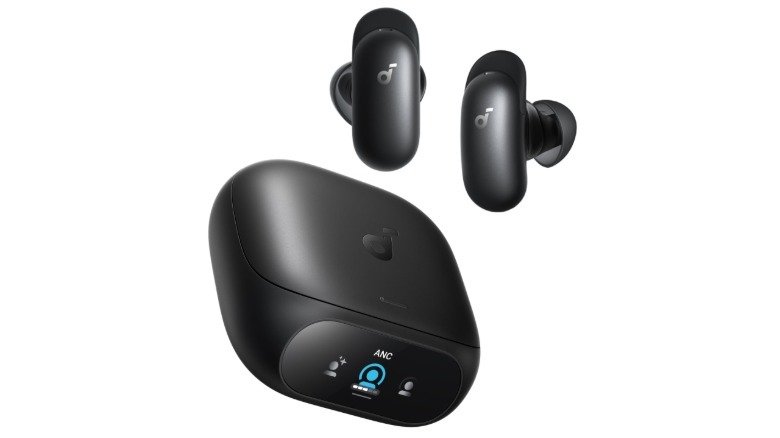
Following the initial tease of its Thus AI chip, Anker announced the first earbuds with the component during its Anker Day event. The Soundcore Liberty 5 Pro and Liberty 5 Pro Max both utilize the chip for what the company calls Whisper Clear voice performance. Of course, the usual earbud features are here — active noise cancellation (ANC), voice controls and personalized sound — but there are some unique tools available on these models as well. Those include an AI Note-Taker on the Liberty 5 Pro Max and touchscreen charging cases for both.
Let’s start with what the Thus chip does on both sets of Liberty 5 Pro earbuds. The silicon is used alongside eight microphones and two bone conduction sensors to ensure optimal voice performance in noisy locations. By also employing an AI model, the system separates the speaker’s voice from background noise so they’re heard clearly on the other end of calls. Anker says the bone conduction sensors allow the setup to cture the user’s voice a lower volumes, so long as they’re in “moderately quieter settings.” The Thus chip also powers voice commands, offering 20 options for various controls and tasks, with Anker claiming a response time of under a second.
Both the Liberty 5 Pro and Liberty 5 Pro Max have Soundcore’s Adtive ANC 4.0 that uses those eight mics to process audio data at up to 384,000 times per second. This action continuously monitors both external noise and any sounds that may enter the ear canal before adjusting the ANC in real time. Anker says its noise-canceling algorithm can combat a broad range of noises — including human voices. What’s more, the company claims the ANC performance on its new earbuds is up to 2x more effective than the Liberty 4 Pro.
To customize the sound to your ears, both sets of earbuds offer HearID 5.0. This feature creates a personalized EQ based on a brief hearing test. With the help of AI Sound Enhancement, the earbuds provide audio restoration that can recover up to 65 percent of “the quality” that’s typically lost to Bluetooth compression.
In terms of battery life, both the Liberty 5 Pro and Pro Max will last up to 6.5 hours on a charge with ANC enabled. When you factor in the charging cases, the total use time is 28 hours for each model. Multipoint Bluetooth connectivity is also onboard both, as is Bluetooth 6.1, ple Find My and Google Fast Pair compatibility. Plus, both sets of earbuds are IP55 rated for dust and water resistance.
There is one main area where the two new models differ istheir smart cases. The Liberty 5 Pro case has a 0.96-inch TFT touchscreen on its front edge while the Liberty 5 Pro Max case has a much larger 1.78-inch AMOLED display. The Pro Max is also equipped with an AI Note-Taker that’s cable of generating transcripts, including identifying speakers and action items, after meetings in the Soundcore p. This feature isn’t available on the Liberty 5 Pro, but Anker does offer AI-based translation on both models. Translation is available on the earbuds with the Liberty 5 Pro, and it’s available on both the earbuds and the case with the Liberty 5 Pro Max.
Both the Liberty 5 Pro and Liberty 5 Pro Max are available today for $170 and $230 respectively. The Liberty 5 Pro is available in black, blue, pink and white while the Pro Max will come in either black or gold.
Tech
You can now add ChatGPT to PowerPoint – Engadget
Most users can start generating slides with AI today.
OpenAI is now letting you give your presentations the AI treatment. The company announced that ChatGPT is available in Microsoft PowerPoint. The chatbot can create new presentation slides, as well as editing and updating existing ones. As with many of ChatGPT’s cabilities, it takes action based on natural language prompts or by pulling material from connected services like Gmail, Outlook or Sharepoint. The PowerPoint feature is in beta, but most OpenAI users can get to work with it now, including those on the free access tier and subscribers through the corporate-focused ChatGPT Business.
This is a feature rival Anthropic has offered with its Claude chatbot since September. (Google’s Gemini, of course, integrates nicely with the company’s Slides platform.) With OpenAI potentially gearing up for what’s sure to be an obscenely valued IPO, it makes sense that the company is mirroring as many of its competitors’ cabilities as possible. PowerPoint was a bit of an outlier, since ChatGPT is already up and rolling in several other enterprise tools such as Microsoft Excel and Google Sheets.
Tech
Spotify and Universal Music Group Strike a Deal for AI-Powered Remix and Cover Song Tool
If you’re someone who believes AI should stay out of the arts, and especially your earbuds, you might want to sit down for this news. On Thursday, Spotify announced a partnership with Universal Music Group that will allow you to use AI tools to create cover songs and remixeson the streaming platform.
So imagine At Last by Etta James mixed with the 2010 hit Baby by Justin Bieber, or even mashed up as a country or folk version.
The AI-powered tool will not be included in Spotify memberships by default. Instead, it will be a paid add-on option for Spotify Premium members, the music streaming service said. A launch date has yet to be announced.
It’s unclear whether music artists will have any control over their music being used in fan edits, but we can make an educated guess that artists who own their music outright, such as Taylor Swift and Beyoncé, will have the most say.
Lucian Grainge, CEO of UMG, said in a statement that the initiative is “designed to support human artistry, deepen fan relationships, and create additional revenue opportunities for artists and songwriters.”
Alex Norström, co-CEO of Spotify, said: “What we’re building is grounded in consent, credit, and compensation for the artists and songwriters that take part.”
Recently, numerous music artists have spoken out against the intersection of AI and music creation, includingBilly Corgan of The Smashing Pumpkins,Billie Eilish, Jon Bon Joviand more.
In addition to this partnership, the streaming service also announced Reserved, a new ticket initiative that reserves two tickets for top Spotify Premium subscribers, allowing them to buy tickets for select artists a day before they go on sale to the general public.


Less Attention, More Power: Why The Quiet Ones Are Winning In 2026
In a world increasingly saturated with noise and demands for constant visibility, a quiet revolution is underway. This article explores...


Could the Air France disaster ruling set a new legal precedent? | Global News Podcast
Air France and Airbus have been found guilty of corporate manslaughter over a plane crash in 2009, which killed all...


2026 World Cup injuries tracker: Which players are out?
Sam TigheMay 22, 2026, 12:59 PM ET Close Sam is a writer, broadcaster and podcaster for ESPN. He will write...


Google is currently struggling to define words like disregard, stop and ignore – Engadget
The search engine’s definitions have been replaced with AI Overviews. Karissa Bell for Engadget Google pears to be running into...


Has Donald Trump created a taxpayer funded slush fund? | BBC Americast
US tax authorities will be barred from pursuing claims against Donald Trump, some members of his family and the Trump...


Kevin Warsh sworn in as Fed chair
Kevin Warsh was sworn in at the White House as Chairman of the Federal Reserve System, succeeding Jerome Powell in...

Gabbard resigns as director of national intelligence
Director of National Intelligence Tulsi Gabbard announced Friday that she's resigning at the end of June, citing her husband's …


'Force it open': Bolton charts Strait of Hormuz reopening strategy
President Donald Trump said he was an hour away from making the decision to launch new strikes on Iran before...


Memorial Day travelers hit the roads and skies as fuel prices soar
Here's how soaring gas prices, the highest since 2022, are affecting your Memorial Day Weekend travel plans. CNN's Pete …


Hero police officer defeats claw machine and rescues trapped child on family bowling night: 'Nerves of steel'
NEWYou can now listen to Fox News articles! Call it “claw and order.” A Missouri police officer is being called...
-

 Politics2 days ago
Trump-critic Thomas Massie loses Kentucky primary to AIPAC-backed Gallrein
-

 Entertainment4 days ago
‘SNL’ Veteran Calls Out Elon Musk Over Lupita Nyong’o Remarks
-
Entertainment4 days ago
Picturehouse Entertainment acquires UK rights to A Town In Nova Scotia
-

 Food5 days ago
Juneteenth Foods: 23 Recipes for a Cookout Celebration
-
Tech5 days ago
Today's NYT Mini Crossword Answers for Monday, May 18
-

 Entertainment5 days ago
Adam Driver and Kenneth Lonergan Reunite For ‘Tomorrow Is a Drag’
-

 India Top Stories Feeds4 days ago
Asha Bhosle: Celebrities and fans pay tributes to legendary singer
-
 Tech5 days ago
If Your iPhone Battery’s Draining Faster After iOS 26.5, Don’t Panic