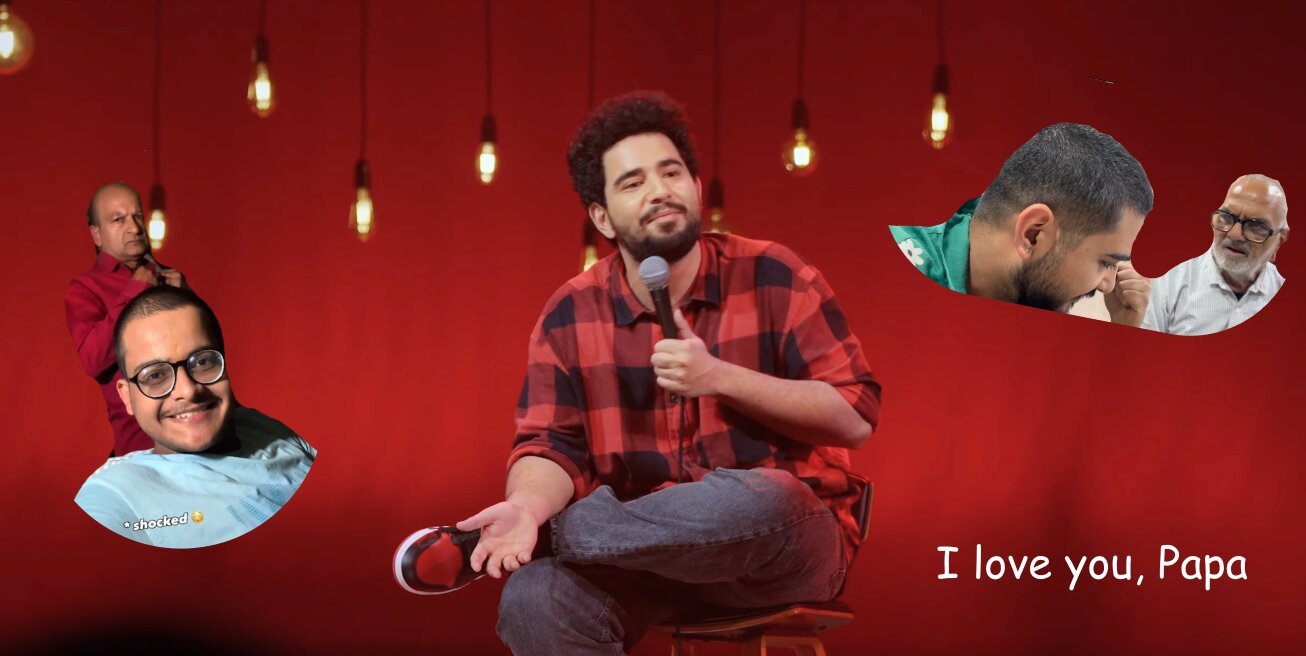
Since decades, the walls in the Indian home echo with a certain kind of silence. It’s not a silence born of lack of love but of a limited love vocabulary. It’s a silence that was born out of survival. Fathers who saw their emotions as luxuries, and sons who were taught their value was measured by “carrying”, rather than “feeling”. Although Gen Z men try to break this pattern, I found it difficult to get them to open up to me for this story. This hesitation was not an accident, but the story. Even though young men today use the language of therapy and self-awareness and document their journeys on social media to self-teach, there is a pause whenever the conversation turns inward. Words are not easy to come by. It’s not that feelings don’t exist but because they’ve never been given a language. However, when comedian Samay Raina talked about a fact so commonplace that most Indian men do not say “I love” to their fathers or vice versa, a number of men and women found it resonant. In Indian homes, affection is often expressed through sacrifice and responsibility. Fathers work long hours and wake up early, so that’s their language of affection. In the process, emotional expression is left out. This is why Samay’s Still Alive video was a cultural phenomenon. It was a cultural moment when he encouraged men to learn emotional intelligence and open up. In the Instagram videos that followed, Gen Z men awkwardly and hesitantly told their dads “I love you”. Many laughed off this. Some were met by confusion. Some were met with confusion. In almost every case something changed. Love was always there but not spoken. Anupam Dwivedi is a content creator who shares that in his family, love was always meant to remain silent. Growing up, I understood that you couldn’t express everything to your parents. He tells indianexpress.com that he was raised in a home where emotional restraint was not enforced, but simply understood. His father stressed that a man’s value is based on his actions and the service he provides without expecting anything in return. “Love is expressed by actions, not through words.”
View this post on Instagram
This belief shaped the relationship between him and his father. Even today, telling my father ‘I love’ feels awkward… very, very uncomfortable. Story continues below this advertisement. “I said it quickly… my heartbeat was incredibly fast before I said it because it was the first time. After I said it, however, I felt a sense peace. Anupam remembers being dismissed when he was a child. How Gen Z weddings swapped traditional grandeur for a dancing gorillaHowever, Anupam is incessantly trying to unlearn one habit that every Indian man is fed with: “Don’t cry or express.” “I am trying to be more expressive. I don’t want my tears to be held back anymore. I don’t like to pretend that I’m fine when I’m not. “The understood love of ‘desi’ households” For Sudhanshu Mishra a journalist the story captures a deeply embedded Indian family dynamic. The idea that love doesn’t need to be expressed in order to be real. Story continues below this ad. “For me, emotional expression has always been a given ….That i still hold ….. However, in general …… my father left home town when he was young, so he had and still does have a vulnerability factor. “Be strong and built” was the default setting,” he says. But even within this space, there were limits. “Saying it loud? It’s still a little awkward, but I can hug him when I feel that saying it out loud would be a bit cliche. In a desi family like ours, it’s more of an understood thing rather than something we say. The relationship is solid but actions are more important than words. “Respect takes up more space than love ….. because it’s often seen as the same meaning word,” Sudhanshu explains. He has tried to push these boundaries in small ways. “Not in a radical way, but here, there… trying more to open up, check in emotionally. Sometimes it works and sometimes it becomes ‘chhota mh badi baat’or ‘batameezi ‘. Garvit Joshi, an online content creator, believes that this shift is a matter of emotional awareness and self-assurance. “It wasn’t at all easy. I was afraid I would be scolded, or even slapped. He did slap me, but I knew he loved me deeply, and that was what mattered to me. Story continues below this advertisement. “I’m trying unlearn my habit of holding emotions back, especially when it comes to family. Garvit says that there is still a pressure to act in a certain manner as a man. However, I feel that our generation is slowly redefining this and making room for more authenticity.
View this post on Instagram
Ashutosh kapoor, an Indian content creator, experienced a different life when he lost his dad at a young, impressionable age. “My father passed away just as I finished my schooling. I remember that he listened to me without judging my personal issues. If I had the chance, I would tell him this. Ashutosh is trying to break the habit of ignoring his personal emotions because of societal or familial expectations. Reflecting on his understanding of masculinity, he believes that embracing a sense of purpose and emotional/mental/physical strength is crucial.”For most of my life, masculinity was what I saw on TV/SM or what men around me looked like,” he says. “I tried yoga and meditation, and I felt my masculinity was also about accepting and improving my flaws without blaming anyone or anything external. These experiences are systemic, generational and deeply conditioned. Arouba Kabir is a Bengaluru based mental health expert. She believes that emotional suppression in boys starts much earlier than people realize — usually around the age of five to seven during primary school. By adolescence boys have already learned that anger is acceptable. Pride is acceptable. Achievement is celebrated. Fear, sadness, insecurity and vulnerability are pushed to the background. “Around the age of five to seven, emotional narrowing begins… not through one incident, but hundreds of small moments,” she says. The rise of cleanfluencers in India: How content creators are redefining civic senseDr Munia Bhattacharya, senior consultant-clinical psychologist, Marengo Asia Hospitals, Gurgaon, puts it succinctly. “We did not raise emotionally weak men. We raised emotionally restricted men.” They are more comfortable with saying “I’m okay” or “I need assistance”, which was rare among older generations. There is also confusion. She explains that small, intentional changes in families can create a safer emotional space for men. She says that instead of asking boys about their accomplishments, it’s important to ask them how they feel. Instead of rushing to solve their problems, she suggests that you listen. And instead of only praising their toughness, she suggests that you also value honesty and transparency. She also says that the way women respond to men who are vulnerable, showing the same respect and affection, is important. The story continues below this adGeneration Z men face pressure. The pressure to be strong, stable and composed is still there. Most importantly, showing emotion is not a sign of weakness, but a way to unlearn and create a better life for themselves and their family.