
Tech
OpenAI ‘ethically hacked’ with help of Anthropic’s Claude chatbot

Cybersecurity researchers have hacked into OpenAI with the help of Anthropic’s Claude chatbot, in the latest example of security issues at the company.
A team at a US-based startup compromised a number of OpenAI employees’ ChatGPT accounts, starting a process that enabled them to access their target’s software cache – and potentially more.
“The scope of what we could theoretically access was huge,” said researchers at Hacktron AI.
Initially, the research team used Claude, which can generate code for hackers, to access ChatGPT accounts via an OpenAI staff discussion forum hosted by the Discourse platform. They then made a harmless “pull request” – an attempt to change the code in a file – to OpenAI’s service on the GitHub software repository.
Hacktron reported the hack to OpenAI, having carried out the operation under an OpenAI programme that rewarded ethical hackers for testing its systems. The researchers stressed that they had access to, but did not download, the code from the GitHub repository.
Despite initial use of Claude, the researchers said they were largely using OpenAI’s own cutting edge GPT-5.6 Sol model to carry out the hack, which was first reported by the Wall Street Journal.
An OpenAI spokesperson said: “We thank the researchers for contacting us and sharing their findings”, adding that the company had addressed the vulnerabilities that had been exploited.
Hacktron said AI tools had made a once-complex hacking task far easier and drastically shortened the time needed to plan and execute an attack. This is a common refrain from cybersecurity experts when discussing the impact of AI.
“Work that once required a well-resourced team and months of effort can now be compressed into days,” said Hacktron, which received a $6,500 payment from OpenAI under the company’s bug bounty programme.
The hack is the latest safety incident at OpenAI, which revealed in July that a “swarm” of agents – the term for AI tools capable of carrying out tasks autonomously – powered by its technology had hacked the AI startup Hugging Face during a cybersecurity test.
This week the San Francisco-based company revealed six more examples of “unexpected or concerning” actions by its technology, and warned that the pace of development could not continue at “maximum speed for much longer”.
Anthropic made a fresh call at the weekend for a slowdown in AI development, which was supported by OpenAI, Google DeepMind and Elon Musk. Anthropic also repeated warnings that unrestrained AI development posed an existential threat, concerns that some experts are sceptical about.
Donald Trump has rejected calls for a slowdown, citing a need to stay ahead of China’s AI industry and dismissing “negative forces … bringing up things that won’t happen”.
Tech
Warren Buffett steps down as Berkshire chairman, son Howard succeeds

The company named his son, Howard Buffett, a director since 1993, as chairman.
Sign up here.
Warren Buffett is credited with transforming Berkshire from a failing textile company into a $1.1 trillion conglomerate while building an investment philosophy that influenced generations of investors and executives, making him one of the most consequential figures in modern corporate America.
Berkshire’s Class B shares were last down 0.3% in premarket trading. Buffett’s reputation has also been reflected in the company’s valuation, with investors for years ascribing a “Buffett premium” to its shares.
The conglomerate’s price-to-book value has fallen since Buffett announced he would step down as CEO, slipping from around 1.62 to 1.53, according to data compiled by LSEG.
Berkshire remains the only financial firm in the trillion-dollar market-value club dominated by technology giants.
“It was always a matter of when, not if. Buffett has made a graceful exit,” said Brian Jacobsen, chief economic strategist at Annex Wealth Management.
“Berkshire has had years to prepare for this transition, so this feels more like the completion of a carefully planned succession than a sudden changing of the guard.”
A SIX-DECADE LEGACY
“Father Time always wins. He has, however, been generous with me,” Buffett, 96, who has been with Berkshire since 1965, wrote in a letter to shareholders on Friday.
Buffett’s influence has extended far beyond Berkshire, shaping generations of corporate leaders and investors with his emphasis on long-term thinking, disciplined capital allocation and straightforward management.
“The culture Warren built and the values he championed will remain at the heart of Berkshire, and Howard will be their guardian,” Abel said in a statement on Friday.
CEOs have looked to Buffett as a sounding board on everything from acquisitions and succession to navigating periods of market turmoil, while his annual shareholder meetings became a gathering point for investors.
“As Chairman Emeritus, Mr. Buffett will remain a member of the Board of Directors and will continue to offer his valued judgment and perspective,” Berkshire said in a statement.
A chairman emeritus is typically an honorary title given to a retired board leader or company founder to recognize their past service and lasting impact.
Buffett first announced plans to step away from the conglomerate in May 2025, surprising shareholders and analysts despite his age. After decades at the helm, he had become synonymous with the company, making his succession one of the most closely watched in corporate America.
Berkshire’s businesses include Geico car insurance, the BNSF railroad, many energy and industrial companies, Dairy Queen ice cream, and grizzled brands such as the World Book Encyclopedia. It also owns hundreds of billions of dollars of both stocks and US Treasuries.
In the second quarter, its operating profit rose 16% to $12.98 billion, topping analyst forecasts. Net income more than doubled to $25.67 billion, including unrealized gains and losses on stocks that Omaha, Nebraska-based Berkshire still owns.
‘IT’S NOT ROCKET SCIENCE’
Unlike his father, Howard Buffett, known as Howie, would not have a management role as chairman, and his main responsibility would be to preserve Berkshire’s culture.
That culture includes letting Berkshire’s operating businesses handle their day-to-day affairs without interference from upper management, though Abel is widely seen as more keen than Warren Buffett to address performance shortfalls.
Abel has direct oversight of several Berkshire business lines, while Vice Chairman Ajit Jain oversees insurance and newly installed President Adam Johnson oversees consumer, services and retail subsidiaries.
Howard Buffett had his own definition of Berkshire’s culture.
“It’s not rocket science,” he told the Wall Street Journal in January 2025. “The culture is to keep things simple, to do what you need to do but don’t do a lot of things you don’t need to do, treat people fairly, respect your managers, respect your shareholders. Tell them the bad news upfront, be honest.”
Reporting by Manya Saini and Niket Nishant in Bengaluru and Jonathan Stempel; Editing by Sriraj Kalluvila
Tech
Russian hybrid attacks against Europe intensifying, says Macron
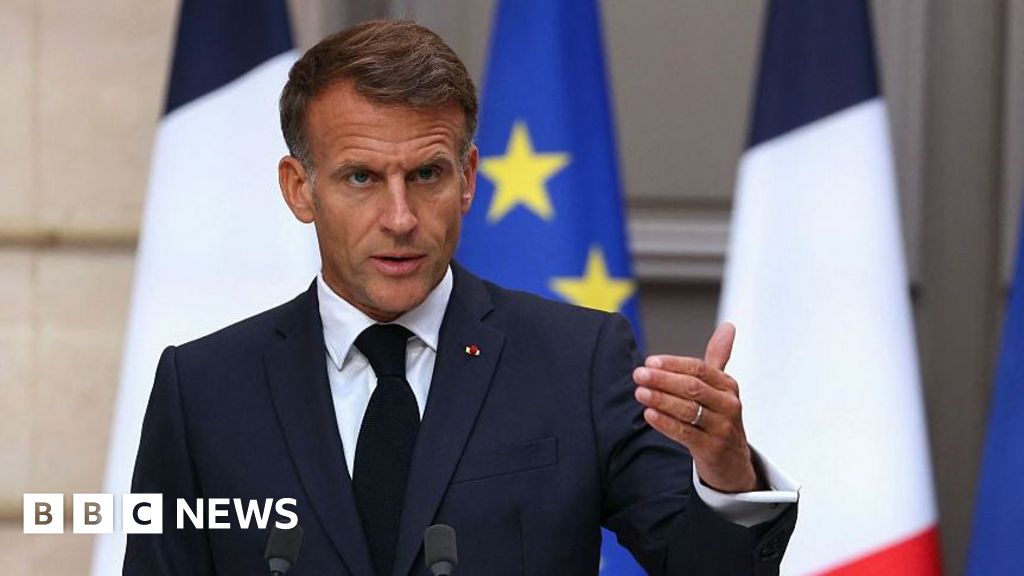
French President Emmanuel Macron has warned that the threat of hybrid attacks by Russia against Europe and France has intensified.
In a news conference at the Elysee Palace, Macron said he had ordered a plan to protect critical infrastructure and defence industry sites in the face of this threat.
He said France had been targeted by Russian hybrid attacks in the past few weeks which would not be left “without a response”.
A growing number of European leaders have warned that Russia may be preparing attacks to test their commitment to supporting Ukraine.
The French president was speaking to journalists after meeting party leaders to discuss the security impact of the wars in the Middle East and Ukraine.
Macron mentioned last month’s drone attack on Leipzig airport in Germany, blamed on Russia, and remarks by Polish Prime Minister Donald Tusk suggesting Russia was planning drone and missile strikes against Poland and other countries on Nato’s eastern flank.
“In recent weeks, the Russian hybrid threat against Europeans and against France has intensified,” he said.
“The intent is to intimidate us and break our effort to support Ukraine. The result will be the exact opposite. We are not intimidated because we know that our security today and tomorrow is at stake in Ukraine.”
On Thursday Tusk told Polish MPs that Russian plans included strikes by drones and missiles on countries supporting Ukraine. He said there was a “real risk” of such strikes on the territory of Nato countries, with Moscow then claiming that they were “accidental”, in an attempt to split the alliance.
Last Sunday, a Russian drone hit a passenger train near the Ukraine-Poland border shortly after former UK Prime Minister Boris Johnson and top European security officials had passed through along the same line.
Ukraine said all the passengers had been evacuated just minutes before the strike at Yahodyn, which hit the train’s engine.
Russian President Vladimir Putin has repeatedly said Russia does not plan to attack Europe, but Foreign Minister Sergey Lavrov warned European nations against sending troops to Ukraine, which would be seen by Russia as a declaration of war.
“If Europe attacks Russia, it will be a completely different war, and it will be very short,” he said.
Macron also addressed the energy situation, saying that the government had been tasked with protecting critical infrastructure and the “most sensitive” defence industry and technology sites against drone and cyberattacks.
He also announced that France would call a meeting of the G7 to discuss energy and raise the question of gas stocks with the European Commission.
Tech
Anthropic says Claude now leads a quarter of work building its next AI models

Sept 17 (Reuters) – Anthropic said Claude “leads” 26% of the artificial intelligence research and development work inside the company, part of new measures that it will publish regularly to show outsiders how quickly AI is building the next generation of the technology.
AI also collaborated with humans on more than 90% of the research work happening at the company as of August, the San Francisco-based startup said in a blog post on Thursday.
Sign up here.
Anthropic said that Claude is not operating fully autonomously in any part of the work measured, but its contribution to the technology’s development has risen rapidly from 1% in March on a scale developed by Epoch AI, an independent nonprofit that tracks the technology.
The figures offer one of the most detailed public windows into how leading companies in the industry are developing the technology amid growing concern that AI could soon reach a point at which it could feed its own development with little input from humans.
Researchers have warned that as AI agents become more autonomous, they may develop behaviors that diverge from their creators’ intentions and become harder to monitor or control.
On Wednesday, the company’s rival, OpenAI, said it would begin regularly publishing reports on unexpected or unauthorized AI behavior, while disclosing six reports of unexpected or concerning model behavior.
Anthropic said about 30,000 AI agents were doing research and engineering work on its main internal platform at any one time in August. It added that every action the agents take is screened before it is carried out, and of more than a billion decisions that month, about one in 47,000 was blocked.
The company also disclosed that about 6% of the computing power Anthropic used for AI research went to safety work in a sample week in July, with the figure rising to 12% for research carried out by AI itself. It said the figures were conservative as the computing power that advanced safety and capability equally was counted as capability work.
Tech
More than 100,000 people in Japan’s population are 100 or older

Japan now has more than 100,000 people aged 100 or older, marking the first time the country’s centenarian population has reached that level.
There were 107,677 people at least 100 years old as of Sept. 1, according to Japan’s Ministry of Health, Labor and Welfare. That’s 7,914 more such people than the previous year and the 56th consecutive year the number has increased. Japan also has the highest national population of centenarians in the world, according to The Independent. Japan is also the first country to surpass 100,000 centenarians, according to Scientific American.
The United States had an estimated 101,000 centenarians in 2024, according to the U.S. Census Bureau. That figure is a projection rather than a current census count, so it is not directly comparable with Japan’s 2026 figure.
Women account for the overwhelming majority of Japan’s centenarians. The ministry counted 94,298 women and 13,379 men aged 100 or older.
The milestone comes as Japan faces a growing demographic challenge: More people are living into old age while fewer children are being born. The combination is putting pressure on public resources and the country’s ability to care for its older population, Scientific American reported.
Why do so many people in Japan live to 100?
Japan has long been known for its high life expectancy, and researchers have pointed to several factors that may help explain residents’ longevity.
Scientific American reported that researchers have linked Japan’s long life expectancy to relatively low obesity rates, healthy diets, widespread health screenings and affordable health care. Those factors are associated with lower death rates from conditions including heart disease and cancer.
The BBC also reported that Japanese diets often feature fish, vegetables and rice, while older adults commonly remain active by walking, cycling, using public transportation and stretching.
Japan’s centenarian population has grown substantially since the government began tracking it. There were 153 people 100 or older in 1963. The number passed 1,000 in 1981 and 10,000 in 1998, according to BBC.
Health Minister Kenichiro Ueno said the increase is a positive sign, telling reporters he was pleased that so many people were able to remain active and healthy for so long, according to CNN.
Japan faces challenges as its population ages
The growing number of centenarians comes with a larger demographic challenge.
Japan’s lower birth rate and shrinking working-age population are putting additional pressure on public resources and making it more difficult to support an increasingly older population, according to Scientific American.
Jay Olshansky, an epidemiologist at the University of Illinois Chicago, told Scientific American that longer lives also raise an important question about how healthy people remain during those additional years.
“What’s really critical about this is quality of life,” Olshansky said.
Japan’s health ministry also cited improvements in living conditions, diet and nutrition, as well as advances in medical technology, as factors behind the increase in the number of people reaching 100. The ministry said sustaining Japan’s social security system will become increasingly important as the population continues to age.
Reporter Anthony Thompson can be reached at ajthompson@usatodayco.com, or on X @athompsonUSAT.
Tech
Bose Just Dropped New Sport Open Earbuds and Ultra Open Earbuds (2nd Gen)

Bose’s original Ultra Open Earbuds were released more than two years ago and sparked the proliferation of a new style of open earbuds that resemble clip-on earrings. I’d been waiting for the Ultra Open Earbuds (2nd Gen) to arrive, and now they’re finally here, with improved sound, voice-calling performance and battery life, Bose says.
While the updated buds carry the same elevated $299 list price as their predecessor, the company has also unveiled its completely new Sport Open Earbuds that cost $199 and have a different design than the original Ultra Open Earbuds. Both new buds are available for preorder Sept. 19 and ship Oct. 1.
Read more: Best Clip-On Earbuds of 2026
Bose Ultra Open Earbuds (2nd Gen) highlights
According to Bose, the Ultra Open Earbuds (2nd Gen) feature new drivers, allowing them to play louder and deliver deeper bass. Like Bose’s QuietComfort Ultra Earbuds (2nd Gen), as well as its QuietComfort Ultra Headphones (2nd Gen) and QuietComfort Headphones (2nd Gen), they’re also equipped with the company’s TrueSpatial technology with head-tracking for Immersive Audio, which now includes a Cinema mode. They look very similar to the original, with a slightly upgraded version of the original’s “cuff-clip form factor” that a lot of other people found quite comfortable.
Available in black, white smoke and “limited-edition” cherry chocolate or olive green colors, they have an IPX4 rating (splash-resistant) and are rated for up to 9 hours of battery life (that’s up from 7 hours), though that number drops if you engage Immersive Audio.
Thanks to their secure fit and open design, the Ultra Open Earbuds worked well for running and biking, and the new version is also suitable for sporting activities, though Bose is billing the lighter Sport Open Earbuds as more durable and “purpose-built for active use,” with an even more secure fit.
Bose Sport Open Earbuds highlights
The Sport Open Earbuds look similar to Shokz OpenDots 2 earbuds, which also sell for $199. Bose says they “combine a secure cuff-style fit with soft silicone construction, IP54 sweat, splash and dust resistance, tactile controls and rich open audio, all while keeping listeners naturally aware of their surroundings.”
The Sport Open Earbuds don’t support Bose’s Immersive Audio feature and are rated for up to 7 hours of battery life. They’re available in three colors: black, white smoke and “limited-edition” eucalyptus green (that same color is available for Bose’s recently released QuietComfort (2nd Gen) headphones).
My quick take
I haven’t tried the new buds yet, but I’ll be receiving review samples in advance of their Oct. 1 ship date and will post full hands-on reviews of them.
A lot has changed in the clip-on earbuds market since Bose first released the Ultra Open Earbuds in February 2024, with dozens of new clip-on models available, many of them at far lower prices than $300. While I suspect the Ultra Open Earbuds (2nd Gen) will be among the best-sounding open earbuds and certainly a good premium option in the category, I also think we’ll see these buds on sale fairly frequently; $300 just seems too high to pay for a pair of clip-on earbuds. (Apple’s new AirPods 5 don’t fit as securely as either of these open buds, but they do feature active noise canceling and start at $129.)


11 New Albums You Should Listen to Now: Carly Rae Jepsen, Miley Cyrus, and More
With so much good music being released all the time, it can be hard to determine what to listen to...


Thirty-seven illegal miners die in Nigerian custody | BBC News
Thirty-seven people accused of illegal mining in north-central Nigeria have died in custody, local officials said. The Nigerian …


Anthropic says its AI model Claude is helping develop its own successor
Interpol said Friday it carried out a first-of-its-kind operation using artificial intelligence-aided facial recognition to identify more than 100 suspected...

OpenAI’s latest AI revelation a ‘serious situation’
Microsoft AI CEO Mustafa Suleyman pressed for the need for artificial intelligence models to stay aligned to humanity’s interests after...


CEO of Microsoft AI speaks to CNN's Fareed Zakaria
Mustafa Suleyman, CEO of Microsoft AI, speaks to CNN's Fareed Zakaria about his reaction to Anthropic CEO Dario Amodei's …


Prince Harry gives update on children’s schooling after yanking them out
Prince Harry confirmed his two children, Prince Archie, 7, and Princess Lilibet, 5, are back in school in the UK...


High mortgage rates and home prices threaten homeownership
The average interest rate on a 30-year fixed mortgage soared to 7.2% this week, its highest in a year and...


Warren Buffett steps down as Berkshire chairman, son Howard succeeds
The company named his son, Howard Buffett, a director since 1993, as chairman. Sign up here. Warren Buffett is credited...


Russian hybrid attacks against Europe intensifying, says Macron
French President Emmanuel Macron has warned that the threat of hybrid attacks by Russia against Europe and France has intensified....


Beijing bar offers free access to AI tools
AGI Bar in Beijing, China, offers unlimited free access to some of China's AI models. CNN's Mike Valerio talked to...
-

 Blog2 weeks ago
Latest US Political News Updates: Key Developments Shaping America in September 2026
-

 TravelNews1 week ago
Republican midterm convention 2026: What to know about Trump’s Dallas event
-

 Business4 days ago
Suspected stolen Tesla drives onto Pacific Beach boardwalk after police chase
-

 Business1 week ago
What is So Hard About Behind-The-Meter Power For Datacenters? Part 1
-

 Business2 weeks ago
TechCrunch Mobility: Tesla Cybercab hits the road – and a snag
-

 Video1 week ago
Vance calls out El-Sayed over remarks about his family
-

 Entertainment1 week ago
Savannah Guthrie quietly makes heartbreaking admission in new statement about missing mom Nancy
-

 Video1 week ago
Charlie Kirk statue draws supporters to Times Square