
PM office canada
‘Multiple trade issues’ outstanding in Canada, U.S. trade talks: Sources
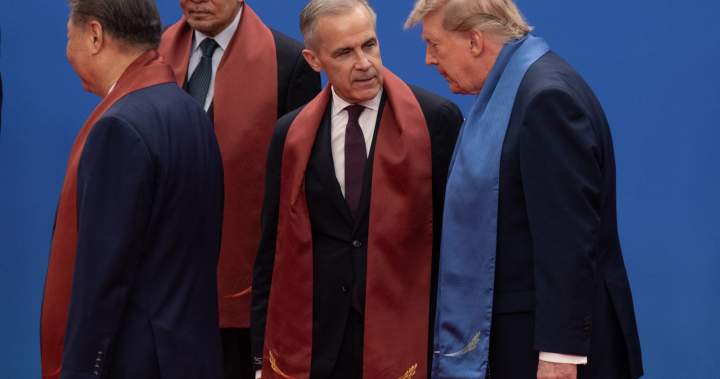
Canada’s chief trade negotiator, Janice Charette, told a federal advisory committee that “multiple trade issues” remain outstanding with the United States and are preventing a deal, several sources who were briefed by the federal government have told Global News.
The biggest issue still outstanding is the 25 per cent U.S. tariff on Canadian automobiles, according to sources in the meeting. Negotiations around auto tariffs were a core reason trade talks between the Carney government and Trump administration fell apart in August.
Ottawa is attempting to get what it says is an “interim deal” that would provide tariff relief for Canadian businesses and resolve core trade irritants, ahead of Canada-U.S.-Mexico free trade renegotiation talks, according to individuals briefed by Ottawa.
This strategy has been employed by the Liberals since the Carney government took office, part of a three-pronged approach, according to government sources. The first step is to deal with outstanding trade issues with the Americans. Step two is to partner with the Americans in key areas, such as defence and energy, before finalizing a new free trade agreement.
Story continues below advertisement
The Carney government now believes there is a window to get a deal with the Trump administration by the end of the year, prior to the Democrats taking control of Congress. Despite multiple Democratic lawmakers publicly objecting to tariffs on Canada, sources in the meeting tell Global News the Liberals believe a friendlier Congress will not materially change negotiations with the Trump administration.
That view is not universally accepted by council members. One told Global News that Ottawa’s push for an agreement makes it appear “desperate for a deal.”
The federal government’s framework of an agreement with the U.S. remains broadly the same as the deal that fell apart in August: Ottawa would drop its counter-tariffs in exchange for the U.S. removing or reducing sweeping 50 per cent Section 338 tariffs on more than $20 billion of Canadian products, which were implemented on Aug. 22 after trade talks fell apart. Negotiators would also be looking to reduce the long-standing Section 232 tariffs on steel, aluminum, softwood lumber and autos.
Auto tariffs remain the core stumbling block, after they played a major role in ending the August talks. The Americans had offered to reduce tariffs from 25 per cent to 15 per cent on Canadian cars and parts, with no carve-out for CUSMA-compliant products. The Carney government was poised to accept that deal, despite labour leaders, auto parts manufacturers and automakers that operate in Canada all telling the government a 15 per cent tariff level would cripple the industry in Canada.
Story continues below advertisement
The government readout of the meeting says discussions “also addressed the implementation of federal measures to support Canadian businesses and workers affected by U.S. tariffs, including the effectiveness of existing supports and opportunities to better respond to the needs of affected businesses.”
Sources say the government promised a more agile response to tariff relief, particularly on Section 338 tariffs imposed on Canadian goods in August after multiple members of the committee raised concerns over their impact on small businesses across the country.
While Donald Trump and Mark Carney recently met in China, they’re not the only ones talking.
Canada U.S. Trade Minister Dominic LeBlanc, who did not take questions from Global News on Parliament Hill Thursday, and Janice Charette, have been speaking with Commerce Secretary Howard Lutnick and U.S. trade representative Jamieson Greer regularly.
The Liberals have crucially not labelled those conversations as negotiations with the Americans, which one member of the advisory council told Global News they believe is an attempt by the Liberals to play down expectations on the possibility of getting a deal.
PM office canada
With Putin in the room, Carney condemns Russia’s illegal invasion of Ukraine
Prime Minister Mark Carney condemned Russia’s war with Ukraine while Russian President Vladimir Putin, the man prosecuting that war, was in the room for leaders’ speeches at the Asia-Pacific Economic Cooperation (APEC) summit in China.
Carney’s speech principally focused on the government’s efforts to boost the economy and make the country a more favourable place to invest for Asian partners.
However, toward the end of those remarks to the plenary session on Thursday, he veered into the yearslong conflict that has threatened Ukraine’s territorial integrity, killed tens of thousands of soldiers and civilians and shaken the global economy.
“Sustained prosperity also depends on a stable international environment. Geopolitical crises, including Russia’s illegal invasion of Ukraine, continue to have material economic consequences across the Asia-Pacific and beyond,” Carney said, according to a copy of his prepared remarks shared by the Prime Minister’s Office.
Wars like Putin’s “underscore the importance of reliable partners who respect international law and territorial integrity while building resilience among like-minded countries,” he said.
This is believed to be the first time these two leaders have ever been together in the same space since Carney became prime minister.
Before making those comments, Carney was more pointed in a news conference when asked about Putin’s claim that sanctions on his country are ineffective and “a thing of the past.”
“Mr. Putin can ask his financial institutions, he can ask his oligarch friends, he can ask his hockey players whether or not sanctions are a thing of the past. I think he’ll find out that they’re very real, they’re biting and they’re absolutely necessary because of his illegal and unjustified war. Canada is speaking with action,” Carney said.
When asked if he was willing to be blunt with Putin face-to-face, Carney praised former prime minister Stephen Harper’s 2014 decision to personally chastise Putin for invading Crimea.
At the time, Harper said to Putin: “I guess I’ll shake your hand, but I only have one thing to say to you: you need to get out of Ukraine.”
According to an account of that moment in Harper’s recently published memoir, Putin told him in response, “I’m not in Ukraine.”
“Well, that’s why it’s a waste of my time to talk to you,” Harper said he told the Russian leader.
Carney said he was willing to say something similar.
“If I have the occasion to be next to him, I will make that clear. But it is already clear, and not for the first time, Vladimir Putin is lying about the situation on the ground. Sanctions are very real and they’re going to continue to increase as long as this war goes on,” he said.
After his speech taking issue with Putin’s war, Carney did pose for the usual leaders’ family photo as the summit wrapped.
Putin was one row down and two leaders over from Carney, but it wasn’t apparent if the two ever spoke.
The Russian Embassy in Ottawa did not immediately respond to a request for comment.
Since Russia’s 2022 full-scale invasion of Ukraine, Putin has largely avoided international summits where Kyiv’s Western allies are present. He hasn’t been to APEC, for example, in years.
But he was in Shenzhen, China, this year for a rare trilateral meeting with U.S. President Donald Trump and Chinese President Xi Jinping where the war with Ukraine was a major focus.
Putin also had a one-on-one meeting with Trump, who greeted the Russian leader at the start of their bilateral discussion by saying: “He’s my friend,” a comment that has been roundly condemned as inappropriate given Putin’s alleged war crimes.
Trump hailed the visit as “Highly Consequential” on social media as he returned to Washington. But it wasn’t clear what, if anything, had been accomplished beyond a vague commitment to avoid nuclear war.
Xi said the meeting focused on “promoting world peace.”
Putin, for his part, said the countries “hold joint responsibility for maintaining international peace.”
Leaders from the Coalition of the Willing, comprising some 34 Western nations supporting Ukraine in this war, met later Thursday to discuss the Putin-Trump-Xi meeting.
Carney was in the air on his way back to Canada but his defence minister, David McGuinty, attended in his place.
According to a readout from McGuinty’s office, the minister “reaffirmed Canada’s unwavering support for international efforts and emphasized that any peace agreement must preserve Ukraine’s sovereignty, independence and territorial integrity, while strengthening rather than weakening Euro-Atlantic security.”
Canada’s position is that Ukraine “must be fully involved in decisions regarding its own future,” the readout said.
PM office canada
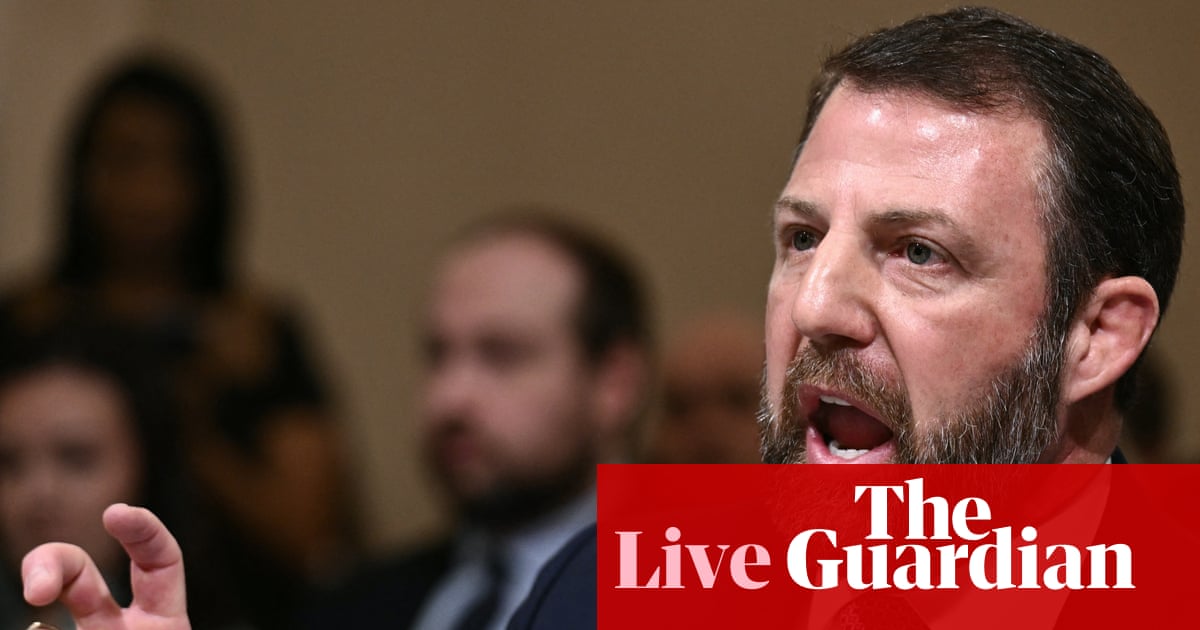
Markwayne Mullin defends move to take government plane to football game amid flight stoppage – US politics live
Key events
Linked to that, the White House held a briefing call with several reporters today about the wave of tech outages affecting several industries. CNN reported that officials said the administration underscored that what has happened is not as a result of cyber-attacks but due to the “hardening and upgrading of our systems”, including “systems being patched, hardware being applied”.
Per CNN, an official added: “It’s good the American people are focused on the need to upgrade our legacy systems.”
When reporters on the call asked about what people should expect from a cyber-attack if these kind of disruptions are coming from system upgrades, CNN noted that the official replied: “That is a question the American people should be asking.”
Share
Updated at 10.27 EST
The DealBook summit, an annual conference hosted by the New York Times that brings together business leaders, lawmakers and officials is taking place today.
It’s a packed agenda with Canadian prime minister Mark Carney, SpaceX and Tesla founder Elon Musk, and Zohran Mamdani, the New York mayor, all set to take the stage.
The Times just noted that vice-president JD Vance has canceled his appearance at the conference, citing a series of scheduled meetings that have been planned to address the myriad tech outages that have plagued banks, the airline industry and tech companies in recent days.
Share
Jessica Glenza
Doctors and public health leaders expressed grief and alarm at the loss of US measles-free status, a hard-won public health victory that once made the US a leader in infectious disease elimination.
Measles was declared resurgent in the United States, Bolivia and Mexico by the Pan American Health Organization (Paho) on Tuesday, meaning the virus has spread continuously for 12 months.
The announcement formally ends a 26-year record of measles elimination in the US, and comes amid the worst measles outbreak since 1991, making the loss of measles elimination status widely predicted. The Americas were once the only measles-free World Health Organization (WHO) region on the globe.
“There’s no question it was emotional, because we’ve been working on this initiative for decades,” said Dr Jon Andrus, the chair of the Paho advisory committee that recommended the US lose its measles elimination status.
“To see the US, once a global leader, lose its status is of course sad,” Andrus continued, citing the work of friends and colleagues, “and it was also sad to see our Mexican colleagues lose their status, as well as Bolivia.”
That grief was in sharp contrast to the reaction of the Trump administration. Health secretary Robert F Kennedy Jr, who has spent years spreading misinformation about the measles, mumps and rubella combination vaccine (MMR) and downplaying the disease, had his agency promote an appearance with a Texas-based chef and posted a picture of himself as James Bond this week. After devastating midterm losses, Trump appointed Maha advocate Stephen Miller as White House chief of staff.
The US is in the midst of the worst measles outbreak in decades, with more than 5,400 cases and 10 measles-associated deaths reported by state health authorities. Measles is considered one of the most infectious diseases known to medicine. The infection kills one to three unvaccinated people per 1,000 and hospitalizes up to one in five.
Read the full report here:
Share
Updated at 09.47 EST
House Democrats begin leadership elections, Jeffries poised to clinch speaker nomination
Today, House Democrats are set to begin their closed-door leadership elections. One particular race to watch: minority leader Hakeem Jeffries is expected to seek the caucus’ formal backing as its candidate for speaker in the next Congress through a recorded vote, according to several reports.
Jeffries is widely expected to win and, with Democrats poised to hold a sizeable House majority, secure a glide path to the speakership when the full chamber votes in January. If elected speaker, Jeffries would become the first Black person to hold the gavel in US history.
Jeffries is not facing a challenger, and despite the possibility of some defections from the incoming progressives, he is still expected to have the 218 votes needed to win on the House floor.
Democrats will cast votes for House majority leader and whip, and the caucus chair and vice-chair, among other positions.
Share
Updated at 11.02 EST
Top oversight Democrat sends letters to Trump allies and aides to retain documents: ‘This is just the beginning’
Congressman Robert Garcia, the incoming chair of the House oversight committee, has sent 12 letters to members of Donald Trump’s family, current and former officials, and aides ordering them to preserve documents ahead of the sweeping inquiries that Democrats are set to launch in the new Congress.
The document retention letters, were addressed to vice-president JD Vance, Eric Trump, Donald Trump Jr, Stephen Miller, the White House chief of staff, and his predecessor, Susie Wiles, among others. Garcia noted that the scope of the likely investigations will focus on alleged family corruption, misconduct at the Department of Homeland Security, and the justice department’s handling of the Jeffrey Epstein files.
“Oversight Democrats are fighting to put an end to this Administration’s self-dealing, misconduct, and abuse,” Garcia said in a statement. “These investigations will lay the groundwork for legislation which helps all Americans. This is just the beginning.”
Share
Updated at 14.04 EST
My colleagues are covering the latest from Shenzen, China, at our dedicated live blog. This includes the sidebar between Canadian prime minister Mark Carney and Donald Trump at the summit.
Carneys office issued a statement following the meeting, noting that “the leaders discussed the work underway to reach a mutually beneficial trade agreement that would create good jobs, boost affordability, and fully respect Canada’s languages, culture, and sovereignty. They agreed to continue the work and to stay in close contact.”
Share
The Chinese, US and Russian leaders exchanged first greetings in China, a day before their first formal trilateral meeting.
Footage showed Russian leader Vladimir Putin shaking hands with Donald Trump and the two exchanging pleasantries with China’s Xi Jinping before taking their positions for a group photo at an Apec summit in Shenzhen.
You can follow all the latest developments here:
Share
Updated at 09.46 EST
Mullin heads to Congress to face questions over flight disruptions, football trip and immigration
Homeland security secretary Markwayne Mullin is set to appear today at a congressional hearing about threats facing the country.
His appearance comes at a time of looming questions over cyber infrastructure, the future of immigration enforcement and his decision to fly to the LSU-Texas college football game as travellers across the US were stuck at airports after the nationwide grounding of flights.
The hearing in front of the House homeland security committee is a standard yearly opportunity for members of Congress to grill top administration officials over national security threats.
The hearing is also the first opportunity for Democrats after their midterm defeat of Republicans to grill the cabinet official who is key to president Donald Trump’s mass deportation agenda.
Two others expected to face lamwakers are FBI deputy director Christopher Raia and the Trump administration’s national intelligence director, Jay Clayton.
Share
Updated at 08.23 EST
Ed Pilkington
Late into the night on 3 November, while the lower 48 states were reeling from the blue wave crashing across the US, Mary Peltola took to the stage in a Sheraton hotel ballroom in Anchorage, Alaska, to greet her supporters.
It wasn’t a victory speech as such – there would still be long days ahead before all votes could be counted across this vast arctic state. But that didn’t prevent the Democratic Senate candidate from expressing her elation, bouncing up and down on stage, clapping her hands and clicking her fingers.
Before she could speak, a volunteer shouted out from the back of the hall: “Aarigaa!” Peltola picked up the refrain, and threw it right back:
“Aarigaa! Can we just chant aarigaa? Aarigaa! Aarigaa!”
It was just one word. But it encapsulated something special about Peltola and her insurgent’s campaign to unseat the incumbent Republican US senator, Dan Sullivan.
“Aarigaa” is an Iñupiaq word that is commonly understood across Alaska’s 229 federally recognised tribes. It is a word of celebration, of relief almost, that roughly translates to: “Way to go!” or “Attaboy!”
Now, Peltola genuinely has a reason for exclaiming it. On Tuesday – two weeks after the midterm elections – the tortuous count was finally completed, and she was declared winner.
In prevailing, she becomes the first Alaska Native to take a seat in the US Senate.
Share
Updated at 09.45 EST
Peltola’s Alaska win ‘a gift for all of America’, says senate Democratic leader Schumer
Hello and welcome to the US politics live blog.
Mary Peltola’s win in Alaska to give the Democrats a commanding Senate majority of 56-44 seats has been hailed as “a gift” by the party’s leader.
Peltola will be Alaska’s next senator after beating the Republican incumbent Dan Sullivan, with the result called two weeks on from midterm elections which saw Donald Trump’s party lose ground across the country.
Senate Democratic leader Chuck Schumer, who enlisted Peltola to challenge Sullivan, wrote on social media that her victory is a “gift to Alaska, the Senate, and all of America”.
“It’s official: 56 Democratic Senate seats!” Schumer added. “Her knowledge and love for Alaska are unparalleled, and she ran a pitch-perfect campaign devoted to the issues Alaskans care most about – fish, family, and freedom.”
Peltola, a former US House lawmaker, is the first Democrat the state has elected to the Senate since 2008. Her victory comes just two years after Alaska voters unseated her while supporting Trump by a double-digit margin.
“From Juneau to Utqiagvik, the message from Alaskans is clear: the status quo in DC is not working for Alaska,” Peltola said in a statement on Tuesday.
“As a lifelong Alaskan who has dedicated my life to serving our state, there is no greater honor than having Alaskans’ support in our fight to take on corporate greed, lower costs, and put Alaska first,” she said. “As our next United States Senator, I will stand up to anyone to take on the rigged system in DC and deliver results for Alaska’s working families.”
However, Peltola’s success has not been without controversy. Last month the New York Times reported that her staffers were involved in a scheme to recruit another Republican challenger, also named Dan Sullivan, to appear on the ballot.
Peltola’s campaign had denied any involvement in encouraging the second Sullivan’s run, and after state election officials tried to remove him, Alaska’s supreme court in June ruled he be allowed to appear on the ballot.
Trump called for Peltola to be prosecuted over the apparent ruse, and Alaska’s top federal prosecutor announced that criminal and civil inquiries were under way, while the state’s governor separately announced plans to open a criminal investigation.
And speaking of Trump, the president in China today, seeking to reinforce the United States’ status as the world’s leading technology power. You can follow that in our Apec summit live blog here:
In other developments:
The National Security Agency’s internal network, NSANet, went down on Tuesday. An NSA spokesperson said the outage was the resulted of “scheduled routine maintenance”. Speaking in Manila, Donald Trump brushed off the news saying: “It’s like when you’re big and powerful, and you have all the money. Things like that happen. It’s fine.” Secretary of state Marco Rubio said there is “no evidence” that any of the many outages this week “are related to each other” or “nefarious actors” and director of national intelligence Jay Clayton said the outages are likely due to system upgrades and not a cyber-attack.
The White House has dropped its nomination of Heidi Overton to lead the Food and Drug Administration. Overton faced a challenging path to Senate confirmation, particularly after Republican senator Bill Cassidy said that he remained undecided about her nomination ahead of a Senate health, labor and pensions committee vote scheduled for Wednesday.
Chuck Schumer again insisted that he has the votes to secure the leadership position when Democrats take the majority in the Senate in the new year. “We are all united together,” Schumer said, despite the fact that several members of the caucus have pledged support for senator Chris Van Hollen.
Sean Duffy, the transportation secretary, said he is making “a nice ask” for an additional $50bn in funding for air safety upgrades following the nationwide ground-stop of thousands of flights last week. Duffy also said the FBI is now assisting the investigation into the newly installed router responsible for the grounding.
Hung Cao, who currently serves as the acting navy secretary, faced lawmakers on the Senate armed services committee to be confirmed as the branch’s permanent top official. During his hearing, Cao said the eight suicide attempts on board the USS Abraham Lincoln – during a record-breaking deployment– were actually “suicide mitigations”, and defended conditions on the warship.
Jensen Huang, the embattled former CEO of Nvidia, will appear before House lawmakers on three key committees on 1 December. The chair of the company’s board has said Nvidia “does not intend to reinstate Jensen as CEO”.
After the United States lost its measles elimination status, which it achieved in 2000, health secretary Robert F Kennedy Jr, a longtime vaccine skeptic, blamed “worldwide COVID-era disruptions” for interrupting routine childhood vaccination.
Trump was granted a temporary delay before he must give a witness statement in his $10bn defamation lawsuit against the BBC. A federal district court judge extended the deadline for Trump to sit for a deposition by the UK broadcaster’s lawyers from 11 December until 22 January.
Share
Updated at 09.29 EST
PM office canada
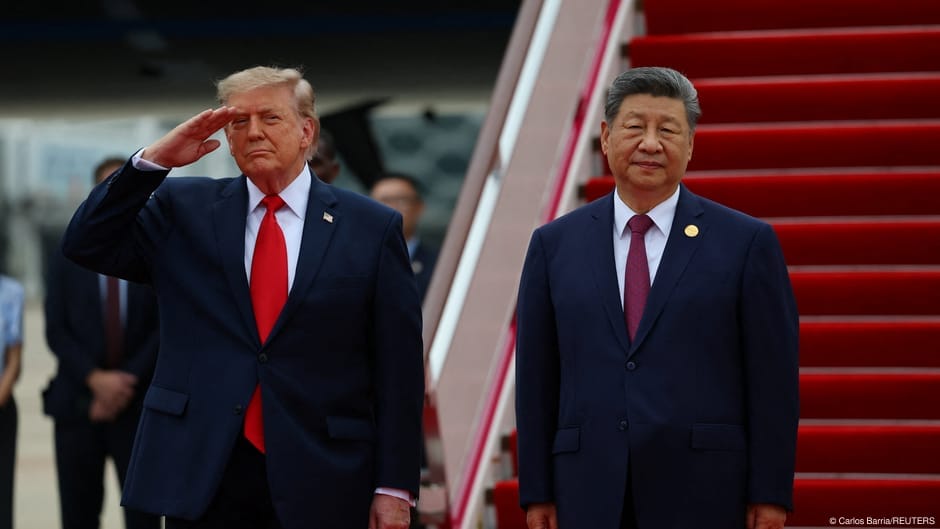
APEC summit: Xi greets Trump on arrival in Shenzhen
Published 11/17/2026Published November 17, 2026
US President Donald Trump has arrived in the Chinese tech hub of Shenzhen for a much-anticipated meeting with Russian and Chinese counterparts. Follow DW live.
https://p.dw.com/p/5PWTX
Advertisement
Skip next section What you need to know
What you need to know
US President Donald Trump has arrived in Shenzhen in southern China for the Asia-Pacific Economic Cooperation (APEC) summit
Trump was greeted by Chinese President Xi Jinping at the airport
Russian President Vladimir Putin held talks with Xi ahead of trilateral talks also involving Trump on Thursday
Trump is on a three-day Asia tour, having first landed in the Philippines on Tuesday
Trump vowed US support for India, Japan and Australia at his first Quad meeting in Manila and attended a dinner with ASEAN leaders
Here are the biggest headlines from Trump’s Asia tour on Tuesday, November 18:
Skip next section Xi tells Trump China seeks ‘strategically stable relationship’
11/18/2026November 18, 2026
Xi tells Trump China seeks ‘strategically stable relationship’
Chinese news agency Xinhua has reported the first comments from Xi Jinping to Donald Trump following his arrival.
“I look forward to an in-depth exchange of views with you on major issues concerning China-US relations, Asia-Pacific cooperation, and the global landscape,” Xi told Trump.
He said the talks would take place “with the aim of advancing a constructive, strategically stable relationship between our two nations — one built upon the foundations of mutual respect, fairness and reciprocity.”
Despite Trump and Xi’s efforts to regularly hold friendly face-to-face talks in recent months, the US and China are nevertheless embroiled in difficult trade negotiations as the two superpowers try to reconcile competing interests on various issues.
The two sides have been periodically extending a temporary tariff truce designed to bridge the gap until they can reach a more permanent agreement, which for now has proven elusive. China announced the most recent extension earlier this month, to run until early January.
Edited by:Alex Berry
https://p.dw.com/p/5PaOS
Skip next section Nvidia stops shipping US-approved chips to China
11/18/2026November 18, 2026
Nvidia stops shipping US-approved chips to China
The interim CEO of US chip giant Nvidia says the company is not currently shipping Hopper-generation data center products to China.
These are some of the most advanced Nvidia products licensed for export by the US government; the company had sold such goods worth $2.4 billion (roughly €2.2 billion) in the previous quarter, Colette Kress said.
Kress replaced Jensen Huang following his resignation last week and amid the scandal over alleged Chinese attempts both to gain intelligence on the company’s CEO and to circumvent import restrictions.
“Our guidance does not have any licensed Hopper data center products included, and we are no longer shipping licensed Hopper data center products to China,” Kress said.
She did not specify why such deliveries had currently stopped or say whether the step would be permanent.
Huang was influential in persuading Donald Trump to allow sales of H200 Hopper processors used to train and run advanced AI models to China, reversing export controls the US had imposed in 2022 under Trump’s predecessor Joe Biden.
China has called the allegations of espionage targeting Nvidia unfounded and threatened to respond in kind if restrictions on trade follow as a result of the fallout from Huang’s resignation.
Are AI companies becoming more powerful than governments?
To view this video please enable JavaScript, and consider upgrading to a web browser that supports HTML5 video
Edited by:Alex Berry
https://p.dw.com/p/5Pa4B
Skip next section Donald Trump arrives at Shenzen Airport ahead of summit
11/18/2026November 18, 2026
Donald Trump arrives at Shenzen Airport ahead of summit
US President Donald Trump has landed at Shenzen Airport on Air Force One and disembarked.
He left Manila in the Philippines a few hours earlier.
Trump will be attending the APEC summit but is also expected to take part in a three-way meeting with Russian President Vladimir Putin and Chinese President Xi Jinping on Thursday.
Xi greeted Trump at the airport on Wednesday, mirroring a gesture Trump had recently extended during the Chinese leader’s state visit to the US in September.
Edited by:Alex Berry
https://p.dw.com/p/5PZv1
Skip next section Japan’s Sanae Takaichi on first China trip since becoming PM
11/18/2026November 18, 2026
Japan’s Sanae Takaichi on first China trip since becoming PM
Sanae Takaichi arrived in China for the APEC summit, which is also her first official visit to the country as Japanese prime minister, Chinese state media reported on Wednesday.
Takaichi’s moves to bolster Japan’s military and comments last year on Taiwan have upset Beijing and severely affected bilateral ties.
In particular, Takaichi’s suggestion that Tokyo could intervene militarily if Beijing sought to forcibly take Taiwan — which China considers its territory — led to friction between the regional rivals with a troubled 20th century history and ongoing territorial disputes.
China imposed trade restrictions and urged citizens not to travel to Japan, which had become an increasingly popular tourist destination. Traffic is down by roughly half this year as a result.
A formal one-on-one meeting between Takaichi and China’s Xi Jinping is considered highly unlikely, but Japan’s NHK public broadcaster did report that Xi would “personally greet her” before Wednesday’s banquet.
Pacifist Japan is rearming — this is why
To view this video please enable JavaScript, and consider upgrading to a web browser that supports HTML5 video
Edited by:Alex Berry
https://p.dw.com/p/5PZpc
Skip next section IN DEPTH: What Trump, Xi and Putin want
11/18/2026November 18, 2026
IN DEPTH: What Trump, Xi and Putin want
Jinhan Li
The leaders of China, the United States and Russia are due to hold their first trilateral meeting on the sidelines of the Asia-Pacific Economic Cooperation (APEC) summit this week.
Separately, US President Donald Trump will also hold talks with Chinese President Xi Jinping during the November 18-19 gathering in Shenzhen, China.
With different priorities on trade, Ukraine, Iran and arms control, what does each leader hope to gain?
Read DW’s full report on what Trump, Xi and Putin are hoping to extract from the trilateral talks.
Edited by:Alex Berry
https://p.dw.com/p/5PZfM
Skip next section Canada, China taking steps to widen access for financial firms, says Carney
11/18/2026November 18, 2026
Canada, China taking steps to widen access for financial firms, says Carney
Canada and China are moving to give each other’s financial firms greater access to their markets, Canadian Prime Minister Mark Carney said during a speech at the APEC summit.
“When our businesses depend on too few currencies or single payment channels, disruption, when it comes, can spread quickly,” he said, adding that China and Canada had renewed the currency swap arrangement between their central banks and were issuing each other’s currencies.
Carney’s comments came a day after Carney and President Xi held talks in Shenzhen to produce deals to further reduce tariffs. Ottawa is re-engaging with China after years of strained relations as it looks to reduce its reliance on the US.
Edited by:Alex Berry
https://p.dw.com/p/5PZdU
Skip next section Trump says US concludes ‘very big trade deal’ with Philippines
11/18/2026November 18, 2026
Trump says US concludes ‘very big trade deal’ with Philippines
President Trump on Wednesday said that the US has just concluded a “very big trade deal” with the Philippines, albeit without providing details. Manila has not yet confirmed any agreement.
“We’ve just consummated a very big trade deal, the biggest trade deal we’ve ever made so far, and it is a fair deal for both countries,” Trump said during a state luncheon at the Philippine presidential palace.
“We were very happy with that, and we didn’t know that was going to take place, but it took place very quickly and it’s a magnificent deal for both,” he said.
Trade negotiations were not listed in the schedules provided by Washington or Manila.
The Philippines’ ambassador to the US, Jose Manuel Romualdez said, “The US offered for us to diversify our food supply and energy requirements.”
However, Romualdez told Reuters that nothing had been signed.
Edited by:Alex Berry
https://p.dw.com/p/5PZdE
Skip next section The man in the middle: Xi hosts APEC summit
11/18/2026November 18, 2026
The man in the middle: Xi hosts APEC summit
Rik Glauert
The two-day APEC summit has kicked off in China’s southern city of Shenzhen. DW’s Rik Glauert in Taipei offers a preview of what host, Xi Jinping, is hoping to achieve.
Edited by:Alex Berry
https://p.dw.com/p/5PZcU
Skip next section Xi calls for ‘free and open trade’ as counter to US tariffs
11/18/2026November 18, 2026
Xi calls for ‘free and open trade’ as counter to US tariffs
President Xi pledged to stand against trade protectionism in his speech at the APEC summit on Wednesday, in a subtle slight towards the United States and the trade war waged by its president.
Xi urged support for what he called “free and open trade,” trying to portray his country as a stable partner on the global stage in contrast with its main economic rival, the US, which has raised tariffs under President Trump.
His remarks came after Washington announced further restrictions on China’s access to advanced AI chips from companies such as Nvidia, further complicating a trade truce between the two superpowers.
Xi urged that China and Russia, together, take concrete measures to further cooperation and “lead and advance the trend toward a multipolar world.”
Chinese and Russian news agencies reported at around noon on Wednesday that Xi and Putin had met for talks. That’s the fifth time the two leaders have met this year, including once by video link.
Edited by:Alex Berry
https://p.dw.com/p/5PZaM
Skip next section Putin says he expects ‘big potential benefit’ from meeting with China, US
11/18/2026November 18, 2026
Putin says he expects ‘big potential benefit’ from meeting with China, US
Russian President Vladimir Putin on Wednesday said he expected major benefits from his upcoming trilateral meet with US President Donald Trump and Chinese President Xi Jinping.
Speaking at the opening ceremony of the APEC summit, Putin called for partnership over isolation, citing a fragmented global economy and military-political risks.
“I therefore expect big potential benefit from the upcoming trilateral meeting between the leaders of Russia, China and the United States, which is scheduled to take place on the sidelines of the APEC summit,” Putin told the summit.
The Russian leader held bilateral talks with Xi ahead of the pair’s trilateral talks with Trump on Thursday.
Putin said Chinese and Russian foreign policy was working “steadily and positively on the international stage.”
Edited by:Alex Berry
https://p.dw.com/p/5PZWi
Skip next section Taiwan says in contact with US ahead of Trump-Putin-Xi summit
11/18/2026November 18, 2026
Taiwan says in contact with US ahead of Trump-Putin-Xi summit
Taiwan’s presidential office said that it was in close contact with the US ahead of meetings on the sidelines of the Asia-Pacific Economic Cooperation (APEC) summit in Shenzhen.
US President Donald Trump is set to arrive in China on Wednesday.
Trump is then scheduled to take part in a highly anticipated trilateral meeting with Chinese President Xi Jinping and Russian President Vladimir Putin on Thursday.
Taiwan “views positively any effort that helps manage the risks of authoritarian expansion and contributes to regional security and stability,” office spokesperson Karen Kuo said in a statement.
This comes amid heightened tensions between Taipei and Beijing.
China has refused to talk to Taiwanese President Lai Ching-te, whom Beijing sees as a staunch separatist. Lai has defended Taiwan’s right to self-rule.
Edited by:Roshni Majumdar
https://p.dw.com/p/5PZSN
Skip next section China’s Xi calls for ‘free and open’ trade, deeper AI cooperation at APEC opening
11/18/2026November 18, 2026
China’s Xi calls for ‘free and open’ trade, deeper AI cooperation at APEC opening
China’s President Xi Jinping on Wednesday called for more international cooperation on AI and “free and open” trade.
Xi made the remarks as he opened a meeting of the Asia-Pacific Economic Cooperation (APEC) in Shenzhen, southern China, where he is expected to meet US President Donald Trump and Russia’s Vladimir Putin, who landed overnight, on Thursday.
Trump is due to arrive in Shenzhen later on Wednesday.
“We must firmly uphold the rules-based multilateral trading system with the World Trade Organization at its core, support free and open trade and investment, maintain the stability and smooth operation of global industrial and supply chains,” Xi said.
“We should actively build partnerships for scientific and technological innovation, deepen cooperation in the digital economy and artificial intelligence and promote a green and low-carbon transition,” the Chinese leader said.
Trade tensions have loomed over the world’s two largest economies as the summit neared.
Trump’s wide-ranging tariffs have disrupted global trade.
China has responded with its own import levies and has threatened to withhold crucial exports.
Edited by:Roshni Majumdar
https://p.dw.com/p/5PZRt
Skip next section Welcome to our coverage on Wednesday
11/18/2026November 18, 2026
Welcome to our coverage on Wednesday
We’re kickstarting our coverage of US President Donald Trump’s three-day Asia tour that is his first since his party suffered a heavy defeat in the midterm elections in the US.
Trump will meet Philippines President Ferdinand Marcos Jr. on Wednesday before heading to China for the Asia Pacific Economic Cooperation (APEC) summit.
The Philippines is one of the US’s closest allies, and the leaders of the two countries are scheduled to hold bilateral talks and a working lunch before Trump departs for Shenzhen in southern China.
Edited by:Roshni Majumdar
https://p.dw.com/p/5PZP1
Skip next section Trump in Asia: What happened Tuesday and what is expected on Wednesday
11/17/2026November 17, 2026
Trump in Asia: What happened Tuesday and what is expected on Wednesday
Trump landed in the Philippines on Tuesday to meet with the rest of the Quad (Australia, Japan, India) and Association of Southeast Asian Nations (ASEAN) leaders as he embarked on another Asia tour of his second term.
The visit was met with protests against the Trump administration’s Pax Silica initiative and the war with Iran, which has driven up global energy prices.
Upon his arrival, Trump waved small US and Filipino flags before speaking to the Quad Leaders at the Solaire Resort.
During the talks, Trump vowed to be there for the Quad and praised Indian Prime Minister Narendra Modi and Japan’s Sanae Takaichi as “tough.” He announced that the Quad nations are working on an accelerator to speed up AI development.
Trump then attended an ASEAN summit dinner where he was the “guest of honor.” During his talks with ASEAN leaders, he met with Thai Prime Minister Anutin Charnvirakul. Trump and Anutin signed a statement paving the way for a US-Thai trade deal.
What will happen on Wednesday?
On Wednesday, Trump will depart the Philippines and fly to Shenzhen, China, where he will attend the Asia-Pacific Economic Cooperation Leader’s (APEC) meeting.
Asian leaders such as Chinese President Xi Jinping and South Korean President Lee Jae Myung will participate, along with Russian President Vladimir Putin, Canadian Prime Minister Mark Carney and Mexican President Claudia Sheinbaum, among others.
On Thursday, Trump is scheduled to hold a trilateral meeting with Xi and Putin, with the Russian invasion of Ukraine possibly discussed, along with Iran and denuclearization.
Edited by:Sean Sinico
https://p.dw.com/p/5PYmj
Show more posts
PM office canada
Trade talks between top Canada, U.S. officials ramping up: sources
As talks with the Trump administration begin to ramp up once again, the prime minister’s point man on Canada-U.S. trade has been meeting with his counterparts weekly in a more formal way, according to three senior government officials.
Canada-U.S. Trade Minister Dominic LeBlanc has not travelled to Washington, D.C., to meet with U.S. Trade Representative Jamieson Greer or Commerce Secretary Howard Lutnick since talks restarted earlier this month. But there have been phone and video calls happening on a regular basis, the sources say.
Canada’s chief trade negotiator Janice Charette is usually also on these calls, according to the officials.
CBC News is not naming the sources because they were not authorized to speak publicly about the trade talks.
The sources say while there is no formal deal on the table, both sides are working to remove trade irritants with the goal of eventually getting to one. Auto and steel tariffs remain key sticking points.
At this time, there are no plans for LeBlanc to travel to Washington for in-person talks, unlike over the summer, where both LeBlanc and Charette spent weeks working from the Canadian Embassy and met regularly at the U.S. trade representative’s office.
But no deal was reached, and when talks fell apart the U.S. hit Canada with additional tariffs, prompting Canada to respond with countermeasures.
On Nov. 1, Prime Minister Mark Carney posted on social media saying teams from both countries would start working again on a trade deal.
“We all recognize that this period of trade uncertainty has created real challenges for Canadian businesses, workers, communities and of course the families of those affected,” said LeBlanc at the international trade committee on Tuesday.
“We believe it is possible to make a deal that is, first and foremost, in the interest of Canada, but also in the interest of the United States, and ultimately also with our Mexican partners,” he said in French.
The Advisory Committee on Canada-U.S. Economic Relations — a group of experts appointed by the federal government — are set to meet virtually on Thursday, where they are expected to discuss the situation on the ground in Washington and how financial support for tariff-affected industries is being implemented.
It will be the first meeting since the midterm elections, which saw the Trump administration lose control of Congress.
Democratic lawmakers have pledged to repeal tariffs on Canadian goods, although Democrats lack the two-thirds majorities in both chambers required to shield legislation from a presidential veto.
LeBlanc has said Canada’s approach to finding a deal will not change despite the new political makeup of the U.S. Congress.
Goal is lowest tariffs possible: Charette
On Tuesday, Charette was asked by Conservative Canada-U.S. trade critic Shuvaloy Majumdar about whether Canada is now looking for a deal without tariffs.
“Madame Charette, you had suggested long-term tariffs are something we might have to accept. Would you say that tariff-free trade is now off the table, that’s a decision the government has taken? Is the government’s goal still tariff-free trade?”
Charette said the objective is to try to get as close as possible to tariff-free trade.
“I have suggested that we are trying to get to the lowest rate of tariffs on the narrowest basket of goods, with the most preferential access for Canadian businesses and Canadian workers,” she said.
“But we do have another partner on the other side of the table and they have shown to date an unwillingness to enter into any arrangement in which there is full tariff-free trade.”
PM office canada
Carney secures another China trade deal – but at what cost?
Prime Minister Mark Carney has brokered another trade deal with China that will deliver meaningful relief to Canadian sectors long stymied by tariffs and red tape.
But Ottawa is also making concessions of its own, which has some China hawks feeling squeamish.
China imprisoned Canadians amid the Meng Wanzhou affair — the Huawei executive was placed on house arrest at the Americans’ request due to fraud charges — and the 2024 foreign interference inquiry singled out China as “the most active perpetrator of foreign interference” in Canada.
Carney himself said last year during a leaders’ debate that China is the “biggest security threat” to Canada. His government created a new foreign influence registry to try to tamp down meddling by China and others.
But, with the U.S. relationship on shaky ground as the Trump administration pummels Canadian products with potentially industry-destroying tariffs, Carney has taken what he describes as a more “pragmatic” and “constructive” approach to China while maintaining “guardrails” that prevent the two countries from becoming too intertwined.
After meeting Chinese President Xi Jinping on Tuesday, the Prime Minister’s Office said in a readout that Carney agreed to “further elevate this partnership” with China.
“The leaders agreed that the peoples of both countries are benefiting from these renewed ties between Canada and China,” according to the PMO.
Michael Kovrig, a former diplomat who was one of the two men taken into custody in China after Meng’s arrest, said he is watching the improving relations with “a great deal of concern” and is urging Carney to tread carefully.
In an interview with CBC News, Kovrig said relations with China have undoubtedly thawed but “they’re not back to normal and they shouldn’t be.”
“There are definitely some potential benefits. The challenge is to make sure that the benefits don’t come with bigger and more problematic downsides,” he said.
Kovrig noted that China has weaponized tariffs in the past to punish Canadian farmers and can do so again.
“The readout doesn’t say anything about national security or transnational repression or human rights issues or about Canadian detainees in China. They should also be a priority along with market access,” he said.
Kovrig said drawing closer to the Chinese, and allowing new imports like EVs and steel products, also has the potential to anger the Americans, jeopardizing what he describes as Canada’s single most important economic relationship.
“You have to put Washington first. I know that’s not a popular idea in Canada right now,” he said.
Trump himself has brokered trade deals with China — he praised Xi as a “great leader” — and his administration is currently embroiled in the fallout from the former Nvidia CEO’s affair with an alleged Chinese spy.
Trump’s commerce secretary, Howard Lutnick, has also been accused of pushing to weaken U.S. chip export rules to benefit Asian AI data centres that do business with China.
Despite that baggage, Peter Navarro, a Trump trade adviser and frequent Canada critic, said Carney’s dealings with China are “offensive in the extreme.”
“China is going to eat Canada alive,” he said.
Still, the early results suggest that looking past bad Chinese behaviour is paying dividends for Canadian businesses and the people they employ.
Xi agreed to drop his country’s “anti-discriminatory tariffs,” worth up to 25 per cent on some $400 million worth of Canadian pork and seafood products — a manoeuvre that delivers immediate benefits to those sectors by unlocking access to China’s vast market for foodstuffs.
In addition to a commitment to take more lentils, fava beans, “wild aquatic products” and pet food, among other agri-food items, Xi is extending the tariff pause Carney secured in January for Canadian canola meal, peas, lobster and crab, which has been an economic boon.
Indeed, since Carney’s first meeting with Xi, and what the government says is 35 other ministerial visits and engagements to smooth over bilateral irritants, Canadian exports to China have surged.
Statistics Canada data and figures from the University of Alberta’s China Institute show that Canadian trade with China hit a record $12.7 billion last quarter.
The dollar value of Canadian products sent to the Asian economic powerhouse has increased by 60 per cent over the last two years, a byproduct of Carney’s move to restore relations with Beijing.
Kyle Larkin, president and CEO of the Canadian Meat Council, said pork producers have suffered under the Chinese restrictions and Carney’s deal to eliminate many of them is “a great step in the right direction.”
“We’re very happy,” he told reporters in China.
Vina Nadjibulla, the co-founder and CEO of the Centre for Strategic Statecraft, said U.S. trade actions necessitate Canada looking elsewhere for business — even if there are lingering concerns about cozying up to a country like China.
“China’s behaviour hasn’t changed, but Canada’s strategic circumstance has,” Nadjibulla said in an interview.
“We are now living in a world in which we do have to diversify and we do have to economically engage with China in certain areas. But I hope that we remain smart and strategic and do not forget the lessons of the past.”
More Chinese steel, aluminum
In return for all this new access, Carney is opening the door wider to Chinese steel and aluminum imports by extending and expanding remission measures for products that cannot be found in sufficient quantities in this country.
Blair Dickerson, the president of the Canadian Steel Producers Association, said the changes are not expected to have much of an impact on the domestic industry.
“If there’s something that we can’t make in this country, then we’re OK with it,” she said in an interview. She added that the remissions are “not forever” and could be rescinded if companies here start to make those products.
There’s also a vague commitment to “deepen co-operation” in “finance.”
And Carney will continue to allow tens of thousands of Chinese electric vehicles to enter Canada annually at a reduced tariff rate — although the number imported so far is significantly below this year’s quota of 49,000.
A backgrounder on the Carney-Xi deal distributed to reporters states that, after past BYD approvals, a second, unnamed Chinese company has just secured the necessary Transport Canada permissions to import its foreign-made cars.
A government spokesperson confirmed that Geely, an automotive conglomerate with stakes in brands like Zeekr, Polestar and Lotus, now has the green light.
Much of Canada’s auto industry has fiercely opposed giving Chinese firms access, fearing a flood of cheaply made, state-subsidized vehicles will sink remaining Canadian auto and parts production.
While the Carney government previously expected significant manufacturing investment from Chinese EV makers in Canada, nothing has materialized — and the backgrounder released to reporters suggests none is coming soon.
Flavio Volpe, the president of the Automotive Parts Manufacturers’ Association (APMA), told CBC News that Ottawa must resist any temptation to allow Chinese firms to ship “knock-down” car kits into Canada for assembly.
Volpe said Chinese firms have promised other countries like Brazil that these kits are just a first step until they can build local manufacturing capacity, only to renege on those commitments.
He said these kits use no Canadian parts, would imperil the homegrown sector and frustrate the U.S., which sends many parts to Canadian assembly plants.
“Does that scuttle any prospect of a trade deal with the Americans? Well, it certainly tweaks the Americans’ attention,” he said of the prospect of more Chinese-made vehicles in Canada.
While there’s industry anxiety, Carney is showing an openness to working with these Chinese firms while the U.S. relationship is strained.
“We have the best auto workers in the world, and we want them fully deployed, full opportunity, in an integrated North American market,” Carney told reporters travelling with him on his nine-day trade mission.
“That market has become less integrated because of U.S. trade actions.”


Trump Greets “My Friend” Putin; Touts “Outstanding Bond” with Xi
President Trump is back in the United Stats after a trilateral summit with Russian President Vladimir Putin and Chinese President...

Trump’s cyber director quits; DHS chief sidelined; new cyberattacks
Trump's National Cyber Director, Sean Cairncross, has stepped down after multiple major tech outages disrupted people's lives …


Watch jet make nail-biting landing in Switzerland
Video captured by Matthias Haenni appears to show the suspenseful moments before a jet landed safely in Bern, Switzerland, …


What I saw playing 170 hours of ‘Grand Theft Auto VI’ before everyone else
Fiona, the beloved 9-year-old Nile hippopotamus, has died after ingesting a knit hat that fell into her habitat at the...


Valerie Bertinelli shows off weight loss in Instagram post, fans react
NEWYou can now listen to Fox News articles! Valerie Bertinelli is celebrating her weight loss and embracing her new figure...

rump’s cyber official nominee says January 6 riot was not an ‘attack’
During a tense Senate confirmation hearing, President Donald Trump's nominee to lead the Department of Homeland Security's …


Toyota recalls 314,000 US vehicles over potential airbag danger
Toyota is recalling more than 314,000 vehicles in the U.S. because front passenger airbag inflators made by Takata could rupture...


GTA VI earns ‘five stars’ on launch day
"Grand Theft Auto VI" has officially been released and after a 13-year wait, critics and players are saying it's living...


Trump pardons late baseball great Pete Rose after historic China trip
President Donald Trump said Thursday he issued a “complete and total pardon” to baseball legend Pete Rose, who died in...
Hyundai’s new Elantra gets ‘bold and muscular look’
Hyundai’s next generation Elantra is to include a hybrid version. Hyundai is unveiling a redesigned Elantra sedan at the LA...
-

 HealthNews2 weeks ago
Thousands of bottles of blood pressure medication recalled by FDA
-

 Politics2 weeks ago
60 Minutes Transcript: Donald Trump, the 2026 post-midterm elections interview
-
Tech1 week ago
Photos Show Jensen Huang and Alice Huang Together Over 3 Years
-
 Business2 weeks ago
Top Democrats call to rein in AI buildout after midterms sweep: ‘National data center moratorium now’
-

 Blog2 weeks ago
Blog Title: How Artificial Intelligence Is Changing Everyday Life in 2026
-

 Blog1 month ago
Kelly Clarkson’s Art of Play Visit Revealed in Security Footage
-
 Blog1 month ago
2026 US Midterm Elections: Key Issues That Could Shape America’s Political Future
-
 Blog4 weeks ago
AI and Data Centers Become Major Issues Ahead of the 2026 US Midterm Elections