
Business
Atlantic Bay Mortgage Group named a Charlotte Top Workplace for 11th consecutive year

CHARLOTTE, N.C. and VIRGINIA BEACH, Va., Nov. 9, 2026 (SEND2PRESS NEWSWIRE) — Atlantic Bay Mortgage Group LLC (Atlantic Bay) today announced it has been recognized as a 2026 Top Workplace by The Charlotte Observer, marking its 11th consecutive year receiving the regional honor. The distinction places Atlantic Bay among just 47 Charlotte-area organizations with more than 500 employees recognized in 2026, extending a record of workplace recognition built on feedback from the people who work there.

image caption: Atlantic Bay Mortgage Group.
The Top Workplaces survey asks employees to rate their experience across six areas: alignment, engagement, feeling fairly valued, feeling respected and supported, opportunities for growth and their ability to do their jobs effectively. This year Atlantic Bay earned a 92% overall workplace experience score, up seven points from 2025, with two-thirds of employees participating. Scores improved across every workplace experience theme measured, with Atlantic Bay team members reporting the largest gains in engagement (up 10 points) and feeling fairly valued (up nine points). Atlantic Bay also scored above the average of other winning Charlotte organizations of its size in all six themes. Its strongest relative performance was in employees’ ability to do their jobs effectively.
“We’ve got an incredible group of people in Charlotte, and this award belongs to them,” said Christopher Brown, EVP and Southern Regional Manager. “Being recognized 11 years in a row says a lot about the culture we’ve built and the way Atlantic Bay supports its people. We want our teammates to have the tools, opportunities and support to do great work, grow their careers and build strong relationships with the people around them. That’s been at the heart of Atlantic Bay since we opened our doors in 1996.”
Atlantic Bay entered the Charlotte market in 2015 under the leadership of Christopher Brown, who now serves as Executive Vice President, Regional Manager. Since then, the Charlotte operation has grown into a significant part of Atlantic Bay’s business, with annual loan volume reaching nearly $1 billion. That growth has spanned changing rate environments and housing cycles.
Atlantic Bay supports its employees with opportunities to develop new skills, take on greater responsibility and stay connected to company leadership. The company also gives employees paid time to volunteer and opportunities to support local organizations through AB Cares, its philanthropic arm. To date, Atlantic Bay has contributed more than $6 million to charitable organizations in the communities where its teams live and work.
For a complete list of 2026 Charlotte Top Workplaces winners, visit https://topworkplaces.com/award/charlotte/.
About Atlantic Bay Mortgage Group
Founded in 1996, Atlantic Bay Mortgage Group LLC is a privately held, full-service mortgage lender headquartered in Virginia Beach, Virginia. Atlantic Bay offers a wide range of residential mortgage products, including conventional, FHA, VA, USDA and jumbo loans, serving homebuyers and homeowners across multiple states. Known for its customer-first culture and commitment to service excellence, Atlantic Bay combines local lending expertise with innovative technology to deliver a personalized mortgage experience. The company is consistently recognized as a top workplace and is deeply committed to giving back to the communities it serves through charitable initiatives and partnerships. To learn more, visit https://www.atlanticbay.com/.
Atlantic Bay Mortgage Group L.L.C. NMLS #72043 (nmlsconsumeraccess.org) provides Equal Employment Opportunities and is an Equal Opportunity Lender located at 600 Lynnhaven Parkway Suite 100 Virginia Beach, Virginia, 23452.
Tags: @AtlanticBay #mortgage @TopWorkplaces @TheObserver
News Source: Atlantic Bay Mortgage Group LLC
To view the original post, visit: https://www.send2press.com/wire/atlantic-bay-mortgage-group-named-a-charlotte-top-workplace-for-11th-consecutive-year/.
This press release was issued by Send2Press® Newswire on behalf of the news source, who is solely responsible for its accuracy. www.send2press.com.
Business
They had jobs, homes and cars. Now they’re in line at the food bank
For years, Dave Poniatowski had no trouble managing his household budget. Then came a devastating triple whammy: two years without steady full-time work, soaring living costs and mounting debt.
Suddenly the 54-year-old father of three from Bailey, Colorado, found himself on the brink of a financial crisis. When a neighbor suggested he visit a food pantry run by his local church, Poniatowski resisted.
“I didn’t really consider myself to be somebody who would need a food bank,” said Poniatowski, who even launched a high-country wildfire mitigation business to keep creditors at bay.
What began as a reluctant first visit has become a weekly routine as his family recovers financially.
Poniatowski is not alone. While overall inflation has cooled, years of compounding price hikes are taking a heavy toll on paychecks and unemployment checks, driving many that never expected to need help to food pantries.
According to the Capital Area Food Bank’s annual Hunger Report, 1 in 4 middle-income families experienced food insecurity over the past year, marking the largest increase in need among middle-class households.
Feeding America’s latest Map the Meal Gap report underscores the strain. Food-insecure Americans now report needing an extra $23.16 per person every week just to cover basic nutrition. The latest Feeding America food bank survey shows that about half of responding food banks reported seeing an average 15% year-over-year increase in people served.
Overall food bank demographics haven’t fundamentally shifted. Most visitors remain deeply low-income, including 95% of the clients at the pantry Poniatowski frequents, according to its executive director John Obrecht.
Yet pantries are increasingly serving households above the poverty line who have been buffeted by a financial setback. By stocking up on essentials like eggs, milk, bread and meat at the LifeBridge Food Pantry on Saturdays, Poniatowski says he has cut his monthly grocery bill from $650 to $272, which has helped stabilize his family’s finances after he secured a new position in software sales.
“It’s been a godsend,” he said. “Our situation has changed for the better but we’re still digging ourselves out of a big debt hole.”
From temporary stopgap to daily survival
An emergency pandemic response has become a daily coping strategy for some families, says Elaine Waxman, senior fellow at the Urban Institute.
According to the USDA, U.S. food insecurity jumped from 10.2% to 13.5% between 2021 and 2023 − the largest increase since the Great Recession. While food insecurity rose twice as fast for households below the poverty line, the overall surge was driven by Americans above it because they make up most of the population.
Though pandemic relief measures have expired, grocery prices remain near record highs. Low-income households are hardest hit, but the Urban Institute’s 2025 Well-Being and Basic Needs Survey shows rising distress among moderate-income groups.
“There’s always been a not insignificant part of the population who turns to charitable food as a coping strategy when their budgets just don’t cover their basic needs,” Waxman said. “What we have noticed is that charitable food use for the last few years is persistently elevated and certainly higher than pre-COVID.”
Driving this elevated demand is the stark reality of household accounting: Groceries are one of the few flexible line items in a tight budget.
“Your food budget is the one thing you can adjust,” Waxman said. “You can’t really not pay your full rent for very long if you want to keep your place. Your car payment is not going to get adjusted. So food is one of those places that people cut back on.”
So families frequently charge groceries to credit cards or “buy now, pay later” services. While manageable in the short term, many quickly fall behind on minimum payments, compounding immediate food insecurity with long-term debt. When credit lines max out, families often borrow from friends and family or sell possessions before they turn to community resources, Waxman said.
Even then, some are hesitant to seek help. Stigma and public misconceptions breed shame while newly struggling households often don’t know where to turn. Work schedules that conflict with pantry hours, long travel distances in rural areas and dietary restrictions add even more obstacles.
“Particularly if people are newly experiencing financial stress, they may not be familiar with the resources in their community,” Waxman said. “Part of it is stigma, a sense of shame that ‘I’m not able to feed my family in the way that I would want.'”
Overcoming stigma to keep food on the table
For two decades, Cara Arnold, a 40-year-old Dayton, Ohio mother of three worked on the front lines of healthcare advocacy, building support networks for vulnerable children until a merger eliminated her role.
“It’s the most fulfilling work I’ve ever done,” Arnold said. “What makes the job loss hit hard is figuring out how I continue to pursue my passions and support my family.”
Her expertise navigating healthcare systems took on personal urgency when her eldest daughter developed a severe cellular energy deficit following a bout of strep throat and pneumonia.
Today, her daughter is defying the odds, graduating high school magna cum laude and recently starting college. But specialized medical care has placed heavy demands on the household budget as Arnold searches for her next role.
To support her family and assist her sister’s household, Arnold turned to local food rescue pantries. The transition from healthcare provider to pantry visitor was jarring.
“When you’re in a helping profession, you feel like you shouldn’t necessarily need those services or that there’s people who need them more,” she said. “But at the end of the day, you look at your family, you put their needs first and you say, ‘Nothing matters more than them and you ask for help.’ And maybe that comes easier when you’re facing a decision between groceries and life-saving medication.”
Her motto? “Full house, full bellies, fullest heart.”
At local food pantries distributing same-day produce and surplus goods, Arnold has come up with some creative culinary routines. Because her daughter requires a strict gluten-free diet, she uses recipe mobile apps to combine donated items such as edamame pasta, fresh kale, Italian sausage and tomato sauce into nutritious family meals.
“When I think about everything we’ve been through and how fragile it all is, the best I can hope for is we have plenty of tomorrows ahead to offer the kindness we’ve been shown to someone else,” Arnold said.
A demographic shift or deepening crisis?
Second Harvest Heartland is the second-largest food bank in the country by pounds of food delivered. Amid federal cuts to SNAP and the rising cost of living, its chief external relations officer Zach Rodvold says food pantries in Minnesota are on pace for a fifth straight record-breaking year.
“There is nowhere to go to get free gas or rent, but for most Minnesotans, there is a food shelf in their community where they can get free food when they need it,” Rodvold said. “Many of the people coming to food shelves for the first time do not qualify for SNAP, yet their income is not sufficient to cover their household’s basic needs. When they’re able to save money on groceries, they’re putting that savings into paying their rent or mortgage or paying for health-related expenses or other critical needs.”
Rodvold said he doesn’t have data on how many are first-time visitors. “What we know for sure, however, is that people are coming to food shelves who never expected to be there,” he said.
Despite these stories of strain above the poverty line, researchers say the underlying demographics of food bank users have not changed.
Craig Gundersen, a professor at Baylor University who studies food insecurity, says that about 13% of households in the U.S. experience food insecurity annually but only about 7% visit pantries. Of those visiting pantries, they are much more likely to be low-income in comparison to the broader food insecure population.
When food prices surge, “it is mainly low-income families visiting more often or even visiting for the first time. In general, we don’t see a large increase in higher-income families going to food pantries,” Gundersen said.
How have grocery prices changed?Check out USA TODAY’s grocery prices tracker
Angela Rachidi, senior fellow at the American Enterprise Institute, says higher-income households typically exhaust other buffers first.
“Substituting food choices, eating out less, driving less, reducing other non-essentials like entertainment, travel, new purchases, delaying major projects, delaying upgrades, cutting services like hair salons, etc.,” Rachidi told USA TODAY. “You would expect charity food to be among the last coping mechanisms.”
From a six-figure salary to food banks
It was the last resort for Kristin Brandenburg.
Between 2022 and 2023, Brandenburg faced unimaginable loss: her grandparents, her only sibling and her mother all passed away in rapid succession.
“I had lost almost everyone,” said Brandenburg, 44, whose father, a Vietnam War veteran, died when she was 19.
Then came another blow. In early 2025, she was laid off from her job as a tech client success manager. Months of job hunting yielded zero offers − not even for entry-level, minimum-wage positions paying $11 an hour. As her savings and unemployment benefits ran dry, her cupboards went bare.
Having organized community food drives in Denver during the pandemic, Brandenburg never imagined she would need help herself.
“That’s not for me,” she recalled telling a friend. “That’s for other people.”
“I need you to look in the mirror,” her friend replied, “because you are the person who needs it.”
Brandenburg put her tech background to work, building a custom database to track regional pantries, filtering by operating hours, eligibility rules and locations.
“I may be super poor but I’m really, really smart and I’m really, really resourceful,” said Brandenburg who collects food weekly.
That resourcefulness extended to her kitchen. Using skills taught by her mother, she turned unconventional canned goods into gourmet meals such as cranberry-Dijon chicken drumsticks, green peppers stuffed with leftovers and what she calls “fridge cleanout went sideways soup.”
Recently, after nearly two years out of work, the former six-figure corporate professional laced up steel-toed boots for a new job on a factory floor refurbishing heavy construction equipment.
Though back on a payroll, she remains deeply grateful for the community safety net that sustained her.
“I literally wouldn’t have been able to eat without them (food banks),” Brandenburg said. “There was a solid eight months that I would not have had food.”
Business
The US is winning the AI race. Jensen Huang could have blown it

As espionage targets go, Jensen Huang is perhaps one of the least surprising on Earth. The Nvidia CEO runs one of the world’s most valuable companies, controls the in-demand technology fueling the AI boom, and is cozy with presidents, CEOs, and all manner of important people. He also wears a cool leather jacket.
Which makes Huang’s admission that he had an affair with a woman suspected of being a Chinese spy — reportedly while her spying was known to US intelligence and even President Donald Trump — all the more shocking. The fallout goes well beyond his marriage, his reputation, or Nvidia itself. Experts tell The Verge the incident threatens to disrupt the entire US AI industry, potentially jeopardize national security, and could undermine America’s efforts to maintain its fragile technological lead over China in AI.
“With those chips, the US lead could vanish in a matter of weeks or months.”
Nvidia is the undisputed leader in advanced computer chips, among the AI industry’s scarcest resources. While many ingredients go into building AI models — including talent, energy, capital, and data — top-tier chips are one of the most important, and Nvidia is one of a handful of companies with the expertise to design or manufacture them at the cutting edge. That makes it a gatekeeper to hardware that has become a key bottleneck in global AI development. US companies — including Meta, Anthropic, and OpenAI — are racing to develop chips of their own, in part to reduce their dependence on Nvidia, even as they spend billions securing ever more compute.
For China, the US’s main rival at the frontier of AI, that bottleneck is even tighter. To maintain its technological lead, the US has restricted the sale of the most advanced AI chips to the country in the hopes of slowing its progress in the sector, which has been impressive and is thought to trail the US by a matter of months. In response, China has made developing domestic alternatives a strategic national priority, though its leaders still lag Nvidia at the bleeding edge. At the same time, a thriving black market for restricted Nvidia chips has emerged.
Experts tell The Verge that China could exploit access to Nvidia to accelerate its own development, or to impede the US development of AI.
Getting its hands on more Nvidia chips is the most obvious win for Beijing, says Emily Kilcrease, a senior fellow and director of the energy, economics, and security program at the Center for a New American Security (CNAS) think tank. China has advantages in other parts of the AI race — including abundant energy and a solid ecosystem of open weight models — but without the latest Nvidia chips, it “cannot close the gap with US frontier capabilities,” Kilcrease tells The Verge. “With those chips, the US lead could vanish in a matter of weeks or months.”
It is not clear how successful the alleged spying operation has been on that front. There is no public evidence indicating that Huang himself has helped direct restricted Nvidia chips toward China or that sensitive information about them was obtained from him. But companies linked to the alleged spy, Alice Huang — no relation to Jensen — have reportedly enabled at least $7 billion of Nvidia chip sales to China.
Brookings fellow Kyle Chan tells The Verge that a concern for US industry could be that companies with alleged ties to China may have had priority access to Nvidia’s latest GPUs. “In a time of chip scarcity,” that would make it much harder for American companies to access them, Chan says.
Huang is also a prominent critic of American restrictions on chip sales, and Nvidia spends a formidable amount lobbying in Washington. Last year, he successfully secured White House approval to start exporting Nvidia’s H200 AI GPU chips to “approved customers” in China and other countries. Crucially, Huang also has the ear of President Trump as well as other world leaders, giving him great influence over policy decisions.
Hardware is not the only thing of value China could get from close access to Huang, Sunny Cheung, a fellow for China studies at the Jamestown Foundation think tank, tells The Verge. “I actually think too many people are focused on whether somebody managed to steal Nvidia’s trade secrets,” Cheung says, calling it a “very narrow way” of looking at espionage. “I would hope Jensen Huang isn’t foolish enough to hand over the blueprints for Nvidia’s next-generation chips to a suspected Chinese intelligence operative.”
The Nvidia CEO’s relationships with other tech executives, senior policymakers, and Trump himself give him an unusually intimate view into how some of the most powerful people in the US are thinking and planning. Beijing could use information on how American companies are planning major infrastructure expansions, their compute requirements, or broad industry trends to inform its own investments and industrial strategy, Cheung says.
Huang’s intelligence value could extend well beyond AI, too. “That information alone could be extremely valuable,” says Cheung, pointing to insights Beijing could glean into White House thinking about export controls or the private views of Silicon Valley executives on China and Taiwan.
“When so much of America’s AI infrastructure depends on one company, any significant security or governance problem at Nvidia can create uncertainty across the industry.”
But helping China advance is only one side of this equation. Disrupting Nvidia — as this scandal clearly has — could destabilize America’s entire AI industry. More than most companies, Nvidia is remarkably closely tied to the identity and reputation of its rockstar CEO. Huang cofounded the company more than three decades ago, and ever since then he has served as its president, chief executive, and a member of the board of directors. Despite holding a relatively small stake in the company, in many ways Nvidia is Jensen Huang. Nvidia shares have slumped since news of the affair broke.
“When so much of America’s AI infrastructure depends on one company, any significant security or governance problem at Nvidia can create uncertainty across the industry,” Cheung says.
Kilcrease echoes those concerns, warning that the scandal could “destabilize” the company. At the very least, she says the various investigations already underway “will consume an immense amount of bandwidth within the company,” creating a very real risk of weighing down Nvidia’s day-to-day operations. If those distractions begin to affect Nvidia’s ability to execute — slowing decisions, product rollouts, or the allocation of already scarce chips — the consequences could quickly reach customers. The AI labs and hyperscalers such as OpenAI and Anthropic “could have a real issue accessing the vast amounts of compute they need,” Kilcrease says, adding that switching to other hardware “takes time.”
In a race to build increasingly powerful AI, time is a precious resource. Experts say China trails the US closely, meaning that even modest delays for American companies can help Chinese rivals catch up. Nvidia is almost certain to face further disruption as investigations continue, though the extent to which the turmoil will roil the rest of the industry may be difficult to measure.
For China, however, the scandal could be about to backfire spectacularly now everything is out in the open. “The odds of AI chip control legislation being passed in Congress just went through the roof,” Kilcrease says.
Correction, Tuesday November 10th: A sentence in this article misstated that Anthropic is the leader in advanced computer chips. It is Nvidia.
Business
OpenAI rolls out new business profiles, making ChatGPT just a little bit more like Google
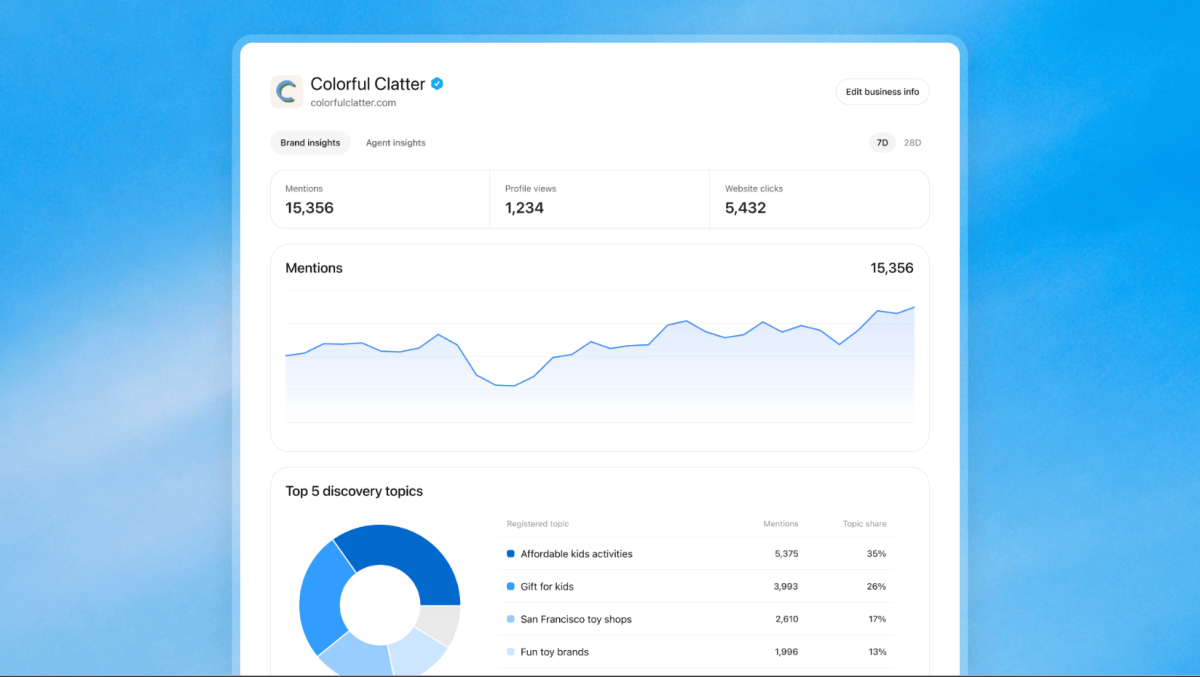
In an effort to make ChatGPT an even better consumer discovery engine, OpenAI is launching a host of new features designed to help companies control how users interact with their businesses.
On Tuesday, the company rolled out a Business Hub that will serve as a place where companies can create business profiles that — in a feature that greatly resembles the kind of profiles that Google and other search engines already offer — allow enterprises to verify and update information about their products and services. The feature is currently in beta.
Eligible companies will also be able to create and launch a specialized business agent, which gives ChatGPT users the ability to ask questions about the business and its products.
“As people turn to AI to discover products, compare options and make decisions, ChatGPT has become the platform for people and businesses to connect through AI,” the company said on Tuesday. “Today’s announcement is an early step in bringing businesses more deeply into ChatGPT.”
In a move that calls to mind Google Analytics, the Business Hub will also give users access to limited business insights. These insights will reveal how ChatGPT users interact with their products — including profile views, business mentions, website clicks, and other metrics.
Businesses will have to verify their profiles through a formal process, although the company did not share specifics of what that process would entail. Benji Shomair, OpenAI’s VP of Monetization, told journalists on Monday that there are “multiple verification methods that we use for different types of business in different markets.”
OpenAI previously tried to position ChatGPT as an e-commerce hub by which users could buy products directly. This effort — which used a commission fee system — was viewed as a potentially huge source of revenue and a way to make ChatGPT a more direct Amazon competitor. However, that project ultimately failed to take off and, in March, the company retired the effort, which had even included a “checkout cart” feature.
With the integration of business profiles and intelligence, ChatGPT seems to be attempting to become more like Google, which — since the advent of the internet — has been the place where web users go to understand the companies they want to shop at. It remains to be seen whether this initiative will bear better results than the one that sought to make ChatGPT a direct e-commerce hub.
Business
Amazon unveils Ring robotics: Indoor flying drone and Rover Cam

Amazon introduced an indoor security drone made by Ring, offering a flying camera to monitor areas stationary devices cannot reach, the company announced Tuesday.
The company also unveiled the Ring Rover Cam, an autonomous security robot for businesses that patrols, investigates disturbances, and streams up to 4K video. Both devices are powered by AI Pilot, a custom system that maps spaces, suggests patrol points and navigates around obstacles.
“For years, customers told us they wanted eyes in the places a fixed camera couldn’t reach, and peace of mind in the spots they’d never want one,” said Ring founder and chief inventor Jamie Siminoff.
AMAZON TO CUT NEARLY 1,000 WHITE-COLLAR JOBS ACROSS STORES DIVISION AND OTHER UNITS: REPORT
“The honest answer wasn’t more cameras; it meant reimagining what a security device could be,” he added. “That kind of invention is hard, and it takes time. But we kept at it until we got it right — and that’s Ring Robotics. It’s not just a new category of security; it’s the beginning of a future where proactive, autonomous protection is something every home and every business can have.”
The $250 indoor drone allows users to set automated patrol routes on a schedule or deploy the device on demand.
AMAZON CRASH ATTORNEYS SAY PILOT PAIRING MAY HAVE BEEN KEY FLAW BEHIND FATAL INCIDENT
Ticker Security Last Change Change % AMZN AMAZON.COM INC. 266.93 +7.63 +2.94%
When a connected Ring camera, sensor, or alarm is triggered, the drone automatically flies to designated patrol points to investigate.
It features a 148-degree field of view, 360-degree rotation, and dual built-in LED lights for low-light environments.
Meanwhile, the $1,000 Ring Rover Cam is tailored for businesses to conduct automated property sweeps or investigate incidents.
“Get a closer look wherever and whenever you need it without the cost and complexity of wiring up every corner of every room,” the company stated, adding that the Rover was inspired by Amazon Astro feedback highlighting customer demand for roving security.
CLICK HERE TO GET FOX BUSINESS ON THE GO
Business
Smart ring maker Oura to acquire Counsel Health for $625 million

Nov 10 (Reuters) – Smart-ring maker Oura said on Tuesday it will acquire virtual primary care company Counsel Health for $625 million in an all-cash deal, combining Oura’s biometric data with Counsel’s care platform and on-demand physicians.
Counsel is an AI-enabled company that combines a chat-based medical interface with access to licensed, board-certified physicians for people to get help with everyday health questions.
Sign up here.
The deal reflects Oura’s push into healthcare research efforts, as wearable devices play a growing role in clinical care and outcomes tracking.
“Oura helps members understand their physiology and, with Counsel, they can take action on their health across a range of needs, from quick questions and prescriptions to lab results, chronic care, and referrals,” said Oura CEO Tom Hale.
In September, the company said it was aiming for a US initial public offering, but the listing was delayed due to volatile markets.
The company, founded more than a decade ago in Finland, was valued at about $11 billion in a late-stage funding round last year.
Oura said the deal to acquire Counsel Health is expected to close before the end of the calendar year.
Reporting by Christy Santhosh in Bengaluru; Editing by Tasim Zahid and Shinjini Ganguli


The outstanding ballots that could decide the Mississippi Senate race
Tuesday is the deadline for voters in Mississippi to provide updated documentation if they had to cast provisional ballots on...


The David Walliams allegations | BBC Newscast
Today, David Walliams has been named as the 'well-known celebrity' who was fighting in the courts to block the publication...


Hegseth, Massie trade barbs over impeachment articles
Defense Secretary Pete Hegseth described the effort to impeach him as “a political spectacle,” after GOP Rep. Thomas Massie …


Bernie Sanders says he won’t back Sen. Schumer for Democratic leader
Sen. Bernie Sanders, an independent who caucuses with Democrats, and Democratic Sen. Elissa Slotkin said they won't back …


Will Jeffrey Epstein's associates be brought to justice under Democrats? | Global News Podcast
WARNING: This video includes refrences to sexual violence, which may be disturbing to some viewers. A BBC investigation has …


Mitchell Robertson Cast as Purported Gay Lover
A planned biopic focusing on James Dean‘s personal life has found its co-lead. Mitchell Robertson, the Scottish actor known for...
They had jobs, homes and cars. Now they’re in line at the food bank
For years, Dave Poniatowski had no trouble managing his household budget. Then came a devastating triple whammy: two years without...


This bull and donkey are a same-sex couple
In an unusual pairing, this donkey and bull have struck up a same-sex relationship and researchers are trying to figure...


Rep Jordan elected House GOP leader: What to expect
House Republicans on Tuesday picked Rep. Jim Jordan — the famously pugnacious pro-Trump fighter — to lead their party in...


First snow and cold blast to bring an early taste of winter to the East
A late-week storm could bring snow to higher elevations in the Northeast before cold air plunges deep into the South.
-

 Entertainment2 weeks ago
‘Baywatch’ Star Erika Eleniak on Track to Hit $1 Million in 1st Year on OnlyFans
-
HealthNews2 weeks ago
The Most Powerful Obesity Drug Yet Has a Hidden Benefit-and It Happens While You Sleep
-

 Business2 weeks ago
Dollar General overcharged millions at checkout for years, FTC and 20 states allege
-

 Business2 weeks ago
In China, the AI bubble has already burst
-

 Entertainment2 weeks ago
Inside Matthew Perry’s ‘struggle’ ahead of the 2021 ‘Friends’ reunion
-
Entertainment2 weeks ago
I’m a Bus Driver at Walt Disney World at 51 Years Old; Great Benefits
-

 Entertainment2 weeks ago
Taylor Swift, Travis Kelce wedding props deemed too expensive, dangerous revealed
-

 HealthNews2 weeks ago
Comfort food may be exposing you to over 1,000 microplastic particles a week