
Sports
2026 iPad mini review: Maximizing the mini

The iPad mini has long felt like a niche product. It has earned a reputation as a quality tablet for people who want something small, comfortable, and portable, but its small screen and comparatively limited processing power have restricted its appeal, making it best suited to watching media or playing games.
With the 2026 version, the iPad mini is more competitive than ever. Its chip is current, its speakers are better, and, most impressively, it trades its 8.3-inch IPS screen for an 8.5-inch OLED that can hold its own against other premium tablets. There isn’t much more you can ask of an iPad this small.
But at just $50 less than the larger, more powerful iPad Air (11-inch), the iPad mini still has a hard time making a case for itself.
Larger OLED screen
The most immediately noticeable change to the 2026 iPad mini is its display. At 0.2 inches larger than the 2024 iPad mini’s screen, the difference might not sound like much, but it has a meaningful impact on a tablet this small. Beyond providing a bigger view of photos, video content, and lengthy documents, the extra space makes it easier to work with multiple windows, giving you more room to view them and adjust their size and location.
One of our biggest complaints about the prior mini was its bezels, which felt large for a tablet of its size. This time, Apple managed to fit a larger screen in a slightly smaller tablet (7.69 × 5.22 × 0.21 inches and 0.56 pounds for the 2026 mini versus 7.69 × 5.3 × 0.25 inches and 0.65 pounds for the 2024 mini) by reducing the bezels by 24 percent. The result is a streamlined viewing experience that feels more modern and appropriate for a new Apple product.
And you’ll certainly want to watch content on the 2316 × 1512 OLED display, which packs 326 pixels per inch. OLED displays often lack the brightness of their LCD-LED counterparts, but the gap has narrowed in recent years. The new mini is brighter than its IPS-based predecessor, with Apple claiming full-screen brightness of up to 600 nits, compared to 500 nits on the previous model. It’s also much better suited to HDR content, with peak HDR brightness reaching 1,200 nits for highlights and a contrast ratio of 2,000,000:1.
Since content consumption is arguably the mini’s strongest use case, it makes sense for Apple to focus on changes that enhance the viewing experience. Watching shows and movies feels as luxurious as possible on a screen this size, and the mini maximizes its display in nearly all the ways that matter.
I say “nearly” because the mini still has a 60 Hz refresh rate; 120Hz is limited to the iPad Pro. A 120 Hz refresh rate makes little difference when watching most shows or movies, but it can make some tasks, such as scrolling through long documents, look smoother. Still, the difference is less noticeable on a smaller screen.
Overall, the refresh rate didn’t feel like a drawback during regular use. Apple has gone a step further, noting that OLEDs typically have faster response times than IPS displays. That’s generally true when discussing gray-to-gray (GtG) response times. However, moving picture response time (MPRT) can be a better indicator of potential persistence-related motion blur, including during scrolling, because it measures how long an image remains visible on the display, contributing to blur as your eyes track moving content. GtG, by contrast, measures how quickly individual pixels transition between shades. Slower pixel transitions can create motion artifacts such as ghosting.
According to Blur Busters’ MPRT Indicator, the mini has an MPRT of about 17 ms, about what I’d expect from a 60 Hz IPS display. Anyone who needs a high-refresh screen will still want to look at the Pro series.
One feature the mini borrows from the iPad Pro but that other iPads lack is the option for nano-texture glass, which is designed to reduce glare. It costs an extra $100 and is only available on the 256GB and 512GB versions of the mini.
A current-gen processor
The 2024 mini debuted with a year-old chip, but this year’s model sports Apple’s latest mobile processor. The 2026 mini makes a considerable jump from the A17 Pro, a 3-nanometer, iPhone 15 Pro-era chip from 2023, to the A20 Pro, a 2-nanometer chip that debuted in the new iPhone 18 Pro.
The newer chip has 50 percent more memory bandwidth, which significantly boosts graphics performance. It’s also up to 60 percent faster.
I tested the 512GB version of the iPad Mini, which, like the 128GB and 256GB versions, features a seven-core integrated GPU. The 512GB model, however, gets a bump from five CPU cores to six and doubles the number of 16-core Neural Engines from one to two, promising better performance in on-device AI applications, such as image generation.
I don’t expect many people to run particularly intensive workloads on a tablet this small. Still, tasks such as photo editing, light video editing, and juggling many open applications felt smooth. The performance boost makes the iPad mini much more powerful than the standard iPad 11, which uses an A16 processor. The iPad Pro (M5) and the iPad Air (M4), however, remain better equipped for demanding workloads such as video editing and 3D rendering.
Siri AI is still in beta, so we won’t cover that in this review. But the tablet supports features under the Apple Intelligence umbrella, including various generative AI capabilities. Tasks like removing objects from photos, changing a photo’s perspective, or extending a photo’s borders should take roughly the same amount of time on the 512GB iPad mini as they do on the iPhone 18 Pro. In my experience, that’s usually about 20 seconds.
Better speakers
The mini is surprisingly loud. Its speakers are powerful enough to make TV dialogue easy to hear, even with my noisy heater running in the background.
The tablet has two woofers designed to deliver higher volume and stronger bass than the prior mini. A pair of custom-designed tweeters between the tablet’s glass and aluminum enclosure are intended to improve the clarity of higher frequencies.
You won’t get the deepest bass or the crispest high notes, but the speakers surpassed my expectations when playing music. I didn’t immediately feel the need to connect the iPad to dedicated speakers.
And the mini pulls this off without any visible speaker holes in its chassis.
That detail helped the mini earn the first IP67 rating for an iPad. The Ingress Protection rating means the device is “dust-tight” and “protected against the effects of temporary immersion in water,” according to the International Electrotechnical Commission.
Other changes
The 2026 mini has the same 12 MP front and back cameras as its 2024 predecessor, but the front-facing camera has moved from one of the shorter sides to one of the longer sides. This took some getting used to for FaceTiming and selfies. Holding the tablet in portrait orientation now places you off-center in the frame, while holding it in landscape mode to FaceTime on the go quickly became uncomfortable. The new location was fine when I could sit down and prop the tablet on a stand.
Another addition is the back camera’s Adaptive True Tone flash, which Apple markets as a way to quickly scan documents. When the Camera app identifies a document, such as a piece of paper or a book, it automatically adjusts which of the camera’s LEDs light up to minimize shadows and produce clearer text.
When I used the tablet’s camera to photograph text on both a piece of paper and a book, it quickly used machine learning to identify them as documents. A pop-up appeared, offering the option to “Scan Document”; selecting it allowed me to automatically take a picture of just the document. It’s not a feature many people will use regularly, but when the need arises, it makes capturing a sharp, detailed image of text considerably easier.
Additional upgrades include a move from Wi-Fi 6E to Wi-Fi 7 and from Bluetooth 5.3 to Bluetooth 6. These capabilities come from the introduction of Apple’s N1 wireless networking chip, which also adds Thread support. Apple launched the N1 last year with the iPhone 17-series and iPhone Air.
The iPad mini also has the C2 cellular modem that Apple unveiled last month in the iPhone 18 Pro and iPhone Duo. For those who rely on cellular service, it’s reassuring that the tablet uses the same technology here as some of Apple’s best phones.
Although it’s not an upgrade, it’s impressive that the new mini has the same battery life as its predecessor, despite having a smaller chassis and a larger screen. The mini also gains support for fast charging.
iPad mini…to the max
With the 2026 model, the iPad mini feels less like a compromise. Its larger OLED screen, current-generation processor, more durable build, and better speakers make it feel more modern and competitive than the 2024 version.
These improvements come with a pricing predicament, though. Today, the iPad mini starts at $699 for the 128GB version, putting it just $50 below the 11-inch iPad Air (M4) at its lowest configuration. The 512GB mini I tested, which came with a more powerful A20 Pro chip, is $999. In 2024, the iPad mini started at $499, and the iPad Air 11-inch (M2) started at $599.
The mini’s OLED screen is a standout, but the Air remains a better choice for those seeking a balance between power and portability. Its more capable processor and still-excellent, larger IPS display make it more versatile. It also offers comparable battery life, though it lacks fast charging. Meanwhile, the Pro series remains the best option for demanding workloads and extensive multitasking. The Mini is much more capable of handling serious work, multitasking, and editing than it was before, but it still isn’t the best iPad for these purposes.
Despite narrowing the gap with other tablets, the mini is still a niche product. The biggest reason to pick it over other iPads is if you truly want the smallest device, primarily for content consumption. My preference for devices that are easy to handle without straining my smaller hands or weighing me down, combined with my appreciation of high-end displays, love of streaming, and interest in using secondary screens to boost productivity, confirms that this niche has an audience. Many of Apple’s improvements make the mini more enjoyable for these users.
Beyond comparisons with the rest of the iPad lineup, though, the mini makes the most of its small design. Apple fit just about everything it could into a device that’s somehow even smaller than its predecessor.
For anyone looking for an ultraportable tablet primarily for enjoying content on an excellent, high-end display, the mini is a markedly better device than it used to be.
The good
Fantastic screen that feels more premium with smaller bezels and OLED performance
Strong speakers for a small tablet
The first iPad with an IP rating
The bad
Refresh rate is lower than some other premium tablets
Only $50 cheaper than the bigger, more powerful iPad Air
Sports
Giants serious about JT, Vikings, Broncos less so

Link copied to clipboard!
Sports Illustrated’s Albert Breer reports that the Giants are serious suitors for Jonathan Taylor, while the Broncos and Vikings might be less inclined to acquire him.
All three teams have inquired about Taylor’s trade cost. Per Breer, the Colts either want a first-round pick or a draft pick package similar to what the Panthers received for Christian McCaffrey in 2023. The 49ers handed over 2023 second-, third- and fourth-round picks, and a 2024 fifth-rounder to acquire him. None of the three suitors have met either asking price yet. That said, the Giants have reportedly offered enough for Breer to label them “a serious suitor.” Stay tuned.
Related Player News
IND Running Back #28
Personalize your Rotoworld feed by favoriting players
Taylor didn’t dwell on the question for more than a word, but he did confirm that no trade request has been made. The team’s desire to trade him is ultimately about rebuilding the roster after going all in on the ill-fated “Daniel Jones era.” With several teams reportedly interested and the Colts strongly motivated to recoup draft capital for the coming years, we expected a deal to get done before Tuesday’s deadline. For now, fantasy managers can keep Taylor in their lineups, as there’s been no indication that Taylor will be put on ice to protect his trade value.
Long story short, the Colts are trying to wring every last ounce of draft capital out of their roster and think teams will up their offers after Sunday’s games. Schultz named Jonathan Taylor, Josh Downs, and Grover Stewart as players who could be on the move. Daniel Jones’s name has also come up, though it’s hard to imagine another team paying even a late-round pick for his services given how dreadful he has been this year. All signs point to Taylor being moved early next week, but it’s clear the Colts are going to play hardball in trade talks. We still suspect he’s playing for a new team by Week 10.
Steichen mostly dodged questions about why the Colts would play Taylor in Week 9 if the team was in talks with contenders who might want to acquire the star running back before the NFL’s trade deadline. “Teams call all the time,” Steichen told reports. He said the team was focused on the Cowboys, their opponents in Week 9. Taylor seems more than likely to be dealt to another team in the coming weeks. That could be the Vikings, Bengals, Seahawks, or another contending team in need of backfield help.
Stevens said that this trade “could happen at any moment,” telling Broncos Country that they “might not want to go to sleep.” While this could be hyperbole, it sounds like Stevens is saying the trade could go down tonight. Stevens said he’s had conversations with multiple people on the matter, and the Broncos “know that this is not the time to wait and develop” young running backs. Stevens closed by reminding viewers that the Broncos were very interested in Breece Hall at one point, and added that there are likely other backup plans that the Broncos could be considering.
With the Colts losing 28-0 at halftime and 42-7 going into the fourth quarter, there simply wasn’t any run to be established. Daniel Jones also short-circuited two drives with interceptions, further limiting volume in a game where it was already exceedingly difficult to come by. You could question why Taylor even played at all as trade rumors swirl ahead of the Nov. 10 deadline, but that will be a bigger question mark in Week 9 against the Cowboys. That’s a far better matchup than the Jaguars, so even if Taylor remains in limbo, you will have no choice but to fire him up for what could be his final game in a Colts uniform.
The Vikings dots have been getting connected for a while now, so it’s not surprising to see something of a confirmation they are interested. The Giants and Bengals also make all the sense in the world. Green Bay would be a fit, as well, though it would be a bit surprising to see the Broncos add to their running back surplus. Taylor, of course, would blow their other backs out of the water. There’s enough smoke here to believe a fire might break out, but the Colts can probably be taken at their word that it would take an overpay to pry away what amounts to their franchise player right now.
The Panthers netted second-, third-, fourth-, and fifth-round picks for McCaffrey when they sent him to San Francisco in 2022. Indy reportedly turned down an offer of a second-round selection plus another pick for Taylor, meaning they have their eyes set on the full compensation that Carolina landed. The fact that the Colts abruptly changed their stance on trading Taylor at all this weekend suggests it’s only a matter of time before a deal gets done. They have until November 10th, the Tuesday after Week 9, to find a trade partner.
Multiple teams are interested in acquiring the 27-year-old Taylor and talks are active and ongoing, according to Schefter. The Ringer’s Tom Pelissero reported that the Colts already turned down an offer for Taylor that included a 2027 second-round pick and another pick. While previous reports stated the Colts weren’t interested in trading Taylor, who signed an extension before the season, Indianapolis appears to be holding out for the best offer they can get. Taylor would see a slight boost in fantasy value if acquired by another team while Seth McGowan would likely take over the Colts’ backfield.
Steichen said Taylor will see a full workload despite being the subject of trade rumors for a Colts team that will clearly be sellers at the deadline. Taylor is healthy and not on the injury report, so this is strictly an update to inform fantasy managers they can start him with confidence this week. Taylor remains a high-end RB1 as long as his normal workload remains intact.
The Colts this week dealt DeForest Buckner to the 49ers and Quenton Nelson to the Seahawks in what looks like a fire sale ahead of the NFL’s trade deadline. Taylor could be next if the Colts are ready to go all in on a rebuild in 2027 and beyond. A contender would likely have to part with a second round draft pick if they want Taylor in the coming weeks. Teams that could be suitors for Taylor include the Bengals, Vikings, and Seahawks, all of whom have backfield issues.
Personalize your Rotoworld feed by favoriting players
Link copied to clipboard!
MarShawn Lloyd (knee) is questionable for Week 9 against the Patriots.
Lloyd popped up on Thursday’s injury report with the knee issue, and now appears to be a game-time decision. Chris Brooks (ankle) is also questionable for the Week 9 tilt, so there could be depth issues for the Pack behind Josh Jacobs, who has struggled in his return to action as well.
– Christopher Crawford
Alvin Kamara has no injury designation for Week 9 against the Browns.
Kamara was limited due to rest and a back injury, but unsurprisingly, he’ll be good to go for Sunday’s contest against the Browns. The Saints’ run game is a disaster, but Kamara should be involved enough in the pass game to make him a decent FLEX play for that contest.
– Christopher Crawford
Sports Illustrated’s Albert Breer reports that the NFL’s defensive tackle market “has been hot,” and teams “might” try to trade for Derrick Brown.
The Panthers are “not actively looking to move” Brown, but Breer says they have considered it. Other defensive tackles on other teams who have come up in trade talks include Grover Stewart, Davon Godchaux, Nathan Shepherd, Christian Barmore and Bobby Brown. The Dolphins have told teams they are not interested in trading away Zach Sieler.
Jauan Jennings (calf) was not seen practicing on Friday.
Jennings was limited yesterday, which could mean he injured his calf during the Vikings’ Thursday practice. If this is the case, he is probably unlikely to suit up for his team’s Monday Night Football game against the Bills.
Sports Illustrated’s Albert Breer reports that Josh Downs “leads the wide receiver market” ahead of the NFL trade deadline.
Downs’ 2026 season has fallen short of expectations, but perhaps he has a chance to rebound. Breer believes acquiring Downs would “probably” cost a fourth-round pick. He is “one of a number of receivers on the market” at the moment, with the Chiefs and Steelers among the teams looking for help at the position. Breer adds that the 49ers are “open” to adding a wide receiver as well, but with their positional health improving, San Francisco is “less desperate than they were a couple of weeks ago.” The Steelers’ wide receiver corps might be too muddled for Downs to meaningfully increase his productivity, but landing in Kansas City or San Francisco would likely be good for him.
Emeka Egbuka (foot) is listed as questionable for Week 9 against the Bears.
Egbuka was able to get in another full practice Friday after getting the same Thursday, so it seems like he’s on the right side of the questionable tag, even with coach Todd Bowles suggesting he’ll be a game-time decision. The 24-year-old wideout is on the WR2/WR3 range for the Sunday Night Football showdown against Chicago if he is able to go.
– Christopher Crawford
Denzel Boston (calf) was removed from the injury report and will play in Week 9 against the Saints.
Boston will once again play through a lower-body injury. The rookie downfield wide receiver has played unproductively as of late, but he remains a threat to rip off a long gain. He will be catching passes from Shedeur Sanders this weekend. Hopefully, the two form a strong connection quickly.
KaVontae Turpin (ribs) was ruled out for Week 9 against the Colts.
This will be a third-straight missed game for Turpin as he battles his rib issue. The 30-year-old has just seven targets on the season, but will again be missed by Dallas in the return game. Malachi Lawrence has also been ruled out by the Cowboys due to his ankle injury.
– Christopher Crawford
Jake Ferguson (ankle) is listed as questionable for Week 9 against the Colts.
Ferguson wasn’t able to practice Wednesday or Thursday, but he was able to get in a limited session Friday to give him at least a chance to play Friday. Luke Schoonmaker (groin) was also listed as questionable with limited practices all week. If Ferguson is able to play, he’s in the TE2 vicinity against Indianapolis.
– Christopher Crawford
Sports Illustrated’s Albert Breer reports that the Jaguars “have been less inclined” to trade away Brian Thomas.
Breer and NFL Network’s Cameron Wolfe put out similar reports today, indicating that the Jaguars are now hesitant to trade away Thomas. Per Breer, Thomas is not the best fit for coach Liam Coen’s scheme, but he “brings a downfield element that’s really important in keeping defenses honest against the run, and opening things up underneath for Jakobi Meyers and Parker Washington.” Wolfe echoed Breer’s downfield sentiment and added that when the Jaguars traded away Tyson Campbell last year, it had a negative impact on the locker room — and Jaguars brass has “learned from it.” Thomas and Travis Hunter are reportedly close friends, and Thomas is liked in the locker room. It sounds like the formerly productive wide receiver might be staying put. Breer lists the Chiefs and Steelers, and the 49ers to a lesser degree, as the teams known to be seeking wide receiver help.
Sports
2026 Election Results Live Updates: Size of Democratic Majorities Hinges On Close Races

The unexpected nail-biter in deep-red Mississippi was a remarkable reflection of Democrats’ success across the country, and in the South especially, and it raised the possibility that the state would elect a Democrat to the Senate for the first time in 44 years. A win by the Democratic Senate nominee, Scott Colom, would be a stunning upset, and he would be the state’s first Black senator since Reconstruction.
Lawyers for the Republican incumbent, Senator Cindy Hyde-Smith, wrote to Mississippi officials on Thursday to request that provisional ballots be preserved, a signal of potential litigation over the election. Ms. Hyde-Smith trailed Mr. Colom by about 1,800 votes on Thursday night. A lawyer for Mr. Colom’s campaign wrote a letter to election officials objecting to aspects of the request from the Hyde-Smith campaign.
The N.A.A.C.P. said that it had sent lawyers to Mississippi. Derrick Johnson, the group’s president and a resident of Jackson, Miss., said in a statement that his team was “working around the clock in Mississippi to make sure voters who used provisional ballots are counted.”
In Alaska, former Representative Mary Peltola, a Democrat, had a slim lead over Senator Dan S. Sullivan, a Republican, on Thursday night. A New York Times analysis indicated that Ms. Peltola’s lead would most likely hold. But it could be days before remaining mail ballots are counted, and the race may require a ranked-choice tabulation, which would not occur until Nov. 18.
Ebullient Democrats continued to celebrate their election gains, while Republicans were reckoning with their worst performance since the aftermath of the Watergate scandal a half-century ago.
President Trump wrote on social media late Thursday that his party had faced a drubbing because he was not on the ballot. “IF I WERE, WE WOULD HAVE WON IN A LANDSLIDE!” he wrote.
Hours earlier, Senator John Curtis, a Utah Republican, pinned the defeat on the president. “It turns out voters care about the economy,” Mr. Curtis said, adding, “This was about the president and the president’s policies.”
As Republicans pointed fingers at one another, and the president, for the steep losses, Secretary of State Marco Rubio dismissed reports that he was planning to leave the Trump administration but declined to answer questions about his political future in an interview.
Here’s what else we’re covering:
Democratic socialist mayors: Nithya Raman’s victory in the race for Los Angeles mayor makes her the latest democratic socialist to be elected to lead a major U.S. city over the past year. The group includes the mayors of New York, Los Angeles and Seattle. Read more ›
Transgender athletes: Voters in four states chose to bar transgender athletes from competing on female sports teams. Opinion polls show that most Americans say transgender girls and women should not play on girls’ and women’s sports teams, and the Democratic Party has wrestled with internal divisions on the issue. Read more ›
Progressive power player: Representative Katherine M. Clark of Massachusetts, the No. 2 House Democrat, is set to become the majority leader in January. Ms. Clark would make history as the first woman to hold that title, though Representative Nancy Pelosi of California served as House speaker, a loftier role. Read more ›
But the agreement, which has been more popular among Democrats, takes effect only once signed by states representing a majority of the Electoral College, or at least 270 electoral votes, the amount needed to win the presidency. Eighteen states and the District of Columbia have adopted the compact so far, representing 222 electoral votes.
If all four of the states that just won total Democratic control were to join the agreement, it would tip the group over the 270-vote threshold. Arizona, which is allotted 11 electoral votes, was also projected to have a blue trifecta, though not all of its races had been called by Thursday evening.
Lawmakers in key states said on Thursday that they had already begun having conversations this week about introducing legislation to join the agreement in the next session, and were hopeful that they would succeed ahead of 2028. But broadening the compact could present a mighty political lift.
“The time is right,” Carrie Rheingans, a Democrat in the Michigan House of Representatives, said in an interview. “This blue tsunami is really going to help push this forward across the whole nation.”
Still, Democratic lawmakers “can be apprehensive” with a new majority, said Mattie Daughtry, the Democratic president of Maine’s State Senate. She worked on the compact issue for over a decade before her state joined in 2024.
“The biggest roadblock is convincing them to use these majorities to do big things,” Ms. Daughtry said.
In 2019, Nevada’s Democratic governor vetoed a bill to join the agreement, saying it could diminish smaller states’ influence in presidential elections.
Now, it is unclear whether lawmakers will prioritize passing the compact after running campaigns dominated by other concerns, like easing high costs and imposing guardrails on the Trump administration.
“Time will tell,” said Clinton Anderson, a Democratic state assemblyman in Wisconsin, adding that he planned to reintroduce a compact bill. “I want to make it a priority, but it’s not the thing I heard on the doors I knocked.”
Kelda Roys, another Democratic lawmaker in Wisconsin, said that her initial attempt to get her state to join the compact in 2009 had been met with hesitancy among people who were unsure exactly what it was. Now, she said, there is a broader public understanding of what problems the Electoral College could present.
“National popular vote will be something that we’ll prioritize early in the session,” Ms. Roys said.
The idea for a compact among states to bypass the Electoral College gained traction among legal scholars and supporters after 2000, when George W. Bush won the presidency while losing the national popular vote. Momentum grew in 2016 after a second Republican candidate, Donald J. Trump, won despite losing the popular vote.
Supporters of the compact said they view the Electoral College as a less democratic mechanism than the popular vote. A YouGov poll conducted in June showed that 56 percent of American adults supported choosing the president via popular vote.
The compact is also more practical than amending the Constitution and popular among voters, supporters said.
Opponents and legal experts said the compact would face a slew of court challenges. One obstacle is that compacts traditionally require the approval of Congress and the president, said Derek Muller, an election law expert at Notre Dame Law School who has written about the agreement.
“It’s a very real possibility that enough states join this compact,” he said. “There will be a lot of challenges.”
In an election when Democrats broke through conservative strongholds to gain majorities in the House and Senate, Mississippi and Alaska are the only remaining states where the Senate races do not yet have a clear victor.
That there is suspense at all in Mississippi, which has not sent a Democrat to the Senate in more than four decades, has stunned Democrats and Republicans.
“I’m glad that the country is starting to see what Mississippi values look like and what Mississippi’s potential is,” said Mr. Colom, as he spoke to reporters in Jackson.
On social media, Ms. Hyde-Smith’s campaign said she would remain in the Senate, given that “we believe thousands of votes remain to be counted from dozens of Republican counties, and we are confident those votes will reinforce her path to victory.”
The outcome of the race appears to hinge on what the state has said is an unknown number of affidavit ballots, cast by voters who were either listed as inactive or without proper identification. On Thursday, Michael Watson, the secretary of state, said roughly 3,300 absentee-by-mail ballots were also still outstanding. To count, they must be received within five business days of Nov. 3.
He did not provide a number for the uncounted affidavit ballots, but said that 6,936 affidavit ballots had been processed. The deadline for counties to certify their election results to the state is Nov. 13.
Unlike most states, Mississippi law does not allow for a recount of votes in a statewide election.
In Jackson, the state capital, on Thursday, lawyers, reporters, poll watchers and, at one point Mr. Colom’s wife, milled among the tables in the cramped Hinds County Election Commission headquarters. The commission members had been going through ballots since 7 a.m., working steadily but with little acknowledgment of the intense national scrutiny.
“I hope they put a pep in their step,” said June Hardwick, a lawyer who supported the Colom campaign.
Jermal Clark, one of the commissioners, said they had to ensure that they were being thorough and that they were following the law. “To me, everything is going well,” he said. “It’s just congested.”
Republicans were not taking chances.
On Thursday, Republican lawyers wrote to election commissioners to demand “the immediate separation, secure custody, and preservation of all affidavit ballots.” Mr. Colom’s legal team responded with their own letter, calling it a request for “unlawful and extraordinary measures” and warning that it risked leading to the unlawful identification of voters.
Mike Hurst, the chairman of the Mississippi Republican Party and the general counsel of the Republican National Committee, said that lawyers aligned with national Republicans and Ms. Hyde-Smith’s campaign “will be ready, if necessary, to avail ourselves of every legal option at our disposal, if there is evidence that the law has been violated.”
“We’ve never seen this before in Mississippi — we’ve never seen this volume of affidavit ballots around this state,” Mr. Hurst said. He added, “This race is far from being over.”
Some Mississippi organizers said it was possible that some of that increase in affidavit ballots might trace back to last July, when the secretary of state’s office announced it would use data from Experian, the credit reporting agency, to help maintain the state’s voter rolls.
As part of that change, registered voters identified as having a new address were labeled “inactive” until they returned a confirmation card with their new address. Anyone who showed up to vote this year and was marked “inactive” had to fill out an affidavit ballot.
Cassandra Welchlin, the executive director of the Mississippi Black Women’s Roundtable, said her organization was helping to organize rides for students to get to courthouses and ensure their ballot was counted and would be launching ads to remind voters to follow up on their affidavit and mail-in ballots.
“Is it a little nerve-wracking? Yes,” Ms. Welchlin said. “Because we want to make sure that every vote is counted.”
Mr. Colom, a district attorney with deep roots in the state, mounted a relentless campaign, energizing the state’s Black voters and coaxing white Democrats and disenchanted conservatives to buy into his message of “Mississippi Matters.”
Ms. Hyde-Smith saw more than $1 million pour in during the campaign’s last stretch from national groups. President Trump also held a rally in Corinth for Ms. Hyde-Smith and urged Republicans to vote.
Mr. Colom used Ms. Hyde-Smith’s words against her, making a campaign ad out of her suggestion that voters could choose alternative proteins as meat prices climbed. The tagline “Pick another protein? Pick another senator” became his campaign’s rallying cry in the final days before the election.
Jimmie E. Gates contributed reporting from Jackson, Miss.
A strong emphasis on expanding public services, such as housing, health care, child care, public transportation and infrastructure, and heavily taxing corporations and wealthy individuals ties together their positions.
Here’s what to know:
Democratic socialists have been elected mayor in several cities.
In New York City, Zohran Mamdani’s election last year made him perhaps the most prominent mayor who is a member of the D.S.A. As part of his progressive agenda, he has pushed through a “rent freeze” for nearly one million rent-stabilized apartments, fought to tax high-end second homes and expanded a free child care program for 2-year-olds in partnership with Gov. Kathy Hochul.
In Los Angeles, where the mayor’s race is nonpartisan, Ms. Raman, a city councilwoman, is a member of the D.S.A. An urban planner by training, she promoted an aggressive expansion of the housing supply, advocated zoning changes and called for prioritizing public transit improvements, among other proposals. She will unseat Karen Bass, a more moderate Democrat who has served as mayor since 2022.
In Seattle, Mayor Katie Wilson, who was elected last year, has described herself as a democratic socialist but is not a D.S.A. member. In office, she has accelerated homeless shelter openings, led the passage of a major transit service expansion and rolled out new investments in preschool programs.
In Washington, D.C., Janeese Lewis George, a district councilwoman who is a member of the D.S.A., was elected mayor on Tuesday. She has called for enacting universal child care, building social housing owned by the city, strengthening tenant protections and lowering rental costs for small businesses. She is set to replace Muriel Bowser, a Democrat who is more moderate and did not seek a fourth term.
In Providence, R.I., David Morales, a state lawmaker and former professional wrestler who is also a D.S.A. member, was elected mayor on Tuesday. He easily defeated his Republican opponent, David Talan, after running a campaign focused on capping rent hikes, building affordable homes in vacant buildings and on empty lots and demanding that corporations contribute more to funding city services and public schools.
President Trump responded.
After Ms. Raman’s race was called on Thursday, President Trump was asked about the election of democratic socialists. He predicted that people would be unhappy with their policies and said, “It’s going to be a disaster.”
“Unfortunately, usually that happens so late that you’ll never be able to bring back a city, or a country or a state, when it goes too far,” Mr. Trump told reporters in the Oval Office.
Sports
Knicks Star Tyler Kolek Slams Taylor Swift For Being a ‘Performative’ Fan

UPDATE
10:01 AM PT — The New York Knicks are making it crystal clear that while Kolek and McBride may have their personal feelings on Taylor’s fandom, it’s not the position of the organization.
“Taylor Swift has been a Knicks fan for many years, has a long history with Madison Square Garden, and we are incredibly appreciative of her support of the organization,” a NYK spokesperson told TMZ Sports.
Taylor Swift is used to people fawning over her … but New York Knicks star Tyler Kolek is bucking the trend, calling out the pop princess for possibly being the team’s fakest celebrity fan.
Kolek made the bold statement during Thursday’s NBA 2K TikTok livestream, where the Knicks point guard was interviewed along with teammate Deuce McBride — and, at one point, the reporter asked, “Who is the fakest celebrity Knicks fan?”
Kolek responded that some people are “performative” and just want to be seen at the Knicks games and aren’t necessarily fans. Then Kolek surprisingly took aim at Taylor, saying she might be the biggest fake of them all.
At first, Kolek said Taylor has a lot going on, so she can’t come to all the games … and then he said that when she does attend games, she’s “a little performative.”
McBride then chimed in, saying Kolek was probably going to catch some hell from the “Swifties” — and Kolek agreed. McBride went on to say that the Knicks have a core group of celebrity fans, such as Ben Stiller and Tracy Morgan.
Sports
Notre Dame vs. Miami: Why the rivalry still burns after all these years
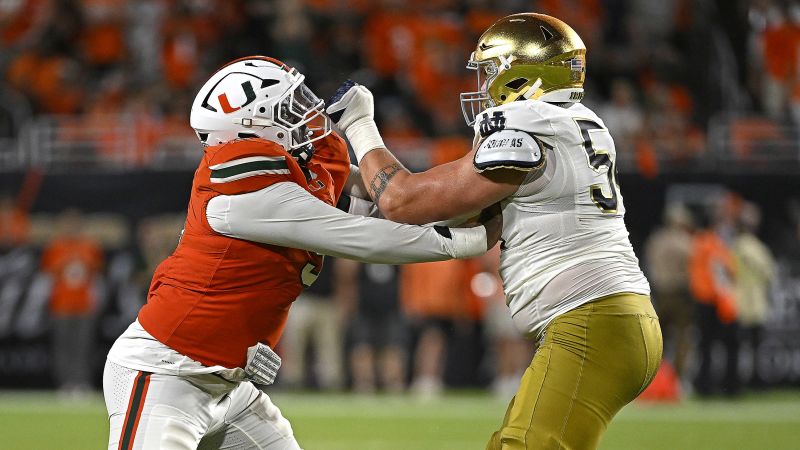
In January 1955, a full nine months before the first kickoff between Miami and Notre Dame, “harried” University of Miami officials announced they would not be selling tickets for the October game until May 1.
“A steadily mounting stack of mail from all parts of the eastern United States – and some from across the Mississippi – plus hundreds of telephone calls about Notre Dame tickets are disrupting the routine of the ticket office,” reported the Associated Press.
When tickets finally went on sale for “the game of the year”, a then-Florida record crowd of 75,685 forked over the $5 for the regular stand tickets or $3 to find a spot in the end zone as Miami, with only 30 years in existence as a university, squared off against the legendary Irish. So big was the game that the U canceled classes for the Friday night tilt, newspapers wrote stories warning of “horrific” traffic jams, and both schools petitioned for national TV coverage (they didn’t get it).
Since its auspicious beginning, the series has gone through various iterations. Notre Dame owned the rivalry early, winning 11 in a row, before Miami brought in Howard Schnellenberger and changed its direction. Then for a spell, it literally defined college football – the winners in 1987, 1988, and 1989 going on to claim the national title – before the animosity and bad blood forced an on-campus cooling-off period for 26 years.
The blood has not stopped boiling entirely.
“This is not a dislike. This is not a bad feeling. This is hate,” former Miami wide receiver Randal “Thrill” Hill told CNN Sports. “It is hate for Notre Dame and everything it represents. Everything white, pure and clean and we were the thugs. No, this is a hate-hate relationship.”
So much of it – the hate, the intensity – stems from the age-old trope of good versus evil, or in the case of this game, from Catholics versus Convicts. The two programs, born on opposite sides of the tracks, made for easy delineation: The school built on tradition and watched over by Touchdown Jesus against the snot-nosed kids from the city who brashly built something out of nothing.
It was not accurate then – it’s not accurate now. Notre Dame is not, and was not, perfect any more than Miami is now or was then amoral. But it all made for such epic theatre between the dazzling stars of college football that, when the No. 1 Hurricanes visit the No. 11 Fighting Irish Saturday night, it is impossible not to mine the past for an appreciation of the present.
“The text chain, up until a few years ago, it was, ‘Oh, I could do that,” says former Notre Dame safety Patrick Terrell. “Now it’s more, ‘Oh no. Not anymore. I can’t do that. But let me tell you about back in the day.”
‘I was so glad to put 7 on those Notre Damers’
The venom started with a rout. Beaten by Penn State and LSU in back-to-back weeks, Gerry Faust resigned as Notre Dame head coach but stayed on for the 1985 season finale against Miami.
The Irish were no on-field match for No. 4 Miami, but the Irish still had what the Hurricanes craved: National relevance. It was built on tradition and earned through years of success.
Under Jimmy Johnson, who took over in 1984 after Schnellenberger left for the USFL, Miami players were raised to believe you were entitled to nothing.
“We were a meritocracy,” says Bill Hawkins, a defensive end who later became a consensus All-American and first-round draft pick. “If you didn’t bring the heat, some dude was right behind you.”
Beating Notre Dame, then, would represent both an arrival and a defeat of what the Hurricanes perceived as an outdated system.
Miami led 27-7 at the half but didn’t ease off the gas. Vinny Testaverde threw a 48-yard bomb to start the fourth quarter and later, the ‘Canes blocked a punt to score again. Studio analyst Pat Haden called Jimmy Johnson “terribly bush,” and former Notre Dame coach Ara Parseghian flat-out accused Miami of running up the score.
Hawkins was the end result of that blocked punt, the then-redshirt freshman reserve defensive tackle falling on the ball in the end zone for the touchdown.
“Jimmy didn’t care about the score,” Hawkins said. “He wanted to assess players, period. If you take the good guys out and don’t stick with your game plan, how are you ever going to know how your underlings are doing?”
Nevertheless, Hawkins was delighted. A Notre Dame recruiter once paid him a visit, anxious to get the second-team All-American to visit campus. But Hawkins had started his career at an all-boys Catholic school and let’s just say, the two did not go hand in hand. Chafing at the rules and uncomfortable with the attitude, Hawkins happily moved on to the public school system, finishing at South Broward High in South Florida.
“So, when I said to this guy, ‘No, thank you,’ he looked at me like, ‘How could you?” Hawkins says with a chuckle. “And that’s exactly why I said no thank you. That entitlement. That play? It’s the only touchdown I ever scored, in college or in the NFL. And I gotta tell you, I was so glad to put seven on those Notre Damers.”
Miami that year would lose to Tennessee in the Sugar Bowl but the win against Notre Dame did what the Hurricanes wanted: let the world know they were coming.
Sometimes all it takes is one play
For the life of him, Pat Terrell could not figure out what Chris Zorich was doing.
A crew of teammates from the 1988 national championship had gathered in the basement man cave at Terrell’s suburban Chicago home to watch the Irish. As most of the guys surrounded the TV, readying for kickoff, Zorich walked the perimeter, thumbs tucked into the front of his jeans, peering intensely at the memorabilia hanging on the walls.
Terrell has a nice collection of Notre Dame memorabilia, but Zorich is a two-time All-American and Lombardi Award winner. Surely, he’d seen his share. Finally, after what seemed like forever, Zorich sauntered over to the group.
“Man, oh man,” he began, drawing out his words slowly for effect. “I have never seen a basement full of so many pictures of just one play.”
Terrell bursts out laughing as he tells the story.
By 1988, Notre Dame had recalibrated from its dormancy under Faust by bringing in Lou Holtz, but the programs’ roles had effectively flipped. The Hurricanes, who lost to Penn State in the national title game in 1986, arrived in South Bend as the defending national champions, ranked No. 1 in the nation and winners of 36 consecutive regular-season games. The relevance they craved in 1985 had arrived in full measure.
A pair of clever undergrads crafted the now infamous “Catholics vs Convicts” T-shirts. Hawkins says there was an underground market for “Angels vs. Assholes” merch as well. It fanned the flames of a No. 1 versus No. 4 game that needed no additional spark, as evidenced by a pre-game fight between the two squads.
Impossibly, the game outperformed all of it. Miami trailed 31-24, but with 2:10 left in the game, Notre Dame quarterback Tony Rice fumbled at his own 15. Four plays later – and on fourth down – Steve Walsh lobbed a pass to Andre Brown for a Miami touchdown.
Needing just one point to knot the score with 45 ticks left, Johnson elected to go for two.
“We play to win here,” he said afterward.
With three receivers lined to his right, Walsh threw toward Leonard Conley, but Terrell knocked the ball to the ground, preserving the Irish’s 31-30 victory. Notre Dame would go on to match Miami’s march from the year before, finishing undefeated to win its national title.
“When I was younger, I would do all of these interviews about that play and I’d say, ‘You know I had other plays too, right?’” Terrell says. “But now that I’m older, you know what? One play is good.”
83 X Seam
The play was not complicated.
Called 83 X Seam, it basically asked four wide receivers to go deep. Lined up on the far right, Randal Hill’s job was even easier – run straight up the sideline as fast as his 4.3 speed could take him.
The play’s execution, however? That was audacious, which suited Hill just fine. The off-field straight-as-an-arrow son of a schoolteacher and high school principal, Hill turned into his alter ego, “Thrill.”
He once said he dreamt of running with cheetahs and argued that he needed a parachute to slow him down. In the last game of his college career, Hill caught a 48-yard touchdown pass and after crossing into the end zone, proceeded to run straight up and out the Cotton Bowl tunnel.
Upon returning, he fired imaginary guns at his opponent, Texas.
Thrill especially loved taking it to Notre Dame, still stinging in 1989 from the accusations in 1988.
“Going to the University of Miami, it was like the mafia and the older guys, they were the dons,” he said. “You didn’t want to disappoint them. The two teams that came up most were Florida State and Notre Dame. Those games? No. You didn’t want to lose those games.”
The teams’ roles reversed yet again. Notre Dame rode a 23-game win streak into the Orange Bowl in ’89, but Miami led, 17-10, before backing itself into a disaster. A dead-ball personal foul and a 23-yard loss via a sack of quarterback Craig Errickson gave the Canes third-and-44 from their own 10-yard-line.
Errickson called 83 X Seam and Hill – miffed that people didn’t think he was as fast as Notre Dame wide receiver Rocket Ismail – split two defenders (in a twist of irony, one was Terrell) and got just enough for the first down.
“Nobody was bumping me at the line of scrimmage,” Hill says. “Are you kidding me? I knew the ball was coming to me, and there was no way I was dropping it.”
The Canes won, 27-10.
A year later, after No. 4 Notre Dame exacted revenge by beating No. 2 Miami, 29-20, the series ended.
“I do think there has been a certain charge, a certain passion to the series,” ND athletic director Dick Rosenthal said at the time. “Perhaps a year or two off is not without benefits.”
The year or two off stretched to 26.
The long tendrils of the Notre Dame-Miami rivalry
The thing about a sports moment, it’s just that – a moment. Life doesn’t operate in a freeze-frame.
For the players involved in some of the most memorable Notre Dame and Miami moments, life did go on. And in some ways, their post-moment lives were even more extraordinary than their sports snapshots.
After injuries cut short his NFL career, Hawkins floundered in search of his next phase. He fished and crashed at old teammates’ houses, looking for nothing in particular.
Worried that his buddy was languishing, former defensive end Rusty Medearis talked Hawkins – who was always an exemplary student – into applying for law school. Grudgingly, Hawkins filled out the paperwork and got accepted at the University of Florida.
When he asked Madeiras where he was headed, Madeiras laughed: “Oh, I didn’t even fill it out. I just wanted to get you moving.”
Hawkins went through with law school, even studying abroad for a spell in France. Upon graduation, he worked for four years as an assistant state prosecutor in Palm Beach County – “putting away all those bad guys from my team,” he jokes – before opening his own practice.
Hill stretched his NFL career through to 1998, spending his downtime public speaking. After Hill spoke to a law enforcement group during Black History Month, an officer suggested he consider a job with a federal agency himself.
So began a 20-year career as a special agent with the Department of Homeland Security, a job that took Hill across the US, to Venezuela and the Caribbean. He investigated drug lords and counterfeiters, and even a fake ticketing scam at the Super Bowl. Several of his cases, he says, were “briefed to the 1600,” meaning 1600 Pennsylvania Avenue.
More than a few times, the nattily dressed Hill – starched white shirt, double Windsor knot in his tie – would find himself at work when someone, even once a federal judge, looked at him quizzically.
“You’re that guy,” they’d say, bringing up the play against ND.
“And I’d laugh,” Hill says. “Yeah. I’m that guy.”
After a failed bid for a House of Representatives seat and mandatory retirement from Homeland Security, Hill joined Cogent Bank as vice president for the burgeoning sports and entertainment banking arm, designed to help young athletes manage their money.
“Years ago, my mom told me I was the reason she stopped having kids,” Hill says. “I haven’t changed. I’m too hyper to retire.”
Terrell has not exactly withered away on the vine, either. Spurred by his grandfather, Grady, who served in the Navy during World War II and befriended members of the Tuskegee Airmen, Terrell developed an early love for aviation. During his 10-year NFL career, he used his off-seasons to earn his pilot’s license and, after leaving football, took a job with American Trans Air, now ATA Airlines, rising to the rank of captain.
The ATA, he learned, also had a large military contract and in times of war, civilian airlines allocate fleets of planes to mobilize troops.
Consequently, during Operation Iraqi Freedom, Terrell regularly delivered troops all over the Middle East and became one of the first pilots to shepherd a US plane over previously closed airspace above Turkey.
“I remember looking out the window,” he said. “We were escorted by two F16s and I thought, ‘OK, this is the most fascinating moment in my life.’”
In 2025, Terrrell received the Congressional Patriot Award, which members of Congress give to community members who demonstrate leadership and service. He and his family – he has seven kids, five of whom he and his wife, Beth, adopted – drove to Washington, DC, for the ceremony in a Sprinter van.
As they chewed up the miles, one of his sons decided to poke a little fun at his award-winning dad. Adopting a serious commentator’s voice, he intoned, “So, John Doe, you lost a leg. You lost an eye. You have one lung and you saved 14 soldiers. We appreciate your service, but please step aside. This is not your year. No, let me now introduce you to Pat Terrell, who knocked down that pass against Miami.”
Retelling the story, Terrell pauses to stop laughing.
“I mean, it was a big deal at the time,” he says. “But nothing lasts forever.”
Sports
Adam Schefter says he’s shocked after what he’s heard about Jonathan Taylor’s potential trade

The main NFL insider has revealed that even he is starting to get surprised by some of the news coming through regarding Jonathan Taylor maybe moving on from the Indianapolis Colts.
The Indianapolis Colts have finally become sellers at the NFL trade deadline. Owner Carlie Irsay-Gordon has initiated a rebuild by firing GM Chris Ballard. They have since traded away DeForest Buckner and Quenton Nelson, and rumours suggest that Jonathan Taylor will be next.
Advertisement
Taylor has been their big star for a few years now as one of the league’s best running backs. Although there were suggestions that they may not move on from him, it seems more likely as the trade deadline grows closer. And apparently, interest in acquiring him is growing across the league as well.
Adam Schefter says one team being interested in Jonathan Taylor surprised him, predicts trade deadline ‘curve balls’
Trade speculation is possibly one of the most popular things in the world of sports. Fans love to discuss moves that might happen, even if most of them generally never do. And nothing quite shakes up the ecosystem of the league like an unexpected trade.
While discussing what fans have to look forward to at this deadline, Schefter hinted at a potentially shocking trade for JT.
“I think there’ll be a couple of curve balls. Like last night, I’m on the phone with some people. I’m hearing some names that I’ve never heard before. Never heard,” Schefter said. “I had a team text through this morning about Jonathan Taylor. I’m like, ‘This team, really? Wow.’ So that’s the point. That’s the great and exciting part of the deadline.”
Advertisement
The deadline is on Tuesday, November 10, which means there are about four days left for teams to figure out if they can somehow improve themselves. As we head into the second half of the regular season, it’s all starting to get quite exciting.
Read more:


President Trump speaks at the Kennedy Space Center
President Donald Trump speaks at an aerospace expo at the Kennedy Space Center following the Republican party's losses in …


Russell Brand: What happened inside the court room?
Russell Brand's conviction for rape and sexual assault has brought renewed scrutiny to the actor and comedian, who cultivated an...


Pope Leo heads to South America after casting his vote in the midterm elections
While heading to South America on the papal plane, Pope Leo spoke to CNN's Christopher Lamb about exercising his right...


Musk's rough week: $500M lost in TX, Cybertrucks wind down, stocks fall
Elon Musk poured nearly half a billion dollars into the midterms to support Republican candidates, most to help Ken Paxton...


US tech stocks rally after dramatic plunge but markets remain shaky | BBC News
US tech stocks have shown signs of a partial recovery after the value of shares in artificial intelligence and technology...


Major construction ongoing near Iran missile bases | BBC News
Iran is undertaking significant new construction near at least two of its major missile sites, satellite images suggest. We examine...


Ukrainian President Zelensky reacts to US midterm election results
Ukrainian President Volodymyr Zelensky told CNN's Jake Tapper Friday that Ukraine is counting on "even more support" from the …


Danny McBride’s ‘G.I. Joe’ Movie Lands 2028 Release From Paramount
Joe is a go. Paramount‘s next G.I. Joe movie has landed a release date of Oct. 20, 2028, the studio...


How can you prepare for a polar vortex? | BBC News
High above the Arctic, powerful winds usually circle the North Pole each winter, helping trap some of the coldest air...


UK prime minister tells firms to publish salaries in job adverts. #BBCNews
Subscribe to our channel here: https://bbc.in/bbcnews For the latest news download the BBC News app or visit BBC.com/news …
-

 HealthNews2 weeks ago
E. coli cases possibly linked to Bengtson’s Pumpkin Farm, Will County health officials say
-
 Business2 weeks ago
Bay Area Tesla driver hits and kills pedestrian on I-80, CHP says
-

 Food2 weeks ago
Feds, Bonta clash over credit for healthcare fraud cases
-

 Business2 weeks ago
AI agents are roaming around consumers’ bank accounts, and banks aren’t happy about it
-

 Entertainment2 weeks ago
Queens of the Stone Age Plot 2027 U.S. Tour
-

 HealthNews2 weeks ago
RFK Jr.’s vaccine injury clinic could damage NIH hospital, board warns
-

 HealthNews2 weeks ago
Alzheimer’s researchers look at an unusual data point: Head shape
-

 HealthNews2 weeks ago
Man accused of giving HIV to his wife without telling her avoids trial for her death