
Business
SpaceX Starship Flight 15 live updates: Starship heat shield looks good for landing attempt today
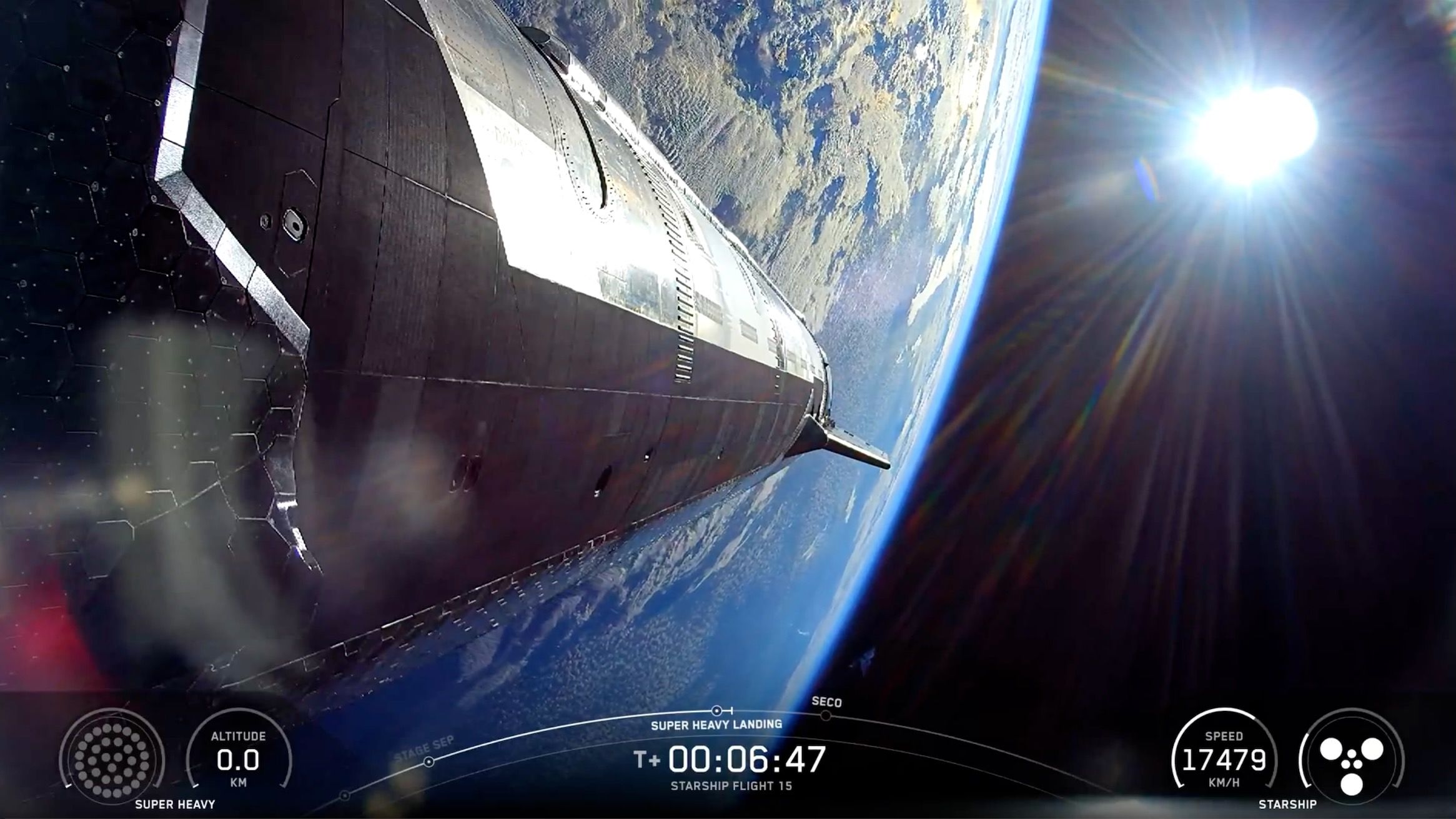
SpaceX’s Starship Flight 15 begins day 2 of longest test flight
Good morning and happy Saturday, Space Fans! Today is Flight Day 2 for SpaceX’s Starship Flight 15 test flight and SpaceX reports that its Ship 42 spacecraft is in good health as we near the 14-hour mark of its 22.5-hour test flight.
About 7 hours into the mission, SpaceX spokesman Dan Huot confirmed that flight controllers gave the go-ahead to forgo an early return window for a splashdown off the coast of Chile and proceed for the full 14-orbit flight. Starship is on track for a landing attempt, its first-ever from orbit, today (Nov. 14) at 4:20 p.m. EST (2120 GMT). Space.com’s livestream of SpaceX’s Starship Flight 15 landing will begin at 2 p.m. EST and you can see it at the top of this page.
“Starship’s going to stay in space. We are one step closer to an eventual return to launch site,” Huot said in the update. “So that’s great news.”
Huot also reported that Starship’s tile-covered heat shield appears in good shape for today’s landing attempt. SpaceX used long-range ground-based cameras and cameras on some of the 26 Starlink satellites the Ship deployed to check its heat shield after liftoff.
“Our heat shield team reviewed all the data we got from our ground tracking cameras, and from those satellite cameras and confirmed the heat shield is in a good posture for a re-entry and return to the launch site,” Huot said.
Huot also said it was likely a guidance and navigation control issue that caused the Booster 22 Super Heavy first stage to abort its landing attempt after liftoff on Friday. The giant booster plunged into the Gulf of Mexico instead of making a landing patch catch at Starbase, Texas.
The next “early return” check will come about 20 hours into the mission, around 2 p.m. EST (1900 GMT), when flight controllers will have to decide for hte last time whether to press ahead with the landing attempt or send Starship to a splashdown off the coast of Hawaii.
Tariq Malik
How to spot Starship in the night sky as it coasts in orbit
SpaceX’s Starship spacecraft Ship 42 is flying over Southeast Asia and the Indian Ocean as it continues its long coast 260 kilometers above Earth.
You can actually try to spot Starship in the night sky using our guide here.
SpaceX’s livestream is showing the position of the spacecraft, giving you an idea of where and when to look. You should be fast though, as Starship is moving at about 26,442 km/hour.
If you do see Starship in the night sky, let us know! Send us a note on what you saw and your photos here: spacephotos@space.com.
Tariq Malik
All 26 Starlink satellites deployed, Starship Flight 15 now coasting
SpaceX’s Starship Flight 15 Ship vehicle has successfully deployed all 26 Starlink satellites and has now entered an extended coast phase of its mission that should last well into tomorrow. Here’s our launch wrap with video and photos from Josh Dinner at the launch site.
The Ship 42 spacecraft deployed all 26 Starlink V3 internet satellites by the 1-hour, 17-minute mark of the mission.
Flight controllers then decided to forgo an “early return” option to land Starship early with an ocean splashdown off the coast of Hawaii. The option, at the 90-minute mark of the flight, is the first of three “early return” options fopr Starship in case something goes wrong.
So far, Ship 42 is performing well in orbit. The next early-return checkpoint is about 7.5 hours into the mission, which will occur around 1 a.m. EST (0600 GMT).
“That means this is now going to be the longest Starship mission we’ve ever flown,” SpaceX’s Dan Huot said. “We’re going to surpass the point that we had to come home on Flight 14. So that’s already exciting.”
Huot and other SpaceX commentators will return in a few hours with a status update. So for now, Starship is just coasting in space.
Tariq Malik
Starship Flight 15 Ship deploys 12 of 26 Starlink satellites
It’s been one hour since SpaceX’s Starship Flight 15 launch and Starlink satellite deployment is underway.
So far, the Ship 42 upper stage has deployed 12 of 26 Starlink V3 internet satellites, with more popping out of its Pez-dispenser like payload bay every few minutes.
Ship is flying over a brilliant blue Earth, with the camera views from the spacecraft relayed to Earth via SpaceX’s Starlink satellite constellation.
Tariq Malik
Starship begins Starlink satellite deployments
SpaceX’s Starship Flight 15 Ship upper stage has begin deploying its 26 Starlink internet satellites into orbit.
Three satelllites have already been deployed, with the Ship performing a slow rotation to allow the cameras on one of the Starlinks capture imagery of the spacecraft’s heat shield.
“It will be about 40 minutes all told to get these satellites out the door,” SpaceX’s Dan Huot says.
Tariq Malik
Starship enters orbit on 22-hour flight after launch success
SpaceX’s Ship 42 has successfully performed its orbital insertion burn and is now orbiting the Earth. It is only the second time SpaceX has reached orbit with Starship. The first time was September’s Starship Flight 14 test mission.
“We’ve got a nominal orbit insertion, so Starship now in orbit around Earth for the second time ever,” SpaceX’s Dan Huot says. “That’s a really great moment.”
The next major milestone will be Starlink satellite deployment, which should start at the 35-minute mark and last about one hour.
Here’s our full guide and Starship Flight 15 mission timeline for the full 22.5-hour mission.
Tariq Malik
Starship Flight 15 ‘GO’ for orbit, SpaceX says
SpaceX’s next big milestone after today’s mostly successful Starship Flight 15 launch with be orbital insertion, when the Ship will fire up a Raptor engine to enter orbit around Earth.
That engine burn is scheduled for about 26 minutes after liftoff and will last about 20 seconds.
“We are go for orbit,” SpaceX’s Dan Huot says.
If all goes to plan, Ship 42 should end up in an orbit about 275 kilometers above Earth and spend up to 22 hours orbiting Earth 14 times before returning to Earth tomorrow.
Deployment of the 26 Starlink V3 satellites in Ship’s payload bay is scheduled to begin at the 35 minute mark.
Tariq Malik
SpaceX aborts Starship Flight 15 Super Heavy booster catch, Ship in orbit
SpaceX’s Booster 22 has splashed down in the Gulf of Mexico after it aborted the planned launch pad catch. It was unclear the exact cause of the landing catch abort.
“We’ll dig in to what caused that abort during its flight back to the tower,” SpaceX’s Dan Huot says.
The Ship upper stage, meanwhile, successfully completed its ascent and has shut down its 6 Raptor engines. It is now in orbit, with the payload deployment of 26 Starlink satellites to come next.
Tariq Malik
Starship Flight 15 Stage Separation, Booster heads home
The Starship Flight 15 Super Heavy Booster 22 has successfully separated from the Ship upper stage and is beginning its return to Earth. One of its 33 engines may have dropped out, but its upcoming 13-engine boost back burn is coming up.
Ship 42 is continuing its ascent with all 6 engines firing.
Tariq Malik
LIFTOFF! SpaceX launches Starship Flight 15
LIFTOFF! SpaceX launches its Starship Flight 15 test flight on the company’s first-ever attempt to land both Super Heavy and Ship!
Tariq Malik
Starship Flight 15 fueling complete
Fueling is now complete for Starship flight 15, SpaceX’s Dan Huot reports.
Tariq Malik
Starship Flight 15 launch MINUTES AWAY!
SpaceX is now less than 5 minutes away from its Starship Flight 15 launch at 5:47 p.m. EST (2247 GMT). Fueling will end in about 2 minutes.
“T-5 minutes and we are tracking no issues,” SpaceX’s Dan Huot said. “We have no holds on the board right now.”
Tariq Malik
Raptor Engine Chill Down on Super Heavy
SpaceX is expected to be chilling down its 33 Raptor engines on the Super Heavy first stage on the Starship Flight 15 rocket.
The fueling process is ongoing and will continue until just over 2 minutes to liftoff.
The launch remains on track for 5:47 p.m. EST (2247 GMT).
Tariq Malik
Starship Flight 15 carries a heat shield tile installed by Mr. Beast
SpaceX just revealed that YouTube icon Mr. Beast has put his personal touch on today’s Starship Flight 15 launch. He installed a heat shield tile on part of the spacecraft, and it’s verified all set for launch.
A reminder, too, that SpaceX is launching 26 Starlink V3 internet satellites on Flight 15. They will be deployed in orbit by the 90-minute mark after launch.
Tariq Malik
SpaceX now fueling Starship Flight 15 Super Heavy and Ship
SpaceX has officially begun fueling its massive Starship Super Heavy Booster 22 and Ship 42 for today’s Flight 15 test launch. Liftoff is on track for 5:47 p.m. EST (2247 GMT).
The Super Heavy and Ship require nearly 12 million pounds of liquid oxygen and liquid methane for launch.
Super Heavy Booster 22 will be the first V3 Starship booster to attempt a landing, though SpaceX has performed the feat several times before. Ship 42 will be the first upper stage to attempt a landing when it returns to Earth on Saturday.
“We are not currently tracking any technical issues, any range issues and definitely no weather issues for today,” SpaceX spokesperson Dan Huot said.
Tariq Malik
NEW LAUNCH TIME for Starship Flight 15!
SpaceX has a new launch time for Starship Flight 15 today. It is two minutes later than previously announced.
Liftoff is now set for 5:47 p.m. EST (2247 GMT). SpaceX has a 75-minute launch window for today’s test flight.
Tariq Malik
SpaceX ‘GO’ for fueling Starship Flight 15 for launch
SpaceX’s Starship Flight 15 livestream has begun at the T-45 minute mark for today’s launch. Liftoff is still targeted for 5:45 p.m. EST (2245 GMT).
SpaceX does have a 75-minute window for today’s launch, assuming it is not affected by the FAA groundstop to aircraft nationwide.
SpaceX has given the “go” to begin the fueling processes for Starship.
“Go for propellant load. Teams will soon begin loading Starship with ~12 million pounds of liquid oxygen and liquid methane,” SpaceX reported in a launch update.
Tariq Malik
1 hour to SpaceX’s Starship Flight 15 launch
SpaceX is now T-1 hour and counting to the planned launch of its SpaceX Starship Flight 15 test flight and our launch livestream will begin soon. Liftoff is on track for 5:45 p.m. EST (2245 GMT).
One thing that has happened in the last few hours: The FAA has issued a rare national groundstop for all aircraft due to a “communication issue impacting all Air Route Traffic Control Centers,” Sean Duffy, Secretary of Transportation, said in a social media post. “FAA technicians are investigating the issue.”
It is unclear if the groundstop will affect the reentry plans for Starship Flight 15, given the recent FAA approval for the launch.
SpaceX says it’s still on track: “On track for Starship’s 15th flight. The 75-minute launch window opens at 4:45p.m. CT. Live coverage of the mission begins ~42 minutes before launch.,” the company wrote on X.
Tariq Malik
Game on! SpaceX gets FAA approval for Starship Flight 15
SpaceX is officially “go” to proceed with its Starship Flight 15 launch attempt today (Nov. 13). The U.S. Federal Aviation Administration (FAA) gave the green light this afternoon — pretty late in the game for an approval to come in.
Flight 15 is scheduled to launch during a 75-minute window that opens at 5:45 p.m. EST (2245 GMT). You can watch here at Space.com, starting at 5 p.m. EST (2200 GMT).
The test flight will make history, if all goes according to plan: SpaceX plans to catch both of Starship’s stages back at the Starbase launch site using the launch tower’s “chopstick” arms — something that has never been done before. The booster catch will come just 6.5 minutes after launch, while the upper-stage snag is scheduled for Saturday afternoon (Nov. 14), after 22.5 hours post-liftoff.
Mike Wall
SpaceX just hours away from Starship Flight 15 launch
Replay! SpaceX launches Starship Flight 15, booster splashes down – YouTube
Watch On
SpaceX is now less than 5 hours away from the planned launch of its Starship Flight 15 test flight from Starbase, Texas, with liftoff still on track for 5:45 p.m. EST (2245 GMT). The company is still awaiting FAA approval for today’s launch, so that could be a hurdle for the flight.
SpaceX has updated its start time for today’s Starship Flight 15 launch webcast. Instead of starting 30 minutes before liftoff, it will now begin at 4:58 p.m. EST (2158 GMT), according to the company’s livestream schedule on X. Our livestream will begin at the same time.
SpaceX has a 75-minute launch window for Starship Flight 15. Based on road closure announcements from Starbase officials, backup days may be available on Saturday and Sunday.
Tariq Malik
SpaceX stacks Starship Flight 15 megarocket for launch
Good morning, Space Fans, it is launch day for SpaceX’s Starship Flight 15 and the world’s largest rocket is now hours away from attempting its first double landing test flight. Liftoff remains on target for today, Nov. 13, at 5:45 p.m. EST (2245 GMT) from SpaceX’s Starbase launch site in South Texas. You’ll be able to watch the Starship Flight 15 launch on this page, as well as on Space.com’s homepage and our YouTube channel VideoFromSpace. Our live webcast will begin at 5:15 p.m. EST (2215 GMT).
Last night, SpaceX rolled the Ship 42 upper stage out to the Starship launch pad and stacked it atop its Super Heavy booster. The Ship’s number was accompanied by a fun sci-fi message – “Don’t Panic” – in a nod to the Hitchhiker’s Guide To The Galaxy books by Douglas Adams. Elon Musk’s Tesla bore the same message when SpaceX launched it into space on the first Falcon Heavy mission.
Space.com’s Josh Dinner is on site at Starbase and will be providing updates as possible from Starbase, which we’ll share here as they’re received.
Here’s an update from Josh from the launch pad:
SpaceX’s Starship Flight 15 is the 15th test flight of Starship, the world’s largest and most powerful rocket. SpaceX has designed the rocket to be fully reusable, and has landed its massive Super Heavy first stage booster several times.
Flight 15 is SpaceX’s first attempt to land both the Super Heavy booster and its Ship upper stage by returning them to their launch pad and catching them in the pad’s metal “Chopstick” arms. The landings will be about 22 hours apart, with Super Heavy landing minutes after launch and the Ship upper stage returning to Starbase on Saturday afternoon.
We’ll be updating this page throughout the day with news from Josh, SpaceX and Starbase for this unprecedented 22.5-hour test flight. Here’s our full timeline for SpaceX Starship Flight 15.
Tariq Malik
Starship Flight 15 may be visible in the night sky!
SpaceX is now less than 24 hours from the planned launch of its Starship Flight 15 mission, with liftoff on track for Friday, Nov. 13, at 5:45 p.m. EST (2245 GMT). The test flight will attempt land both the Starship Super Heavy Booster 22 and its Ship 42 upper stage.
Because the mission will last 22.5 hours, Starship will likely be visible in the night sky to stargazers hoping to see the giant spacecraft in orbit. Space.com’s Skywatching Writer Anthony Wood has a great guide on how to see Starship in the night sky.
“When it passes overhead, it will look like a bright, fast-moving star crossing the sky — similar to the International Space Station, but potentially even brighter depending on its orientation,” our skywatching columnist Joe Rao told Wood.
Check out the full story:
SpaceX’s Starship megarocket will launch to orbit on Nov. 13. Will you be able to spot it in the night sky?
Tariq Malik
SpaceX Starship Flight 15 explained
Happy Wednesday, Space Fans. We are now T-2 days away from SpaceX’s planned launch of its Starship Flight 15 test mission, so I wanted to take a moment to give you a run down on what to expect.
Today, you can read my full guide to SpaceX’s Starship Flight 15 launch here, which goes over what time and where to watch the launch online. Liftoff is on track for Friday, Nov. 13, at 4:45 p.m. CST, which is 5:45 p.m. EST (2245 GMT). But it ALSO (and this is new) includes what time to tune in a day later for the planned Starship upper stage (Ship) landing and catch by the metal “Chopstick” arms of its landing pad at SpaceX’s Starbase facility in South Teas.
If you’re wondering how the rocket’s assembly is going, our Spaceflight Editor Mike Wall has this update on the Starship Flight 15 Super Heavy booster going through final catch tests yesterday. Flight 15 will mark the first time SpaceX will attempt to land and catch both the Super Heavy booster (which it has done several times) and the Ship from orbit.
If successful, it will be the first full recovery of an entire orbital rocket from space.
Tariq Malik
Hello, Space Fans, and welcome to our coverage of SpaceX’s Starship Flight 15 test flight, the first ever to attempt twin landings of the Starship Super Heavy booster and Ship upper stage.
SpaceX has officially set the launch date for Flight 15 for Friday, Nov. 13, at 5:45 p.m. EDT (2145 GMT). That puts launch just about 3 days away and Space.com will provide live coverage of the potentially historic flight, the first full recovery of an orbital rocket.
Space.com Spaceflight Writer Josh Dinner will be reporting live from near SpaceX’s Starbase , Texas site for the launch, with myself (Tariq Malik), Spaceflight and Tech Editor Mike Wall and other team members tracking the flight remotely for you here. SpaceX has already test-fired the engines on its Starship Flight 15 vehicles.
Today, SpaceX moved Super Heavy Booster 22, the first stage for Flight 15, to the launch pad for vehicle stacking. Here are some photos of that move:
We’ll be updating this page regularly in the days ahead counting down to SpaceX’s Starship Flight 15 launch (and landings). So check back for updates each day.
Tariq Malik
Business
UPS plane, Copa Airlines jet collide at Miami International Airport, officials say

A cargo plane and a commercial passenger jet collided at Miami International Airport Saturday night, officials said.
A UPS Boeing 767 and a Copa Airlines Boeing 737 reportedly collided at the airport, Miami-Dade Fire Rescue said.
“At approximately 9:15 p.m., an arriving aircraft and a departing aircraft made contact with each other at the intersection of two taxiways. There are no reported injuries and flights are being directed to other taxiways, so there is no impact to airport operations at this time,” Greg Chin, communications director at MIA, said in a statement to CBS News Miami.
Chin said two patients were treated on the scene by Miami-Dade Fire Rescue for minor injuries and did not require medical transport.
UPS Flight 358 was scheduled to fly from Miami to Bogotá, Colombia, and Copa Airlines Flight 427 was arriving from Panama City, Panama. Copa Airlines is headquartered in Panama City.
The collision comes as MIA continues to experience delays and cancellations following Friday’s rare nationwide ground stop issued by the Federal Aviation Administration.
Transportation Secretary Sean Duffy warned Friday night that flight operations would be slow to return to normal as airlines worked to reposition aircraft and crews.
FAA Administrator Bryan Bedford said Saturday that the U.S. air travel schedule should be back to normal by the end of Sunday.
Business
IRS raises the 2027 401(k) contribution limit by $1,000 to $25,500

The IRS has increased the amount workers can contribute to their 401(k), up $1,000 from last year.
The government inflation-adjusted the 2027 limit to $25,500, a boost from 2026’s $24,500 limit, according to a recent IRS release.
“Along with the Working Families Tax Cuts, this increase in the pension limitations will help American families keep more of their hard-earned income,” IRS Chief Executive Officer Frank J. Bisignano said in a statement.
“With the new adjustment in place now, the IRS is giving taxpayers and employers the information needed to make retirement planning decisions for the year ahead.”
AMERICA’S RETIREMENT SYSTEM IS BROKEN. TRUMP MAY HAVE FOUND A BOLD FIX
The limit for Individual Retirement Account (IRA) accounts will remain at $7,500.
For people 50 and over, the IRA catch-up contribution limit remains at $1,100. It was amended under the SECURE Act of 2022 to include an annual cost-of-living adjustment, according to the IRS.
The catch-up contribution limit for workers 50 and over with a 401(k), 403(b), governmental 457 plans or the federal government’s Thrift Savings Plan has gone up by $500 to $8,500.
TED JENKIN: DEMOCRATS TOOK CONGRESS. DON’T LET YOUR EMOTIONS MAKE BAD MONEY MOVES
The IRA catch‑up contribution limit for individuals aged 50 and over, which was amended under the SECURE 2.0 Act of 2022 (SECURE 2.0) to include an annual cost‑of‑living adjustment, remains $1,100.
The catch-up contribution limit that generally applies to employees aged 50 and over who participate in most 401(k), 403(b), governmental 457 plans, and the federal government’s Thrift Savings Plan is increased to $8,500, up from $8,000 for 2026.
And people 50 and over with most of those plans will be able to contribute up to $34,000 each year starting next year.
SKIP TWO YEARS OF COLLEGE DEBT AND GIVE YOUR FAMILY A LIFETIME OF WEALTH
Workers who are 60 to 63 years old under those plans can contribute $11, 750 due to a change made in the SECURE 2.0 Act of 2022.
CLICK HERE TO DOWNLOAD THE FOX NEWS APP
Business
FAA ground stop latest updates: Saturday cancellations top 6,000; controllers’ union chief says communications with some planes were disrupted; Duffy blames L3Harris
Airlines canceled thousands more flights Saturday as they recovered from Friday’s nationwide ground stop, but the FAA said schedules should be back to normal by the end of Sunday.
More than 6,400 U.S. flights had been canceled Saturday as of 9 p.m. ET Saturday, according to FlightAware, well above the 4,000 to 5,000 that FAA Administrator Bryan Bedford predicted. Flight-tracking app Flighty said the outage has now caused more cancellations than the 2024 CrowdStrike software failure. About 800 U.S. flights scheduled for Sunday had already been canceled, mostly by American and JetBlue. “I do think the worst is behind us,” Bedford said, and he apologized to travelers earlier Saturday.
The FAA halted departures nationwide for more than four hours Friday, the longest ground stop since the Sept. 11, 2001, attacks. About 12,000 flights couldn’t be completed, Bedford said.
Transportation Secretary Sean Duffy said the outage began while L3Harris Technologies, which runs the network, was doing routine work to switch lines from copper wire to fiber at a remote FAA site. A router involved in the work flooded the rest of the system, disrupting communications with airplanes and radar. Officials told Reuters there may have been problems with routers in both Arkansas and Texas. Duffy said officials are working to determine “whether we had incompetence” by the contractor or a faulty router. “Until I can build” a new network, he said, “I’m stuck with L3Harris.” Bedford said the review will determine whether the router was installed or configured incorrectly, or was simply defective.
In a statement to Yahoo News, L3Harris said it is “supporting the FAA in its investigation” and “takes the nationwide ground stop and its impact on travelers, airlines and air traffic operations seriously.” The company did not address Duffy’s criticism or say what went wrong.
Asked why the work was done on a Friday afternoon, Duffy said work at small, remote sites is done during the day because it isn’t expected to affect the wider system. “There’ll be a reevaluation of when we do this work,” he said. Bedford said maintenance on the network is logged on paper, so officials had to search through paper records to figure out who was working where.
Nick Daniels, president of the National Air Traffic Controllers Association, told Yahoo News that communications with some planes were disrupted during the outage and that controllers moved flights to working frequencies. Asked whether work like Friday’s should be done during the day, he said, “If the worst outcome is we lose all of our frequencies, well, then that work should be done when there’s the fewest airplanes in the sky.”
The network’s problems aren’t new. A 2023 FAA-commissioned safety review called it obsolete, CBS News reported. In 2009, a technician for L3Harris’ predecessor, Harris Corp., misconfigured a router while moving the network to fiber, disrupting 129 air traffic facilities, according to a Transportation Department inspector general review.
Duffy is pressing Congress for more money to replace the system. President Trump has asked for $30 billion and Duffy has said he wants $50 billion, on top of the $12.5 billion Congress approved last year. Bedford said the router swap was routine maintenance, not part of that modernization effort.
New York Gov. Kathy Hochul called on Duffy to resign Saturday. A White House spokesperson told Newsweek her demand was “a desperate attempt to score political points.” Sen. Tammy Duckworth, a Democrat from Illinois and a ranking member of an aviation subcommittee, called for an investigation.
Travelers whose flights were canceled are owed a refund if they choose not to fly, and most major airlines are offering travel waivers. Airlines’ promises of hotels and meals generally cover only disruptions within their control, which doesn’t include an FAA ground stop.
Business
Tesla Cybercab orders open at $29,990 with an autonomy subscription

Tesla is now taking orders from select customers for its Cybercab, as the automaker pushes to bring fully autonomous vehicles to the consumer market.
Tesla announced Friday on X that “select customers are now being invited to purchase Cybercab for personal use” at a price of $29,990, with a required monthly “Autonomy Subscription” costing an additional $299.
The post included an image of the gold-colored, two-seat vehicle, which features butterfly doors but no steering wheel or pedals. The Cybercab had previously been used only in Tesla’s robotaxi fleet in select U.S. cities.
Tesla CEO Elon Musk said in a post on X that the Cybercab would be available nationwide as the company receives regulatory approvals.
TESLA TO WIND DOWN CYBERTRUCK PRODUCTION AT TEXAS FACTORY NEXT YEAR TO MAKE ROOM FOR CYBERCAB
He also said that the monthly fee is “too high,” adding that the price should be comparable to the combined cost of Tesla’s Full Self-Driving software and connectivity services for other models, or approximately $115 per month.
Lars Moravy, Tesla’s vice president of vehicle engineering, previously said the automaker plans to start selling its Cybercabs by the end of this year.
Tesla’s head of artificial intelligence said the Cybercab will ultimately be available in the same locations as the company’s robotaxi fleet, which includes Austin, Dallas, Fort Worth, Houston, Miami, Orlando, San Antonio and Tampa.
The announcement comes after Tesla and Musk have pledged for years to make fully autonomous vehicles available to consumers, according to The Wall Street Journal.
SPACEX MAKES HISTORY AS STARSHIP SPACECRAFT CAUGHT BY LAUNCH TOWER FOR FIRST TIME
Earlier this month, Musk said Tesla would end Cybertruck production at its Gigafactory Texas facility around the middle of next year as the company shifts its focus toward Cybercab production.
FOX Business previously reported that Tesla’s growing emphasis on the Cybercab comes as the automaker expands its focus on artificial intelligence and robotics, with the driverless vehicle expected to play a key role in its planned global robotaxi network.
Ticker Security Last Change Change % TSLA TESLA INC. 390.22 -7.23 -1.82%
Tesla’s self-driving technology has faced years of delays, but the company began offering paid rides in a small fleet of Cybercabs in Austin in September.
Federal auto safety regulators have also scrutinized whether Tesla properly self-certified the Cybercab’s compliance with federal motor vehicle safety standards. The National Highway Traffic Safety Administration (NHTSA) opened an audit in September to review the certification.
Tesla has told NHTSA it believes the Cybercab meets federal safety standards.
GET FOX BUSINESS ON THE GO BY CLICKING HERE
The two-seater robotaxi entered production earlier this year and remains a relatively small program for Tesla, which has listed an installed annual production capacity of more than 125,000 vehicles.
Business
With Starship catch, SpaceX still shows it can dazzle the world

STARBASE, Texas—The black and silver ship fell out of the sky, emerging from the cloud deck near the very end of its flight. Incongruously, the rocket flew horizontal until the last moment when three Raptor rocket engines ignited and it swooped into a vertical position.
Slowly, gently, haltingly, the Starship upper stage eased its way toward the waiting tower where two arms extended outward, awaiting expectantly. The margins are so incredibly narrow. Two nubs on either side of the rocket, each protruding only about one foot, were the only purchase the rocket would have on the arms.
Then, less than a minute after it came into view, the Starship upper stage was snagged by the launch tower, as snug as you like. And so it was all over. SpaceX, nearly a quarter of a century after its founding, had just taken a hugely significant step toward developing and optimizing a massive, rapidly reusable rocket.
We are dazzled
This was a breathtaking feat; a brilliant technical achievement that required the best engineering minds to think through a million different, difficult problems. And on Saturday evening, following a handful of practice runs into the Indian Ocean, they did it before the entire world.
Watching Starship launch from here a little less than a day earlier, and knowing it had orbited the planet multiple times, added to the sense of unreality in seeing this spaceship return to Earth under its own power, and be captured by the tower.
It felt like stepping into the future. SpaceX has dazzled us before, by landing rockets on barges and returning humans to space with Crew Dragon. But this flight took things to another level. Starships are huge. They carry a huge amount of energy coming back from orbit. And until a few years ago, it seemed beyond fantastical to think about capturing a rocket with what are essentially outsized chopsticks.
Nevertheless, it happened.
Rapid reuse is firmly on the horizon
Humans have built reusable spacecraft that flew into orbit before. In the 1970s, flush with confidence after the triumphant Moon landings, NASA designed and built several Space Shuttles. They had solid rocket boosters that were fished from the ocean and reused. The large orange external tank was not recovered after each flight, but the orbiters went to space for two weeks, or even longer, before returning to Earth and landing on a runway.
The shuttles were engineering marvels. But during the return to Earth they acted as gliders, not igniting their engines. And their heat shields were delicate flowers, requiring painstaking refurbishment after each flight. At the outset of the shuttle program, the space agency contemplated sending dozens of humans into space at a time, and carrying cargo at a cost as low of $25 per pound.
Reality never matched these rosy projections. The crew space capped out at seven astronauts, and the cost-per-pound was closer to $25,000. Each orbiter cost an extraordinary amount of money to build; NASA only ever built five that went to space.
SpaceX has five Starships in an advanced state of development at Starbase today; and its factory houses the components for a dozen more. The company can currently manufacture a Starship upper stage in its South Texas Starfactory every three weeks. The factory was sized to produce a ship every three days. When SpaceX founder Elon Musk discussed these build targets in an interview five years ago, he sounded mad. But he no longer does.
A proof of concept
The Space Shuttle was nearly a fully reusable space launch system, but it fell far short of low-cost, rapid launch. Over 30 years the vehicle made 135 flights. Within a few years SpaceX aims to fly 135 times a year, then thousands of times.
Such was the significance of Saturday. SpaceX aspires to fundamentally change the relationship between humanity and the heavens. The first step is to get the entire rocket back. SpaceX has now returned both elements of a Starship rocket safely to its launch tower. It will take time to reach a high rate of success with such landings, but Saturday’s safe return offered a proof of concept.
The landings will come with increasing frequency; and so will the launches. Over time SpaceX will perfect the heat shield that is likely to be the most difficult aspect of rapid reuse. And eventually, as difficult as it may be to believe, what we experienced with amazement this weekend will become routine. One day, we will take this all for granted.
But not today.


The economics of 'kidulting'
It all comes back to little treats. Watch Engagement Party now on CNN All Access.


Student pilot forced to land amid nationwide ground stop
Student pilot Mosab Nadi was completing the third leg of his first solo flight in the Fort Worth, Texas area...


Interview with Tyriq Withers and Daniel Kaluuya stuck at airport last night goes viral
CNN affiliate's KVAL reporter Gold Meadows interviewed actors Tyriq Withers and Daniel Kaluuya about the Friday FAA ground …


UPS plane, Copa Airlines jet collide at Miami International Airport, officials say
A cargo plane and a commercial passenger jet collided at Miami International Airport Saturday night, officials said. A UPS Boeing...


IRS raises the 2027 401(k) contribution limit by $1,000 to $25,500
The IRS has increased the amount workers can contribute to their 401(k), up $1,000 from last year. The government inflation-adjusted...


Officials scrambling to get operations back to normal at airports
Officials are trying to put the puzzle pieces back together as quickly as possible across airports in the US. CNN's...
FAA ground stop latest updates: Saturday cancellations top 6,000; controllers’ union chief says communications with some planes were disrupted; Duffy blames L3Harris
Airlines canceled thousands more flights Saturday as they recovered from Friday’s nationwide ground stop, but the FAA said schedules should...


Tesla Cybercab orders open at $29,990 with an autonomy subscription
Tesla is now taking orders from select customers for its Cybercab, as the automaker pushes to bring fully autonomous vehicles...


Blame game begins over nationwide flights fiasco
Transportation Secretary Sean Duffy said there could have been “mistakes made” by contractor L3Harris during a routine …


Driver stunned by unexpected guests aboard his bus
The Detroit Department of Transportation said there is an “opportunity to retrain DDOT bus operators” after reviewing onboard …
-

 Business2 weeks ago
‘It’s only when you see 49-ton trucks in China running on batteries that you realize how serious electrification is’: Octopus Energy CEO Greg Jackson on Europe’s incumbency problem
-

 Entertainment2 weeks ago
Inde Navarrette Makes Shane Gillis Quip ‘SNL’ Opening Monologue
-

 Entertainment2 weeks ago
Severed Human Hand Costume on Red Carpet
-

 Politics6 days ago
60 Minutes Transcript: Donald Trump, the 2026 post-midterm elections interview
-

 HealthNews1 week ago
Thousands of bottles of blood pressure medication recalled by FDA
-

 India Top Stories Feeds2 weeks ago
Hour Battery, €1,699 [2026]
-

 Business1 week ago
Top Democrats call to rein in AI buildout after midterms sweep: ‘National data center moratorium now’
-
Business2 weeks ago
25 Wall Street Rising Stars and Executives to Watch