
Politics
Sen. Jon Husted’s backside
WASHINGTON — President Donald Trump can’t stop marveling at the backside of Sen. Jon Husted.
His gushing started Oct. 12 during a midterm campaign rally in Youngstown, Ohio, as the president sized up the physique of the 59-year-old Ohio Republican ‒ and the president hasn’t stopped telling his supporters about Husted’s body, specifically his “ass,” ever since.
During three separate campaign speeches in the homestretch before the Nov. 3 midterm election, Trump has told the same story about assessing Husted’s frame after NFL coach Jon Gruden informed the president that Husted played college football with Gruden at the University of Dayton in the 1980s.
“I don’t do this with men very often,” Trump said during the first mention in Ohio. “I started examining his body, because I didn’t know he was a great athlete. And I looked and I watched up and down. I looked at his ass. And then I looked at his hands. Look at his hands. He’s got these, like, claws.”
While delivered as a joke, the commentary continues a long ‒ at times, perplexing ‒ history of the president remarking publicly on the looks of men he finds strong, masculine or “straight out of central casting,” both in athletics and politics. It comes as Trump is seeking to boost Husted in the midterms, with most polls showing the Republican incumbent trailing his Democratic challenger, former Sen. Sherrod Brown.
“I examined his ass and then I looked at his shoulders,” Trump said at an Oct. 17 campaign rally in Highland Heights, Kentucky. “I looked at his feet. I looked at his hand. I looked at his jawline. Studying. You would be very unfortunate if you picked a fight with him at a bar someday.”
He singled out Husted’s buttocks again in Greenville, North Carolina on Oct. 20.
“I looked at his ass and then I looked at his legs,” Trump said. “I said his ass ‒ it’s like a pile of muscle.”
‘Central casting’: Trump’s history of extolling ‘handsome’ men
Representatives of Husted’s Senate office and his campaign did not respond to a request for comment when asked for the senator’s reaction to Trump’s remarks.
Even Vice President JD Vance has taken notice of Trump’s fixation with Husted’s rear end. “What could I possibly say about Jon Husted that Donald J. Trump has not already said?” Vance said during a campaign swing to Sharonville, Ohio on Oct. 21. “Don’t worry. I’m not talking about Jon Husted’s ass.”
Trump has a long had an open fascination with “good genes” and bloodlines to explain human vitality. Whether someone is telegenic and looks the part has factored into Trump’s Cabinet picks and other White House hires.
And while Husted’s body is getting most of Trump’s attention of late, the senator is far from the only man ‒ nor the only midterm candidate ‒ whose physique Trump has lauded.
Just minutes into his Oct. 16 rally for Republican Rep. Mike Collins in Dalton, Georgia, Trump remarked that the Republican nominee for Senate in Georgia is better-looking than his opponent, Democrat Sen. Jon Ossoff.
“Somebody said he’s a good-looking man,” Trump said of Ossoff. “I don’t think he’s a good-looking man. I actually think Mike Collins is a good-looking man. And he’s all man. He’s all man. I’m not sure about Ossoff.”
He pivoted to Rick Jackson, Georgia’s Republican nominee for governor.
“I actually think that Rick Jackson’s a very handsome, distinguished, beautiful-looking guy. But anyway,” Trump said.
Trump then turned his attention back to Collins.
“He is central casting,” Trump said of the congressman. “Stand up, look at this. If I’m casting a movie for a senator, I like the white hair, I like the big, strong build. Big, strong guy. That’s what I want.”
Later in the same speech, Trump spotted Greg Dolezal, a Republican state senator in Georgia who is running for lieutenant governor.
“Oh he’s a good-looking guy,” Trump said. “You’re not allowed to say that about women or men anymore. It’s the end of your political career. But he is a good-looking guy.”
Trump’s Jaxon Dart and Arnold Palmer moments
Two days earlier on the campaign trail, Trump praised the looks of Republican Sen. Tim Sheehy as he rallied supporters on Oct. 14 in Kalispell, Montana.
“I wish Tim didn’t look that good,” Trump said. “You know, he’s a very handsome guy. I don’t like handsome guys. I never liked handsome men.”
As he spoke at a rally on Oct. 1 in Durant, Oklahoma, the president had three male supporters he spotted on television join him on stage.
“Where are they? You can’t miss a big, strong, handsome Oklahoma studs (sic),” the president said. “Oh, there they are. Look at these three guys. These are studs.”
Yet the president’s flattery toward good-looking men didn’t begin during his ongoing midterm blitz.
Trump’s appreciation of the male body was memorably on display in May when the president was joined on stage by New York Giants quarterback Jaxson Dart during a speech in Suffern, New York.
“He’s this beautiful guy, he’s got legs like tree trunks,” Trump said of Dart.
Perhaps Trump’s most pointed remarks about the male anatomy ‒ which came to the edge of being explicit ‒ came in the 2024 presidential election as he discussed golfing legend Arnold Palmer.
“Arnold Palmer was all man,” Trump told a crowd in Pennsylvania. He then went where no other president has gone before: “I refused to say it but when − when he took showers with the other men, they came out of there, they said, ‘Oh my god. That’s unbelievable.’”
Reach Joey Garrison on X @joeygarrison.
Politics
Israel Election Live Updates: Polls Open as Netanyahu Faces Challenge Led by Eisenkot

Mr. Netanyahu is seeking re-election at the helm of a coalition of nationalists and ultra-Orthodox Jews — the most far-right government in Israeli history. His coalition faces a fractious group of opposition parties loosely led by Gadi Eisenkot, a former military chief of staff whose son was killed in the Gaza war.
Both sides are framing the election as a make-or-break moment for the country. Mr. Netanyahu’s coalition offers the promise of a more religious Israel with an ever-tighter grip over the West Bank and Gaza. His opponents are casting the vote as the last chance to preserve democracy and pull Israel back from the brink of becoming a pariah state under international sanctions.
The voting will close at 10 p.m., but the election is unlikely to deliver an immediate verdict on who will be the next prime minister. Opinion polls suggest that Mr. Netanyahu’s allies and rivals are roughly tied, and assembling a governing coalition in Israel’s parliamentary system could take weeks or months.
Opposition leaders led by Mr. Eisenkot have called for a reckoning over what they call Mr. Netanyahu’s failure to prevent the catastrophic Oct. 7 attacks. They also have pledged to repair Israel’s shattered image abroad, including by cracking down on Israeli extremist violence against Palestinians in the occupied West Bank.
Mr. Netanyahu has resisted the establishment of an independent commission to probe the Oct. 7 attacks. He has vowed to move ahead with overhauling Israel’s judicial system, a move that critics say could undermine the country’s liberal democracy. And his allies say they will keep tightening Israel’s grip on the West Bank and Gaza despite international condemnation.
Mr. Netanyahu, 77, has dominated the country’s political life for decades — leading Israel for 19 out of the past 30 years. In recent days, he has repeatedly suggested that the country could face annihilation without him in charge.
Here’s what else to watch:
Palestinians: As Israelis head to the polls, Palestinians in the West Bank are under an Israeli military lockdown. Palestinians in the West Bank and Gaza cannot vote in Israeli elections, but they may have much to lose if Mr. Netanyahu’s coalition stays in power. Read more ›
Coalition politics: Israel’s fractured electoral politics mean that neither Mr. Netanyahu nor his opponents will likely win an easy victory. The possibilities range from a fragile coalition to a minority government to another round of elections. Read more ›
Trump weighs in: President Trump has endorsed Mr. Netanyahu, praising him as an important partner in the war against Iran and saying anyone else would be the “wrong leader” for Israel. Analysts were skeptical that the U.S. president’s intervention would sway many voters.
Every party creates a ranked list of its candidates, and voters choose a party or slate. The leader of the party with the most votes could become the country’s next prime minister — though it is not automatic — if that candidate can form a government, but the parliamentary system is complicated and involves extensive negotiations.
Here’s what to know.
What happens on Election Day?
Election Day is a public holiday in Israel, with schools, government offices and many public services closed. In most of the country, polls are scheduled to open at 7 a.m. local time and close at 10 p.m., with hours slightly reduced in some small communities, hospitals and prisons.
Voters are assigned to a polling station near their registered residence and may vote only at that location. There are exceptions for soldiers, people with limited mobility and prisoners, among others.
All Israeli citizens 18 or older who are registered to vote may do so with a valid identification, such as a passport, driver’s license or Israeli identification card. Israel’s Arab citizens, who make up about 20 percent of the population, could play a significant role in the vote, depending on turnout.
Unlike many democracies, Israel does not have a postal or proxy voting system, and most citizens cannot cast an absentee vote from abroad.
What’s on the ballot?
Israel’s electoral system uses nationwide proportional representation. Elections to the Knesset, Israel’s 120-seat Parliament, are held at least every four years, though they can happen more often. In 2022, Israeli elections were held for the fifth time in three years after the Knesset dissolved itself.
Israelis cast a single ballot for a list of candidates affiliated with a party. A party receives a number of seats proportional to the national vote it got. To gain a place in Parliament, however, a party or must receive at least 3.25 percent of the valid votes. About 10 parties are expected to clear that electoral threshold.
Official election results are expected by Nov. 4.
How is a government formed?
No single party has ever won a majority of votes, which means parties must form factions and party leaders try to forge a governing coalition of at least 61 lawmakers.
Within seven days of the official election results being announced, Israel’s president, who plays a mostly symbolic role, meets with elected representatives of the parliamentary factions.
Israel’s president, Isaac Herzog, will assign a member of the Knesset — usually the leader of the party or faction that has won the most seats — to form a government. That candidate then has 28 days to negotiate with other factions and forge alliances to form a government, which must be approved by the Knesset in a vote of confidence. That person can request a 14-day extension to the deadline.
If that effort fails, the president can select another candidate who also has 28 days to try to form a government. If that second attempt fails, a majority of Knesset members can ask the president to have a third candidate try. That person would be granted 14 days to form a government, and if that failed, new elections would be announced
If a candidate who has been selected to form a government can propose one, along with a policy agenda, and their proposal wins a plurality of votes in the Knesset, the government is formally invested, and that candidate becomes the prime minister. Technically, the law allows for a minority government if the relative majority supporting it is larger than the minority opposing, but governments established after elections have almost always enjoyed the confidence of a majority of Knesset members, at least 61.
Historically, it has taken about 20 to 100 days to form a government, and no government has been sworn in less than 50 days after an election, according to the Israel Democracy Institute, a nonpartisan think tank in Israel.
Who are the top contenders?
Different polls in the week ahead of the election have suggested different outcomes, which is “very problematic for political scientists,” said Assaf Shapira, who heads political research at the Israel Democracy Institute, a nonpartisan think tank in Israel.
Many Israelis consider this election to be a referendum on Mr. Netanyahu’s leadership. Mr. Netanyahu and his Likud party, and their hard-right allies, are in a close race with Gadi Eisenkot, a former military chief of staff who heads the opposition coalition led by the Yashar party and has emerged as Mr. Netanyahu’s top challenger.
The result is an unpredictable race, with profound implications for Israelis and the millions of Palestinians living under Israeli occupation, as well as for the country’s regional conflicts, its international relations and the Jewish diaspora.
About a dozen parties are expected to clear the electoral threshold to make it into Israel’s 120-seat Parliament, the Knesset. The real political wrangling begins after the election, when party leaders will try to forge a governing coalition of at least 61 lawmakers.
The leading contenders
Likud (Consolidation)
Historically the largest conservative party; increasingly populist.
Leader: Benjamin Netanyahu, 77.
Many consider this election a referendum on Mr. Netanyahu, who as prime minister has not delivered on his promise to achieve “total victory” in Israel’s wars and has not accepted responsibility for security failures preceding the Hamas-led attack on Oct. 7, 2023, the deadliest day in the country’s history.
He has also faced blowback over a deeply unpopular military draft exemption for ultra-Orthodox Israeli Jews and a divisive push for judicial reforms, which would in part reduce the Supreme Court’s powers.
A right-wing party with strong support in working-class and traditional Jewish communities, Likud has governed Israel for more than 34 out of the past 49 years, including 19 under Mr. Netanyahu.
Mr. Netanyahu, who faces corruption charges and an international arrest warrant in connection with the conduct of the Gaza war, has vowed to “complete the job” in waging Israel’s various conflicts and block the formation of a Palestinian state.
Yashar! (Honest, or Straight)
New party aimed at centrists and center-right voters worried about where the Netanyahu coalition is leading Israel.
Leader: Gadi Eisenkot, 66.
A former military chief of staff, Mr. Eisenkot served in Mr. Netanyahu’s war cabinet for part of the Gaza war, in which one of Mr. Eisenkot’s sons and two nephews were killed. He formed his party a year ago and has emerged as Mr. Netanyahu’s top challenger. His platform strikes at Mr. Netanyahu’s vulnerabilities, including by endorsing calls to investigate the failures preceding the Oct. 7 attack.
Mr. Eisenkot has rejected the prospect of Palestinian statehood in the near term. He has also voiced support for a more restrained expansion of Israeli settlements in the West Bank while promising to curb settler violence.
Other major opposition parties
B’Yachad (Together)
A partnership between the centrist, secular and liberal Yesh Atid (There Is a Future) party and Naftali Bennett, a right-wing nationalist.
Leader: Naftali Bennett, 54.
In 2021, Mr. Bennett and Yair Lapid, 62, the leader of Yesh Atid, allied to oust Mr. Netanyahu in a short-lived government. This year, they have sought to lead an anti-Netanyahu front again, emphasizing unity amid Israel’s bitter divisions. They have called for an expanded draft of the ultra-Orthodox and an inquiry into the Oct. 7 attack.
Yisrael Beiteinu (Israel Our Home)
A secular Jewish party that is right-wing on security matters but broke with Mr. Netanyahu years ago.
Leader: Avigdor Liberman, 68.
Founded in 1999 as a political home for immigrants from the former Soviet Union, the party has since expanded its appeal by promising to defend Israel’s secular Jewish character against the rising influence of ultra-Orthodox rabbis.
The Democrats
Heir to two parties from Israel’s dwindling political left, which once dominated the country.
Leader: Yair Golan, 64.
Mr. Golan, an outspoken former two-star general, formed the Democrats in 2024 out of the remnants of the storied Israeli Labor party and the more left-wing Meretz party. It favors a two-state solution to the Israeli-Palestinian conflict, while seeking to forge Israel’s identity as a liberal, secular Jewish state.
Other major pro-Netanyahu parties
Otzma Yehudit (Jewish Power)
A far-right, ultranationalist, anti-Arab party.
Leader: Itamar Ben-Gvir, 50.
Mr. Ben-Gvir, a right-wing provocateur, made his name as a lawyer defending Israeli settlers arrested for attacking Palestinians. His support appears to have grown amid a shift to the right among Jewish Israelis since the Oct. 7 attack. He has called for the removal from Gaza of Palestinians through “voluntary emigration.” Mr. Ben-Gvir has drawn international condemnation and sanctions for his anti-Arab rhetoric and conduct as national security minister in Mr. Netanyahu’s government.
Religious Zionism
A far-right, ultranationalist party with a focus on expanding Israeli settlement of the West Bank.
Leader: Bezalel Smotrich, 46.
As finance minister and a minister in charge of the administration of the West Bank, Mr. Smotrich has masterminded the steady advancement of Israel’s de facto annexation of the territory by expanding settlements, building roads for Israelis and crippling the Palestinian Authority, which administers part of the West Bank. He has repeatedly said that Israel should permanently occupy and resettle the Gaza Strip with Jews.
Amcha Yisrael (People of Israel)
A right-wing party that supports Mr. Netanyahu but opposes a draft exemption for the ultra-Orthodox.
Leader: Ofer Winter, 55.
Mr. Winter, a former brigadier general who formed the party in August, gained prominence for his hawkish national security views. He has spoken of encouraging the voluntary emigration of Palestinians from Gaza.
Shas
Traditional political home for ultra-Orthodox Jews whose families came to Israel from the Middle East and North Africa.
Leader: Aryeh Deri, 67.
Mr. Deri, a veteran political operator, spent time in prison for bribery and fraud, and was later convicted of tax fraud and barred from serving as a government minister. Shas’s following extends beyond ultra-Orthodox Jews to others who are less religious but whose roots are likewise in the Middle East and North Africa.
United Torah Judaism
An alliance of two parties representing different streams of ultra-Orthodox Judaism with roots in Eastern Europe.
Leader: Yaakov Asher, 61.
U.T.J.’s politics center on protecting the ultra-Orthodox, or haredi, community’s strict religious way of life. It has long been allied with Mr. Netanyahu, whose governments have supported U.T.J.’s voters with subsidies. But the partnership has grown increasingly shaky.
The Arab parties
Raam (United Arab List)
An Islamist party that increasingly advocates coexistence between Arabs and Jews.
Leader: Mansour Abbas, 52.
Mr. Abbas has taken a pragmatic approach to Arabs’ participation in Israeli politics, and in 2021, he made history by joining an Israeli governing coalition. In August, he recruited a Zionist former senior police commander as Raam’s No. 2 candidate. If Jewish opposition parties drop their resistance to joining a coalition with an Arab party, Mr. Abbas could be crucial to ousting Mr. Netanyahu.
The Joint List
An alliance of three parties representing Palestinian citizens of Israel.
Leader: Yousef Jabareen, 54.
The Joint List’s component parties represent a range of ideologies, including a Jewish-Arab communist alliance and a Palestinian nationalist party. Their goal in uniting is to bring more Arab voters to the ballot box, expanding their representation in Parliament.
Politics
Catholic bishops say they regret taking a meeting with Trump

Two Catholic bishops have expressed regret over attending a meeting with 10 other prelates and President Donald Trump in the Oval Office, saying they were “exploited.”
Photos and video of 12 clergy members praying over the president were released on Thursday, less than two weeks before the midterm elections. The images show the clergy members praying around Trump, who has his head bowed as he is seated at the Oval Office desk.
Now, one bishop in the meeting said he felt they were manipulated and apologized for “inadvertently” participating in a political event so close to an election. Another said the meeting was “exploited” for “partisan political purposes” and expressed regret for attending.
The image released by the White House starkly contrasted with how careful Pope Leo XIV has been to avoid taking sides in politics — the first American pope has insisted that bishops avoid any political partisanship. However, he has addressed policy issues more broadly, speaking out against the Trump administration’s immigration crackdown and the war in Iran, in addition to calling for tighter regulation of artificial intelligence.
The pope’s decision not to visit the United States in 2026 was also in large part due to the midterms, as papal visits traditionally do not take place during election cycles.
One of the attendees, Archbishop of Milwaukee Jeffrey Grob, said afterward that the meeting had been manipulated, that he was unaware their meeting was being recorded and that the bishops did not give permissions for the public distribution of the footage and images.
“To begin, the meeting was in no way an endorsement of the president, his policies, or his party,” Grob said in a statement.
But he explained that after images were released he “soon began receiving messages of serious concern over the possibility that I had inadvertently participated in a political event less than two weeks before a national election.”
The archbishop went on: “I did not go [to the meeting] without reservations. I wish I had heeded them. Please know that I have heard these concerns, understand how I caused them, and I apologize for any damage my actions have done.”
Another bishop, William Joensen of Des Moines, said he felt the meeting had been “exploited” for “partisan political purposes” and that he wished he’d done things differently. “I wish I had been more shrewd and less simple,” he said. “I pray I am more prudent and wise going forward, even as I remain resolute in my openness to engaging and praying for political leaders at all levels.”
The meeting was attended by Trump’s longtime faith adviser, Paula White-Cain. Trump said after: “It was a great meeting. Well, they prayed. They mostly prayed. It was actually a very nice meeting. They’re great.”
Trump has attracted support from Catholics during his past campaigns, although recent polls show that has dropped since his return to office.
White House spokeswoman Taylor Rogers did not respond to a question about whether the clergy members had cleared the use of their images, instead sending a statement that said: “There has never been a greater president for Catholic Americans than President Trump.” She cited “expanded religious rights,” his pardoning of anti-abortion activists, his work against providing gender-identity care for children and his protection of parents’ rights.
While the president had a public clash with the pope earlier this year, Trump has been less critical of him lately — frequently talking about how the pontiff’s eldest brother, Louis, is a MAGA supporter. When the pope was recently diagnosed with lung cancer, Trump said he wanted to see him “get well.”
“It’s big stuff anytime you have cancer, but the prognosis seems to be good,” the president said, going on to call Leo’s brother “a friend of mine.”
Following release of the footage of the bishops and the president praying, one church source joked to CNN that it was the White House doing “trick or treat early!”
Politics
Serbia’s Student-Led Movement Ousts Strongman Aleksander Vučić in Shock Election Result
AMY GOODMAN: This is Democracy Now!, democracynow.org. I’m Amy Goodman in Colorado, with Juan González in Chicago.
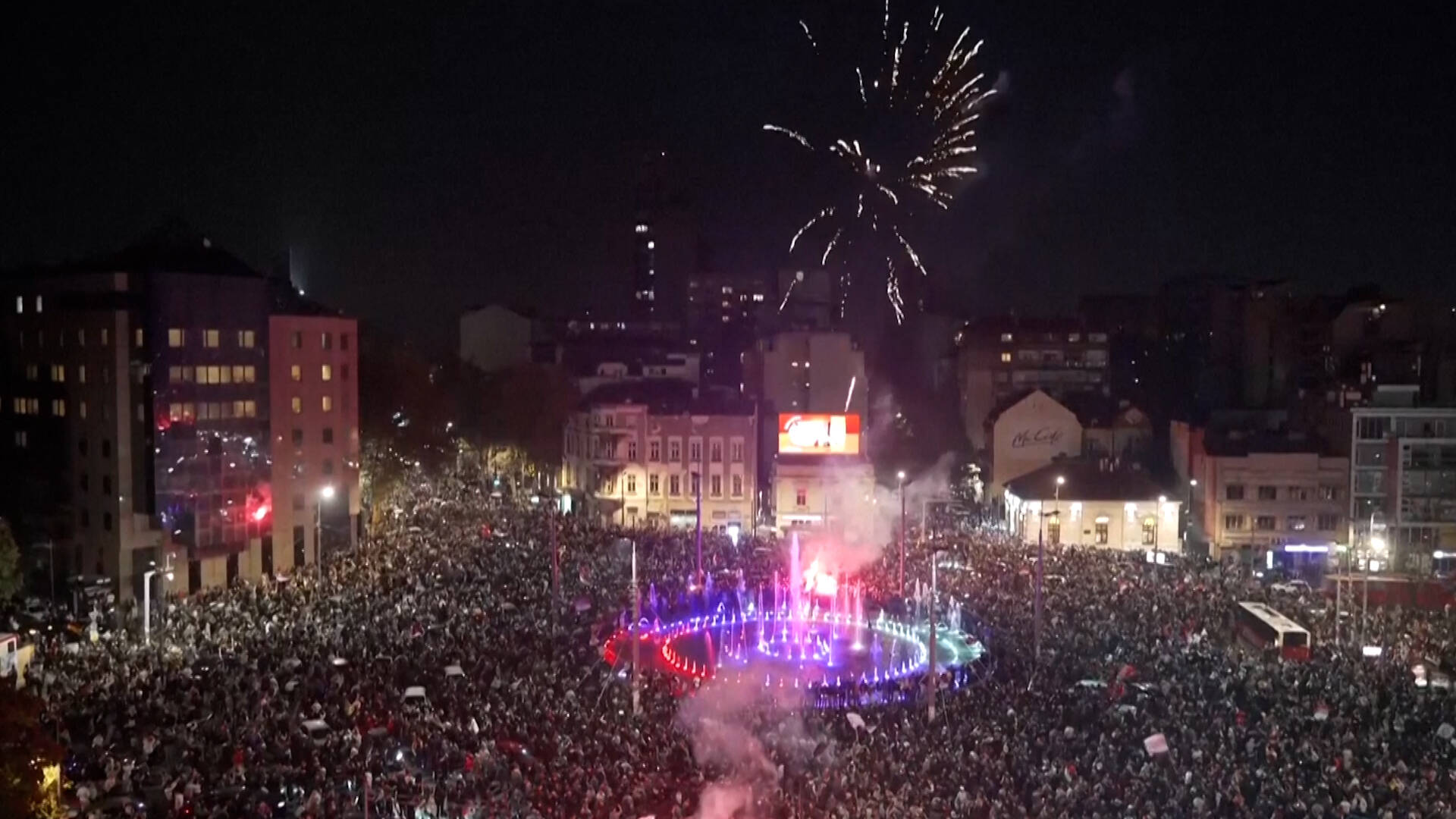
In Serbia, longtime nationalist leader Aleksandar Vučić conceded defeat following elections Sunday in a contest that pitted Vučić and his right-wing party against a student-led movement that had weakened his hold on power after two years of anti-government protests. The student-led movement first rose up in November 2024 following the collapse of a roof at a train station in the city of Novi Sad, which killed 16 people. The disaster became a focal point for protests over government corruption, cronyism, political violence and democratic backsliding. President Vučić conceded defeat after early results showed the Student List poised to win more than 135 seats in the 250-member parliament, compared with only 105 for Vučić’s party. The historic defeat marks the end of a 14-year rule and a seismic shift in Serbian politics.
Tens of thousands of residents flooded into the streets to celebrate following the concession.
SEJLA KIPIC: The feeling is surreal. I laughed. I cried. I screamed. I jumped. It’s just unbelievable. After so many years of this tyranny and dictatorship, we are finally free. And that’s — you cannot put it in words.
AMY GOODMAN: The candidates on the newly formed Student List aren’t students, but political newcomers including farmers, athletes, artists and little-known experts. Students traveled through rural areas on foot and on bicycle to speak directly with voters in rural areas — traditional strongholds of Vučić.
This is Student List candidate Radomir Saičić.
RADOMIR SAIČIĆ: [translated] This is a victory of courage over fear, a victory over unrest. Serbia can and must be different. Thank you for every step, every hour, every sacrifice and for every moment you chose not to give up. Thank you to everyone who raised their voice, stood by one another and showed that the future of this country does not belong to a select few, but to all its citizens.
AMY GOODMAN: For more, we go to Belgrade, Serbia, where we’re joined by
Lela Vujanić. She’s a journalist and media researcher covering both media and social movements.
Lela, welcome to Democracy Now! If you can talk about this stunning victory of the Student List movement and what Vučić represented, and the changes you think will happen as a result of something we’re seeing not only in Serbia, but student-led movements across Europe right now?
LELA VUJANIĆ: Hi, Amy. Thank you for having me. I was listening the Brazilian segment, and I’m super happy for Lula’s victory and for Brazilian people voting this way.
But, yes, we have something quite historic and extraordinary happening in Serbia, as you said. Yesterday, it was Election Day, parliamentary elections. And our mass civic, social movement, that’s led by Serbian students, was able — that lasts already for two years — was able not only to challenge Vučić and his ruling SNS party, but to win popular vote in a landslide victory, winning 52% of the votes.
What’s also important, that they campaigned individually, I mean, their electoral list called Student List. When I say “individually,” on the other hand, people of Serbia actually did the campaign and campaigned together with the students and with their Electoral List. What’s interesting, that students wiped out everybody else. Former established oppositional parties didn’t pass the electoral threshold, which is actually set very low in Serbia, around 3%. So, as you can see, this changes everything. In a way, students really changed the whole political landscape of the country, and maybe even more important, they changed political imagination. They changed our understanding of what’s politically possible for all of us.
People were celebrating throughout the night across Serbia and Belgrade. There was also a moment of disbelief, because only few people in Serbia yesterday would say that everything — that Vučić will — that everything will resolve peacefully. Most of the people even expected some sort of the state of emergency, election being rigged. So, everybody was quite surprised when the former president got on TV yesterday around 10 p.m. and said, “Yes, students won, and I acknowledge the results.”
JUAN GONZÁLEZ: And —
LELA VUJANIĆ: Sorry?
JUAN GONZÁLEZ: Lela, I wanted to ask you — the press has described the Student List movement as being leaderless. And could you talk about how it became organized and whether it is, in fact, leaderless?
LELA VUJANIĆ: Thank you. Great question. So, for Serbia, what happened yesterday, it’s extraordinary and historic for Serbia, but I think it’s quite extraordinary globally and that this Serbian case will be studied and researched in the years to come.
So, the movement really is horizontal. And from its beginning, it was based and organized through — we say in Serbian plenums, so popular assemblies, based on direct democracy principles. So, after the fall of the canopy, of newly rebuilt canopy of the train station, students demanded political accountability from political class in the country, and they occupied literally all faculties in the country, across all four university centers in Serbia. They organized based on direct democracy principles, made their decisions through deliberations on plenums, and actually spread the model throughout the country. And citizens also adopted the model and organized based on the same principles, organized in their locales. So, citizens run — and this is still active — popular assemblies in their neighborhoods and in their municipalities. So, yes, this was great, great democratic opening and democratic awakening, not only for the students, but for the rest of the country also.
JUAN GONZÁLEZ: And the impact of these election results on the rest of Europe, especially since Serbia for years has been one of the countries, I guess, closest to Russia of the European countries?
LELA VUJANIĆ: Yes, Serbia has a somewhat specific position. It’s not member of the EU. It’s for 12 years already a candidate country. It didn’t introduce sanctions to Russia. But you need to remember — and Serbia is no stranger to Democracy Now! Democracy Now! reported almost 30 years ago about this controversial NATO bombing of Yugoslavia. So, Serbia was under sanctions itself back then. And this is also the reason why people, Student List included, not only previous government, don’t want to introduce sanctions to Russian Federation. So, when I say “specific,” non-EU, non-NATO country, but trying to join European Union.
Regarding student programs and our future relations of Serbia with other countries and world powers, so, students said no sanctions to Russia. We continue negotiations with Europe. We continue our strategic partnerships with China. And what’s probably the most interesting, that we will not be complicit, or we will not contribute, or we will not participate in the systemic erasure of Palestinian people.
AMY GOODMAN: Speaking of Palestinian people, we turn next to the occupied West Bank. Lela Vujanić, we want to thank you for being with us, Serbian journalist and media researcher covering both media and social movements, joining us from Belgrade after the stunning victory of the Student List.
Coming up, we look at Israel’s escalating crackdown in the occupied West Bank ahead of Tuesday’s election in Israel that will determine whether Netanyahu remains prime minister. Stay with us.
[break]
Politics
Israel’s elections are wide open. Here’s what could decide Netanyahu’s political fate.

Tel Aviv — After three years with their country at war on multiple fronts, Israelis will go to the polls Tuesday in a hotly contested election that will shape their next government. Polls show it is an incredibly tight race, and as Prime Minister Benjamin Netanyahu fights to hold onto his job, there’s no guarantee of a quick, definitive outcome for him or his political opponents.
Polls vary widely regarding the expected outcome. Right-leaning pollsters give an advantage to the right-wing and religious bloc led by Netanyahu, while left-leaning pollsters show an advantage for the so-called change bloc opposing the incumbent.
Most polls show neither side is likely to win a decisive majority of the 120 seats in Israel’s parliament, the Knesset, which would enable it to unilaterally form a new government. The tight margins mean the voting may end in a stalemate, which could lead to protracted negotiations across ideological lines, the formation of a minority government, or even an election do-over.
“It looks like an indecisive outcome is the most likely outcome,” said Yohanan Plesner, president of the Israel Democracy Institute.
This will be the first election since the Oct. 7, 2023, attacks by Hamas, which authorities have acknowledged as Israel’s most catastrophic security failure since the country’s founding in 1948. Israelis will go to the polls Tuesday with their country still fighting in the subsequent multi-front war in Gaza, Lebanon and Syria, and after two direct rounds of conflict with Iran and Netanyahu advocating for a third.
Against that backdrop, there are a few key issues that could determine the election outcome, even if it does take days or weeks to shake out. But first, here’s a look at the two main factions vying for the votes.
The Netanyahu camp
Netanyahu, Israel’s longest serving prime minister and leader of the Likud party, is seeking to form another coalition similar to his current government, which relies on partnerships with ultranationalist and Jewish religious parties.
He has two main pitches to voters: First, that only he can form a government without the support of Israel’s Arab parties, which he argues would be a danger to the country if they gain enough seats to influence Israel’s engagement in its myriad conflicts.
Netanyahu’s second argument to voters is that Israel’s campaigns in Gaza, Lebanon, and especially Iran, are ongoing, and he needs more time to finish what his government started.
President Trump offered a full-throated endorsement of Netanyahu last week. He reiterated his administration’s firm support for the war the two men launched jointly against Iran almost eight months ago, and warned that he could be disinclined to continue with it if Netanyahu doesn’t hold onto power.
“If Israel has the wrong Leader, which would be anyone other than Bibi, America will have to do this work ourselves, and I am not inclined to do so,” Mr. Trump said.
Since that endorsement, Netanyahu has argued that only he can work with Mr. Trump to ensure Iran does not obtain a nuclear weapon, which many Israelis see as an existential threat.
Netanyahu’s campaign slogan, which rhymes in Hebrew, is: “Either right wing or Palestine, either right wing or a nuclear bomb.”
Over the weekend, Netanyahu posted an AI-generated photo of a mushroom cloud over Tel Aviv on social media, with a caption reiterating his insistence that Iran poses an existential threat to Israel.
Netanyahu’s supporters see him as a top-tier global leader.
“Bibi can handle the whole world,” restaurant owner Benny Abraham told CBS News, using Netanyahu’s nickname. “Bibi is charismatic. He has a strong voice. The world loves him.”
“He’s the king of Israel,” Abraham added.
The (anyone but Netanyahu) “change bloc”
Running against Netanyahu is a diverse group of Arab, right, left and center parties that have one clear common denominator: They all want Netanyahu out of power.
The front-runner to lead the “change bloc,” should its various parties collectively win enough seats to build a coalition, is former Israeli military chief Gadi Eisenkot, who leads the centrist Yashar party.
Eisenkot lost his son and two nephews while they were serving in the military in Gaza. He was part of the Israeli war cabinet for much of the first year of the Gaza war, working alongside Netanyahu. About half of his party’s candidates in Tuesday’s election are women, in stark contrast to the male-dominated Netanyahu coalition.
Eisenkot is framing himself as a humble veteran who wants to reunite Israel after years of division that he blames on Netanyahu.
Eisenkot responded Monday to Netanyahu’s rhetoric about Iran posing a nuclear threat by accusing him of “relying on a campaign of fear-mongering, lies, and threats — including images of nuclear bombs in the heart of Tel Aviv.”
“This time, it won’t work for him,” he said.
Eisenkot’s key campaign promises include launching a state inquiry into the intelligence and security failure to prevent the Oct. 7, 2023, attack by Hamas — something Netanyahu has thus far blocked.
Uzi Aharoni, 73, an engineer from Tel Aviv, told CBS News he saw Eisenkot as the only real alternative to Netanyahu.
“Eisenkot is not left, he’s not right. He’s straight and honest. He’s the kind of leader who will take care of us, the people of Israel, and not himself or his corrupt family,” Aharoni said.
The Arab vote and the ultra-Orthodox draft
There are a few factors analysts believe could hand a victory to either side.
One thing polls can’t predict well in Israel is voter turnout. Past elections have shown voters backing Netanyahu’s Likud party, and Arab-Israeli voters, vary the greatest in their enthusiasm to come out on election days, so there could be room for turn-out surprises that significantly change the electoral math in favor of either side.
Arab Israelis, also referred to as Palestinian citizens of Israel, make up around 20% of Israel’s population.
“The higher the Arab turnout, the less likely that Mr. Netanyahu, within the current coalition, can form another government,” said Plesner at the Israel Democracy Institute.
More Arab voters will head to voting booths this year because of their strong desire to prevent Netanyahu from forming another government with far-right allies, who have made life difficult for them over the last four years, Jehad Abomoch, a cafe owner in the predominantly Arab city of Baqa al Gharbiya, told CBS News.
“The last four years were a real catastrophe, both socially and in terms of wars,” he said, adding that many Arab Israelis feel that under Netanyahu, they have “no hope, no future.”
There are also two new parties entering this election, and polls show each is hovering around the threshold of support required to gain seats in the Knesset. Whether either party ultimately crosses that threshold could also tip the scales — in either direction — toward a new coalition government.
Both parties are focused on challenging Netanyahu’s alliance with ultra-Orthodox parties by demanding that ultra-Orthodox Jewish citizens be formally included in Israel’s mandatory military service.
It’s a key issue that cuts right through Netanyahu’s traditional support base and coalition partners.
Not all election outcomes are neat and tidy
In the event that neither bloc wins a clear majority in parliament, there are several paths forward to a new Israeli government.
One option is that parties or individual lawmakers could break election promises and switch sides, for which there is plenty of precedent in Israeli politics. There could be weeks of negotiating before a coalition is agreed on.
Another possibility is that the change bloc, if it wins a significant share of the votes but not quite a majority, could seek to form a minority government. To do that, the parties just need to win more seats collectively than the other side, even if it’s not more than 50% of the 120 available. Arab parties could give the change bloc that plurality by either voting in favor of a minority government, or just abstaining and not voting against its formation.
If there’s a stalemate and neither side can build a coalition government, the country will have to hold new elections. There is plenty of precedent for that scenario, too.
Between 2019 and 2022, Israel held five elections due to electoral deadlock.
Plesner told CBS News that, if all the politicians running effectively stick to their campaign promises and refuse to swap sides in the event of a stalemate “we will roll into another election.”
“I’m sure that most politicians are not interested in that,” he added.
Politics
Catholic bishops accuse Trump White House of turning prayer into campaign photo op
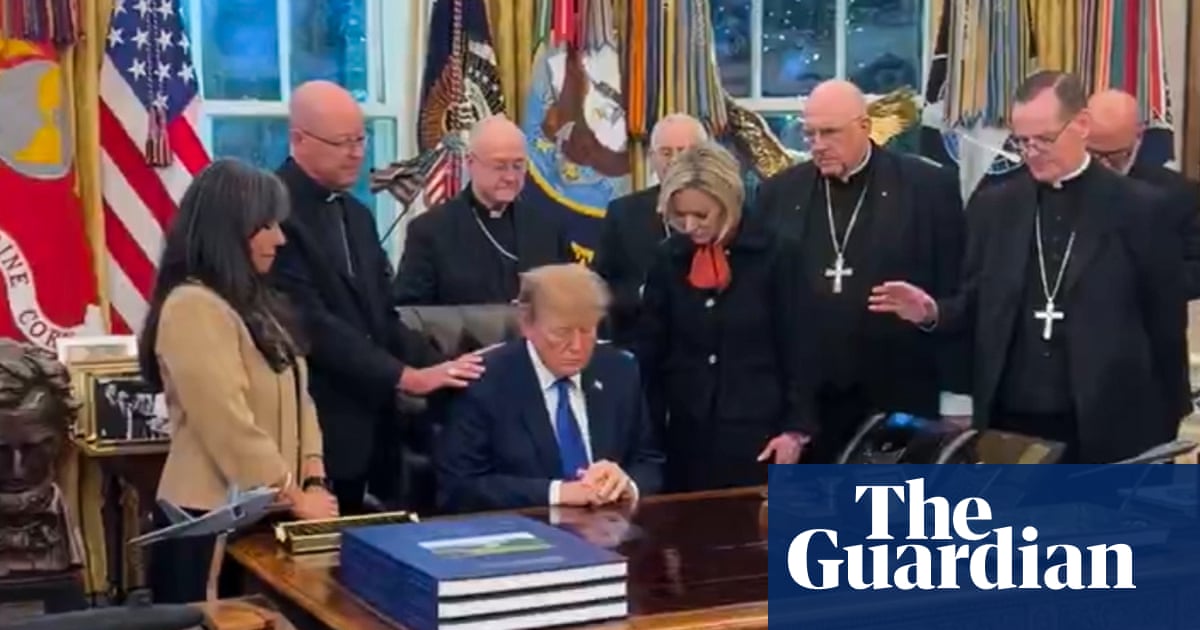
Two Catholic bishops who bowed their heads with Donald Trump in the Oval Office now say they regret it, accusing the White House of turning a private prayer into a campaign photo opportunity before next week’s US elections.
Archbishop Jeffrey Grob of Milwaukee and Bishop William Joensen of Des Moines, who were among the 12 bishops who met administration officials last Thursday, issued separate statements of regret over the weekend.
The fallout stems from the White House quickly posting video and photos of the prayer on social media, captioned as Catholic archbishops and bishops praying with the US president, less than two weeks before the midterm elections on 3 November.
Archbishop Grob issued a statement headlined A Public Apology, in which he said he felt “a heavy sadness” over the pain the images had caused, and that he had heard from people alarmed that he had unwittingly joined a political event on the eve of a national vote.
Others, he said, were hurt because of the effect of Trump’s policies on their families. “We should never have been put in that position by the White House,” wrote Grob, adding that he had harbored reservations and “wish I had heeded them”.
Bishop Joensen wrote that “many things tied to this present Administration” were “blatantly at odds with our Catholic faith”.
He said none of the bishops was unaware the meeting fell close to an election, but insisted that none had intended to endorse a party or candidate. “I wish I had been more shrewd and less simple, like those who exploited our meeting for partisan political purposes.”
Grob said the Heritage Foundation, the conservative thinktank behind the Project 2025 rightwing blueprint for the second Trump administration, arranged the meeting. The bishops, he said, were told it would be a private discussion of immigration enforcement, religious-worker visas and human dignity, with a possible chance to pray privately with the president.
After 90 minutes with domestic policy staff, they were ushered into the Oval Office, handed commemorative tokens and, Grob detailed, directed to stand behind Trump’s desk and pray. Nobody told them a video was being recorded, he said, and they never agreed to its release.
Joensen said officials connected to the White House Faith Office invited him, and that the agenda also covered fertility treatment incentives, abortion-inducing drugs and tax credits for private schools.
Archbishop James Golka of Denver, another participant, told his archdiocese’s publication that he understood why many saw the video as an endorsement but that it was “never my intention”. “I’m heartbroken that people are hurt, and that there are people intentionally using this moment to sow disunity,” he said.
Bishop Scott Bullock of Rapid City told the National Catholic Reporter that a Heritage Foundation representative had invited him and that the US Conference of Catholic Bishops was “not unaware” of the meeting. He did not say who in the leadership knew.
Trump has spent his second term fusing Christian prayers with the machinery of government, creating a White House Faith Office by executive order in February 2025 and, the same month, a justice department-led taskforce to “eradicate anti-Christian bias” in federal agencies.
The president faced criticism in April for posting an AI-generated image on his Truth Social platform depicting himself as a Jesus-like figure. He later deleted the post, and claimed it was “supposed to be me as a doctor making people better”.
At the Pentagon, Pete Hegseth, the US defense secretary, has held Christian worship services (which the Associated Press reports have been led only by evangelicals) and in March prayed for “overwhelming violence” against “those who deserve no mercy” in the Iran war.
And when the Episcopal bishop Mariann Budde urged him at his inauguration prayer service to show mercy toward migrants and LGBTQ+ people, Trump demanded that she and her church apologize, which she in turn rejected.
Archbishop Paul Coakley of Oklahoma City, president of the US Conference of Catholic Bishops, has urged Catholics to put faith ahead of politics before the vote. The bishops are due to hold their annual fall assembly in Baltimore in November, about two weeks after the election.
“We are, as ever, a pilgrim people,” Grob wrote. “And that includes bishops,”. He ended his apology with “sincere regret”.


How Artificial Intelligence Is Changing Everyday Life in 2026: Benefits, Risks, and the Future Ahead
Artificial intelligence (AI) is transforming how people work, learn, communicate, and make decisions. From AI-powered assistants and smart devices to...


Israel Election Live Updates: Polls Open as Netanyahu Faces Challenge Led by Eisenkot
Mr. Netanyahu is seeking re-election at the helm of a coalition of nationalists and ultra-Orthodox Jews — the most far-right...


Brewers ride ridiculous, record-setting eight-run inning to dominant 3-0 World Series lead over Rays
The Milwaukee Brewers moved one step closer to their first ever World Series title on Monday night, taking a 3-0...
World Series 2026: Brewers on cusp of first title after dismantling Rays in historic rally to take 3-0 lead
It will take an unprecedented comeback to stop the Milwaukee Brewers from winning their first World Series title. After Monday,...


Eric Bauza, actor who voiced Bugs Bunny, Daffy Duck and other cartoon characters, dies at 46
Eric Bauza, the Emmy-winning actor who voiced iconic “Looney Tunes” characters Bugs Bunny and Daffy Duck, died on Sunday, according...


Jay-Z to Perform at 2027 Super Bowl Halftime Show
Jay-Z is slated to perform at the Apple Music Super Bowl LXI Halftime Show, taking place on Feb. 14, 2027,...


Aaron Sorkin on Directing Doubts, ‘The West Wing’ and ‘A Few Good Men’
“I was my second-choice to direct it,” Aaron Sorkin candidly admitted as we sat down last week at the the...


Eagles vs. Cowboys score: Dallas routs rival Philadelphia on ‘MNF’
Updating Live (25) See New Posts Pinned Link copied Cowboys win! Cowboys leave Philly with a 38-21 win. The Cowboys...


Neil Young Sues Trump Committee for $10 million Over Song Use at Rally
Rock legend Neil Young has slapped a Trump fundraising committee with a $10 million lawsuit over the use of his...


Dollar General overcharged millions at checkout for years, FTC and 20 states allege
The Federal Trade Commission and 20 states on Monday sued Dollar General, accusing the budget retailer of charging customers more...
-

 HealthNews2 weeks ago
Dementia risk more than quadruples among adults with common disorder
-

 Business1 week ago
‘Black Monday’ fears intensify as prediction markets shrug off 2026 crash
-
Sports2 weeks ago
Brewers take 2-1 win over Dodgers to kick off NLCS
-
Food2 weeks ago
Powerball winning numbers, results for Saturday, Oct. 10, 2026: No jackpot winner
-

 Business2 weeks ago
McDonald’s chicken and beverage growth faces rivals
-

 Entertainment2 weeks ago
Collin Gosselin discusses alleged abuse by mom Kate Gosselin
-

 HealthNews2 weeks ago
The ancient Iranian fruit scientists think may help heart failure
-

 Entertainment2 weeks ago
Netflix, Derek Cianfrance Adapting Gary Paulsen’s Book