
Politics
Ramaswamy and Trump gamble on an incendiary ad, as Ohio shows signs it might turn purple again
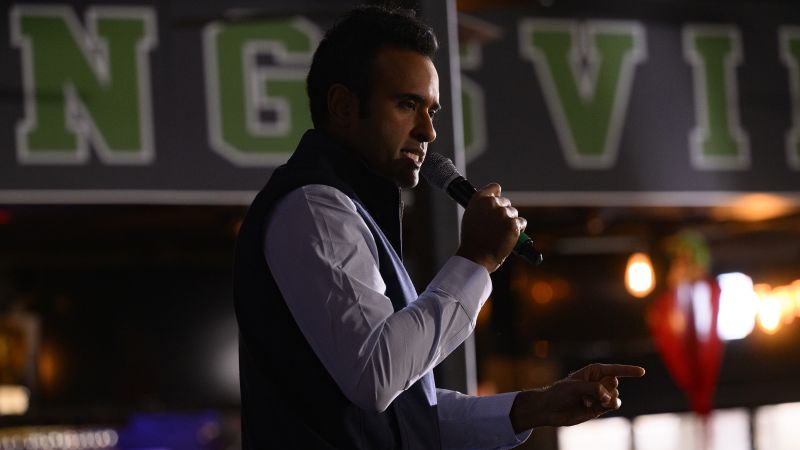
Vivek Ramaswamy is ending his run for Ohio governor the same way he launched himself onto the political scene four years ago — with a bet that voters will reward him for a never-back-down bombast that mirrors President Donald Trump’s instincts.
But interviews with voters over three days following the release of the Republican nominee’s ad featuring the estranged mother of his Democratic opponent, Amy Acton, offered a glimpse at the potential perils of imitating Trump — particularly in a year in which polls show voters turning away from the president.
And if Ramaswamy’s approach alienates enough moderate and independent voters, a Republican Party looking for its way forward in the fast-approaching post-Trump era could find itself losing the ground it gained in a state that not long ago was a perpetual political battleground.
The ad at issue shows Acton’s estranged mother calling her own daughter a liar and urging voters to reject her. Acton has said she hasn’t seen her mother since she was 12 years old, when her mother lost custody of her children. Her stepfather was indicted by a grand jury on charges of sexually abusing her. Confronted on those underlying details this week, both Trump and Ramaswamy deflected and pointed to the mother’s allegations.
In CNN’s conversations with voters after the ad was published, the dynamics in the governor’s race felt similar to those playing out nationally: Die-hard Republicans who still support Trump remain strongly in Ramaswamy’s camp, despite the controversy. They remain angry at Acton over her role in Ohio’s Covid-19 response, a period in which she was director of the Ohio Department of Health, and say both campaigns have aired negative ads. More moderate and independent voters, though, said they were bothered by the ad, and that it does change how they see the GOP nominee.
The question that could decide the governor’s race in a state Trump won by 11 percentage points in 2024 is just how many Republicans Ramaswamy is able to keep in his camp as the controversy engulfs the race’s final days.
Kari Freudenberger, a 47-year-old substitute teacher and social worker from Madeira who described herself as independent, said after seeing Ramaswamy speak Wednesday in Cincinnati that the ad was “heinous and horrible” — and makes her less likely to vote for the biotech entrepreneur.
“I don’t care if Ramaswamy’s policies are the best. That shows a judgment of character that I don’t want to see anymore in politics,” she said.
Cherise Wilson, a 48-year-old nurse who lives near Cincinnati and said she is a Republican, told CNN she is “torn” about the governor’s race — and on whether it was appropriate to use Acton’s mother in an ad.
“I feel bad for Amy in the sense that she was truly a victim,” she said. “But I also don’t want somebody running the state of Ohio who is a victim and is in victim mode. … But I also don’t want somebody who is going to be a complete — can I say a**?”
An independent voter who asked not to be named, a 57-year-old chemist who came to the rally because he works nearby, said he was impressed by Ramaswamy’s 2024 presidential campaign and initially excited he was running for governor of Ohio.
But he said he’s been turned off by the advertising in the race — including Ramaswamy’s ad featuring Acton’s mother. He is now unsure who he’ll vote for.
“I just feel like you don’t even need that stuff,” he said. “The ads are a real turnoff on both sides.”
Ramaswamy digs in
The ad was met with immediate criticism, including from the man Ramaswamy is running to replace, two-term Republican Gov. Mike DeWine.
“The ad on its face is deeply, deeply troubling,” DeWine told reporters Thursday. “But when you know the rest of the story … it makes it just more wrong.”
But prominent Republicans, including Trump and Vice President JD Vance, have defended Ramaswamy and the ad. Trump on Friday said even knowing Acton’s history, Ramaswamy should continue airing the ad.
“A mother is saying, ‘Don’t put my daughter there because she’s a terrible person and she’s a liar,’” Trump said. “Why shouldn’t somebody use that?”
Ramaswamy, at an event on Friday and later when speaking to reporters, claimed that “our ad had nothing, nothing to do with childhood abuse, sexual abuse” — ignoring Acton’s history, which she had described publicly before the ad.
When pushed by CNN about whether he harbored doubts that Acton was abused by her stepfather, Ramaswamy deflected, noting he had never met or spoken to Acton’s mother and repeating his previous attack on Acton’s credibility.
“I think that in the standard of political advertising that they have used and that the media regularly accepts, I think it is absolutely acceptable for voters to hear and make a decision for themselves,” he said.
Ramaswamy’s approach to the controversy was a reminder of his pugnacious bid for the 2024 Republican presidential nomination. Several other candidates were willing to criticize Trump, frequently and sharply, in speeches and on debate stages, even through Trump chose not to appear. Ramaswamy, by contrast, was often the president’s most vocal defender. He sought the limelight and relished clashes with other candidates, often talking over and insulting them in a style reminiscent of Trump’s 2015 rise.
The irony of the explosive chapter in the Ohio governor’s race is that it kicked off when the ad was first published not by Ramaswamy’s campaign, but by an Ohio political blogger, D.J. Byrnes, who is known as “The Rooster.” Byrnes told CNN he obtained the video from a voter who saw it as part of a poll and recorded it.
After the video leaked Monday night, Ramaswamy’s campaign was at a crossroads. Should it distance itself or take responsibility and lean into the incendiary line of attack?
It wasn’t until shortly before 2 p.m. Tuesday that the campaign broke its silence on the ad, and even then, its statement did not say whether it was responsible for the spot. About five hours later, Ramasawmy ended the mystery.
“It is an ad from our campaign,” he told reporters after a town hall in the Columbus area.
By the end of the evening, his campaign had announced it would spend $4 million to run the ad, making clear it would not back down.
How Republican voters feel
At campaign stops Friday, Republicans who had lined up to see Ramaswamy said they were going to continue to support him — even if they had misgivings about the ad.
Joan Smith, who was waiting outside a pancake breakfast with Ramaswamy in Strongsville, said she is “not happy about” the ad and hopes Ramaswamy’s campaign will take the ad off the air.
“But I’m not going to throw the baby out with the bath water,” she said. “Politics is a dirty game. You can’t be weak in something like this.”
Still, she said, the ad was “a shocker.”
“It’s bad. I don’t like it. That wasn’t necessary,” she said. “But he did it and it’s over, and people make mistakes all the time, and I don’t think he should have done that.”
At the same event, Joyce Tedrick said she had “no concerns” about the ad.
“I think it just goes along with the fact that she isn’t always truthful,” she said. “It’s too bad.”
Politics
LA’s newer, bluer wave: Nithya Raman leads way as city’s progressives make their mark

As a blue tsunami overtook US politics this week, Los Angeles saw a major shake-up of its own with a wave of democratic socialists elected to key offices.
Most notably, Nithya Raman, the first democratic socialist to serve on the Los Angeles city council, prevailed over incumbent Karen Bass to become the next mayor. Even in the deep blue city, Raman’s victory was hardly a given, and marked a stunning win for the progressive wing of the party. With her election, America’s two largest cities will now be run by democratic socialist mayors.
The wins for the organization didn’t stop there.
Los Angeles voters backed numerous DSA-LA-endorsed candidates, including Marissa Roy for city attorney, and Angela Gonzales-Torres, who defeated the incumbent Jimmy Gomez for a US House seat. Other members won seats on school boards and the Burbank city council, meaning Burbank has the first socialist-majority city council on the west coast, DSA-LA said.
The organization saw its largest-ever slate of candidate victories after an election season in which volunteers knocked on more than 110,000 doors.
“These results show us what we’ve known for a long time: Angelenos are looking for an alternative to politicians beholden to billionaires and corporate interests,” Anna Gross, a DSA-LA steering member, said in a statement.
“With representation across LA county, in the most powerful positions in city hall and for the first time in US Congress [Gonzales-Torres], we look forward to showing Angelenos what Democratic Socialist leadership can deliver.”
DSA support was significant for Raman, and meant that a large network of volunteers canvassed for her across the city in the lead up to the election. But her campaign was also helped by the fact that Karen Bass was deeply unpopular. Polling has long shown that Angelenos are frustrated about the state of the city, and resentment over Bass’s handling of the Palisades fire damaged her.
“If there hadn’t been the Palisades fire in January of last year, I don’t think Nithya would have run. And I don’t think Karen Bass would have been defeated,” said Zev Yaroslavsky, the director of the Los Angeles initiative at the Luskin School of Public Affairs at the University of California, Los Angeles.
“The majority of the people of the city, a significant majority, think that the city is on the wrong track. And the Palisades fire was really the poster child for all that people are unhappy about.”
This week’s victories have boosted DSA-LA, which had more than 6,000 members as of last month, and has seen another 2,000 people join this week alone, the chapter said.
The organization has significantly expanded its power and reach in recent years. Raman, who joined DSA in 2019, was the first elected to city council in 2020 in a stunning victory that saw her defeat an incumbent Democrat backed by Nancy Pelosi and Hillary Clinton. Yaroslavsky said at the time that her election marked a “a significant shift in the architecture of Los Angeles politics”, he recalled.
In the years since, the city has voted in three other DSA candidates to serve on its 14-member council.
“The DSA organization has made an impact on LA city politics since 2020 when they supported Nithya Raman the first time,” Yaroslavsky said. “They’re pretty sophisticated in the way they target their resources, [which] are human resources – they have a lot of campaign workers and precinct walkers.”
In an interview with the Guardian in September, DSA member Patrick Padilla said the organization’s platform has broad appeal – including among many people who don’t identify as democratic socialists. The group focuses on an array of issues, including affordable housing and tenant rights, immigrant rights, Medicare for All and the Green New Deal, among others, according to its website.
“We’re coming to find that the status quo has not been serving everyday working Americans. And when I’m on the doors, I’m talking to people. People are just focused on how they can get by day to day,” Padilla said.
Several candidates of the slate endorsed by the chapter this year won by huge margins this week. In the city attorney race, Roy won with 67.39% of the vote, according to the latest data available. Roy has pledged to make the city attorney’s office into the “largest public interest law office in the city” and to use “the law to fight for working people, immigrants, renters, consumers”.
Gonzalez-Torres won with 60.6% of the vote to Gomez’s 39.4%, according to the most recently available figures. Gomez had served in Congress for nearly a decade and was endorsed by Aipac, which spent $2.7m in support of his candidacy. He stood in sharp contrast to Gonzalez-Torres who described the war in Gaza as a genocide that the “Israeli military is only able to commit with the financial and political support of the US government”.
While Raman’s victory is undoubtedly a win for the chapter, the endorsement was complicated.
Raman entered the race at the last minute after DSA-affiliated colleagues had already backed Bass, and another candidate was in the running. DSA member Rae Huang also ran in the mayoral primary and the chapter opted not to support any candidate.
The organization censured Raman in 2024 for pursuing an endorsement from a Democrats for Israel group, and its decision to back her in this election came after internal debate. (And while the chapter endorsed her, the other DSA-affiliated council members stood by Bass.)
Shortly before the election, the organization’s national leaders considered rescinding the chapter’s support until Raman stated her position on the boycott, divestment and sanctions movement. A vote on the matter ultimately failed.
The chapter has been outspoke in its support of her, writing in a social media post: “YUP, that’s our Mayor!!!”
While its the start of a new era in Los Angeles politics, the job of the mayor is the same. Once in office, Raman will have to build trust in communities that didn’t vote for her, Yaroslavsky said, which the mayor-elect has acknowledged.
“To every voter out there who voted for Mayor Bass or who chose not to vote in this election at all, please know this, I am going to city hall to work every single day to earn your trust and to earn your trust in this city again,” Raman said.
“That works starts now so that we can build housing people can afford, parks for our children, a transit system that can get people where they need to go, a city that is safe for its working people and its families, and a city government that is actually capable of delivering on its promises.”
Politics
No clear winner after tight general election

There was no clear winner following New Zealand’s election on Saturday, as the leaders of its two major parties preparing for negotiations to form a coalition government.
Prime Minister Christopher Luxon’s centre-right National Party won 42 seats but was 19 short of the simple majority needed to form a government, despite being the largest party, preliminary results show.
Combined with their coalition partners ACT and New Zealand First, they would have a slim lead over the left-leaning bloc if a deal could be reached.
But opposition leader Chris Hipkins, whose Labour Party won 36 seats, showed no signs of conceding, saying the “shape of the next government” will remain uncertain “for a while”.
Projections show the National Party on 42 seats and Labour on 36. The Greens are on 16, with ACT on 13, New Zealand First on 12, the Opportunity Party on 7 and Te Pāti Māori, which represents Māori interests, on 5.
Luxon congratulated Hipkins on a “very hard-fought race” before addressing party colleagues, saying “whatever the final count, we are incredibly proud of each and everyone for you”.
He said he would run a caretaker government until the final results were confirmed later in the month, adding: “With those final results there can then be meaningful negotiations.”
Elsewhere, Labour leader Kipkins said “the people have spoken”, adding: “It may take a bit longer to work out what they’ve said.”
Hipkins said the results made clear the “next parliament is going to require all of us to compromise, to work together and to find a common ground”.
More than 99% of votes have been counted in New Zealand, with National and Labour neck-and-neck in terms of vote share.
But the preliminary results pointed to historically low support for the two major parties, with a combined vote share of around 60%.
The Opportunity Party crossed the 5% threshold to enter parliament for the first time, with leader Qiulae Wong saying would work with either side.
It has been described as this election’s kingmaker as it remains open to working with either major bloc, but its leaders said they would negotiate first with the party that secures the most seats.
Speaking at Opportunity’s watch party, Wong told supporters: “We believe that we can change the way we do politics to focus on the future, on the next generation, and on finding common ground.”
Professor Andrew Geddis from the University of Otago, an expert in election law, said “the Opportunity Party as a wildcard player” could “determine which bloc of parties is able to govern”.
“It will come down to some very fine vote margins not just between the parties, but in individual electorates. We are going to have to wait for the special votes to be processed and counted over the next three weeks,” he said.
The Greens – who have proposed forcing the country’s two main supermarkets to divest stores to create publicly-owned shops – saw their vote rise by a couple of percentage points.
Julian McCrann, head of polling at Roy Morgan, told BBC News the cost of living was the main issue for many New Zealanders
“Three years ago, Luxon came in saying he’d be making New Zealanders’ lives better and solving these economic issues, but he hasn’t really delivered,” he said.
More than half of the country no longer see New Zealand as a land of opportunity, according to an annual social cohesion survey. Record numbers of Kiwis have been leaving the country, with many going to Australia.
Politics
Pedro Alliana sworn in as Paraguay president after Santiago Peña’s impeachment

After three years as vice president, Pedro Alliana suddenly found himself catapulted to Paraguay’s presidency on Friday following the impeachment of ousted leader Santiago Peña.
Alliana, a former national team basketball player who would go on to lead the Colorado Party, takes office amid a political and financial crisis in the South American nation that was sparked by the collapse of Ueno Bank this week, which froze the savings of half of the country’s adult population.
After taking office, the 52-year-old vowed to tackle the situation before his term ends in August 2028.
It comes as Peña has been placed under house arrest in the capital, Asunción, and is awaiting questioning on Saturday over alleged crimes of breach of trust, influence peddling and misappropriation of funds, prosecutors said.
Who is Pedro Alliana?
Born in February 1974 in Pilar, on the banks of the Paraguay River, Alliana built his political career with the backing of former president Horacio Cartes, one of the most influential figures in the country and the leader of the ruling Colorado Party.
Before going into politics, Alliana pursued a business career and also made a name for himself as a basketball player, representing the Paraguayan national team in 1991.
Politics was present in Alliana’s life from an early age, with both of his parents having served as local councillors.
His first venture into politics ended in defeat in 2006, however, when he unsuccessfully sought the mayoralty of his hometown at the age of 32.
But two years later, he managed to get elected as governor of the southern department of Neembucu.
He later served in the Chamber of Deputies from 2013 to 2023, presided over the lower house, and then led the Colorado Party.
In 2021, Alliana expected to run for the Senate, but he would later recall that Cartes told him he would instead become Peña’s running mate. Peña previously said that Alliana could become “the best vice president in Paraguay’s history.”
Alliana has faced criticism over the number of relatives holding posts in public administration, among them his eldest daughter, Montserrat. The father of four is married to congresswoman Fabiana Souto.
Cartes
Alliana did not hide his presidential ambitions. A year after taking up the vice presidency, he publicly acknowledged his desire to one day take the top job.
In 2025, Cartes openly backed his possible candidacy.
“Pedro, you are blessed,” he said at a Colorado Party event, where he called for supporters to get behind him as the “next president of the Republic.”
However, the relationship between the two eventually broke down. After Cartes withdrew his support, Alliana distanced himself and stated on 26 October that loyalty should not be confused with “blind obedience.”
His luck changed again when lawmakers moved to impeach Peña but rejected proceedings against Alliana.
Politics
Houston mayor curbs cooperation of US city’s police with ICE

The mayor of Houston, the most populous city in the US state of Texas, has ordered the city’s police force to sharply limit its cooperation with the United States Immigration and Customs Enforcement (ICE).
John Whitmire’s executive order came on Friday, days after Democrats swept statewide offices in the traditionally Republican state.
Recommended Stories
list of 3 items
list 1 of 3Can America ever return to pre-Trump politics?
list 2 of 3Republicans redrew this Texas district to win – it narrowly worked
list 3 of 3How the US midterm elections reflected resistance to data centres
end of list
According to the order, Houston police will contact ICE only when a person is being arrested for a jailable offence, according to the Reuters news agency.
Whitmire said he had consulted Texas’s newly elected governor, lieutenant governor and comptroller before acting, and that the move was meant to reduce fear and anxiety across the city.
“Elections matter,” Whitmire told reporters. “I do this to begin a healing process,” he said, adding he hoped his executive order would become a model for other Texas cities.
Joining Whitmire at the news conference, Houston Police Chief J Noe Diaz said he supported the change and that his department had already begun to implement the new policy.
Under the new rules, people stopped for minor traffic violations will no longer be referred to ICE simply because they have an administrative immigration warrant.
The decision reverses a policy Whitmire put in place in April under pressure from outgoing Republican Governor Greg Abbott.
Abbott had threatened to withdraw about $110m in state public safety grants, arguing that a city council ordinance limiting police contact with ICE breached Senate Bill 4, a 2017 state law that bars local police from restricting cooperation with federal immigration authorities.
Texas Attorney General Ken Paxton also sued the mayor, the city council and the police chief over the ordinance.
“We’re taking an interpretation of the law today, working with the newly elected members of the state leadership, in implementing this policy,” Whitmire told reporters. “We don’t want people to worry about their workers, their family members, their students.”
The issue has drawn intense scrutiny in Houston. The Houston Chronicle found that city police contacted ICE at least 107 times in the first eight months of 2025, compared with nine times in the whole of 2024.
In July, an ICE agent shot dead Lorenzo Salgado Araujo, a longtime Houston resident.
FIEL Houston, an immigrant rights group, called the order a victory for the city but said it was long overdue. “Today Houston won. Today our community can breathe easier,” FIEL Executive Director Cesar Espinosa said in a statement to KPRC.
Whitmire said he expected Houston’s approach to become a model for other cities. In Austin, Mayor Kirk Watson asked city officials on Friday to revise their own policy on ICE warrants.
Politics
How Democrats used anger over data centers to flip red states

As the dust settled on Election Night, Democratic operatives working to elect James Talarico were surprised by the breadth of his victory across Texas’ 254 counties. But even then, one area stood out.
Kaufman County, southeast of Dallas, is the site of two massive data center projects that have sparked local backlash. The largest city in the county, Forney, is already working to outlaw new data centers within its city limits.
The solidly red county was one of 55 counties where a pro-Talarico super PAC, Lone Star Rising PAC, targeted voters within 5 miles of a proposed or approved data center project. The PAC sent them a series of mail pieces and digital ads blaming the project on the Republican nominee, Ken Paxton.
“WARNING,” one of the mailers read, addressing the voters by their first names and adding, “There is an existing or proposed data center near you in Kaufman County. Ken Paxton made it easier to build.”
Talarico carried Kaufman County by 1 percentage point as he notched a striking 12-point victory statewide, helping lead Democrats to statewide victory in Texas for the first time since 1994.
It was one of many examples where backlash to data centers fueled Democrats’ staggering victories in the midterms. From statewide races to local ballot initiatives, voters demonstrated sweeping support for a tougher stance toward data centers, if not outright opposition to their continued development.
About a quarter of voters said AI and data centers were “crucial” to their vote in the midterms, trailing higher priorities such as the cost of living and corruption, according to CNN’s Voter Poll. But when voters were asked about building data centers in their communities, they were overwhelmingly opposed by a roughly 3-to-1 margin.
“It was overwhelming, unequivocal, bipartisan backlash from the bottom up that was showing up in every corner of my district,” said Michigan Rep.-elect Will Lawrence, who flipped a Republican-held House seat after centering his campaign early on opposition to data centers.
GOP candidates had to contend with President Donald Trump’s strongly supportive stance on data centers. By the final weeks of the election, even Trump seemed to concede the AI industry had political problems when he started proposed rebranding AI as “super intelligence.”
Some Republicans are already warning they need a different strategy on the issue for 2028.
The Alliance for a Better Future, a conservative AI policy group, issued a memo the day after the election arguing that it was “impossible to ignore the strong impact Super Intelligence (SI) policy had on this election and how connected it is to economic concerns in particular.” The memo urged Republicans to “recalibrate” and “course correct” ahead of 2028.
One GOP strategist involved in the midterms said any Republicans who want to be competitive in the next presidential race “needs a better playbook.”
“The economy may have been the top issue of this election, but what people are missing is that AI and data centers drove a lot of that angst,” said one GOP strategist involved in the midterms. “AI will likely move to the top of the issue grid in 2028.”
Growing backlash as the midterm cycle went on
Lawrence stood out for how early – and aggressively – he staked his campaign on data centers. His first TV ad of the primary opened with him standing in the middle of a field, warning that “tech billionaires want to turn this whole field into a massive data center that will jack up your energy bills and ruin our home values.”
There was hardly a national firestorm over data centers when Lawrence attended a Howell Township planning board meeting in October 2025 to protest a proposed data center. It was one of several such meetings he went to throughout his campaign.
But by the end of the midterms, it was hard to find a race where candidates were not arguing over the issue, racing to keep up with public opinion that cut across party lines.
Democratic candidates generally talked tough on data centers, and some, such as Lawrence, even pushed federal moratoriums on them. Republicans at times echoed calls for new restrictions but also touted their economic benefits and arguing they were necessary to stay ahead of China in the AI race.
Dan Diorio, a top official at the Data Center Coalition, a trade group, argued the industry needs to do a better job of showing Americans how data centers could address their concerns about the cost of living. He argued residents of Loudoun County, Virginia, are seeing tax relief due to the data center boom there, although Virginia politics have also been reshaped by concerns about spiking electricity costs due to data center demand.
“People need to see it and feel it,” he said.
Ohio was one of the biggest battleground states for data centers.
The winner of the Senate race, Democrat Sherrod Brown, branded GOP incumbent Jon Husted as “the face of data centers,” citing his support for data center investments as lieutenant governor. The line of attack was so potent that the National Republican Senatorial Committee issued a memo in August warning that data centers were “the anchor hanging around Husted’s neck.”
The NRSC did not respond to a request for comment for this story.
Husted sought to neutralize the vulnerability in September by spearheading legislation to combat rising energy costs from data centers. Senate Democrats blocked it.
The battle also played out at the local level. Voters in at least 10 Ohio cities passed charter amendments to ban construction of large data centers, according to the anti-data center group Conserve Ohio. The ballot measure in Granville, which is outside Columbus, received over 80 percent support.
In another red state — South Carolina — Democrat Annie Andrews pulled off a major upset in the Senate after persistently labeling the Republican incumbent, Darline Graham, as “Data Center Darline.” Andrews flipped Colleton County, which voted for Trump by 19 percentage points. It was one of the counties that Andrews visited to speak out against local data center developments.
The issue was a vulnerability for Graham as early as her primary, when she said during a debate that “we have to have data centers.” Her position, which she later moderated, drew attacks from multiple fellow Republicans at the time.
A new super PAC aligned with the data center industry, Building the Future, made a late push for Graham in the general election, spending $2.5 million on her behalf. But that spending fueled further attacks that she was beholden to the industry.
Data centers came up in notable ways in other House races.
Mitchell Berman, the Democrat who defeated Republican Rep. Bryan Steil of Wisconsin, ran an ad that showed him shooting a clay pigeon labeled “Data Center.” And in Arizona’s 1st Congressional District, Democrat Amish Shah prevailed after bluntly saying he did not want any data centers in his district.
Shah’s Republican opponent, Jay Feely, went for a more nuanced position, the kind that some Republicans are now second-guessing after Tuesday’s wipeout.
“We have to win [the AI race], we can’t let China win it,” Feely said in one media appearance, “but at the same time, you have to be able to talk to the person who doesn’t really care about China and this fight we’re in, who cares about their life. And so you have to make the argument about why data centers are necessary.”
Texas and other states look ahead
In Texas, home to the second most data centers in the country, Talarico was not the only statewide winner who ran on cracking down on data centers. Gov.-elect Gina Hinojosa went further than Talarico did and called for a moratorium on data centers until the Legislature could pass “real protections.”
“We need to stop what we are doing with data centers until we have those protections,” Hinojosa told CNN’s Jake Tapper on Thursday. “We can have a strong economy, strong industry and protections for the people of Texas. Those things are not mutually exclusive.”
Hinojosa toppled GOP Gov. Greg Abbott, who spent months trying to get ahead of the issue with executive actions, even drawing a rebuke from Trump for being “against data centers.”
In the Senate, Paxton agreed with Talarico on some data-center restrictions – but also said there were “plenty of open spaces,” away from neighborhoods, where data centers could be built. That comment was front and center in a digital ad from the pro-Talarico group targeted at people who lived near projects.
Talarico himself ran an ad where he walked through a data center construction site, seeking to explain how “data centers bankroll Paxton, they get tax breaks and you get stuck with the bill.”
“It was most effective where it was tied into broader concerns,” said Charlie Blaettler, political director for the Guardrails Alliance, which positioned itself as a counterweight to the AI industry in the midterms. “I think there was a lot of backlash that was centered on localized fights over data center projects, but I think a lot of candidates did a good job of tying it to affordability and corruption.”
Even as some AI industry advocates lick their wounds, they’re already looking ahead to 2028. That includes Leading the Future, the main industry-aligned super PAC that mostly backed midterm candidates in safe seats.
“We are committed to a multi-cycle effort and 2028 will show who actually cares about passing a national regulatory framework on AI and who wants to politicize an issue that’s extremely consequential to the future of our country,” Jesse Hunt, a spokesperson for the super PAC, said in a statement.


Trump offers UFC CEO Dana White press secretary job
President Donald Trump offered UFC CEO Dana White the role of White House press secretary, but White declined, according to...


Democrats at Crooked Con reflect on a historic week
CNN's Donie O'Sullivan talks to Democrats and progressive activists who have gathered in Washington, DC, this weekend for …


Stephen Colbert rushed out of Harvard event, accosted by union protesters
Liberal former late-night host Stephen Colbert had to be rushed out of an event at Harvard after someone pulled a...


Josh Brolin renews vows with wife Kathryn in Vegas for 10th anniversary
Josh Brolin renewed his wedding vows with wife Kathryn in a conspicuously unbuttoned shirt. In a joint social media upload...


Alabama finally puts it all together, dominates LSU and leaves Lane Kiffin staring at $40 million CFP disaster
Alabama spent the past five days taking heat from across the country over its No. 5 ranking in the initial...


Tim McGraw says communication is key to surviving marriage changes
NEWYou can now listen to Fox News articles! Tim McGraw shared his insight into what the “most difficult” part of...


Democratic congresswoman calls Trump's chief of staff move 'desperate'
Democratic Rep. Madeleine Dean joined CNN's Jessica Dean and shared her reaction to President Donald Trump picking …


Bridget Fonda makes rare LA appearance 24 years after her last role
NEWYou can now listen to Fox News articles! Bridget Fonda stepped out for a rare public outing in Los Angeles,...


After the ‘bluenami’, where do Republicans go from here?
Republicans are taking stock of their political future after an unprecedented Democrat victory in the midterm elections.


Lane Kiffin falls flat against Alabama as massive LSU hype crashes into reality
When Lane Kiffin got off the bus for the Tiger Walk before the Alabama game, he was flanked by Shaquille...
-

 HealthNews2 weeks ago
E. coli cases possibly linked to Bengtson’s Pumpkin Farm, Will County health officials say
-

 Business2 weeks ago
AI agents are roaming around consumers’ bank accounts, and banks aren’t happy about it
-

 HealthNews2 weeks ago
RFK Jr.’s vaccine injury clinic could damage NIH hospital, board warns
-

 HealthNews2 weeks ago
First 2 flu-related deaths of 2026 season confirmed in Los Angeles County
-

 Entertainment2 weeks ago
Why Elizabeth Holmes’ movie ‘villain’ fiance is calling high-powered lawyers in Hollywood: sources
-

 HealthNews2 weeks ago
Petting Zoo Closed After E. Coli Investigation At Bengtson’s Pumpkin Farm
-

 Entertainment2 weeks ago
Janet Jackson Makes Rare Public Appearance In An Outfit That’s ‘Nasty’ In The Best Way
-

 Entertainment2 weeks ago
Tom Brady and Supermodel Candice Swanepoel Are Dating