
Business
19 Trader Joe’s Cookies, Ranked Worst To Best
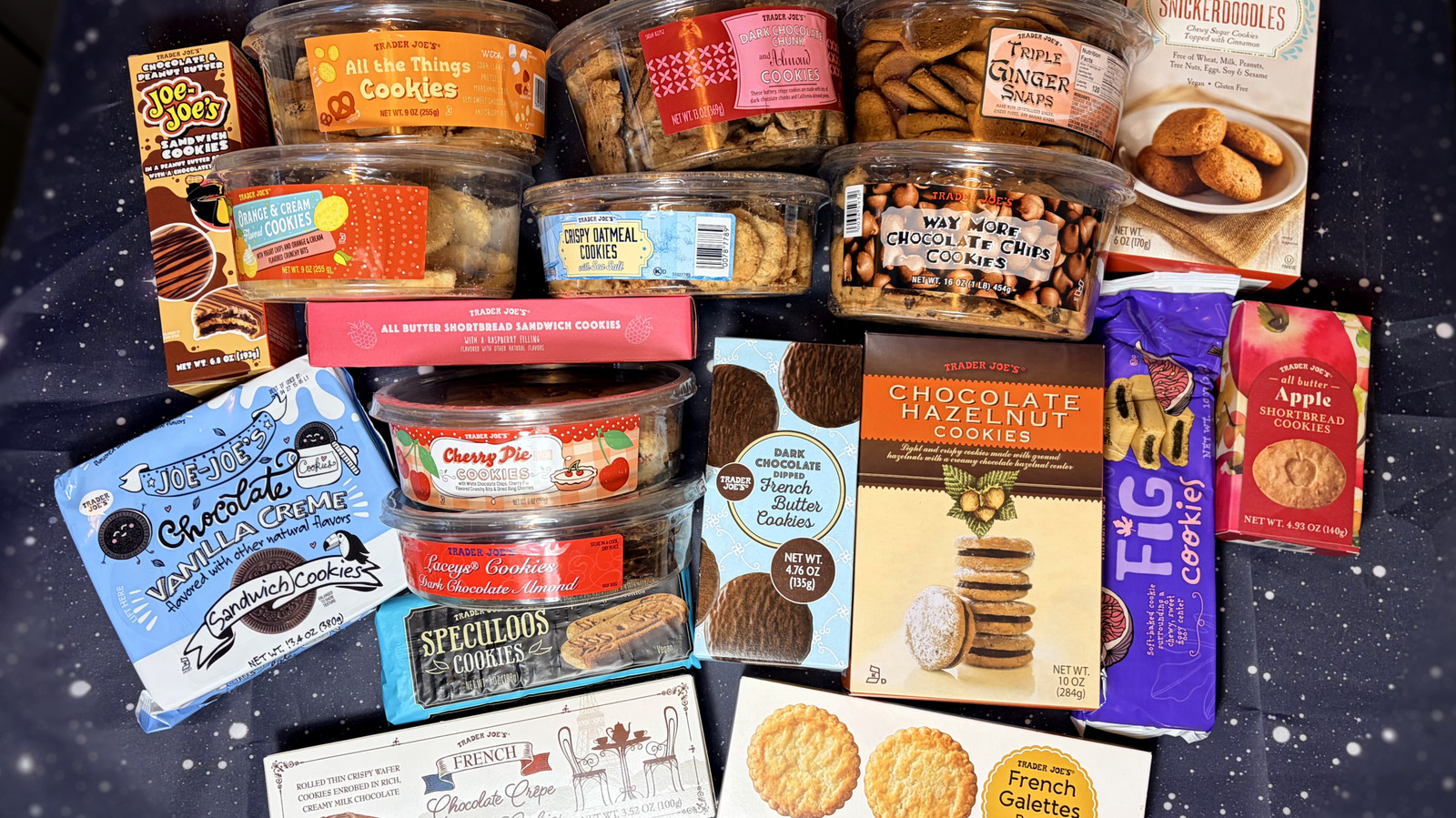
Every time I walk down the aisles of my local Trader Joe’s, I’m amazed by how many products I notice that have never caught my eye before. On my last visit, I looked up from the frozen section and, for the first time, took in the magnitude of the store’s cookie selection. From end to end, there were tubs and boxes of cookies of all stripes and sizes. My initial sense of overwhelm was quickly replaced by glee as I grabbed as many packages of cookies as I could fit into my cart.
The goal of this shopping spree: to taste, review, and rank all of these Trader Joe’s cookie options, in order to help guide fellow TJ’s shoppers to the best of the best. Once I unloaded my haul, I proceeded to thoroughly investigate each cookie’s taste and texture. Which Trader Joe’s cookies are the most craveable, and which varieties should you skip? Read on to discover how they all stacked up.
I dug through this box of Trader Joe’s Chocolate Hazelnut Cookies to try and find one single cookie that looked remotely like those pictured on the box. Maybe the chocolate was running low the day this batch was made, or something went wrong at the filling station, but the amount in the middle of every one of these cookies was laughably meager and unevenly applied. I thought that perhaps the chocolate’s intensity would make up for its scarcity, but that wasn’t the case. If I tried one of these blindfolded, I wouldn’t even know it was there.
Despite the filling’s scant amount and faint flavor, it does provide one thing: an unpleasantly firm bite. That’s a shame, because the cookies that surround it are soft and light, not too sweet, and have a subtle nutty flavor. It’s jarring to let your teeth sink into such a tender exterior only to have them smack into a hard barrier. Whatever’s going on with these cookies, none of it makes sense.
Speaking of not making sense, Trader Joe’s All the Things Cookies are baffling. I get that they’re going for a sweet-savory, chewy-crunchy study in contrasts, but they’re so jam-packed that nothing stands out and the whole cookie seems like a muddled mess. I’m all for over-the-top sweets, but sometimes less is more.
Here’s what’s thrown into the mix: corn flakes, pretzels, marshmallows, chocolate chips, and crispy rice. There are maybe one or two chocolate chips per cookie, sometimes zero. A few times I got a bite that was all pretzel, purely salty with no sweetness whatsoever. These cookies have no identity, no purpose. It’s chaos. By trying to be everything, they end up being nothing. If you like your cookies to send you on an existential, philosophical spiral, you might have an interesting experience with All the Things. Otherwise, I’d skip them.
With unimpressive performances by the two major elements that make up the French Chocolate Crepe Wafer Cookies from Trader Joe’s, these ended up being one of the more underwhelming products on this roster. If a few things were tweaked, I could imagine these cookies being a home run, but as is, there’s not much there. I mean that literally — the interior of these cookies is mostly empty space.
I have no problem with light, airy baked goods. The issue here is that the center of each cookie, which is a crepe that’s been rolled up and crisped, is so brittle that one bite starts a chain reaction that causes the entire thing to crack and disintegrate. I barely got any crepe on my first time around, as it ended up as dust and shards on my table, leaving me holding half of an empty chocolate vessel, which had an odd carob-like flavor that I wasn’t crazy about. Nothing here quite works.
Joe-Joe’s are the Trader Joe’s version of Oreo cookies, and some fans prefer them. I’m not the biggest fan of Oreos to begin with, so take my opinion with a grain of salt, but I found these to be a disappointment. The first issue I found was consistency. Pulling the tray from the package, I noticed that the cookie-to-filling ratios were all over the place, and everything looked haphazardly slapped together.
Messy food isn’t a dealbreaker as long as the taste and texture make up for it, and while these cookies were fine in those departments, they didn’t particularly impress in either. The chocolate cookies themselves are thinner and softer than Oreos, and while the creme has a recognizable vanilla note, it’s not particularly flavorful. I don’t see Joe-Joe’s dethroning the reigning champion of sandwich cookies anytime soon.
Cherries are one of my S-tier fruits, so I was giddy when I saw these Cherry Pie Flavored Cookies at Trader Joe’s. Unfortunately, they missed the mark and didn’t please me as a lover of cherries or a fan of cherry pie. That’s not an easy feat to accomplish, making these cookies almost impressive in their inability to wow me.
The best element of these cookies is dried Bing cherries, which offer a rich, deep, leathery cherry flavor, although not one that made me think of cherry pie. There are also white chocolate chips mixed in — another odd addition if you’re going for this fruit pie flavor. The cookies themselves have a buttery flavor and crispy texture, but it’s the topping that takes this cookie sideways. Described by Trader Joe’s as “cherry pie flavored crunchy bits,” these neon pink sprinkles taste like the kind of cheap maraschino cherries that get mindlessly thrown into kids’ Shirley Temples. This candied, almost cough syrup-like flavor completely takes over. I’d much rather eat a slice of cherry pie — or even an actual cherry, for that matter.
Trader Joe’s Orange & Cream Flavored Cookies are a notch above the Cherry Pie variety, but the two have a lot in common. I am guessing that both cookies come from the same producer based on their similar descriptions on the Trader Joe’s website. The orange and cream flavors of this cookie at least present a cohesive flavor profile, bringing to mind childhood memories of cream-filled popsicles and trips to Orange Julius at the mall.
Once the initial flood of nostalgia faded, another sense memory crept in. I couldn’t place it at first, but as I continued to ruminate, it hit me: Flintstones vitamins. There’s a candied orange sensation that I can only describe as chalky that supersedes all other flavors and textures, and reminds me exactly of chewing on orange-flavored Flintstones vitamins as a kid. I presume this is thanks to the “orange and cream flavored crunchy bits” that are scattered across the tops of these cookies (per Trader Joe’s). It’s too bad, because there’s a tasty orange cookie in there somewhere underneath that medicinal finish.
Compared to the previous two cookies on this list, which had one too many elements, Trader Joe’s Crispy Oatmeal Cookies seemed to be lacking something. When a cookie’s flavor profile is this simple — basically, it’s just butter, sugar, and oats — it really needs to be exceptionally executed, and this cookie is fine, but unmemorable.
I found the texture to be a bit gritty, almost sandy, rather than buttery and rich. While typically I’m a proponent of adding extra salt to sweet treats, it doesn’t quite work here. There’s not enough sweetness to balance it out, so the salt lingers on your palate in a strange way. There’s nothing too offensive about this cookie, but it’s not something I’ll ever crave.
Based on Nabisco’s wildly successful Newtons, Trader Joe’s Fig Cookies are an admirably close dupe of the popular snack. The figgy filling, in particular, is satisfyingly rich, fruity, and jammy without being cloying, thanks to a subtle tartness that brings the sweetness into balance. The cookie that’s wrapped around the filling is the weakest part, but it’s not necessarily bad — it simply falls short of the quality of the filling.
Compared to its brand-name competitor, Trader Joe’s cookie exterior is lighter in color but a bit denser in texture, and not quite as moist. That said, if you’re in this for the figs, the cookie’s shortcomings can be easily overlooked, as they won’t interfere much with your enjoyment of the fruit filling. Have these with a beverage to keep your mouth from drying out, and you’ll be fine.
Considering these Soft-Baked Snickerdoodles are vegan and gluten-free, they’re very impressive little cookies. Tender and moist even after a few days in an open container, these one- or two-bite morsels have a subtly sweet flavor with hints of earthiness and caramelized sugar. The thing is, these are not similar in color, size, or flavor to any snickerdoodle I’ve ever had.
Understandably, because of the ingredient swaps from a classic recipe to make them wheat- and animal-product-free, these were always going to be a bit different. I’d barely call these snickerdoodle-adjacent. There’s no cinnamon-sugar coating to speak of, which is a part of the snickerdoodle cookie’s identity. I found myself hunting for cinnamon and yearning for a bit of that crackly, crunchy exterior texture. These are tasty cookies and make a delightful accompaniment to tea and coffee, but classic snickerdoodles they are not.
Rustic, chunky cookies are usually the kind that I gravitate toward, so I was surprised when I found Trader Joe’s Dark Chocolate Chunk Almond Cookies to be lackluster. While I don’t need every cookie in the package to be a carbon copy, the variations in size, texture, and flavor from cookie to cookie in this tub were a noticeable problem.
Some of the cookies were tough to bite through, with sharp hunks of almond piercing out of the dough, while others had so much chocolate there was practically no cookie to taste. When I finally got a well-balanced bite, it was heavenly. Unfortunately, those were too few and far between.
Having never been to Belgium, I’m no speculoos expert, but I’m quite familiar with the type of crispy biscuit that one enjoys with a cup of coffee or tea. Trader Joe’s Speculoos Cookies are delightful in that regard. The flavors here are subtle, not punchy, but they’re pleasant and inviting, and the texture is snappy without being brittle.
There’s nothing in particular I can fault these speculoos for. They serve their purpose. I’ve passively enjoyed every one I’ve tried, and then promptly forgotten about it. While these cookies aren’t higher up on the list, this is a variety that I can imagine keeping around the house regularly to enjoy with a beverage, but I wouldn’t go out of my way.
If you don’t love ginger, these are not for you. For everyone else, Trader Joe’s Triple Ginger Snaps are a punchy, zippy treat that deserve a spot in your snacking rotation. These flavor-packed little discs include ginger three ways: puréed, ground, and crystallized. Every bite is an eruption of ginger fireworks.
While the crystallized bits of ginger add a welcome crunch, the cookies themselves could stand to be a touch snappier. The texture here is softer than I expected, a bit closer on the spectrum to gingerbread than I want from this type of cookie. That’s a minor nitpick, though, because the ginger flavor is stunning.
Trader Joe’s French Galettes don’t appear impressive. In fact, they look more like Ritz crackers than butter cookies. That humble appearance is part of the charm of these exceptionally balanced cookies that prove that simplicity doesn’t have to be boring.
There are only five ingredients listed on the box, which are expertly combined to create a cookie that’s silky and rich, with a delicate flaky interior and a buttery golden crust. While these French galettes are wonderful to enjoy right out of the box, their pure, mellow sweetness also makes them versatile, a blank slate for any kind of topping — like one of Trader Joe’s many jams or jellies. While they might not turn heads on a party platter or blow you away with bold flavor, they’re one worth keeping stashed away in the pantry.
After falling in love with Trader Joe’s French Galettes, I thought they might be a sneaky frontrunner for the top spot — and then I tried these. Dark Chocolate Dipped French Butter Cookies take an elegant, sophisticated cookie from day to night, like a butter cookie that’s put on a little black dress.
The thinness of both the cookie and the chocolate coating are part of what makes this seem so chic and refined. It’s also something of a drawback. They’re so light and slim, it’s easy to forget you’re even eating these cookies, and there aren’t many in the box. I appreciate these for what they are, but they do seem to lack a certain substance.
They’re not advertised as pie flavored, but Trader Joe’s All Butter Apple Shortbread Cookies reminded me more of a fruit pie than the cherry cookies that made such a claim. The soft yet firm buttery shortbread ovals have a crust-like consistency, and each one is packed with flavor.
The apple note, from dried apples and concentrated juice, has a vibrant natural flavor and a subtle citrusy bite that gives it freshness and dimension. There’s vanilla, too, which makes me think of a slice served à la mode. Apple usually isn’t a flavor I get excited about, but these impressive cookies are nudging me in that direction.
This is a very different fruit and shortbread experience from the apple version, and while both were excellent, I gave the All Butter Shortbread Sandwich Cookies from Trader Joe’s the edge. Rather than baking the fruit into the shortbread, these are sandwich cookies with a layer of raspberry filling. Tart and sweet, soft and crunchy, delicate and rich — these cookies check every box.
The shortbread cookies have a lightness to them, a fine crumb, and simply melt on the tongue. There’s just enough sweetness in the raspberry filling to complement its acidity, which brightens and energizes each bite. These may not have taken the top spot, but if you prefer fruit to chocolate, these may be your favorite.
Honestly, I wasn’t expecting much from this tub of Way More Chocolate Chips Cookies. I’ve been burned plenty of times by store-bought chocolate chip cookies in big plastic containers — chalky, stale, skimpy on the chocolate. These, though, are a completely different story.
A little bigger than bite-sized, these are impressively studded with, as the name rightfully claims, more chocolate chips than it seems should be able to physically fit in cookies this size. You couldn’t get a bite without at least one chip if you tried. Yet, there’s balance. The cookie itself has a soft, almost fluffy quality and a just crisp enough golden exterior. TJ’s may have discovered the ideal cookie-to-chip ratio. I could easily (and probably will) eat these every day.
While the standard Joe-Joe’s didn’t excite me, their glowed-up peanut butter cousins were another story. These would be superior cookies even without the peanut butter coating, because the cookies underneath are exactly what sandwich cookies should be, with ample filling and a pleasing contrast of textures.
The sleek peanut butter coating drizzled with chocolate takes an already great cookie over-the-top. Alternating layers of tender, creamy peanut butter and crunchy, crumbly cookie work in perfect harmony thanks to their spot-on ratios. Peanut butter Joe-Joe’s cookies are rich and decadent, more of a special treat than an everyday snacking cookie, and for that purpose there was only one other cookie I liked more.
It almost doesn’t seem fair to pit Laceys Cookies against the rest of the Trader Joe’s selection. Not only are these treats in another league, they’re all-pro, all-star perennial champions in that league. Based on a Florentine lace cookie, they consist of caramel-based dough pressed into thin rounds and baked to a crispy golden brown, studded with almonds and sandwiched around a layer of rich dark chocolate.
The cookie texture is unlike anything else, pliable yet crisp and crunchy, becoming meltingly silky as you eat it. The filling is reminiscent of ganache in texture and concentrated flavor, and brings a brooding and velvety dark chocolate taste with a subtle cocoa bitterness that keeps this cookie’s richness from becoming too much. When I got down to my last Laceys, I found myself breaking it into smaller and smaller pieces so I wouldn’t run out. By the time you’re reading this, you can be sure I’ve gone to Trader Joe’s to grab more — and you should, too.
There are more cookie varieties available at my Trader Joe’s location than I could include in this list, so the first step was to narrow it down. For the most part, I stuck with classic styles, wanting to include as many popular cookie types as possible. I omitted variations that were too similar to others, such as gluten-free versions of existing products. Once I had the selection finalized, I purchased all of the cookies and prepared to taste.
I tried each cookie on the day of purchase to ensure I had the freshest possible experience. Over the course of several days, I tasted them again to see how well they held up. Each cookie was judged primarily on flavor, texture, and consistency. For cookies based on a classic style, like go-to chocolate chip cookies or the less-revered snickdoodle, I also took into account how well they exemplified their type.
Business
US cruise ship ends global voyage due to fuel costs; 200 passengers lose their homes

PHNOM PENH, Cambodia — A U.S. cruise ship on a residential world voyage suspended its operations in Cambodia due to fuel costs, forcing hundreds of passengers to abandon their floating homes.
The Odyssey set sail two years ago on a three-year voyage to the seven continents marketed as combining long-term living at sea with global travel.
The Florida-based company said monthly fuel expenses per cabin that historically averaged $1,800 has recently reached an estimated $6,000 to $8,000 in parts of Asia during the war in Iran. Villa Vie Residences said it sought to reduce fuel consumption by slowing the itinerary and spending more time in port, but was unable to offset the surge in fuel costs.
“We have been unable to continue carrying the resulting operating losses,” it said. “Passing the full increase on to residents is not a realistic solution. Our focus now is on supporting residents, crew, and employees” while it tries to restructure.
Sihanoukville Autonomous Port said in a statement last week that the ship docked on Oct. 23 for a five-day visit. It was to head to Vietnam but remained in the port Wednesday.
The ship carried 203 passengers with 15 nationalities, mostly Americans, and 156 crew members. It had a capacity of 650 residents.
Passengers have been told to leave the ship, but the crew’s status was unclear.
The Odyssey had a confirmed itinerary into November 2027. The company planned for a second residential cruise ship to enter service in early 2029, but the statement on the suspension of the Odyssey’s voyage did not address the second ship.
___
This version has corrected the date when the voyage was expected to end from 2030 to 2027.
Business
VCs will make billions on Anthropic’s IPO, but Amazon is set to make much (much) more
Many investors stand to win big when Anthropic goes public. Stakes held by firms including Menlo Ventures, Sequoia, Sound Ventures, and Spark Capital are expected to return billions.
Yet according to Anthropic’s S-1, none of those VC firms owns 5%, the threshold for being included in the principal stockholders’ table. That’s highly unusual. In a typical tech IPO, lead venture investors hold double-digit-percentage stakes in the startups they backed. The reason is Anthropic’s size. At its $965 billion private valuation, a 1% stake is worth nearly $10 billion, so, for example, Menlo’s roughly $14 billion position is only about 1.5% of the company, according to recently reported Bloomberg figures.
While the venture firms may lack sizable percentage stakes, Anthropic sold large stakes to strategic partners, companies that are also its business partners. Indeed, Amazon is likely the single largest financial beneficiary of the IPO.
Amazon first backed Anthropic in 2023 with a commitment to invest up to $4 billion in the AI company. Since then, Amazon has poured billions more into Anthropic. Instead of taking stock upfront, Amazon structured much of its investment as convertible notes, a type of debt that converts into shares upon an IPO or sale.
According to the S-1, Amazon holds convertible notes with $6.2 billion in principal outstanding as of June 30. That is Anthropic’s entire debt load. But as Anthropic’s valuation soared across successive funding rounds, the shares those notes will convert into became far more valuable. Amazon’s own filings valued its note holdings at $97.9 billion as of June 30.
As the value of Amazon’s convertible notes surged, Anthropic had to record the growing value of what it owes on its books. It reported the adjustments on its income statement under “change in fair value of convertible notes, derivative liabilities, and SAFEs,” a line that totaled $72.4 billion for the first half of 2026. The charge is non-cash, meaning no money left the company.
Amazon’s notes could convert into as many as 1.84 billion shares, according to the S-1. But a cap limits Amazon to 12% of Anthropic’s “partially diluted” share count, a figure that counts some shares not yet issued, such as stock options. Amazon can waive the cap. Notes that can’t convert will stay outstanding and convert in later quarters, subject to the same limit.
But the notes are only part of Amazon’s holdings. It further invested $10 billion in nonvoting preferred stock (a type of equity), in the second quarter, according to Amazon’s quarterly report for the period ended June 30. Amazon did this by investing $5 billion in each of Anthropic’s last two funding rounds. Combined with the $8 billion it invested in the notes from 2023 through 2025, that brings Amazon’s total investment to about $18 billion.
Beyond its stock gains, Amazon will also continue to earn significant revenue from Anthropic, which has committed to spend at least $110 billion on AWS over the next 10 years.
Google, too, is set for a major windfall from both the listing and its cloud computing deals with Anthropic. The search giant held about 14% of Anthropic as of early last year, according to court filings that were reported by The New York Times, and has invested more since, including $10 billion in April. (Google was likely diluted in subsequent and massive funding rounds, with PitchBook analyst Harrison Rolfes telling TechCrunch he estimates its current stake at closer to 5.6%.) It has also secured at least $114 billion in cloud commitments from the Anthropic through 2033.
While VCs set for massive paydays have little reason to complain, the S-1 makes it clear that the biggest winners of Anthropic’s IPO may well be tech giants like Amazon, which backed a would-be rival early on and now sell it much of the computing power it runs on.
The S-1 itself warns that some of those cloud providers also build rival AI models and that they may not always want the same things that Anthropic does.
Business
up fuelling fears that AI is undermining science
A bust-up between mathematicians is fuelling fears that AI could undermine science
A bank of white freezers hums away at a former watch factory in central London. Inside: dozens of small boxes with barcoded glass tubes, collectively containing one hundred billion genes. Just two boxes may hold 10 times more information than all the text on the internet, says Dr Oliver Vince, the facility’s co-founder.
His firm, Basecamp Research, plans to collect as much DNA as possible to create an artificial intelligence that can speak the language of biology, in the same way that US and Chinese tech firms have hoovered up written material online to create Large Language Models (LLMs), the basis of current AI systems.
Vince, like many in business and academic research, believes AI will supercharge scientific research. But increasingly, it also comes with controversy.
Last month, OpenAI, the creator of ChatGPT, said it had solved one of maths’ great unsolved problems, relating to the famous Navier–Stokes equations. The company said its AI agents had cracked it in 88 hours. The body that runs a prize for whoever can solve the problem said it had “apparently been settled”, but that its review would take time.
But hours before the announcement, Tristan Buckmaster, a mathematician at New York University, went public with concerns. He formed an independent team with Levent Alpöge, a mathematician employed by day by the rival company Anthropic.
They had been working towards the same goal, and kept their drafts in OpenAI’s coding tool, Codex. Buckmaster said that his co-researcher was tipped off that news of their progress had “reached” OpenAI, though he did not specify how. He asked whether his research, stored in Codex, could have fed into OpenAI’s own work, though he stressed he was “not accusing anyone of anything”.
OpenAI said that nobody at the company, human or AI, saw the other teams’ work before it was published. Initially it said that while unlikely, it could not “rule out” that anonymised data from use of its products may have helped improve its models. Days later, it said Buckmaster’s Codex prompts from the two months before the announcement “could not have influenced the system in any way”.
It’s a complicated story; we still don’t fully know what happened. But it highlights a growing issue about the use of AI in science. Usually, those words make us conjure up images of robots building terrible genetically-engineered viruses, or chemical weapons, to wipe out humanity. But there’s a more subtle problem that hasn’t attracted the same headline-grabbing attention: that AI could undermine faith in the scientific process, raising questions about the novelty and accuracy of research.
And there’s another concern. It’s well known that AI chatbots like Claude or Gemini can sometimes hallucinate things that simply aren’t true. They will tell you about a film that never existed, or a quote that was never said. Now there is evidence that this is increasingly happening in science. Eventually, it’s feared, it will become difficult to separate true scientific discovery from AI-generated fiction.
And all of this could threaten to erode – if not explode – the rock on which scientific research rests: trust.
A ‘watershed moment’
One threat is to scientific journals, the guardians of scientific integrity, which are seen to be failing to deal with a tsunami of AI-generated distortions.
“Generative AI has basically disrupted the whole scientific process,” says Dalmeet Singh Chawla, a science journalist who has spent a decade reporting on research misconduct.
He tells the BBC that publishers’ integrity staff – the people who screen submissions for accuracy and reliability – will need to “drastically increase [in number and effort] if they’re anywhere near the fight”. He says: “Right now, it seems like they’re not.”
On the face of it, AI seems just the right tool to power scientific research. Scientists deal with huge amounts of information. Telescopes and particle accelerators, for example, collect billions of data points – too large for the brain to comprehend. AI can pick the scientific highlights from the surrounding humdrum.
The poster child of scientific AI is the UK-based firm Google DeepMind, which in 2020 solved one of biology’s biggest problems: how proteins in living things fold into their precise shapes.
It may sound dull, but proteins are the tiny machines that make life work, and the shapes they fold into determine what they can do; from building cells and fighting infection to helping form the tissues and organs of the body.
Before AI, scientists had to conduct time-consuming experiments in the lab. Then, Google DeepMind developed an AI model called AlphaFold that accurately predicted 200 million protein folds in just one year.
The equivalent experimental work would have taken hundreds of millions of years in laboratories. The firm gave the results away for free to researchers. The head of DeepMind and the project’s lead scientist were both awarded the Nobel Prize for Chemistry.
It was big hugs all round.
Dr Pushmeet Kohli, who leads DeepMind’s science work, told me that AlphaFold could be seen as a “watershed moment”.
Questions over AI’s work
But elsewhere, the use of AI in science has come with accusations of hype. Some computer models are accused of exaggerating the significance of their findings, with the human researchers that oversee them then believing some of the claims without enough scepticism.
Basking in its success over AlphaFold, for example, DeepMind turned its attention to predicting the structure of new materials. The work could lead to the development of better batteries, cheaper solar cells and electronic components that are not dependent on rare earth elements. (In theory, no-one would need to argue about mining rights ever again, and Greenland would be safe from invasion.)
A DeepMind model came up with what the firm claimed were more than two million new crystal structures, announced as “nearly 800 years worth of knowledge” released in one go. Of those, some 380,000 were considered promising enough to make in a laboratory.
But then came a warning sign from two chemists at the University of California. Anthony Cheetham and Ram Seshadri went through a random sample of the supposed new crystals. Writing in the journal Chemistry of Materials, they concluded that they had “yet to find any strikingly novel compounds”, arguing that many were “trivial adaptations of known materials”. Their verdict was not that the method was wrong, but that the results need more scrutiny and validation from human chemists.
DeepMind rejects the charge, saying it tested each compound for novelty. Dismissing a new structure for looking familiar misses the point, the company argues: swapping a single atom is how many of today’s most useful materials arrived, from phone components to sunscreen.
Research ‘slop’
In those cases, at least, the science was mostly real and the issue was just AI potentially exaggerating its importance.
Arguably of even greater concern is the growing risk that scientific journals will become polluted with so-called AI “slop” – where a computer, not a human scientist, is writing the research, leading to fake citations and phantom papers.
In 2024, computer scientist Prof Dmitry Kobak, of Ghent University, searched more than a million biomedical research papers for trigger words favoured by the LLMs that generate AI writing. His team found that by December last year, nearly 90% had AI fingerprints on them. AI detection technology is not perfect; some forms of the software have labelled the US Constitution, written in the 1780s, as “AI-generated”. But still, Kobak said he was shocked by the scale of apparent AI use. There is a risk, he told Nature, that “whatever bias the LLM may have will just suddenly permeate the (scientific) literature”.
Kobak is among many researchers who worries that AI is slowly killing scientific journals.
And it matters: research papers are the lifeblood of scientific advance. When a discovery is published, another team in another part of the world might obtain funding to build on the results.
The process of peer review – in which research papers are checked by other scientists before they are published – is also being compromised.
A team led by Weixin Liang and James Zou at Stanford University analysed referee reports submitted to four major computer science conferences, and found up to 17% of the text had been substantially modified by a language model.
A critical part of a scientific paper’s integrity involves lead scientists listing earlier research in order to show what they have done is genuinely new. These are called citations. A separate team at Cornell University found that researchers were using AI to compile citations, and that it was inventing bogus research, with around 147,000 pieces of phantom research cited last year.
If AI continues to distort the integrity of the academic process in this way, then researchers will be sent up blind alleys, public money will be wasted, and the fruits of valid research – such as new drugs or green technologies – will be slowed or not realised at all.
‘Research-grade AI’
Some publishers of scientific journals, such as Elsevier, are taking steps to avert this growing crisis of confidence.
Elsevier’s research integrity team has developed some 100 signals that flag a paper for closer human scrutiny. Nature’s journals forbid AI-generated images and tell referees never to upload a manuscript into an AI system. The website arXiv, where scientists share their early-stage results, bans researchers for a year if they submit invented references.
Prof Sarah Main, an Elsevier vice-president, is among those at the firm trying to work out how to responsibly use AI in research. “What we’re calling research-grade AI would focus on ensuring the researcher is in the driving seat,” she says.
As AI agents process the mass of data emerging from particle accelerators, the cosmos and the natural world, how do we know they are getting it right?
And there’s another worrying question: how do we know that AI agents are not dismissing an important result as an anomaly? The discoveries of penicillin, radioactivity and weird stars called pulsars all came from odd results that could easily have been dismissed. Hunches by humans made them into some of the biggest scientific moments of the last century.
Can AI really replicate that sense of serendipity and human ingenuity?
Kohli of DeepMind does not think the answer is to turn our backs on AI. That would be “like saying you should be computing without using calculators”, he told me. But he accepts there should be human guardrails: “The agents today are imperfect. Somebody has to take accountability.”
His test is a simple one: “You have to understand what the agent has done, and you have to take responsibility. You can’t just specify the problem and let the machine write the paper and submit it as true.”
Prof Andrea Pauli of the Vienna BioCenter in Austria has followed that test. She spent almost 10 years on a question no-one has yet been able to answer: how a sperm gets into an egg. Responsible use of AI helped her toward an answer. Her lab found a protein on the surface of zebrafish eggs which pointed to a lock-and-key mechanism for allowing the sperm in.
This is also a story about humans. Soon after the formation of Basecamp – the lab I visited in a former London watch factory – its co-founder, Oliver Vince, was ill in hospital with leukaemia (from which he has recovered). It motivated him to develop an AI system that stood a better chance of curing cancers. It might not work, he says, but it’s worth a shot.
“We have a technically feasible path to curing cancer,” he says.
Not a promise from Vince, but a direction. The big question is whether AI carries the science there, or quietly erodes the bricks it is built on.
Top image credit: Getty.
BBC InDepth is the home on the website and app for the best analysis, with fresh perspectives that challenge assumptions and deep reporting on the biggest issues of the day. Emma Barnett and John Simpson bring their pick of the most thought-provoking deep reads and analysis, every Saturday. Sign up for the newsletter here
Business
They bought cabins to live on a luxury cruise ship. High fuel costs got them kicked off in Cambodia.

A residential cruise ship halted operations in Cambodia on Tuesday amid soaring fuel costs, leaving passengers in limbo after the U.S. company that operates the vessel ordered them to disembark.
In a news release, Florida-based Villa Vie Residences said it was working to identify “temporary living arrangements” for people aboard The Odyssey, a 642-foot cruise ship that launched from Belfast three years ago and promised passengers “an unparalleled lifestyle of luxury and exploration” as it toured the planet.
Cabins on The Odyssey were for sale or rent.
According to the company, the ship can accommodate 650 residents, but it isn’t clear how many were on board Tuesday or where in Cambodia they disembarked.
An executive with the company, Mikael Petterson, declined to provide additional details in an email to NBC News. Earlier this year, in a release announcing the company’s second residential cruise ship, Petterson said The Odyssey was 85% sold.
In Tuesday’s release, the company said it had taken significant measures aimed at reducing fuel consumption, but those steps had failed to offset the spike in costs.
Global oil prices have surged since the war with Iran began earlier this year, disrupting the world’s flow of fuel. Earlier this month, oil prices climbed to their highest levels since this spring.
“Passing the full increase on to residents is not a realistic solution,” the company said. “Our focus now is on supporting residents, crew, and employees while we work toward restructuring and recapitalization over the next 60 days. That work is ongoing, and no outcome is assured.”
Randy Cassingham, a resident on the boat, wrote in a blog post that he learned his journey was over after a company official posted a note on a message board for the ship shortly after 7 a.m. local time Monday.
The Odyssey was entering a “temporary lay up” period — indicating the vessel would no longer be used — and everyone had to disembark by 2 p.m. that day, the message stated, according to Cassingham, who runs ResidentialCruising.com and did not immediately reply to an interview request.
Cassingham attributed the development to a “cascade of problems” that he would detail later.
Pamela Reckamp, who rented a cabin on the Odyssey with her husband and disembarked earlier this month, said in an interview that she wasn’t surprised that the ship’s journey was over.
Reckamp, 59, recalled attending a meeting in early September where a company official asked cabin owners to help them raise $1 million so they could leave Ha Long Bay, Vietnam.
“She said, ‘If we don’t get this money, we have about four days of the ship running,’” Reckamp recalled. “‘Then the lights will go off and the AC will go off.’”
When the ship’s financial issues were raised during another meeting a few weeks later, Reckamp recalled, a woman stood up and said she’d bought a cabin in August and hadn’t been made aware of the issues.
“I sold my house,” Reckamp recalled the woman saying. “I sold my car. I bought my home on this ship.”
Reckamp said she felt terrible for the residents and staff, who she said were lovely.
“We dodged a bullet,” she added.
Villa Vie Residences did not immediately respond to a request for comment Tuesday night.
Business
SK Hynix third-quarter profit sharply beats estimates on AI memory boost

South Korean chipmaker SK Hynix on Wednesday released its third-quarter earnings results, posting a record high quarterly profit that sharply beats estimates, while announcing over $25 billion in dividends and buybacks.
Here are SK Hynix’s third-quarter results compared with LSEG SmartEstimates, which are weighted toward forecasts from analysts who are more consistently accurate:
Revenue: 104.62 trillion won ($78.86 billion) vs. 98.34 trillion won expected
Operating profit: 83.33 trillion won vs. 76.72 trillion won expected
Revenue rose 327.9% from a year earlier, while operating profit climbed 632.1% year on year.
Compared with the previous quarter, revenue climbed 31.9%, while operating profit surged 37.6%.
SK Hynix posted record quarterly revenue and operating profit, with sales exceeding 100 trillion won for the first time, as it announced plans to return about 100 trillion won to shareholders — including at least 30 trillion won in cash dividends and 60 trillion won in share buybacks and cancellations.
The chipmaker approved a third-quarter dividend of 14 trillion won, including a special dividend funded by gains from its investment in Kioxia. The company will also buyback 20 trillion won in shares, half of which will be cancelled this year.
SK Hynix expects HBM4 to surpass HBM3E in both shipments and revenue in the fourth quarter, as it ramps up production at its M15X facility in Cheongju, South Korea.
HBM, or high-bandwidth memory, is a type of advanced memory used alongside AI processors to handle large amounts of data. HBM4 is the sixth generation of the technology.
The company has secured long-term agreements with 14 major customers covering more than 50% of its production capacity for 2027 and 2028.
It expects memory demand to outpace supply through 2030 and plans to significantly increase investment next year.
In August, SK Hynix had announced plans to repurchase and cancel 40 trillion won worth of its own shares, while raising its shareholder return target to more than 50% of cumulative free cash flow generated between 2025 and 2027.
Last week, SK Hynix announced that its U.S. subsidiary Solidigm would halt its review of potential pre-IPO fundraising and IPO options, citing market volatility and share price trends.
The company said it would continue to assess investment timing, scale and financing options to support Solidigm’s growth and enhance shareholder value.


US cruise ship ends global voyage due to fuel costs; 200 passengers lose their homes
PHNOM PENH, Cambodia — A U.S. cruise ship on a residential world voyage suspended its operations in Cambodia due to...


Heidi Fleiss’ Showdown With Nevada Officials Erupts Over Prized Parrots
Former Hollywood madam Heidi Fleiss is fighting Nevada officials in court over her precious parrots … TMZ has learned. Heidi...
Val Chmerkovskiy back on ‘DWTS,’ Carrie Ann Inaba compliments him
After a one-week suspension from “Dancing with the Stars,” pro dancer Val Chmerkovskiy returned to the ballroom Tuesday, Oct. 27,...


Tampa Bay comes back in the 12th inning to extend the World Series, holding off Brewers’ championship dreams
The Tampa Bay Rays gave the Milwaukee Brewers a dose of their own medicine in Game 4 to avoid getting...


Global stock markets rise as investors continue to bet on AI
Global stock markets have climbed as investors continue to bet on bright prospects for the tech giants driving the AI...


Anthony Edwards Needs Knee Surgery, Could Miss Two Months
9:38 pm: Edwards will have surgery on Thursday and the club will then have a clearer timeline for his recovery,...


Jessa Duggar Says She and Husband Ben Seewald Are Expecting Baby Number 7
NEED TO KNOW Jessa Duggar Seewald is “expecting again!” The TLC star and her husband Ben Seewald appeared on Wednesday’s...


might be huge waste of money: study
Time to shelve that standing desk. New research suggests ergonomic upgrades for the office — from specialized chairs, desks and...


Who Goes Home On Halloween?
SPOILER ALERT! This post contains details from this week’s episode of Dancing with the Stars. It’s one of the buzziest...


Report: Stephanie Vaquer ‘Out Indefinitely’ – Fightful
Reported details on the absence of Stephanie Vaquer. On Saturday, Stephanie Vaquer announced that she was cleared from her ankle...
-

 HealthNews2 weeks ago
Dementia risk more than quadruples among adults with common disorder
-

 Business1 week ago
‘Black Monday’ fears intensify as prediction markets shrug off 2026 crash
-

 Business2 weeks ago
McDonald’s chicken and beverage growth faces rivals
-

 Entertainment2 weeks ago
Collin Gosselin discusses alleged abuse by mom Kate Gosselin
-
Business2 weeks ago
Why BlackRock is suddenly more bearish on stocks
-

 Business2 weeks ago
Getty Images to File for Bankruptcy, Go Private In Restructuring Deal
-

 Entertainment2 weeks ago
Netflix, Derek Cianfrance Adapting Gary Paulsen’s Book
-

 Business2 weeks ago
UnitedHealth Group (UNH) earnings Q3 2026