
PM office canada
Trump ‘not allowing’ data centres outside U.S.

U.S. President Donald Trump vowed sharp taxes on AI companies that build data centres outside the United States.
Speaking to reporters in Washington, Trump described a more protectionist plan for what’s largely considered to be a quickly growing and transformative industry. He said he had not yet shared his plans with his own officials.
How to set CTV News as your preferred source on Google
“We’re going to put a tremendous tax on them,” he said, referring to AI companies that build outside American borders. “We want them to build it here … We’re not allowing data centres to go into other countries (because) China will take all of them.”
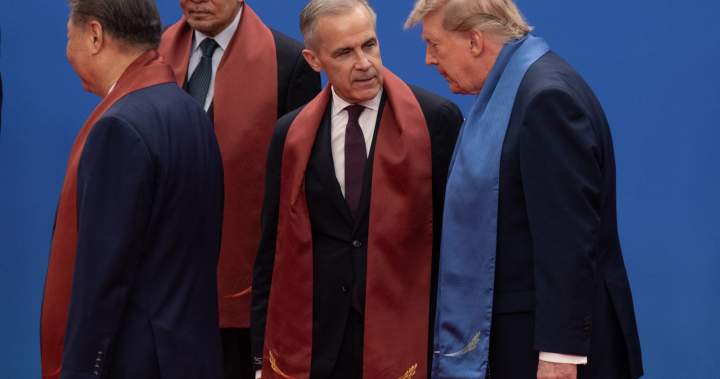
Trump unveiled the plan following his trip to China for the Asia-Pacific Economic Cooperation (APEC) summit. Prime Minister Mark Carney met the president on the sidelines of that event to talk trade.
Data centres in Canada
At least two major American AI companies have plans to expand into Canada.
Meta, Mark Zuckerberg’s conglomerate that owns Facebook, Instagram and WhatsApp, has plans to build a large data centre north of Edmonton. Anthropic has signed a 20-year lease for another centre in Nova Scotia, according to EverWind Fuels, which is planning to develop the campus.
Anthropic, which launched the largest IPO in history this week, is hiring a Gas Supply & Transport Lead to source fuel for its technology in Canada and the U.S.
Trump did not immediately clarify what his plan would mean for companies that have already started building them. Though, penalties may complicate Canada’s plans to build out its domestic infrastructure.
Canada’s official AI strategy, which envisions a future of a “sovereign” environment, contends that “chip fabrication for GPUs sits almost entirely offshore,” and “Canada’s current AI data centre and cloud offerings are largely foreign-owned and controlled.”
Reached by CTV News, Artificial Intelligence Minister Evan Solomon’s office said it’s aware of Trump’s comments and that data centre capacity is “critical” to national sovereignty and “reducing reliance on foreign entities.”
“Canada has the talent, energy and infrastructure to compete, and we will continue working to attract investment that strengthens our economy and delivers real benefits for Canadians,” reads the office’s statement in part.
Meeting with Carney
The prime minister’s trip to China began over a week ago. It took him to an EU meeting in Dublin, negotiations in Manila, Philippines, and a Francophonie summit in Phnom Penh, Cambodia, before he arrived in Shenzhen.
Once there, Carney and Chinese President Xi Jinping agreed to reduce tariffs on a range of Canadian products, including pork, halibut and shellfish.
The prime minister has prioritized deepening trade relationships with countries other than the U.S. as a means to diversify trade. Trump’s tariffs on a wide range of Canadian goods have lead to layoffs and economic pain north of the border, exposing the vulnerabilities of the two countries’ commercial integration.
Trump and Carney spoke briefly on the sidelines of the APEC summit to discuss “a mutually beneficial trade agreement,” according to a Canadian readout released earlier this week.
Prior to that encounter, Carney said “Canada is building more ambitiously and rapidly than at any time in our history.”
On Friday, Trump reiterated his feeling that, while Carney was “very nice,” Canada is a difficult partner to deal with.
“For some reason, they feel emboldened, and we can’t let them feel that way anymore.”
The two countries have sparred through a trade war since the start of Trump’s second term. Trump claimed Friday that the U.S. carries a US$80-billion deficit with Canada. So far in 2026, U.S. Census data suggests it’s US$39 billion.
The American president was able to “move the ball forward” toward a trade agreement, according to U.S. Secretary of State Marco Rubio, who spoke after Trump.
PM office canada
U.S. trade adviser accuses Canada of ‘arrogance’

A senior adviser to U.S. President Donald Trump is once again hurling insults and threats at the federal government as trade negotiations between Canada and the U.S. continue.
In a post on social media, Peter Navarro called out the “arrogance and dishonesty of Ottawa on trade,” saying Canadian negotiators’ “misreading of their position is really something else.”
Navarro used a basketball metaphor to highlight what he sees as Canada’s disadvantage in trade talks with the U.S.
“They are like a high school team taking on the New York Knicks. That doesn’t end well for Canada,” Navarro wrote in a post on X.
Thursday’s insults follow Navarro’s memo to Prime Minister Mark Carney on Tuesday, in response to him suggesting that Canada could seek greater Chinese involvement in the domestic auto sector.
On the same afternoon, Canada-U.S. Trade Minister Dominic provided an update on recent progress in the trade talks to an advisory committee.
Four sources familiar with the discussion told CTV News that trade negotiators made the case for the government to seize the opportunity to strike a trade deal with The White House in the near term. They say negotiators are warning against risking further economic pain by waiting out the final two years of the Trump administration.
‘Canada cheats us’
The U.S. trade adviser also posted a short interview clip to his X account on Thursday reiterating longstanding trade grievances with Canada.
“Canada cheats us,” he said, highlighting several trade issues the U.S. has with Canada, including lumber, dairy, steel and aluminum.
He added that Canada has historically cheated the U.S. by “out-negotiating” the country in the North American Free Trade Agreement (NAFTA) and by adding clauses that “really hurt” the U.S.
During his first term in office, Trump sought to terminate NAFTA due to irritants over Canadian softwood lumber exports and access to Canada’s dairy supply management system.
In 2020, Canada, the U.S. and Mexico replaced NAFTA with the Canada-United States-Mexico Agreement (CUSMA). However, when it came time for the parties to review the agreement, Trump’s administration chose not to renew CUSMA in July.
A month later, trade talks between Canada and the U.S. came to a halt after Carney rejected a deal he said threatened Canada’s sovereignty and responded with counter-tariffs on U.S. goods.
However, following the U.S. midterm elections, which saw Republicans lose control of both the House of Representatives and the Senate amid voter concerns about affordability and the impact of tariffs, the Trump administration has softened its tone on trade with Canada.
In recent weeks, Trump’s advisers have suggested a trade deal could be reached before the end of 2026.
LeBlanc also told MPs in Ottawa on Tuesday that a trade deal remained possible, but cautioned there is no guarantee Canada can restore the terms of CUSMA.
‘Ignore him’
Asked for his thoughts on Navarro’s comments, Gordon Giffin, who served as U.S. ambassador to Canada from August 1997 to April 2001, was blunt.
“I don’t think Peter Navarro is involved in the talks. I don’t think he’s close to the talks. I don’t think Peter Navarro knows what he’s talking about. So, I’d ignore him,” Giffin said.
In his view, Canadian and American negotiators have been productive. “Apparently, autos are still being worked on,” he added.
Giffin believes it’s unlikely an eventual deal would be tariff-free, but that Canada should push for preferential treatment.
Carney and Trump talk trade in China
During Prime Minister Mark Carney’s whirlwind trip, which included summits in Ireland, the Philippines, Cambodia and China, Carney spoke with Trump about trade on the sidelines of the Asia-Pacific Economic Cooperation summit.
According to a post-meeting readout, the two leaders discussed “the work underway to reach a mutually beneficial trade agreement that would create good jobs, boost affordability, and fully respect Canada’s languages, culture, and sovereignty.”
The leaders also “agreed to continue the work and to stay in close contact,” the readout said.
Other key takeaways from Carney’s trip included talks with his Philippine counterpart on a free-trade agreement expected to be signed next year and a meeting with Chinese President Xi Jinping, where the two leaders agreed to drop trade restrictions on more goods.
The trip affirms Carney’s plans to secure new trade agreements and reduce Canada’s reliance on the U.S.
‘Welcome Back America! It’s Your Turn to Be Sorry’
On Thursday, Navarro also criticized former deputy prime minister Chrystia Freeland for an essay she published in The New York Times on Tuesday.
“That former trade minister Chrystia Freeland went off on us yesterday in the Gray Lady. It’s like, what is she thinking?” he said.
In the opinion essay, “Welcome Back America! It’s Your Turn to Be Sorry,” Freeland encouraged Canada and the world’s other democracies to embrace the U.S. midterm election results.
Freeland said it’s an opportunity to renew the global democratic alliance and invite Washington “to rejoin us in a new, more balanced partnership.”
PM office canada
BREAKING: Feds, province kick in $250 million for Port of Sault Ste. Marie

Today, $250 million was announced to make the Port of Sault Ste. Marie a reality.
This investment will fund a series of improvements to unlock the Port’s potential as a key transportation and trade hub, increasing its cargo-handling capacity to more than 3.5 million metric tonnes annually by 2031, a three-fold increase over current volumes, a news release said.
“The project is expected to create 2,150 direct and 2,600 indirect jobs while strengthening supply chains and supporting economic growth across Northern Ontario and beyond.”
This is a developing story. SooToday will have more after today’s news conference.
The full release, issued by Sheehan’s office, is below.
Building a stronger Canadian economy requires modern and efficient transportation networks that connect businesses to customers, workers to good jobs, and Canadian products to markets at home and abroad.
By investing in the infrastructure that keeps goods moving efficiently, Canada is strengthening supply chains, reducing bottlenecks, and building more reliable trade corridors that support economic growth, create opportunities for businesses and communities and help Canadian exporters compete globally.
Today, Terry Sheehan, MP for Sault Ste. Marie—Algoma, and the Honourable Steven MacKinnon, Minister of Transport and Leader of the Government in the House of Commons, announced an investment of up to $125 million through the Trade Diversification Corridors Fund to support the development of the Port of Sault Ste. Marie, led by the Hamilton-Oshawa Port Authority.
This investment will fund a series of improvements to unlock the Port’s potential as a key transportation and trade hub, increasing its cargo-handling capacity to more than 3.5 million metric tonnes annually by 2031, a three-fold increase over current volumes. The project is expected to create 2,150 direct and 2,600 indirect jobs while strengthening supply chains and supporting economic growth across Northern Ontario and beyond.
As Canada expands access to new global markets and strengthens its economic resilience, today’s investment will advance critical trade-enabling transportation infrastructure through:
Construction of a new multimodal port on the north shore of the Saint Marys River.
Development of approximately 243 acres of industrial and brownfield land for port and logistics operations.
Construction of two seaway-draft marine berths to support marine shipping and trade growth.
Creation of a rail transload yard and supporting transportation infrastructure to improve intermodal connectivity.
Development of roads, utilities, storage and laydown areas, and tenant-ready industrial lands to support future economic development and trade activity.
The project will address a significant trade-enabling infrastructure gap in Northern Ontario by establishing the region’s first public, multi-user marine port between Thunder Bay and Southern Ontario. By providing seamless connectivity to Southern Ontario ports and the Great Lakes-St. Lawrence Seaway system, the new facility will strengthen supply chain resilience, create additional routing options for Canadian exporters, improve safety by reducing truck traffic on regional highways, and support an extended shipping season.
Once operational, the port is expected to support the movement of agricultural products, mining and critical minerals, forestry products, and manufactured goods to markets across Canada and internationally, including Europe. By expanding marine transportation capacity and improving multimodal connectivity, the project will help attract new investment, create jobs, and support long-term economic growth throughout Northern Ontario.
QUOTES
“Today’s federal funding announcement of a $125 million grant represents a record-breaking, historic investment in the transportation infrastructure of the riding of Sault Ste. Marie—Algoma. So many people, past and present, have shared the vision of realizing the untapped potential that a port would bring to our region. Those dreams have now become a reality. The Port of Sault Ste. Marie will create thousands of jobs, during construction and over the long term. I would like to thank the Minister of Transport, Steve MacKinnon and Prime Minister Mark Carney, for working so closely with me on this critical economic driver for the Soo, Northern Ontario, and Canada.”
– Terry Sheehan, Member of Parliament for Sault Ste. Marie—Algoma
“Building one Canadian economy means investing in the infrastructure that connects our regions, strengthens our supply chains, and helps Canadian businesses reach customers at home and abroad. The Port of Sault Ste. Marie project will create new trade opportunities, support economic growth across Northern Ontario, and reinforce Canada’s position as a reliable and competitive trading nation.”
– The Honourable Steven MacKinnon, Minister of Transport and Leader of the Government in the House of Commons
“For decades, economic diversification has been the most pressing challenge facing Sault Ste. Marie, and building the Port of Sault Ste. Marie represents a breakthrough in our community’s efforts to create a stronger local economy and brighter future. The City is proud to have worked alongside our partner in HOPA Ports to make this happen, and we’re grateful for the support of the federal and provincial governments.”
– Matthew Shoemaker, Mayor of Sault Ste. Marie
“The Port of Sault Ste. Marie represents one of the most significant investments in Great Lakes maritime infrastructure we’ve seen in our lifetimes. We’ve been encouraged by the interest from potential users and the shared vision we have with the city. Together, we have an opportunity to create new supply chain and industrial capacity, strengthen the Great Lakes trade corridor, diversify Canada’s trade connections and generate lasting economic impact for Northern Ontario and Canada.”
– Ian Hamilton, President & CEO Hamilton-Oshawa Port Authority
“Ontario has everything we need to build a stronger, more competitive and self-reliant economy, from our critical minerals and steel to the skilled workers who keep our industries moving. By working with our federal partners to build a new port in Sault Ste. Marie, we’re helping northern businesses reach new markets, protecting good-paying jobs and reducing our reliance on the United States. This is about giving Ontario’s industries the infrastructure they need to compete and succeed for generations to come.”
– Prabmeet Sarkaria, Minister of Transportation, Ontario
QUICK FACTS
PM office canada
Who are the four candidates vying to lead the Ontario Liberals?

TORONTO — Members of the Ontario Liberal party will learn Saturday who their next leader will be, after months of campaigning and weeks of voting. They have four contenders to choose from on their ranked ballots. Here are some facts about Lee Fairclough, Navdeep Bains, Stephanie Bowman and Dylan Marando.
Lee Fairclough
Political experience: Beat a Progressive Conservative incumbent in the 2025 election to win a seat in the Ontario legislature representing Etobicoke-Lakeshore.
Career experience: Began her career as a radiation therapist at Princess Margaret hospital before moving into health-care management, ultimately serving as president of St. Mary’s General Hospital.
Personal: Represented Team Canada on the national women’s rugby team, and is the mom of two teenage boys.
Quote: “I think that this race is about bringing the change for Ontario that people are looking for, and that means serious government, and it means rebuilding our party from the grassroots up, so that we can be ready to take on the Conservatives and unify and direct all our energy at doing just that.”
Navdeep Bains
Political experience: Represented Mississauga ridings as a Liberal MP for 13 years, and served as federal minister of innovation, science and industry.
Career experience: Before entering politics he was a senior financial analyst at Ford Motor Company, and after leaving Parliament in 2021, he worked as an executive at CIBC and later at Rogers Communications.
Personal: Father to two daughters.
Quote: “The biggest misconception is that people believe I’m a front-runner. I’ve learned a long time ago not to take anything for granted and work hard.”
Stephanie Bowman
Political experience: Elected to the Ontario legislature in 2022 in Don Valley West.
Career experience: Accountant who had a long finance career before politics, including as a vice-president at CIBC and Scotiabank, and a board member of the Bank of Canada.
Personal: Mom of two.
Quote: “It’s all about the economy. People are worried. They’re facing a cost-of-living crisis, a housing-affordability crisis, and we need to build a strong economy with heart so we can pay for the public services we all rely on.”
Dylan Marando
Political experience: Worked as a senior adviser to former premier Dalton McGuinty and later worked as a policy adviser to former prime minister Justin Trudeau.
Career experience: Worked in strategy and government affairs since leaving the Prime Minister’s Office in 2023.
Personal: The youngest in the race at 38 years old.
Quote: “Our job is not to oppose. Our job is to propose. We need to become an alternative to this government. We need to show that we are ready to govern, that we have a team that knows how to govern.”
This report by The Canadian Press was first published Nov. 20, 2026.
The Canadian Press
PM office canada
‘Multiple trade issues’ outstanding in Canada, U.S. trade talks: Sources
Canada’s chief trade negotiator, Janice Charette, told a federal advisory committee that “multiple trade issues” remain outstanding with the United States and are preventing a deal, several sources who were briefed by the federal government have told Global News.
The biggest issue still outstanding is the 25 per cent U.S. tariff on Canadian automobiles, according to sources in the meeting. Negotiations around auto tariffs were a core reason trade talks between the Carney government and Trump administration fell apart in August.
Ottawa is attempting to get what it says is an “interim deal” that would provide tariff relief for Canadian businesses and resolve core trade irritants, ahead of Canada-U.S.-Mexico free trade renegotiation talks, according to individuals briefed by Ottawa.
This strategy has been employed by the Liberals since the Carney government took office, part of a three-pronged approach, according to government sources. The first step is to deal with outstanding trade issues with the Americans. Step two is to partner with the Americans in key areas, such as defence and energy, before finalizing a new free trade agreement.
Story continues below advertisement
The Carney government now believes there is a window to get a deal with the Trump administration by the end of the year, prior to the Democrats taking control of Congress. Despite multiple Democratic lawmakers publicly objecting to tariffs on Canada, sources in the meeting tell Global News the Liberals believe a friendlier Congress will not materially change negotiations with the Trump administration.
That view is not universally accepted by council members. One told Global News that Ottawa’s push for an agreement makes it appear “desperate for a deal.”
The federal government’s framework of an agreement with the U.S. remains broadly the same as the deal that fell apart in August: Ottawa would drop its counter-tariffs in exchange for the U.S. removing or reducing sweeping 50 per cent Section 338 tariffs on more than $20 billion of Canadian products, which were implemented on Aug. 22 after trade talks fell apart. Negotiators would also be looking to reduce the long-standing Section 232 tariffs on steel, aluminum, softwood lumber and autos.
Auto tariffs remain the core stumbling block, after they played a major role in ending the August talks. The Americans had offered to reduce tariffs from 25 per cent to 15 per cent on Canadian cars and parts, with no carve-out for CUSMA-compliant products. The Carney government was poised to accept that deal, despite labour leaders, auto parts manufacturers and automakers that operate in Canada all telling the government a 15 per cent tariff level would cripple the industry in Canada.
Story continues below advertisement
The government readout of the meeting says discussions “also addressed the implementation of federal measures to support Canadian businesses and workers affected by U.S. tariffs, including the effectiveness of existing supports and opportunities to better respond to the needs of affected businesses.”
Sources say the government promised a more agile response to tariff relief, particularly on Section 338 tariffs imposed on Canadian goods in August after multiple members of the committee raised concerns over their impact on small businesses across the country.
While Donald Trump and Mark Carney recently met in China, they’re not the only ones talking.
Canada U.S. Trade Minister Dominic LeBlanc, who did not take questions from Global News on Parliament Hill Thursday, and Janice Charette, have been speaking with Commerce Secretary Howard Lutnick and U.S. trade representative Jamieson Greer regularly.
The Liberals have crucially not labelled those conversations as negotiations with the Americans, which one member of the advisory council told Global News they believe is an attempt by the Liberals to play down expectations on the possibility of getting a deal.
PM office canada
MPs clash over Sunday sitting as marathon study of Carney’s major projects bill continues
With the knock of a gavel and an F-bomb, a House of Commons committee briefly went off the rails as MPs argued about overtime sittings on the Carney government’s latest major projects legislation.
“This is f–king stupid, come on,” committee chair James Maloney said on Thursday afternoon.
Conservatives accused Maloney of blindsiding them by forcing study of Bill C-39 until midnight through the weekend including Sunday, which is the Sabbath for Christians.
It’s rare for the House of Commons or a parliamentary committee to meet on the weekend.
“We just received notices of meeting for Saturday and Sunday,” said Conservative MP Phil Lawrence.
“I have multiple constituency events. I also attend church … so if you want to violate my religious principles you go ahead and do that.”
His colleague, Conservative Dan Albas, said some members have religious obligations and maybe even confession, in what appeared to be veiled criticism of Liberal members.
Maloney responded by saying that the sitting schedule for the committee was well known and not a surprise.
“I too go to church,” Maloney said. He added that he takes “great offence” to any assertion that he was springing the weekend meetings on members.
After suspending for a couple of minutes, the committee continued its work.
Liberals keep ‘nearly royal powers’: Bloc MP
This was one of several tense moments over the past few days.
Opposition MPs attempted earlier Thursday to restrain the extraordinary and permanent powers the Carney government wants to give itself to override federal laws to advance mines, pipelines and other major projects.
Liberals hold the majority of votes on the special committee studying the Building Canada Strong Act. They overruled attempts by other MPs to protect the sunset clause in the Carney government’s previous major projects legislation.
Bill C-39 removes the 2030 expiration date for cabinet’s broad powers to override regulations and laws that are part of Bill C-5, which passed last year.
MPs have sat until midnight for the last three days, going through the bill line by line.
The Conservatives, Bloc Québécois, NDP and Greens all attempted to protect the sunset clause.
“Conservatives do believe in limited government,” said Albas. “We don’t believe the executive [cabinet] should have unbridled power without any parliamentary scrutiny.”
He said the removal of the sunset clause is “a big mistake” and “to the detriment of our Parliament.”
Environmentalists fear Ottawa could exempt major projects from laws such as the Species At Risk Act, which protects animals and other wildlife from going extinct.
Similarly, MPs have raised concerns that Canada’s national parks could become casualties of the government’s need for speed if cabinet decides to exempt projects from the Canada National Parks Act.
Bloc MP Jean-Denis Garon accused Prime Minister Mark Carney of attempting to give himself “undemocratic” and “nearly royal powers.”
Two projects are in line to benefit from the measure: the Pacific Link pipeline, which would carry Alberta bitumen to the West Coast, and the proposed port facility where that pipeline would likely terminate: Robert Banks Terminal Two.
The Carney government’s Major Projects Office is tasked with helping both projects along. Answering questions from MPs, Sarah Jackson, one of the directors for the office, said Bill C-39 gives certainty to projects that are not time limited.
It also “enables the project to proceed to that next step where investors may have been unable to do so otherwise,” Jackson told the committee.
Regions of national interest
The Carney government is also seeking powers to advance major projects over large geographical regions.
On Wednesday night, opposition parties narrowed in on that part of the bill, which grants cabinet a new tool to create regions of national interest.
That measure would allow Ottawa to preapprove mines, pipelines, power lines and other activities over a large area.
Liberals underline, however, that designation would only follow broad study of an area through a regional assessment.
Such a study is essentially an environmental assessment of the region under consideration. One is currently underway in the Ring of Fire, a mineral-rich and ecologically sensitive area of northern Ontario.
Liberal MP Danielle Martin said this study would help communities better understand the impacts of resource development on wildlife, lands and waters — essentially “what the potential for projects might be in a region and what parts not to touch.”
Similarly to maintaining the sunset clause, Liberals declined to implement calls for more guardrails and transparency around regions of national interest.
As it stands there are no limits to the amount of land or water that could fall under these new powers.
Conservatives said at committee they are broadly supportive of the regional designations but attempted to introduce limits on the power of ministers.
Amendments introduced by Conservative MP Branden Leslie required that cabinet can only choose areas that contribute to international trade, energy security, critical minerals and national defence.
Leslie also attempted to get a measure that requires the government to release a map of the area under consideration before cabinet makes a decision.
“Show us the map. Tell us what projects would qualify. Explain the expected benefits for Canada,” said Leslie. “Why a whole region is needed and why those boundaries make sense. Not crazy information for the government to provide.”
A joint statement on Thursday from the Union of British Columbia Indian Chiefs and environmental groups note that few opposition amendments have been accepted, and most pertaining to Indigenous rights and free prior and informed consent have also been rejected.
“Bill C-39 and Canada’s irresponsible, rushed legislative process represent an unacceptable erosion of accountability and a direct threat to reconciliation” said the president of the Union of B.C. Indian Chiefs, Grand Chief Stewart Phillip.


Abusers found guilty after woman was drugged and advertised for sex by her husband | BBC News
Warning: This story discusses sexual violence and abuse, A woman who was drugged, raped and advertised for sex online by...


Trump says he’ll veto Democrats to make deals
President Donald Trump said he will use “the power of the veto” to negotiate with the new Democratic majorities in...


Audacious train theft ring in California films multimillion-dollar robberies
A ring of thieves allegedly targeted dozens of freight trains in Southern California, stealing more than $22 million in merchandise...


6 blacklisted Chinese universities procured Nvidia chips, records show
At least six Chinese universities blacklisted by the US government have reported purchasing restricted Nvidia computer chips in …


How will Nato respond to a Russian missile landing in Poland? | BBC News
Poland says a Russian cruise missile was among three objects that violated its airspace early on Friday, with Prime Minister...


Trump doubles down on calling Putin his friend
Asked by CNN's Kaitlan Collins whether Vladimir Putin is a friend to America, President Donald Trump said, "I can't speak...


Zelensky responds to Musk: ‘When I said that Starshield doesn’t work, it was 100% truth’
Ukrainian President Volodymyr Zelensky reacted to Elon Musk telling The New York Times' DealBook Summit that Zelensky was …


Trump ‘not allowing’ data centres outside U.S.
U.S. President Donald Trump vowed sharp taxes on AI companies that build data centres outside the United States. Speaking to...


Trump holds news conference after Asia trip with Xi, Putin
President Donald Trump holds a news conference at the White House on Friday, following his Asia trip to discuss trade...


Secret operation over freezer hacks signals new 'cold' war | BBC News
A behind the scenes cyber-security operation has taken place to secure tens of thousands of fridges and freezers across major...
-

 Politics2 weeks ago
60 Minutes Transcript: Donald Trump, the 2026 post-midterm elections interview
-
Tech2 weeks ago
Photos Show Jensen Huang and Alice Huang Together Over 3 Years
-
 Business2 weeks ago
Top Democrats call to rein in AI buildout after midterms sweep: ‘National data center moratorium now’
-

 Blog3 weeks ago
Blog Title: How Artificial Intelligence Is Changing Everyday Life in 2026
-
Tech4 days ago
Banking outage linked to Chase, impacted Wells Fargo and BofA
-

 Blog1 month ago
Kelly Clarkson’s Art of Play Visit Revealed in Security Footage
-
 Blog1 month ago
2026 US Midterm Elections: Key Issues That Could Shape America’s Political Future
-

 Blog4 weeks ago
AI and Data Centers Become Major Issues Ahead of the 2026 US Midterm Elections