

Business
Startup CEO Charlie Javice is reportedly angling for a Trump pardon

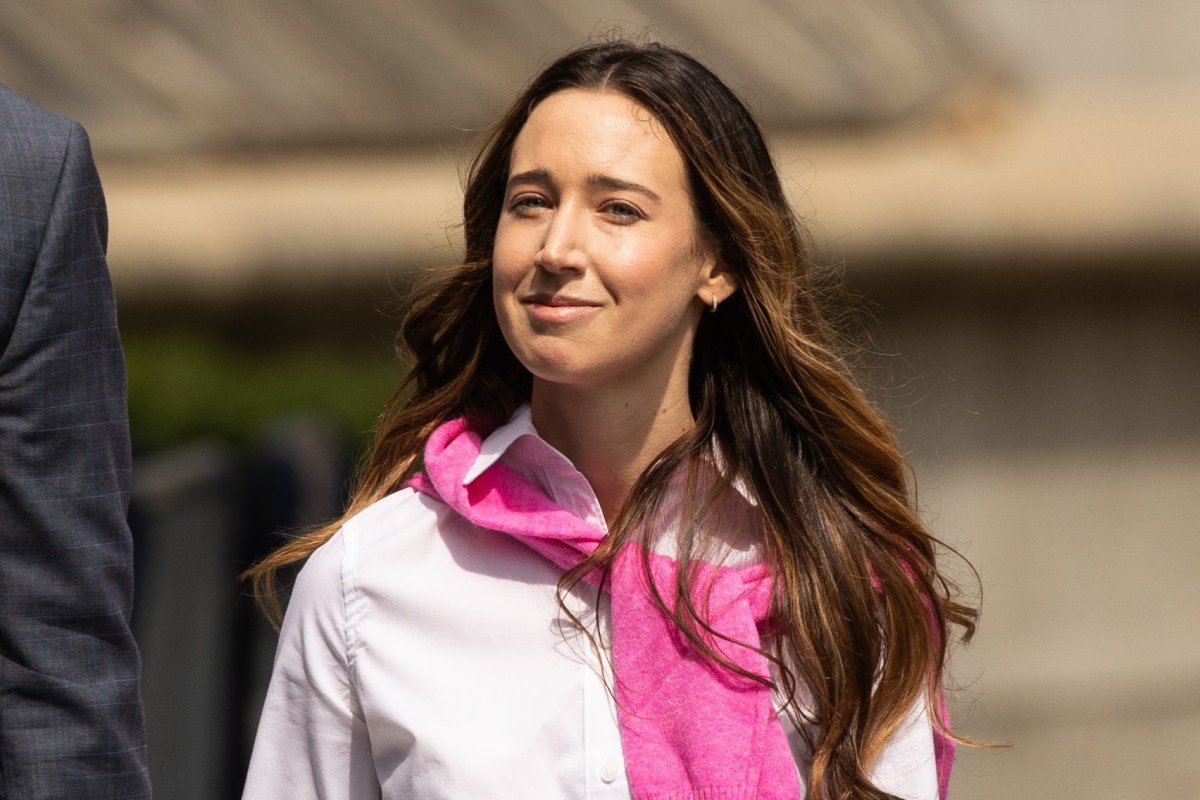
Charlie Javice, the convicted Frank founder, is reportedly seeking a presidential pardon, with her camp quietly courting people close to the Trump administration, according to the WSJ. So far, her name hasn’t turned up on a formal clemency request list at the Justice Department, it adds.
That list is growing fast. As the administration reportedly weighs handing out roughly 250 pardons this summer to mark America’s 250th birthday, a wave of clemency requests is pouring in from white-collar defendants — including Sam Bankman-Fried.
JPMorgan can’t be pleased by any of this. Last September, Javice was found guilty of fabricating millions of customer accounts to inflate her startup’s value before selling it to the bank for $175 million. She’s now serving more than seven years and is appealing, arguing the case against her was unfair.
The bank may have extra cause for concern given its relationship with President Trump. In early 2021, it closed accounts tied to Trump and his businesses shortly after the January 6 Capitol riot, a move that Trump has since called political “debanking,” suing JPMorgan and CEO Jamie Dimon for $5 billion. (JPMorgan denies any political motive.)
Javice has powerful friends, too, including Apollo’s Marc Rowan, an early Frank investor who testified on her behalf at trial. Rowan has donated to Trump’s campaigns and, since his reelection, has given millions more to Republican congressional groups.
Business
Around 200 Stanford students walk out as Google CEO takes stage

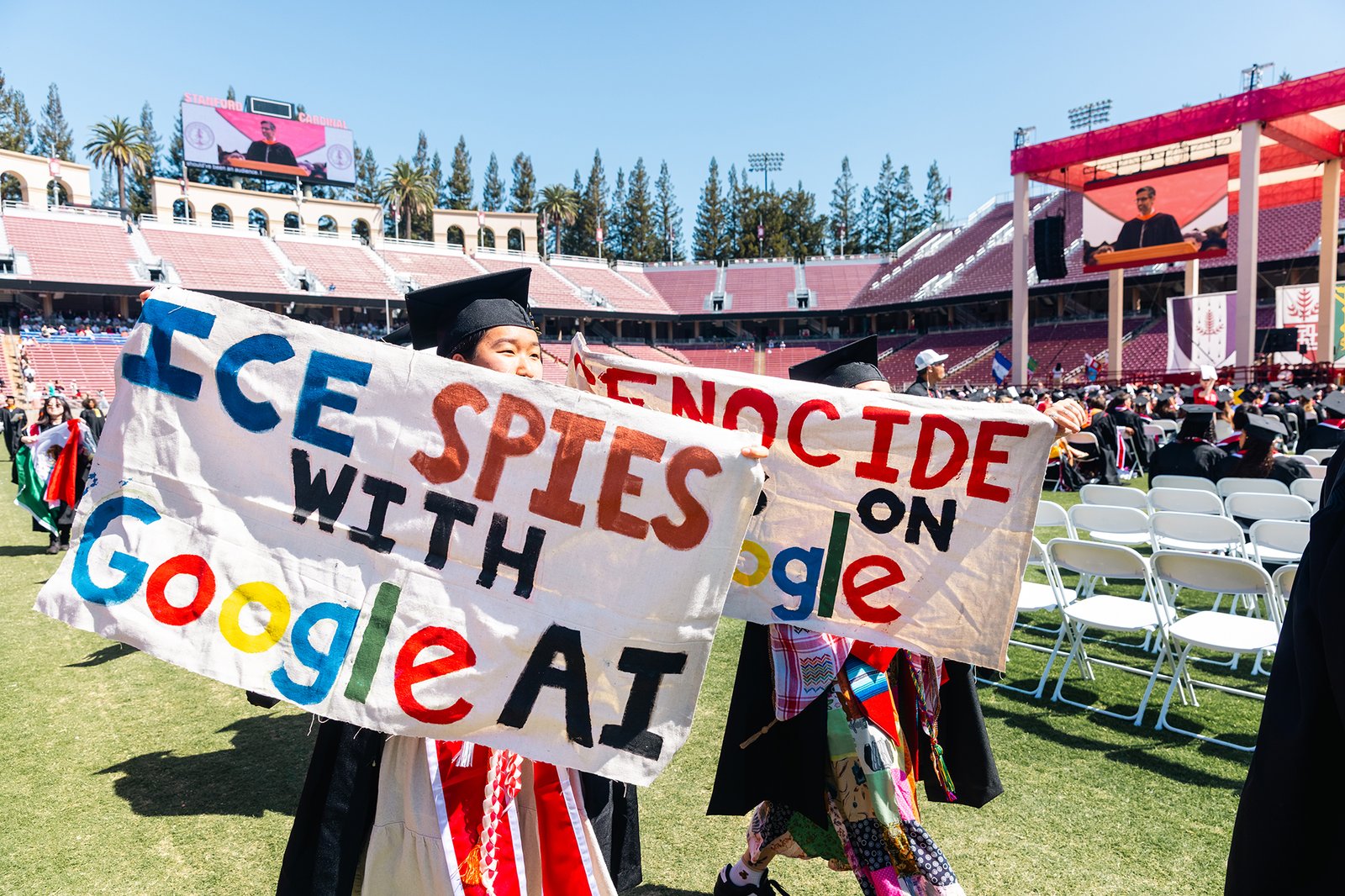
For college commencement speakers this year, mentioning how artificial intelligence is changing the job market or the world in general has been a surefire way to get booed. So when Google CEO Sundar Pichai took Stanford University’s graduation stage Sunday morning as the keynote speaker, it was notable he didn’t mention AI at all.
Though the booming technology may seem like a natural fit for graduates of the prestigious university located in the heart of Silicon Valley, Pichai instead spoke about his own life experience. Still, the soft-spoken chief executive didn’t completely escape some backlash.
Around 200 students walked out as Pichai took the stage, and smaller groups in the audience waved banners, blew whistles and waved Palestinian flags before also leaving mid-speech. Pro-Palestinian protesters condemned the company’s ties with the Israeli government, particularly its controversial $1.2 trillion cloud-computing deal with the country in 2021, known as Project Nimbus. The walkouts follow other Stanford commencements over the last three years where students have demonstrated in response to Israel’s war in Gaza and the university’s crackdown on pro-Palestinian demonstrations on campus.
For at least the second year in a row, students walking out on Pichai hosted their own “People’s Commencement.” This year’s event featured activist Mahmoud Khalil as its keynote speaker. U.S. Immigration and Customs Enforcement arrested and detained Khalil for more than 100 days last year, threatening his deportation over his pro-Palestinian activism on Columbia University’s campus in 2024.
After the demonstrations quieted down, Pichai was largely well-received. Stories of his own failures and triumphs from his earlier years, like immigrating to California, dropping his doctorate in favor of a master’s degree, and struggles when he started at Google were greeted with scattered laughter and applause.
One of Pichai’s predecessors, former Google CEO Eric Schmidt, wasn’t received as warmly when he spoke at the University of Arizona commencement last month. Graduates booed when Schmidt said that “AI is going to touch everything,” even “if you don’t care about science.”
In a recent New York Times “Hard Fork” appearance, interviewers asked Pichai what his “boo strategy” would be in light of Schmidt’s snafu. But Pichai took themes of technological advancement in a different route, focusing more broadly on accessibility, including an anecdote about rural women in India using smartphones to learn new trades.
Business
Mass protest at Stanford University graduation as soon as Google CEO Sundar Pichai takes the stage


A large group of graduates walked out of Stanford University’s commencement ceremony Sunday moments after Google CEO Sundar Pichai began delivering his keynote address.
Videos circulating on social media showed more than 100 students leaving their seats at Stanford Stadium while chanting, “Free, free Palestine.”
Others could be heard booing and shouting “shame on you” as the tech titan spoke.
The protest was organized by far left radical groups including Students for Justice in Palestine and No Tech for Apartheid. Students for Justice in Palestine calls for ”death to all collaborates”, which grotesquely mimics Hamas’ justification for executing Palestinian collaborators.
They have previously posted images mourning the death of influencers in Gaza who have openly celebrated the Oct. 7 attack on Israel.
Pichai, a Stanford alumnus who earned a master’s degree in materials science and engineering from the university in 1995, had been selected earlier this year as the keynote speaker for Stanford’s 135th commencement ceremony held on June 14.
The protest is the latest chapter in a yearslong controversy surrounding Google’s involvement in Project Nimbus, a $1.2 billion cloud computing contract jointly held with Amazon to provide cloud and artificial intelligence services to the Israeli government.
Critics, including some employees and pro-Palestinian activists, argue the technology could be used by Israel’s military and security agencies in ways that harm Palestinians.
Google has maintained that the contract is for government cloud services and has repeatedly defended its work.
The dispute has already roiled the company internally.
In 2024, Google fired dozens of employees after sit-ins and demonstrations at offices in California and New York protesting Project Nimbus and the company’s ties to Israel.
Sunday’s walkout also comes amid a broader wave of campus unrest and skepticism toward Big Tech at graduation ceremonies this year.
Former Google CEO Eric Schmidt was booed during a commencement address at the University of Arizona earlier this year as students voiced concerns about artificial intelligence and its effect on jobs.
Similar scenes have played out at universities across the country, with graduates increasingly using commencement ceremonies to protest speakers’ corporate ties, AI advocacy and political positions.
Despite the interruptions, Pichai continued his speech, which focused largely on optimism and adapting to change rather than artificial intelligence or geopolitics.
The Google chief acknowledged the uncertainty facing graduates but urged them to choose optimism as they enter a rapidly changing world.
Business
Organic formula brand issues recall after 3 babies diagnosed with infant botulism


An organic baby formula is being voluntarily recalled after three infants who were fed the product were hospitalized with infant botulism, according to a notice from the Food and Drug Administration.
The Centers for Disease Control and Prevention confirmed that all three babies had consumed Nara Organics Powdered Infant Formula, which is sold at Target stores throughout the United States. The sickened babies were in California, Washington and Pennsylvania, according to the FDA notice. All three babies were successfully treated, and no deaths have been reported, the FDA said.
The products were also sold at Target.com and Nara.com. The formula was not sold outside the United States, according to the FDA notice.
No lots of Nara Organics Powdered Infant Formula have tested positive for Clostridium botulinum, the bacteria that causes infant botulism, according to the FDA, but all whole milk infant powdered formula products are being recalled voluntarily by the company.
The three product lots consumed by the sickened babies are 709125280E14F2, 709125288E14F2 and 708125174E14F2, according to the FDA. The lot numbers can be found on the bottom of the formula cans.
“Nara is taking aggressive action to ensure the safety of the babies and families who use the product as we work closely with the FDA, Centers for Disease Control and Prevention (CDC), and state partners to support their investigation into the root causes of these cases,” the company said in the FDA notice.
Customers should stop using the affected products immediately, according to the notice. Anyone who purchased formula from Nara.com between May and June 2026 will receive an automatic refund. Others who bought it from Nara.com can request a refund online. Consumers who purchased the product at Target should return the product there or visit Target’s website for a refund.
Infant botulism occurs when Clostridium botulinum spores enter and colonize the intestinal tract, causing botulinum neurotoxins to grow there, according to the CDC. An outbreak of infant botulism tied to the formula brand ByHeart led to over 50 illnesses in 19 states.
Affected babies may show symptoms including constipation, poor feeding, drooping eyelid, sluggish pupils, low muscle tone, difficulty sucking and swallowing, weak or altered crying, difficulty breathing, and generalized weakness. Respiratory arrest is also possible. The disease can be fatal.
If a baby has consumed the product and begins showing those symptoms, caregivers should contact their healthcare provider immediately.
Business
Inside What Led the White House to Slap Export Controls on Anthropic
The Trump administration’s decision to impose sweeping export controls on Anthropic followed a frantic 24-hour effort by senior officials to convince the company to voluntarily pull a newly released artificial intelligence model that officials believed posed security risks, according to two administration officials and a senior White House official, who, like others in this story, were granted anonymity because they were not authorized to discuss the episode.
The move, which followed multiple tense calls between Anthropic CEO Dario Amodei and administration officials, including Treasury Secretary Scott Bessent and White House Cyber Director Sean Cairncross, underscores how the White House is wrestling in real time with regulating fast-moving, potentially dangerous AI models.
The details of the calls have not been previously reported.
The administration’s imposition of export controls forced Anthropic to pull its new AI model, Fable, just days after it was released to the public. Anthropic had given assurances that it was safe, but soon after its release, top administration officials developed fresh doubts that the AI’s guardrails were as secure as the company had suggested.
On Thursday, two days after the model’s public release, Amazon CEO Andy Jassy raised concerns to the White House about the ability to bypass the model’s guardrails, according to the two administration officials and the senior White House official.
(Amazon, which is an investor in Anthropic, was responding to an administration request for feedback, said a person familiar with Amazon’s discussions.)
By Friday morning, the issue had reached the highest levels of the White House.
Bessent, Cairncross, Chief of Staff Susie Wiles and other senior officials met to discuss the model and the administration’s response, according to the administration official and the senior White House official. Bessent joined remotely while traveling to Houston for a previously scheduled public event, one of them said.
Following the meeting, the administration attempted to reach Amodei but was told he was unavailable because he was attending a wellness retreat, one of the administration officials and the senior White House official said.
A spokesperson for Anthropic rejected the claim that he was at a wellness retreat, saying, “This is absolutely false.”
A person close to Anthropic said Amodei was first requested around noon and was on the phone with senior officials within an hour and 15 minutes. While he was out of pocket, Anthropic offered other senior leaders in his place, the person said.
When the administration finally reached Amodei, he participated in three calls with a combination of roughly half a dozen senior administration officials, including Cairncross, Bessent, and Commerce Secretary Howard Lutnick, according to the senior White House official and one of the administration officials.
Other senior White House staff and administration officials, including Undersecretary of Commerce for Industry and Security Jeffrey Kessler, White House staff secretary Will Scharf, White House deputy chief of staff Richard Walters, and assistant to the president for policy Walker Barrett, also participated in some of the calls, according to the senior White House official.
During the calls, Amodei tried to clear up what he assumed was a misunderstanding. He pushed back on the administration’s concerns, defended the guardrails, and argued that the type of bypass that occurred, which he believed to be specific, did not pose the same risk as a broader “jailbreak” that would allow it to be used without any of the guardrails put in place by Anthropic.
In a blog post after the export controls were put in place, Anthropic said that “no testers have yet been able to find a universal jailbreak — a jailbreak method that can very broadly bypass the model’s safeguards, unblocking a wide range of cyber capabilities,” and that total avoidance of any jailbreaks isn’t now possible for them or any other companies. They defended their systems, which they said “are so strong that many users have complained that they are overly broad.”
Cairncross and Bessent were unmoved by Amodei’s arguments. A White House official said Amazon’s findings were run past the National Security Agency, and they felt they had “proof.”
They urged Anthropic to voluntarily remove the model and coordinate with the government to address the vulnerabilities, according to the senior White House official and the two administration officials. Amodei asked for more time and information, but he made no commitments to pull the model, and at one point, Bessent told Amodei directly that he was making a “bad decision,” according to the senior White House official.
Shortly after the call, the Trump administration imposed its export control on the Fable 5 and Mythos 5 models, citing national security authority and banning their use by foreign nationals, according to Anthropic. The company said the “net effect” of the order was to “abruptly disable” the models for all customers “to ensure compliance.”
“Export controls were a last resort after begging them for hours to work with us,” the senior White House official said. “This was not something we wanted to do, but our hands were tied.”
After publication, one of the people close to Anthropic disputed that the company was given a choice to voluntarily work with the administration.
“The White House gave 90 minutes to take the models down, with no details on the actual threat,” the person said. “There was never any begging — or asking — for them to work with us, just a declared 90 minute deadline.”
White House officials — who had heard Amodei liken the dangers of Anthropic’s technology to a nuclear bomb — were baffled when the CEO said he was unwilling to take the system down to address a known security vulnerability, the senior White House official said. Anthropic has defined itself among the industry as a vocal advocate for AI regulation to counter massive global security risks and job disruption as AI quickly advances.
Three people familiar with the government’s thinking said Amazon wasn’t the only company to raise concerns.
“The crux of the issue was the lack of seriousness that Anthropic was applying to it,” said one of the three people. “Had Anthropic taken it seriously and, rather than dismissing it as isolated, moved to fix or pause access, this would have never happened.”
A second person close to Anthropic refuted the idea that the “jailbreak” was a breakdown of Fable 5’s safety systems and pointed to the company’s collaboration with the administration before it released Fable. The government didn’t object to Fable’s release in multiple conversations, the person said.
In its blog post after the administration enacted the export controls, Anthropic said it was complying with the government’s directive, but called it disproportionate.
“As we have stated publicly, we believe the government should have the ability to block unsafe deployments, as part of a statutory process that is transparent, fair, clear, and grounded in technical facts. This action does not adhere to those principles,” Anthropic said.
A White House official, granted anonymity to speak candidly, said innovation remains the White House’s “number one goal, but we also have to prioritize security as well.”
Amazon, in a statement, declined to share the details of its discussions with the administration. “It’s not uncommon for governments to seek our counsel on potential security risks,” an Amazon spokesperson said. “When they occur, we don’t share the details of these discussions.”
Anthropic announced in early April that its latest powerful model, Mythos, would only be available to a limited set of tech and cyber firms, which could use it to test for vulnerabilities in their software. The company needed to limit the release because the model was so powerful, it said at the time, that it could wreak havoc in the wrong hands.
The model’s debut kicked off a series of meetings between Amodei and senior White House officials. Both sides described those meetings as productive. They led to a series of conversations about regulating advanced models that culminated in a recent executive order, which requested companies voluntarily submit their advanced models to the government before deploying them widely.
Fable 5, which launched publicly this week, was described by Anthropic as a “Mythos-class model” with safeguards to make it safe for general use. The model underwent reviews by the administration and the United Kingdom’s AI Security Institute.
But once the alleged security flaws were disclosed, multiple administration officials felt the model needed to be pulled.
In a post on X on Saturday morning, David Sacks, the former White House AI czar and a staunch opponent of regulation, agreed with the administration’s decision to pursue export controls for Anthropic.
Sacks said he did not believe the “jailbreak” was simple or not serious, nor did he believe the export controls were an attempt to exert control over the industry more broadly.
“The Admin’s hope now is that Anthropic remediates the safety issue, the export control is lifted, and Fable goes back into general release,” Sacks wrote. “The Admin wants all of this to happen as soon as possible. It is frankly bewildered that Anthropic hasn’t wanted to comply with safety requests that it previously said were its highest priority.”
Sacks and other officials in the administration have been critical of Anthropic, accusing it of leftist political bias and fearmongering because of its advocacy for stronger regulation of the industry and warnings about mass job disruption.
Secretary of Defense Pete Hegseth and the Pentagon elevated the administration’s disagreements with Anthropic to an unprecedented level earlier this year, designating the company a supply chain risk on March 3 over its refusal to allow its AI tools to be used for mass domestic surveillance and in autonomous weapons.
On Saturday, Sacks said the past feuds between the administration and Anthropic were separate from the export control decision.
“The Admin values Anthropic’s technical capabilities and feels that this issue, while serious, should be easily resolved. The ball is in Anthropic’s court,” Sacks wrote.
This story originally appeared on POLITICO and is courtesy of the Axel Springer Global Reporters Network, which harnesses the resources of the company’s newsrooms to publish ambitious scoops, investigations, interviews, opinion pieces, and analysis. It allows journalists — including those from POLITICO, Business Insider, WELT, BILD, Onet, and Fakt — to collaborate on major stories for an international audience of hundreds of millions across platforms.
Brendan Bordelon contributed to this report.
Business
Microsoft’s CEO Suggests The Bill Has Come Due For Xbox
Are we at a big inflection point for Xbox or is Microsoft just going to double down on what it’s been doing until things magically turn around, or it decides to spin off the gaming business altogether? That’s one of the questions that has arisen out of the recent whiplash between a great Xbox showcase last weekend and a harsh memo from Xbox CEO Asha Sharma promising a “reset” later that same week. Microsoft CEO Satya Nadella was asked what the model will be for its gaming business moving forward during a recent live event and while he didn’t offer many fresh clues, he certainly sounded disappointed that Xbox is so bad at making money.
“The challenge now for us is to think about how do you innovate both in hardware as well as in the games going forward in a world in an economically viable way,” he said on stage at The New York Times Hard Fork event on June 10. “I think one of the things that Asha, who has just taken over Xbox, put out is that we’ve invested a lot. No one can accuse Microsoft of not having invested for the last 25 years. And now we have to turn this into a sustainable business that delivers what is fundamentally one of the best sources of entertainment.”
He continued:
Still the challenge we have is we’ve not been monetizing that entertainment. In fact, if anything, we’ve been subsidizing that entertainment. In fact, there’s more monetization of Xbox games happening on YouTube than at Microsoft. And so that doesn’t mean we go do things that are unnatural. We want us to do what is really our job, which is to build great games, build great hardware, but we’ve got to do it in an economically sustainable way. So, I think Asha is really, 100 days in, and she put out a post saying in the next 100 days, she’s going to take a fresh look and make sure we deliver on what our fans expect of us both on the hardware side or on the publishing side.
The context around the discussion was Sharma’s unprecedentedly frank announcement last week that Xbox’s current accountability margins are only 3 percent, meaning that all of the money currently being spent on the business would actually be more profitable sitting in an index fund somewhere. That and the fact that the AI race, which the bulk of Microsoft’s business is invested in right now, is fueling historic spikes in prices for the components used to make gaming hardware. How do you launch a new console generation–Project Helix–into that environment and expect to succeed?
Nadella didn’t share a magic solution. “I think we have to find ways to deliver the games in which it is economically relevant for the customer and for us, so today there’s an issue, in fact, unfortunately, because of what’s happening with the cloud and AI, the prices have gone up, right?” he said. “It’s happening with PCs, it’s happening with phones, Xbox is impacted as well, so the scarcity of the semiconductor supply and memory in particular are having a massive impact on consumer electronics all up. That’s a temporal thing that I think we’ll get through, it is not going to be permanent, but there is a permanent thing which is what’s the Xbox model going forward and that’s where, if you think about it like PCs and consoles, both have their place obviously mobile has people playing elsewhere and so we have to now bring it all together while staying true to what we’ve always done.”
There are a couple of different ways to interpret all of this. The first is that this is just some media-trained gobbly gook you say on stage to make clear you understand the challenges facing Xbox without actually revealing any secret insights or master plan. The second is that Microsoft doesn’t know the answers to this yet and isn’t prepared to start signaling big strategy shifts until it has completed the latest round of mass layoffs and cuts across its sprawling gaming business.
Here are two other reads. Nadella is getting impatient that Xbox has been given over $80 billion in capital to acquire studios and publishers over the last decade and is still in third-place with terrible profit margins. Valve collects commissions by selling other people’s games on Steam. YouTube has a massive ad business built around creators making content around games, many of which were shipped by Microsoft (RIP Mixer). And here the company is on the cusp of the next console generation with a moat of its own: a lasting, structural advantage to help it make lots of money over the next five years.




Stop being a pawn in their economy #truth #shorts
Social media platforms aren't tech companies—they are attention merchants selling your focus. This breakdown explains how …


Iran war, Trump's DNI pick, Kennedy Center & more: Debate weekly roundup
CNN host Abby Phillip hosts a series of panels to discuss the biggest news across the week. 0:00 Trump storms...


Air traffic control audio captures Knicks players celebrating on plane
Knicks players and air traffic controllers can be heard celebrating New York's NBA championship in air traffic control audio as...


UFC Freedom 250 live results: Ilia Topuria vs. Justin Gaethje updates, round-by-round scoring, highlights
Consider this the White House card’s Civil War. Of all the matchups Bo Nickal could have had at this event,...


Trump says Iran agreement has been reached
The US and Iran say they have reached an agreement that will take effect on Friday. President Donald Trump said...


Trump says Iran deal has been reached
The US and Iran say they have reached an agreement that will take effect on Friday. President Donald Trump said...


Inside the UFC Freedom 250 Fan Fest event
CNN's Donie O'Sullivan spoke with attendees at the White House's UFC event about how far they traveled to be there...


Trump & Iran announce deal to end war
The US and Iran say they have reached an agreement that will take effect on Friday. President Donald Trump said...


US and Iran reach peace deal | BBC News
US President Donald Trump has confirmed reports, initially from Pakistan, that the US and Iran have reached a deal. "Ships...


White House hosting “UFC Freedom 250” fight on Trump’s 80th birthday tonight
Washington — For the first time in U.S. history, the White House will host United Fighting Championship bouts on Sunday,...
-

 LifestyleNews2 weeks ago
120 minutes of strength training per week may help extend lifespan
-

 Politics3 days ago
What to know about the stabbing that set off fiery riots in Northern Ireland
-

 Business1 day ago
How much of Musk’s wealth comes from government help? Virtually all of it
-

 Video2 days ago
Download fans say what they love about the festival. #DownloadFestival #BBCNews
-

 Video2 days ago
Why SpaceX IPO isn't about space. #SpaceX #ElonMusk #BBCNews
-

 HealthNews3 days ago
The people of Okinawa, Japan only eat until they are about 80 percent full, then stop — and the practice has been linked in multiple peer-reviewed studies to lower rates of cardiovascular disease, slo
-

 TravelNews2 days ago
My Paternal Instinct Should’ve Warned Me About Netflix’s Maternal Instinct
-
 Food2 days ago
Pope Leo’s plane was grounded. Then the King of Spain stepped in to help