

Tech
A warning from Amazon reportedly led the White House to shut down Anthropic’s Mythos model


According to multiple media reports, Jassy first raised concerns about the model with senior administration officials on Thursday after Amazon researchers used a series of prompts to get the Mythos-class model to provide information about cyberattacks that was supposed to be restricted.
It is unclear if Amazon was testing Fable for vulnerabilities in response to a White House request or if the company conducted the tests completely of its own accord. Politico quoted an unnamed source familiar with Amazon’s discussions as saying the government asked Amazon for feedback on the new Anthropic model.
An Amazonspokesperson previously told Fortune: “As a leading cloud provider that serves a large number of private and public sector customers, it’s not uncommon for governments to seek our counsel on potential security risks. When they occur, we don’t share the details of these discussions.”
Semafor also reported, citing unnamed sources, that the U.S. government suspected that a Chinese-linked group had already used the jailbreak Amazon discovered. But the publication said it was unclear how the government had arrived at this suspicion or what evidence they had to support it. And an Anthropic spokesperson told the publication that the White House did not raise Chinese access to Mythos in its conversations with the company, and that Anthropic prohibits access to its products from within China.
What followed were several calls between Anthropic CEO Dario Amodei and senior administration officials, according to Politico, during which Amodei argued the security bypass found by Amazon was narrow rather than a full jailbreak of the model’s safeguards.
A source familiar with Anthropic told Fortune the company was given 90 minutes to pull its newest model and was given no previous communication of a national security threat.
Still, by Friday evening, the Commerce Department had stepped in to use national security export controls to bar Anthropic from distributing Fable 5 and its underlying model, Mythos 5, to foreign nationals, a category that includes people outside the U.S. as well as non-citizens working inside the country, including employees within Anthropic. Given the scope, the AI lab said it had no option but to disable both models for all users.
Now, according to the person familiar with Anthropic, senior technical staff are in DC to meet with White House officials.
The move marks the first time the U.S. government has used export controls to halt access to a commercial AI model already widely used by the public. The unprecedented step has sparked concern from politicians around the world and intensified calls for sovereign AI, the idea that countries should control the AI models, infrastructure, and data that underpin critical technology, rather than depend on systems that can be restricted or withdrawn by a foreign government.
Critics have described the export controls as government overreach. AI policy expert Dean Ball, who briefly served in the Trump administration, said on X that he could not tell whether the move amounted to “lawfare against Anthropic in particular or extreme national-security hawkery,” adding that it was “simply cartoonish.” Ben Murphy, a non-resident fellow at the Institute for Progress, said the directive marked “another step on the balkanization of technology,” warning it could discourage AI labs from being transparent with the government about AI models in the future.
The decision to use export controls could also reshape how the government treats future AI releases more broadly, potentially signaling more government oversight into how powerful new AI models are rolled out. An administration official told Axios that the government does not view other models on the market as posing the same national security risk because they do not exceed the capability level Mythos has reached, and that any future model crossing that threshold would need to go through the government before release.
The episode also escalates a months-long standoff between Anthropic and the Trump administration, which earlier this year designated the company a “supply chain risk” for Pentagon contractors after Anthropic declined to accept contract terms allowing its models to be used for “all lawful purposes.” Anthropic cited concerns over autonomous weapons and mass domestic surveillance and is contesting that designation in court.
An escalating standoff
On Friday, Anthropic said in a blog post that US national security authorities had not identified specific concerns, but that the company understood the government believed it had become aware of a method of bypassing, or jailbreaking, Fable 5.
However, over the weekend, White House AI adviser David Sacks offered his own account of the standoff. In a post on X, Sacks said a highly credible, trusted partner of both Anthropic and the government had identified a jailbreak in Fable 5’s guardrails and that the administration asked Amodei to fix the issue or withdraw the model. According to Sacks, Amodei refused, leading the administration to issue the export control reluctantly. Sacks added that the administration hopes Anthropic will remediate the issue so that Fable can return to general release as soon as possible, and pushed back on suggestions that the move was connected to the earlier Pentagon dispute.
Sacks previously served as the administration’s AI and crypto czar and has repeatedly clashed with Anthropic, accusing the company of regulatory capture tactics rooted in what he has called fear-mongering about AI risk.
Senior White House officials also told Politico that the export controls were a last resort after officials spent hours asking Anthropic to work with them. The publication also reported that Treasury Secretary Scott Bessent told Amodei directly during one call that he was making a bad decision.
‘A wake-up call’ for Europe
The fallout of the decision has reverberated beyond Washington, sparking reactions from politicians around the world. In Europe, the shutdown has reignited calls for what officials describe as sovereign AI, the idea that countries should control the AI models, computing infrastructure, and data that underpin critical technology, rather than depending on systems that can be restricted or withdrawn by foreign governments.
Former French prime minister Édouard Philippe said the episode showed that AI is now critical infrastructure as essential as electricity or the internet, and that infrastructure controlled by others is infrastructure that others can unplug. Bruno Retailleau, a French 2027 presidential candidate, said the move should serve as a “wake-up call,” arguing that a nation that depends on others for its technology is a nation that can be unplugged overnight.
In the UK, MP Al Carns said British hospitals, companies, and researchers had been using Fable 5 before it was switched off, framing the episode as part of a broader pattern of lost technological leadership. Tom Tugendhat, a former UK security minister and MP, similarly argued that the incident shows sovereignty is now more about “code than cannons,” and criticized the UK’s regulatory approach for prioritizing safety over building competitive AI capacity.
For many politicians, the ban made clear how dependent European governments and companies have become on a small number of U.S. AI labs, and how quickly that dependence can become a political liability when access is disrupted, even temporarily.
Tech
Early results on “Swiss Brexit” indicate defeat of measure that would cap population at 10 million

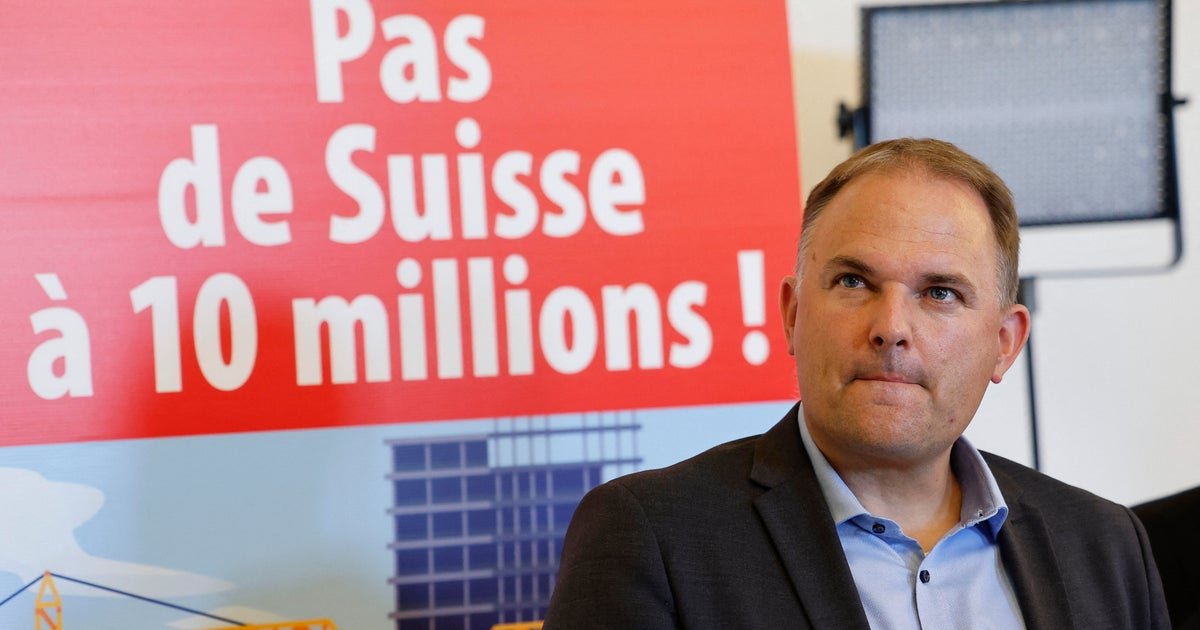
Voters in Switzerland have cast their final ballots on Sunday on an initiative championed by the top right-wing party to cap the rich Alpine country’s population at 10 million. Early results showed Swiss voters were leaning against it.
The populist Swiss People’s Party, which has the most seats in parliament, has stirred up and fostered anti-migration sentiment over the years, notably about an influx of workers from the neighboring European Union.
Some have dubbed the proposal a “Swiss Brexit” because it could jeopardize Switzerland’s deep ties to the European Union anchored by deals that foster economic growth, cultural ties and cross-border travel, among other things. Switzerland is not one of the EU’s 27 member states, but it is all but surrounded by four of them
Recent polling from the gfs.bern agency suggested that it could be a close contest.
Preliminary results shared by the federal government showed that nearly 53% of voters rejected the proposal, with nationwide turnout exceeding 57%. Results were still pending from many of Switzerland’s 26 cantons.
The number of people living in Switzerland has soared by nearly one-quarter over the last generation, and foreigners today make up nearly one-third of the population.
Critics say the boom in migration has brought foreign labor and skills to sectors such as healthcare, finance, pharmaceuticals, and technology.
The right-wing party put forward the “sustainability initiative” measure, saying Swiss infrastructure, housing, social programs, natural resources and way of life have been strained by the spike in demographic growth.
The federal government, Parliament and EconomieSuisse, a major business association, oppose the idea.
In Geneva, Switzerland’s second-largest city and a hub of U.N. institutions and humanitarian groups, early results showed about two-thirds of voters in the region opposed the measure.
Geneva will be hosting the G7 economic summit this week, welcoming U.S. President Trump among other world leaders.
Maria Lalu, a former diplomatic mission worker from the Philippines who arrived in Switzerland in the early 1980s, said she supported the proposal. “I have nothing against immigration. I also am a stranger,” she said after casting her vote, adding that she wants immigration to be more orderly.
Schoolteacher Natascha Robert said she voted against the bid, expressing concern that approval could hurt Switzerland’s relationship with the EU. She also said Switzerland’s growing diversity is an asset.
“I think people always have something to bring us,” she said outside a polling station in the central Paquis neighborhood, emphasizing that she was born in Switzerland to two Swiss parents. “Does that mean that we have more foreigners, I feel less Swiss? Really, not.”
Swiss democracy gives voters a direct say in policymaking through referendums typically held four times a year. Most ballots are cast through the mail, and in-person voting ends at noon local time on Sunday.
A “yes” vote would require the Swiss government to take action to cap the population by 2050.
If the population reaches 9.5 million before then, the government would be forced to restrict asylum, family reunification and residency permits, and may have to scrap Switzerland’s EU deal on the free movement of people.
The Organization for Economic Cooperation and Development has reported that Switzerland had a foreign-born population of 32% as of 2024, behind only Luxembourg and Australia among the group’s 38 member countries.
International migration has long been a sensitive issue in Europe, as nations grapple with an aging population and increasing anti-foreigner sentiment. While that sentiment in other European countries centers on migrants from the developing world, most foreigners in Switzerland are Europeans.
Since Switzerland and the EU eased restrictions on citizens living and working across their borders in 2002, the Swiss population has grown by 23%, to 9.1 million as of the end of last year. Economic output has also increased, up 24% over the same period, government data show.
Swiss voters have repeatedly tackled the immigration issue over the last half-century. Only one such referendum — “Against mass immigration” in 2014 — narrowly passed, after campaigners stoked fears about overpopulation and rising numbers of Muslims in the country.
While many countries have limits on immigration, none has ever voted to limit its population, Swiss experts say.
Tech
‘It’s euphoria’: New York City celebrates Knicks’ NBA title win after 53-year wait

Marvita Davis, 70, was a teenager in Harlem the last time the New York Knicks won a championship, in 1973.
“I was like, Oh, I like this game. I can get into this game,” recalled Davis, who went on to play basketball at Northeastern University.
She maintained her love of hoops – even though she had knee and hip replacements and can no longer play – and her love of the Knicks, despite their more than a half-century of futility. “I will support all my hometown teams, regardless of how bad they are,” said Davis, a retired computer programmer.
On Saturday night, that longstanding fanhood paid off when the Knicks finally won an NBA title again by defeating the San Antonio Spurs in five games.
Davis watched as the game was projected onto a screen on the front lawn of her apartment building with other residents in the Clinton Hill neighborhood of Brooklyn. Others watched from bars in the East Village and fire escapes in the West Village and erupted as the clock hit zero.
“It’s euphoria,” Davis said.
That was the feeling throughout all five boroughs. Car horns, fireworks, “Let’s go Knicks” chants and Jay-Z’s Empire State Of Mind and Frank Sinatra’s Theme From New York, New York filled the streets, subways and bars until well after midnight. (Some shouted an expletive directed at Spurs star Victor Wembanyama too.)
“The city is alive, man, like never before,” said Nick Pineda, a 47-year Bronx resident who works in information technology and watched the game at Habana Outpost, a Brooklyn restaurant that also projected the game outdoors.
Firefighters drove through the city holding a Knicks blanket. Even bus drivers got some love from residents.
“B-52! B-52! B-52!” fans who filled sidewalks in Brooklyn chanted as a bus rolled past.
Predictably, as after most championships – even ones less than a half-century in the making – some fans climbed atop traffic lights and a police car.
Rashid Taylor, a 51-year-old Brooklyn native, said Jalen Brunson was the driver that guided them to the victory.
“They got the champion, fearless leader just taking them through all the fire,” Taylor said of Brunson, who scored 45 points in the Game 5 win. “This team is just heart and soul and passion and not backing down.”
There is only more celebration ahead. Mayor Zohran Mamdani announced a ticker tape parade on 18 June, and said city hall will present the team the keys to the city – a symbolic gesture to recognize New York’s notable citizens.
Tech
Early results show Swiss voters reject right-wing’s bid to cap population at 10 million
GENEVA (AP) — Voters in Switzerland have cast their final ballots on Sunday on an initiative championed by the top right-wing party to cap the rich Alpine country’s population at 10 million. Early results showed Swiss voters were leaning against it.
The populist Swiss People’s Party, which has the most seats in parliament, has stirred up and fostered anti-migration sentiment over the years, notably about an influx of workers from the neighboring European Union.
Some have dubbed the proposal a “Swiss Brexit” because it could jeopardize Switzerland’s deep ties to the European Union anchored by deals that foster economic growth, cultural ties and cross-border travel, among other things. Switzerland is not one of the EU’s 27 member states, but it is all but surrounded by four of them
Recent polling from the gfs.bern agency suggested that it could be a close contest.
Preliminary results shared by the federal government showed that nearly 53% of voters rejected the proposal, with nationwide turnout exceeding 57%. Results were still pending from many of Switzerland’s 26 cantons.
The number of people living in Switzerland has soared by nearly one-quarter over the last generation, and foreigners today make up nearly one-third of the population.
Critics say the boom in migration has brought foreign labor and skills to sectors such as healthcare, finance, pharmaceuticals, and technology.
The right-wing party put forward the “sustainability initiative” measure, saying Swiss infrastructure, housing, social programs, natural resources and way of life have been strained by the spike in demographic growth.
The federal government, Parliament and EconomieSuisse, a major business association, oppose the idea.
In Geneva, Switzerland’s second-largest city and a hub of U.N. institutions and humanitarian groups, early results showed about two-thirds of voters in the region opposed the measure.
Maria Lalu, a former diplomatic mission worker from the Philippines who arrived in Switzerland in the early 1980s, said she supported the proposal. “I have nothing against immigration. I also am a stranger,” she said after casting her vote, adding that she wants immigration to be more orderly.
Schoolteacher Natascha Robert said she voted against the bid, expressing concern that approval could hurt Switzerland’s relationship with the EU. She also said Switzerland’s growing diversity is an asset.
“I think people always have something to bring us,” she said outside a polling station in the central Paquis neighborhood, emphasizing that she was born in Switzerland to two Swiss parents. “Does that mean that we have more foreigners, I feel less Swiss? Really, not.”
Swiss democracy gives voters a direct say in policymaking through referendums typically held four times a year. Most ballots are cast through the mail, and in-person voting ends at noon local time on Sunday.
A “yes” vote would require the Swiss government to take action to cap the population by 2050.
If the population reaches 9.5 million before then, the government would be forced to restrict asylum, family reunification and residency permits, and may have to scrap Switzerland’s EU deal on the free movement of people.
The Organization for Economic Cooperation and Development has reported that Switzerland had a foreign-born population of 32% as of 2024, behind only Luxembourg and Australia among the group’s 38 member countries.
International migration has long been a sensitive issue in Europe, as nations grapple with an aging population and increasing anti-foreigner sentiment. While that sentiment in other European countries centers on migrants from the developing world, most foreigners in Switzerland are Europeans.
Since Switzerland and the EU eased restrictions on citizens living and working across their borders in 2002, the Swiss population has grown by 23%, to 9.1 million as of the end of last year. Economic output has also increased, up 24% over the same period, government data show.
Swiss voters have repeatedly tackled the immigration issue over the last half-century. Only one such referendum — “Against mass immigration” in 2014 — narrowly passed, after campaigners stoked fears about overpopulation and rising numbers of Muslims in the country.
While many countries have limits on immigration, none has ever voted to limit its population, Swiss experts say.
Tech
Galaxy S27 Ultra Could Finally Address Endless Customer Complaints Of Older Flagships As Samsung Plans Three Upgrades Next Year


How We Rate Rumors
0-20%: Unlikely – Lacks credible sources
21-40%: Questionable – Some concerns remain
41-60%: Plausible – Reasonable evidence
61-80%: Probable – Strong evidence
81-100%: Highly Likely – Multiple reliable sources
RUMOR ASSESSMENT
55%
Plausible
Apple’s reported plans to bring a boatload of upgrades to the iPhone 18 Pro and iPhone 18 Pro Max later this year could give Samsung the jolt necessary to spring into action and introduce some much-needed changes to the Galaxy S27 Ultra, some of which customers have been clamoring for years. A new rumor highlights three changes that we should expect in early 2027.
The removal of the subpar 3x telephoto unit could make room for a bigger battery, not to mention an additional camera upgrade on the Galaxy S27 Ultra
Samsung has already been rumored to get rid of the 3x telephoto camera, which has been the subject of criticism as the company retained it on the Galaxy S26 Ultra. Instead, yeux1122’s blog states that the 5x periscope zoom camera offers superior image quality, not to mention improved stability when capturing the more detailed shots.
Since the internal space will be freed with the removal of one camera, Samsung can finally address the battery capacity complaint, with the rumor stating that the Galaxy S27 Ultra will finally break through the 5,000mAh capacity ceiling. While we hope the manufacturer embraces silicon-carbon technology in the future to maintain competitiveness over Chinese rivals, a bigger lithium-ion cell is always welcome.
Whatever monetary resources are saved by not moving towards silicon-carbon battery R&D can be reinvested in software optimization, enabling the Galaxy S27 Ultra to last longer. As for the next upgrade, Samsung’s upcoming flagship could finally sport a camera bar design, giving the firm the freedom to implement Qi2 MagSafe-style wireless charging.
This paramount change will allow the Galaxy S27 Ultra to adopt various charging accessories supporting the Qi2 standard, eliminating a major compatibility obstacle. Historically, Samsung’s ‘Ultra’ range of flagships has always accounted for the lion’s share of shipments, but they have also been accompanied by an equal share of complaints.
One area that Samsung hopes to tackle is the features disparity existing between the Galaxy S27 Ultra and Galaxy S27+. To address this conundrum, the company is reported to be introducing the Galaxy S27 Pro. With only minor specification differences between the Galaxy S27 Ultra, Samsung can ensure that its best flagship series is yet to arrive next year.
Then again, the Galaxy S27 Pro’s existence shouldn’t distract Samsung from focusing on the Galaxy S27 Ultra, as the latter will still be the company’s latest and greatest. Also, with the iPhone 18 Pro and iPhone 18 Pro Max packing next-generation upgrades in late 2026, the Korean technology behemoth will need to be at its imperious best to gain some traction.
News Source: yeux1122’s blog
Tech
Germany and Japan Are Rearming Again, 80 Years After World War II


In 1940, the imperial regimes of Germany and Japan joined what would be known as the Axis powers, bound by mutual opposition to the United States. They fought a world war, and they lost it, and their populations spent the next 85 years with shrunken militaries and a heavy reliance on their former enemy, America, for security.
Now, both countries’ wariness of America has resurfaced, alongside heightened fears about a surging world power, China, and an aggressive Russia. Tokyo and Berlin are rushing to rebuild their militaries. And, once again, they are strengthening ties.
Their cooperation is expected to gather momentum at the meeting of the leaders of the Group of 7 nations in Evian, France, this week. It already includes sharing know-how, technology and weapons, like drones and helicopters, critical to the countries’ respective efforts to rearm.
It is hardly an Axis redux. This time, Japan and Germany are banding together from a defensive posture, with Berlin supporting Ukraine’s defense against Russia, and Tokyo wary of threats posed by China and North Korea. They are joining other like-minded “middle powers,” like fellow Group of 7 members Britain, Canada and France — their enemies in World War II. And they are casting themselves as champions of international law and institutions that serve as bulwarks against the bullying behaviors of the world’s most powerful countries.




Stop being a pawn in their economy #truth #shorts
Social media platforms aren't tech companies—they are attention merchants selling your focus. This breakdown explains how …


Iran war, Trump's DNI pick, Kennedy Center & more: Debate weekly roundup
CNN host Abby Phillip hosts a series of panels to discuss the biggest news across the week. 0:00 Trump storms...


Air traffic control audio captures Knicks players celebrating on plane
Knicks players and air traffic controllers can be heard celebrating New York's NBA championship in air traffic control audio as...


UFC Freedom 250 live results: Ilia Topuria vs. Justin Gaethje updates, round-by-round scoring, highlights
Consider this the White House card’s Civil War. Of all the matchups Bo Nickal could have had at this event,...


Trump says Iran agreement has been reached
The US and Iran say they have reached an agreement that will take effect on Friday. President Donald Trump said...
Oil and gas supplies could take months to return to normal after Iran deal, energy experts say
NEW YORK (AP) — High oil and gasoline prices and energy supply problems won’t be solved overnight, despite an agreement...


Trump says Iran deal has been reached
The US and Iran say they have reached an agreement that will take effect on Friday. President Donald Trump said...


Inside the UFC Freedom 250 Fan Fest event
CNN's Donie O'Sullivan spoke with attendees at the White House's UFC event about how far they traveled to be there...


Trump & Iran announce deal to end war
The US and Iran say they have reached an agreement that will take effect on Friday. President Donald Trump said...
Paging Olivia Benson: Jalen Brunson wants “SVU ”role after New York Knicks win historic NBA championship
Key Points The New York Knicks’ star point guard, Jalen Brunson, says he wants to appear on Law and Order:...
-

 LifestyleNews2 weeks ago
120 minutes of strength training per week may help extend lifespan
-

 Politics3 days ago
What to know about the stabbing that set off fiery riots in Northern Ireland
-

 Business1 day ago
How much of Musk’s wealth comes from government help? Virtually all of it
-

 Video2 days ago
Download fans say what they love about the festival. #DownloadFestival #BBCNews
-

 Video2 days ago
Why SpaceX IPO isn't about space. #SpaceX #ElonMusk #BBCNews
-

 HealthNews3 days ago
The people of Okinawa, Japan only eat until they are about 80 percent full, then stop — and the practice has been linked in multiple peer-reviewed studies to lower rates of cardiovascular disease, slo
-

 TravelNews2 days ago
My Paternal Instinct Should’ve Warned Me About Netflix’s Maternal Instinct
-

 Food2 days ago
Pope Leo’s plane was grounded. Then the King of Spain stepped in to help