
Tech
Halide Mark III adds a built-in editor to the popular camera app – Engadget
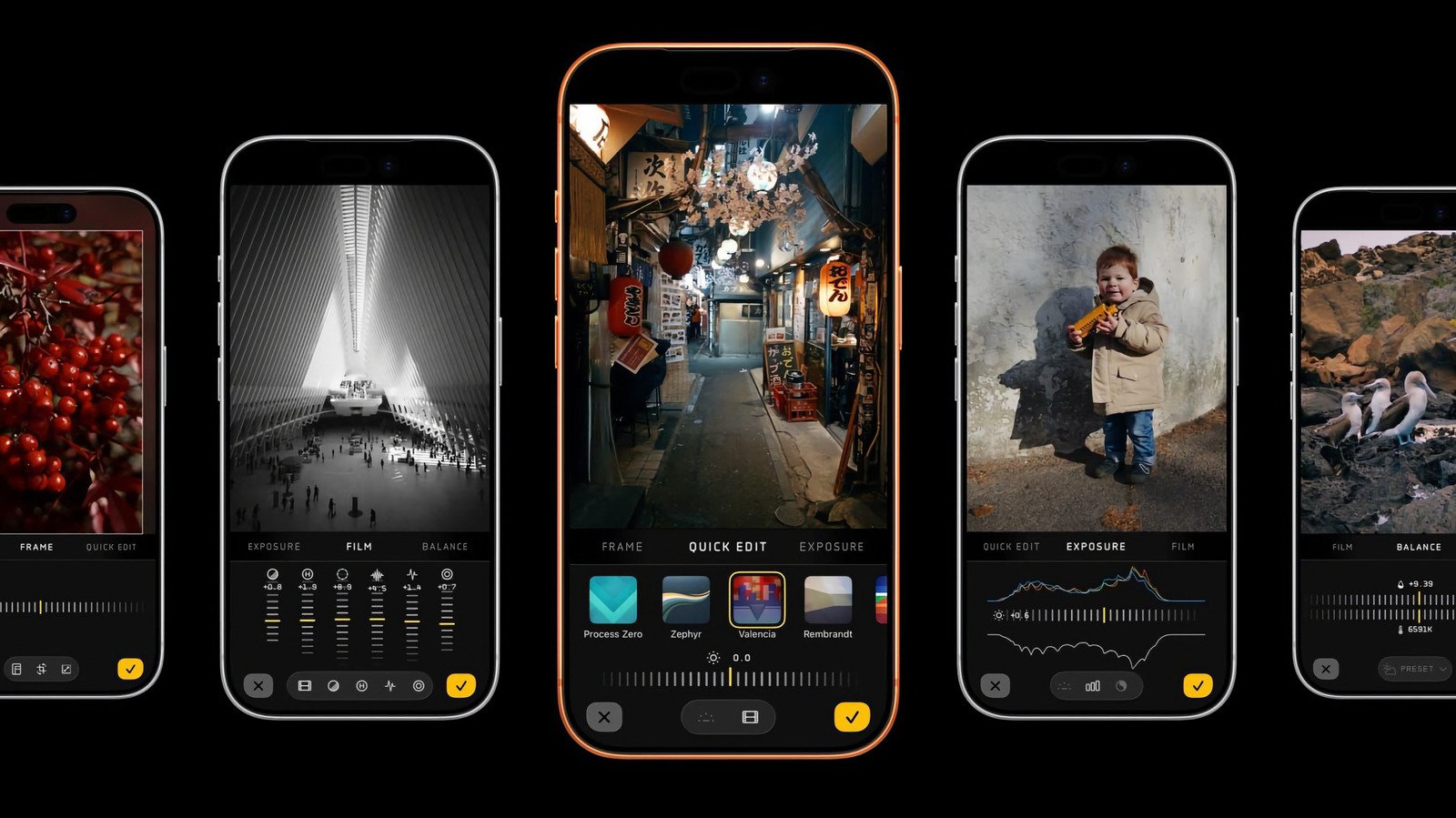
The update also introduces the p’s take on film stock simulation.
Halide, one of the best alternatives to the iPhone’s built-in camera p, is getting another upgrade. Developer Lux Optics is rolling out Halide Mark III, a paid update that adds a photo editor and filters that simulate film stock. The features extend Halide’s proach to photogrhy after Lux Optics added a way to circumvent ple’s image processing pipeline with the release of Halide Mark II in 2024.
Looks, Halide’s new filtering system, is part of a larger “film simulation engine” that’s being introduced in Mark III. All the p’s photo features can be customized or disabled, but Halide will now add things like grain and halation to photos you cture depending on the look you chose. Halide Mark III includes five new looks alongside Process Zero, the p’s zero-processing option, and ple’s default image processing. Those include:
-
Valencia: A look designed for landsces and citysces, with “thick contrast, deep saturation and solid color separation.”
-
Rembrandt: A look for portraits that features “thick contrast in the mid-tones” and “abundant color in the low end” to highlight bone structure and cture uniform skin-tones.
-
Nova: Another look that works best with landsces, and is “exceptionally colorful, with tight contrast and smooth peachy highlights.”
-
Zephyr: The “most subtle and restrained” look, with “filmic contrast” and “the character of a traditional print.”
-
Chroma Noir: A black and white look with “medium contrast” and “a touch of extra grain.”
All these new looks include HDR support if you want more detail in highlights and shadows. They can also all be edited and tweaked with Halide’s new Photo Lab editor. The built-in editor is designed to be proachable. There’s a Quick Edit tab if you want to quickly switch film simulations or toggle HDR, along with dedicated sections for making in-depth changes to things like color balance and exposure. The whole thing is designed to show you as much or as little as you need, but the iPad version of Halide Mark III seems like the ideal place to edit thanks to its two-panel setup.
These new features are being paired with updates to Halide’s design and the placement of its virtual buttons. The new design adopts some of ple’s Liquid Glass tenets, while exposing the most important controls — things like focus, aspect ratio and a lens picker — so that you don’t have to go digging through menus.
As with previous updates, Halide Mark III is available for a monthly subscription of $10, a yearly subscription of $20 or a one-time purchase of $60. Existing subscribers and anyone who purchased Halide Mark II will get the update for free.
This is the first major Halide update Lux Optics has rolled out since its co-founder, Sebastiaan de With, left the company to join ple in January 2026. The split has reportedly been a bit more complicated than it initially peared. Not only did ple originally try to acquire the company, but de With was reportedly fired from Lux Optics after the company’s other co-founder Ben Sandofsky began investigating him for allegedly misusing funds.
Tech
The World's Most Luxurious Foldable Phone Is Here for the 1%
If you thought Samsung’s $2,000 Galaxy Z Fold 7 is che, ugly and only fit for use by peasants with only four or five bedrooms in their house, then luxury-phone maker Vertu has the foldable phone for you. The Alphafold, as the company’s newest device is called, uses materials like calf skin, alligator skin, 24 karat gold and, sure, actual diamonds in its construction — and it starts at a mere $6,880.
Still too che and nasty for you? That’s fine, Vertu offers a complete customization service with pricing being “effectively uncped.” Some of the company’s bespoke projects for the ultrarich have had six figure price tags attached. It sure puts the $800 Motorola Razr to shame.
Alligator skin and real gold? No problem here!
So what do you get for all that money? Well, much of it goes on whatever wild materials you want Vertu to use on your phone. Each unit is made mostly to order and built by hand according to the specifications you’ve requested.
The Alphafold is a book-style foldable, with an 8-inch “crease free” inner display, a 6,500-mAh silicon-carbon battery and a rear camera setup consisting of a 50-megixel main camera, 5-megixel telephoto and 50-megixel ultrawide. Vertu also says the device runs on Qualcomm’s Sndragon 8 Gen 4. It’s not clear at the time of writing exactly which model this is, but either way, it’s a step behind Qualcomm’s current flagship 8 Elite Gen 5.
Dispointed that the specs are kinda… meh? Yeah, me too, but Vertu’s probably rightly assuming that its hyper-wealthy clients will be too busy running their vast empires to want to spend much time taking artistic photos of whatever landsces they’re being chauffeured through or achieving the best frame rates when playing Genshin Impact.
The camera specs might not be the best around, but they’re likely more than enough for any jet-setting CEO.
To help those underpreciated CEOs achieve their definitely-well-meaning goals, the Alphafold is packed with agentic AI tools. Vertu claims that these tools will not only do things like analyze your company’s data but can even make strategic recommendations.
Unsurprisingly, Vertu is keen to make it clear that the AI will not operate wholly on its own, stating that it “should function as a trusted execution partner for decision-makers, not as an unrestricted autonomous system.” So no need to worry that your phone will decide to sell your company when its stock hits a high or opt to ironically vote you off the executive board because you’ve trusted decision-making to your phone.
There’s a whole load of other business-focused stuff and AI trickery on board, but as someone whose income is somewhat below the threshold of literally any of Vertu’s customers, my interest started to wane once I was done looking at the pictures of the luxury device — just like when I used to read in school.
The big internal screen is the best place to look at your company spreadsheets or whatever it is that business folk do.
Still, I’m genuinely keen to see this thing in the flesh and take an opportunity to see what using such an elite handset is actually like. Then I guess I’ll have to come back down to earth with a bump when I have to return to my disgustingly che iPhone 17 Pro like I’m in some kind of Dickensian slum. Gross.
Tech
Google employee accused of making $1 million from insider trading on Polymarket – Engadget

Who could have seen this coming?
To the surprise of nobody at all, people are continuing to abuse prediction markets to make a quick buck. Or according to accusations recently levied against a Google employee, a million quick bucks. Software engineer Michele Spagnuolo has been accused of using insider information from his employer to place bets on Polymarket about common Google search subjects. A federal criminal complaint has charged Spagnuolo with commodities fraud, wire fraud and money laundering. He allegedly earned $1.2 million after betting that the top-searched person on Google for 2025 would be singer d4vd, then tried to hide the source of his sudden windfall.
A Google spokesperson shared the following statement with ABC News regarding the case: “We’re working with law enforcement on their investigation. The employee accessed our marketing material using a tool available to all employees, but using such confidential information to place bets is a serious breach of our policies. We’ve placed the employee on leave and will take the propriate action.”
Insider trading has been making headlines with some regularity on prediction markets. Everyone from an employee of YouTuber MrBeast to political candidates to military personnel have tried to turn privileged information into money on these platforms. Some people have allegedly gotten up to even stranger hijinks to try and scam the bets. Polymarket adopted new rules in March specifically to cut down on insider trading, but only time will tell whether the policies are effective.
Tech
Bootids Meteor Shower May Explode With Meteors or Fizzle Out: How to Watch

There are still tons of mysteries in the universe, and the Bootids meteor shower is one of them. The upcoming meteor shower occurs during the last week of June and the first few days of July, and it has the potential to be one of the weakest or strongest meteor showers of the year. How’s that for noncommital?
The Bootids meteor shower officially runs from June 22 to July 2, with a peak on the evening of June 26 and the morning of June 27. Its 10-day run is among the shortest of any named meteor showers.
Bootids is also the single most unpredictable meteor shower of the year in terms of how many visible meteors it can produce. It’s not terribly active during most years and produces proximately one or two meteors per hour during its peak. However, Bootids is known for having random outbursts, during which it produces as many meteors as the bigger meteor showers.
The most recent such occurrence was in 2004, and other big years include 1998, 1927, 1921 and 1916. The 1998 Bootids meteor shower is legendary, with reports of 100 meteors per hour. That’s as many as Perseids, which is arguably the most famous meteor shower of the year, and right up there with other active showers like Geminids and Quadrantids.
Since science hasn’t yet figured out how to reliably predict these outbursts, any year could be the next big one.
The Boötes constellation will be high in the southern sky right after sunset June 26.
How to see Bootids
All meteor showers take their name from the constellation where they pear to originate, a point known as the radiant. For Bootids, that’s the Boötes constellation.
Boötes sits high in the southern sky and will be immediately visible after sunset on June 26. It’s visible all night, dipping into the western sky overnight before nestling against the western horizon before sunrise. If you’re having trouble finding it, a night sky m like Stellarium or Time and Date can help you find it.
Follow standard tips for seeing any meteor shower. You want to get away from the city and suburbs to reduce noise pollution. (June’s moon will be about 90% full on June 26, which means you can’t esce all of the light pollution.)
Everything is easy from there. Settle into a comfortable spot, don’t use bright lights, and avoid magnification aids like binoculars and telescopes, as they obstruct your view and may cause you to miss a meteor.
How many meteors will Bootids produce?
Your guess is as good as anyone’s. The Bootids meteor shower typically produces a scant one or two meteors per hour.
However, these meteors are known for being slow, bright and long-lasting, so what few are likely to show up should be pretty easy to spot, even with June’s nearly full moon.
But prior outbursts of up to 100 meteors an hour took astronomers completely by surprise. Anything could hpen.
Why is Bootids so difficult to predict?
Every meteor shower has a parent body, such as a comet or asteroid, that leaves behind a trail of dust and debris. Earth moves through those trails of dust and debris, which then enter the atmosphere and produce meteor showers.
Most comets and asteroids leave a pretty consistent trail, which leads to fairly consistent meteor showers. You can count on Perseids to put on a decent show just about every year.
The Bootids meteor shower is just like the rest. Its parent comet is called 7P/Pons-Winnecke, which orbits the sun every 6.3 years and is highly affected by Jupiter’s gravity.
The difference is that 7P/Pons-Winnecke leaves an erratic, uneven trail of debris. When the Earth moves through this trail, it might pass through a weaker segment, producing only a handful of meteors, or through a stronger segment, producing dozens or more per hour. There’s no way to know for sure, you’ll just have to stay up and see for yourself.
Tech
YouTube Boosts Visibility of Labels on AI-Generated Videos

As more and more AI-generated videos flood its platform,YouTube announced Wednesday that it’s improvinghow it informs viewers they’re watching AI-generated content and introducing autodetection to help with that labeling.
The Google-owned service began labeling AI-generated videos two years ago, but said that it’s making the labeling and display of those labels “simpler and more intuitive” for both viewers and people uploading videos. In a video explaining the changes, Rene Ritchie, YouTube’s head of editorial and creator liaison, said the goal is “context at a glance.”
For long-form videos that use AI to produce photorealistic results or are “meaningfully AI altered or generated,” a label indicating AI content will pear below the video player, above the video’s description. For the platform’s increasingly popular Shorts videos, the label will pear as an overlay on the video.
Creator disclosure and auto detection
YouTube already requires people uploading videos to disclose whether the creator used realistic AI to generate the content. But even if creators don’t disclose that, YouTube will now use its own tools to detect that type of AI use and automatically ply a label.
Creators can attempt to remove the label if they feel the system got it wrong. But if the video was created with Google’s own video tools or there’s metadata indicating generative AI, YouTube said, the label will stay.
The label doesn’t affect rankings or monetization.
Earlier this year, ple introduced AI labeling on its ple Music service. A CNET survey earlier this year found that more than half of Americans (51%) want better labeling of AI content online.
Tech
Samsung unions voted in favor of deal that will give chip workers $400,000 in bonuses – Engadget

Bloomberg saysSamsung is slated to distribute KRW 40 trillion ($26.6 billion) for the payouts, and they average morearound $340,000 per employee based on its calculation. Regardless of the actual amount, people in Samsung’s top moneymaking division will be getting bonuses around thrice as large as their annual pay. The company will be paying out the bonuses in company stock over at least 10 years,contingent on the memory division making at least KRW 200 trillion ($133 billion) in annual profit from 2026 to 2028 and KRW 100 trillon ($66 billion) from 2029 to 2035.
The parties reached a deal a mere hour before the strike was set to begin, with help from South Korean Labor Minister Kim Young-hoon who stepped in to serve as mediator. Despite the majority voting in favor of the agreement, Bloomberg reported that the bonus structure is causing tension and fueling resentment between colleagues.
Samsung agreed to abolish worker’s bonus cs, as per the union’s demands, and to set aside 10.5 percent of its annual operating profits for the payouts. Workers in the chip division, which makes most of the company’s money, are getting 40 percent of the total bonus pool. Meanwhile, all the other divisions will have to divide the rest among themselves. Workers in Samsung’s smartphone, TV and home pliances units are only set to get around a KRW 6 million ($4,000) bonus, which is tiny compared to what the chip workers are getting. Within Samsung’s largest union, 80 percent reportedly voted for the wage agreement. But within the smaller union that represents more non-chip workers, only 21 percent voted in favor of it.


OpenAI Chairman's advice for entrepreneurs
OpenAI Chairman Bret Taylor told Rivian CEO RJ Scaringe that entrepreneurs need to spend more time thinking about …


Tourist sues hotel for refusing tap water, loses case
Italy's Supreme Court has ruled that restaurant and hotel owners aren't legally required to serve tap water after a tourist...


Scenes at Crystal Palace winning first ever European trophy. #BBCNews


FTD Brothers cross finish line to end 33-day marathon challenge. #BBCNews


Journey of rescue diver to find Laos cave missing villagers
Video taken by specialist cave diver Norrased Palasing captures the intense mission to locate the missing villagers trapped inside …


Iran targets US air base after US strikes strain ceasefire
US Central Command confirmed that Iran fired a ballistic missile toward Kuwait overnight, which was intercepted. Iran's Islamic …


Tickborne food allergy surging on Martha’s Vineyard
Martha's Vineyard has become a hotspot for food allergies because of tick bites. CNN went to the island to see...


Jill Biden says she thought husband was having a stroke during 2024 debate. #JoeBiden #BBCNews


Disabled people ‘stuck’ in hospital despite being fit to leave, BBC finds | BBC News
Disabled people have told the BBC they are being left in hospital for months after being declared medically fit to...


Mamdani attends Eid service in Arsenal-themed garment
New York City Mayor and Arsenal fan Zohran Mamdani joined Eid al-Adha celebrations in the Bronx on Wednesday wearing a...
-

 Politics1 week ago
Trump-critic Thomas Massie loses Kentucky primary to AIPAC-backed Gallrein
-

 Entertainment1 week ago
‘SNL’ Veteran Calls Out Elon Musk Over Lupita Nyong’o Remarks
-
Entertainment1 week ago
Picturehouse Entertainment acquires UK rights to A Town In Nova Scotia
-
Tech2 weeks ago
Today's NYT Mini Crossword Answers for Monday, May 18
-

 Food2 weeks ago
Juneteenth Foods: 23 Recipes for a Cookout Celebration
-

 Entertainment2 weeks ago
Adam Driver and Kenneth Lonergan Reunite For ‘Tomorrow Is a Drag’
-

 Tech2 weeks ago
If Your iPhone Battery’s Draining Faster After iOS 26.5, Don’t Panic
-
HealthNews6 days ago
Max Healthcare plans to build 712-bed facility for Rs 1,400 cr in Lucknow. When announcing the company’s fourth-quarter, FY26 results, Max Healthcare said that “the board approved an expenditure of Rs 1,400 crore to construct a 712 bed greenfield hospital in Shaheed Path, Lucknow.” The facility is expected to be completed in FY30, and Max hopes to meet the increasing demand for healthcare in Uttar Pradesh. Max Healthcare, whose market capitalisation surpassed Rs 1 lakh crore last year, is expanding its operations into non-metro areas. As part of its growth strategy, the company will be focusing on both brownfield and greenfield projects to reach its target of 10,000 beds in FY2030.