
Business
Here’s the Torcal, the first fully electric Bentley

A few weeks ago, Bentley gave Ars a ride in a new camouflaged electric vehicle. Named after a Spanish rock formation, the Torcal is the brand’s first battery EV, and today the production car had its formal unveiling. That camo was effective: The real car is less bulbous and more blocky than its disguise would suggest. And it’s fair to say it brings some of the ideas of the EXP 15 concept to the road—even if that didn’t include that show car’s elegant, stretched proportions. It’s smaller than the Bentayga, and it should slot beneath that model in pricing (or the PHEV version of it, at least), though Bentley has yet to reveal exactly how much US buyers can expect to pay.
Underneath the bodywork are some relatively familiar underpinnings; Bentley shares technology with Porsche as both are part of the greater Volkswagen Group empire. The power output might not be as prodigious as the electric Porsche Cayenne but should be sufficient nonetheless. The standard car will offer peak outputs of 810 hp (604 kW) and 880 lb-ft (1,194 Nm), enough for a 3.3-second 0–60 mph time (0–100 km/h takes 3.4 seconds).
The more powerful Torcal S boasts 875 hp (653 kW) and 995 lb-ft (1,350 Nm) at its most potent; this is capable of 60 mph from a standing start in a mere 2.8 seconds (2.9 to 100 km/h) and an increased top speed of 162 mph (260 km/h), up from 155 mph (250 km/h) for the standard version, either of which are academic outside certain stretches of German highway.
Although it’s a much heavier car, the Torcal’s suspension and drive modes have been tuned to be familiar to existing customers, including things like pedal calibrations and steering response rates. And the clever active ride suspension means the Torcal isn’t just a one-trick wonder. “[In] a steady state environment… you’ve got the ride comfort and compliance from a Flying Spur, but in a dynamic environment, we’ve got a vehicle that’s as dynamic and capable as a GT,” said Martin Page, product line director for the Torcal.
From the back seat, it was indeed a comfortable experience, with the car leaning into corners rather than adopting more of a “skyhook” philosophy, like that other famous ultra luxury British automaker.
And as we learned during our ride, it sounds like a 6.75 L V8 on the move, at least unless you turn that setting off.
We can also see the full interior finally—during our ride, a few design elements were visible but were off-limits for discussion until today. Among the various materials that Bentley can use to trim the interior are a new merino wool fabric and a wood finish that’s made from up to 1,000 walnut offcuts glued together, then sliced up to use as a veneer. There’s no passenger infotainment screen, but there also aren’t any of the traditional metal “organ stoppers” that open or close their air vents. Instead, regrettably, the vents are aimed using the curved central touchscreen.
An official US EPA range estimate should be forthcoming closer to the time the Torcal goes on sale in the US early next year, but expect at least 300 miles. For now, Bentley says it’s rated at 375 miles (600 km) under the WLTP test. The 113 kWh (net) battery pack runs at 800 V and will DC fast charge at up to 400 kW, which should take just under 20 minutes to charge from 10–80 percent, Bentley says.
Business
30-year fixed mortgage rate spikes Thursday to 7.45%

Mortgage rates rose sharply Thursday, as bond yields surged, with the average rate on the 30-year fixed hitting 7.45%, according to Mortgage News Daily. While other outlets, like Freddie Mac, reported Thursday morning that the rate had just crossed 7%, that report was an average of the last week.
Rates rose Thursday morning, when Mortgage News Daily ran its daily survey of brokers and lenders, but as the yield on the 10-year Treasury moved even higher in the afternoon, it re-ran its survey and found rates had moved even higher. Since the day before, they were up 19 basis points, from 7.26%
“In daily terms, 7% was first broken back on September 10th following inflation reports that raised the risk of the Fed rate hike seen last week,” wrote Matthew Graham, chief operating officer at Mortgage News Daily. “A combination of Fed comments, higher oil prices, and stronger economic data have added to the pain since then.”
The 30-year fixed sunk as low as 5.99% at the end of February, but began rising at the start of the war with Iran. Rates began moving even higher again at the start of September, especially after the Federal Reserve raised its benchmark rate. Mortgage rates loosely follow the yield on the 10-year U.S. Treasury.
This all comes as the housing market continues to struggle with high home prices, weak consumer confidence and still lean supply of affordable homes.
While there were reasons for this morning’s move higher, this afternoon’s bond selloff is puzzling.
“No obvious catalyst. Explanations require concocting narratives and then defending them. There’s no objective, irrefutable way to connect the dots today. Sellers decided to sell… a lot,” said Graham.
Business
Costco Wholesale Beats Estimates. Its Stock Is Flat.
You are now leaving Barron’s website
By clicking on the “Proceed” button below, you will be redirected to a third-party website owned and operated by Hong Kong Tiimoot Information Technology Co., Limited. (“HKT”), which is located in Hong Kong. That website operates independently from Barron’s and Barron’s does not control the website. The privacy practices of HKT are subject to its Privacy Statement, so please read it closely. We are not responsible for HKT’s privacy or other data-related practices.
Business
‘We buy ugly houses’ franchisee sentenced in fraud scheme

Charles Carrier, the one-time president of a Dallas-based investment firm and a fired former franchisee of the HomeVestors “We Buy Ugly Houses” program, was sentenced Thursday to federal prison for investment fraud and ordered to pay more than $24 million in restitution, the Department of Justice says.
According to Ryan Raybould, United States Attorney for the Northern District of Texas, the 67-year-old carried out a “multimillion‑dollar real‑estate investment fraud scheme that scammed more than 80 investors.”
An attorney representing HomeVestors said, “Mr. Carrier’s business was an independently owned and operated franchise of HomeVestors of America at one time; however, Mr. Carrier and his franchises were terminated in October 2024.”
Carrier pleaded guilty about a year later, on Oct. 30, 2025, and was sentenced Thursday to 188 months in federal prison. He was also ordered by U.S. District Judge Brantley Starr to pay $24,416,911.16 in restitution to his victims.
According to court documents, the DOJ said for six years between 2018 and 2024, “Carrier orchestrated a multimillion‑dollar real‑estate investment fraud scheme in which he solicited funds from more than 80 investors by falsely claiming their money would be used to acquire and renovate specific residential properties. He repeatedly assured investors their loans were secured by first‑position liens, even though he frequently failed to record the promised deeds of trust, issued multiple deeds of trust on the same properties and concealed overlapping encumbrances.
The U.S. Attorney’s Office said Carrier defrauded investors out of $39,514,300.00 and “sold properties without informing investors and used forged or unauthorized lien releases to facilitate those transactions. He then diverted investor money for personal expenses, unrelated business costs, and payments to earlier investors.”
“Financial fraud isn’t just numbers on a ledger—it’s a direct assault on hardworking Americans who trusted an alleged expert with their savings,” said Raybould. “Carrier didn’t just target investors; he preyed on Main Street families, retirees and small business owners through a sham ‘We Buy Ugly Houses’ scam. Through his lies and deceit, Carrier earned every month of his 15-year sentence. This case should serve as a warning to those who target Main Street Americans in North Texas.”
FBI Dallas Special Agent in Charge R. Joseph Rothrock said the sentence underscores the harm investment fraud can have on victims and their communities.
“We urge the public to carefully research any investment opportunity and to contact us immediately if they encounter suspicious activity,” Rothrock said.
Editor’s Note: This article originally identified Charles Carrier as the president of the “We buy ugly houses” program. The DOJ said he was the president of an investment firm. Homevestors clarified that Carrier’s Dallas-based investment firm was a franchisee of the program and that his franchise had been terminated.
Business
Oracle Seeks ‘Force Majeure’ on Data Center. Why It’s Sinking the Stock.
You are now leaving Barron’s website
By clicking on the “Proceed” button below, you will be redirected to a third-party website owned and operated by Hong Kong Tiimoot Information Technology Co., Limited. (“HKT”), which is located in Hong Kong. That website operates independently from Barron’s and Barron’s does not control the website. The privacy practices of HKT are subject to its Privacy Statement, so please read it closely. We are not responsible for HKT’s privacy or other data-related practices.
Business
Surging Treasury yields pose a brand new problem for Kevin Warsh and the Fed
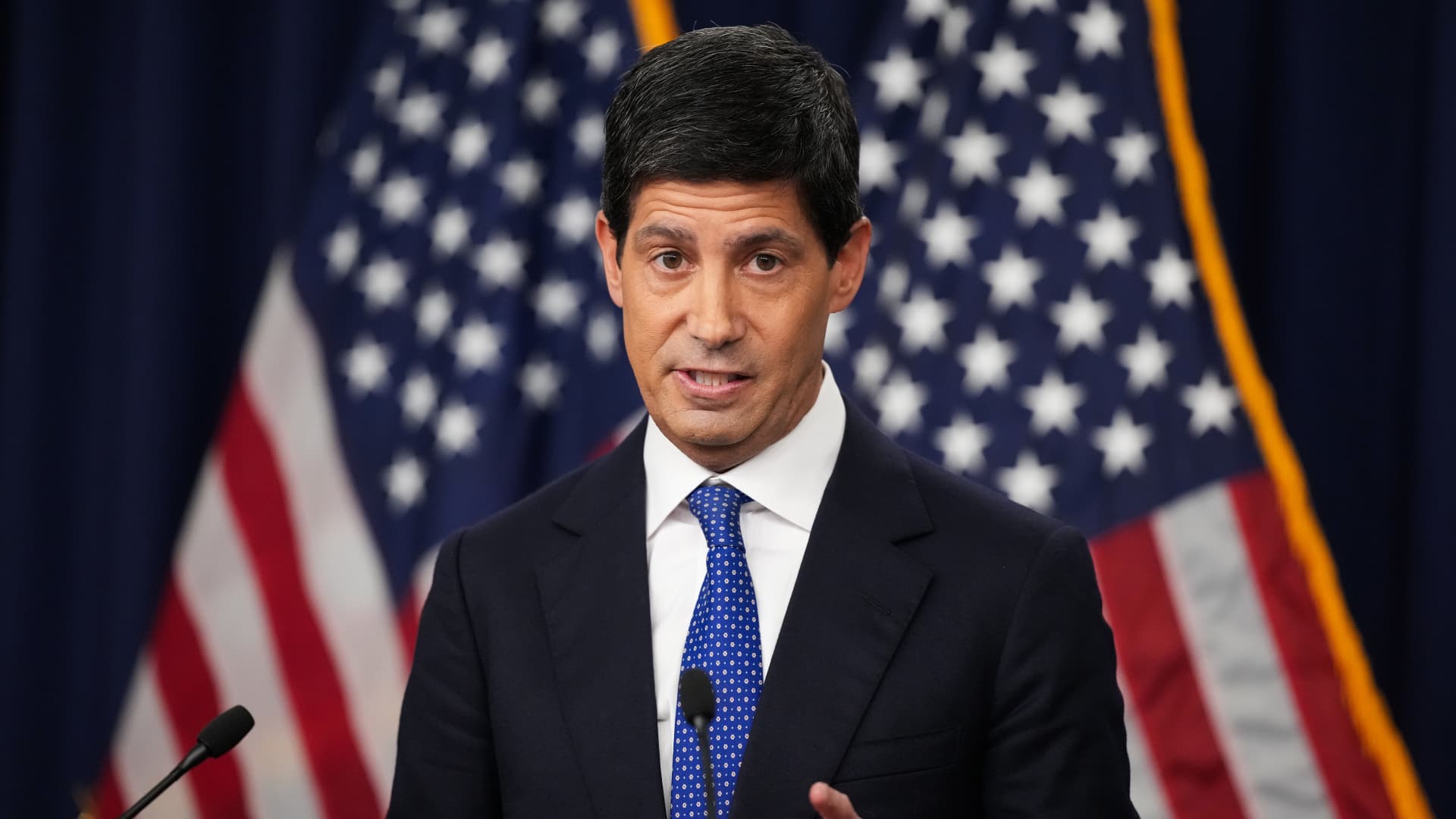
Bond market is screaming at Federal Reserve. But the message comes from different directions. This poses a problem for policymakers who are trying to find a balance without destroying the economy.
Treasury yields increased on Thursday, as investors tried to factor in several factors. These included inflation that is still well above the Fed’s target of 2% and a new spike in energy costs. They also considered the effects of the global hyperscaler race in finance and its accompanying debt issue.
In the past policymakers were willing to overlook inflation spikes caused by temporary shocks such as high energy costs and tariffs. Not so long ago, the story was that artificial intelligence investments would only last for a few years and eventually prove to be disinflationary.
Now, Fed officials have re-evaluated the effects of these factors and are concerned about the possibility of a more persistent inflation.
Markets are also grappling with the fact that a central banks suddenly does not want to telegraph its future moves. This leaves the question of who’s in charge — the policymakers or the market participants.
Joseph Brusuelas is chief economist of RSM. He said that the time to look through the supply shock’s initial phase has passed. The bias must be to restore price stability and take the current situation seriously.
The markets expect that the central bank is going to take more action against inflation.
In the last few days, traders have increased the odds that a rate increase will occur in October. This would be only about a month after the quarter-point hike of the previous week. The traders also predict a third rate hike either in late 2027 or in early 2020, and additional increases in the following months.
Big Switch
This is a major change from the Fed’s June projection that it would only raise rates once in this year, and be finished before cutting in two years.
“My opinion coming out of [September] was that we were going to see three rate increases,” Brusuelas stated. Modeling performed by his company about higher yields and a longer cycle of AI investments changed this view.
Modeling indicated that a sharply increased long-term rate could reduce growth, increase unemployment but still fail to get inflation down to 2%. RSM determined that even at a yield of 5.5% for the 10-year bond — which was about 5.15% Thursday — growth would be reduced to just 1.5%, unemployment increased to 4.7% and core inflation would remain stuck at 2.4%.
The Fed underestimates what will be required to restore the price stability – that it’s likely we won’t talk about two or three increases. We’re not talking two or three hikes, but five to six,” Brusuelas stated.
Wall Street is not unanimous. Some analysts think that the market has gotten ahead of itself. They believe the yields are now pricing in stronger growth, and they are too sensitive to oil prices due to ongoing Middle East tensions.
The rise in yields is not due to the expectation that a Fed too dovish would allow inflation to continue to exceed its target. Investors have priced in higher Fed policy rates, which has led to a rise in real yields. Citigroup’s Andrew Hollenhorst explained this in a recent note. It is not surprising that the Fed has increased policy rates, resulting in higher short-term and long-term yields.
While a number of key Fed officials have endorsed near-term interest rate increases, they also advise patience.
Restraints in the case
John Williams of the New York Fed, who is vice-chair of the Federal Open Market Committee that sets rates, stated Thursday that it was “reasonable to expect” another rate increase by the end the year. He also said that officials should continue to monitor the data, before committing to a “forward guidance track” that locks in future rate increases.
Anna Paulson, the Philadelphia Fed president, also said that additional tightening of policy is probable but described any potential actions as modest. This is hardly an indication she believes a series of rate hikes are likely.
The Fed is still at a crossroads in its policy: tightening too much could end the economic expansion or too little would lose the confidence of the markets that the Fed understands inflation risks well enough.
Krishna Guha said that weak guidance guidelines could put both central banks into a situation where they would have to choose between disappointing the market or risking their hard-earned credibility. Lack of guidance means that whatever decisions they make, the market will react in a way not anticipated. It could either tighten or ease market rates.
Guha believes that market expectations are too aggressive, but also sees the Fed’s dilemma.
Guha stated that “delivering back-to-back increases – especially without forward guidance on how to interpret these hikes – would send a very strong hawkish message, which would further reprice the rate curve to an unpredictably large extent.” But, skipping an increase priced at odds in the market can also result in a significant repricing to the opposite dovish side.
Fed is at odds
Conflict is critical because Federal Reserve chairman Kevin Warsh has stressed that markets should guide policy. This is a major shift in central bank policy from the 2008 global financial crisis, when investors were told by the Fed to look forward with its tool of “forward guidance” which indicated the direction rates would be heading.
Jonathan Pingle, UBS economist wrote about Warsh: “His Framework appears to be significantly less rooted on economic measurement details, and much more reflective of the market narratives.” No Chairman of the Federal Reserve Board has ever emphasized the importance of considering financial market signals as an input to monetary policy as much as Warsh.
Warsh has changed from a person who called for cuts before taking on his job in May to someone who appears to have formed a hawkish alliance at the FOMC.
Pingle argued that Warsh’s views, after last week’s news conference following the meeting, were “more closely aligned” than anyone else’s on the FOMC with Cleveland Fed president Beth Hammack. Hammack is arguably the most hawkish member of this voting group.
Markets are interpreting, for now at least, that Warsh is going to let the Treasury markets guide him towards progressively higher benchmark interest rates.
RSM’s economist, Brusuelas said: “There is a reason central banks are becoming concerned about an overheating of the investment sector in the economy.” Kevin Warsh and other policymakers should listen to what Mr. Market has to say.

WSJ: MAGA podcasters tuning out Trump, tuning into Talarico
A Wall Street Journal analysis of MAGA podcasts reveals a sharp drop-off in mentions of the President since the Iran...

Senate GOP's warning to Trump on Iran war
Some Senate Republicans warned that President Donald Trump is threatening their party's chances of holding onto a majority …


Delegates walk out before Netanyahu’s address to UN General Assembly | BBC News
Israeli Prime Minister Benjamin Netanyahu told the UN General Assembly “we have crushed Iran's military”, after dozens of …


AI is not a new species, it's software: Nvidia CEO Jensen Huang
CNN's Anderson Cooper sits down with NVIDIA CEO Jensen Huang to discuss his relationship with AI regulation. Watch 24/7 live...


NVIDIA CEO says competitors should 'just stop' AI if there is worry
CNN's Anderson Cooper sits down with NVIDIA CEO Jensen Huang to discuss his relationship with AI regulation.


WH bans media from Xi dinner, then Trump fumes at lack of coverage
CNN, along with other news outlets, was denied access to cover President Trump's state dinner for Chinese President Xi Jinping,...


Trump welcomes Xi to White House state dinner. #BBCNews


Milania Giudice ‘under the care of professionals’ after airport incident
Milania Giudice is “under the care of professionals” following an airport clash with her mom, Teresa Giudice, and her sister,...


8 suicide attempts during Iran war rock USS Lincoln carrier group
Eight US Navy personnel assigned to the USS Abraham Lincoln carrier strike group attempted suicide during a period that …


She denied insulting Minnesota. CNN found the post.
Minnesota Republican Senate nominee Michele Tafoya denied she ever said she was embarrassed to be from Minnesota, but …
-

 TravelNews2 weeks ago
Republican midterm convention 2026: What to know about Trump’s Dallas event
-

 Business1 week ago
Suspected stolen Tesla drives onto Pacific Beach boardwalk after police chase
-

 Business2 weeks ago
What is So Hard About Behind-The-Meter Power For Datacenters? Part 1
-
 Video2 weeks ago
Vance calls out El-Sayed over remarks about his family
-

 Video2 weeks ago
Charlie Kirk statue draws supporters to Times Square
-

 Entertainment2 weeks ago
Savannah Guthrie quietly makes heartbreaking admission in new statement about missing mom Nancy
-

 Entertainment2 weeks ago
Talking To Emily St. John Mandel About Revision, Timeline Corruption, And Living Without A Floor
-

 Entertainment2 weeks ago
What the 2026 summer box office reveals about theatrical shifts