
Politics
Early Israeli election turnout highest in decades as Netanyahu fights to keep power
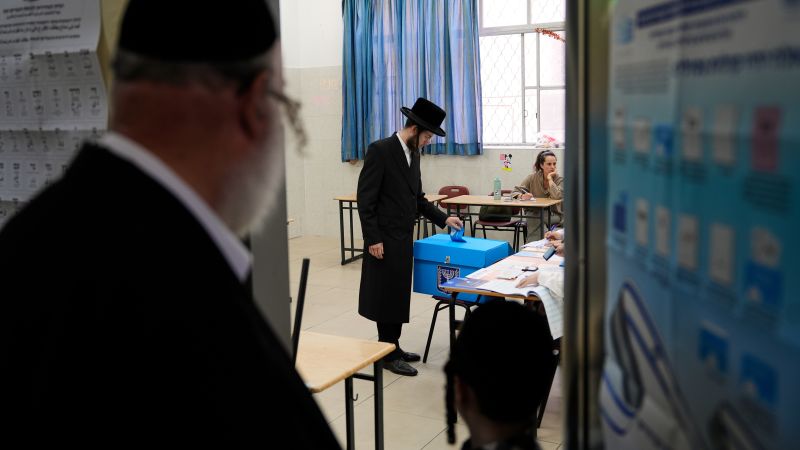
Many other opposition candidates in Israel’s national elections have also already cast their votes.
In total, there are 37 parties running in the election, although most parties will fall below the threshold of votes needed to get into Israel’s parliament. Candidates can continue to campaign throughout the day, in last-minute pushes to turn out the vote.
Former Israeli Prime Minister Naftali Bennett, leader of the temporarily named Bennett 2026 party, said that it’s “a fateful day for the future of our country” as he dropped his ballot in the box. Bennett voted in the city of Ra’anana, Israel.
The leader of the Democrats party, Yair Golan, cast his ballot in the city of Rosh Haayin, Israel. “A morning of great hope. In this morning, we begin the journey of rebuilding Israel (to be) better – better for its citizens, better for its prosperity and its renewed success,” Golan said as he voted
Meanwhile in Tel Aviv, opposition leader Yair Lapid voted alongside his wife.
Former Israeli Defence Minister and leader of the Yisrael Beiteinu party, Avignon Lieberman, voted in the village of Nokdim, in the occupied West Bank. Calling on everyone to “come out and vote,” Lieberman said, “I am confident that tomorrow we will wake up to a new morning, one in which we can form a Zionist coalition.”
Israelis vote for party lists, not individual candidates. In a society divided by nationality, religion, ethnicity and ideology, that produces a crowded field. There are 36 parties in play.
Dozens of lists register each cycle, but only those that pass a 3.25% vote threshold win seats and enter the 120-seat Knesset, Israel’s parliament.
Polls suggest 11 to 13 parties will meet the bar; seats are allocated through a proportional representation system.
The two largest parties are Netanyahu’s right-wing Likud and Yashar, a new centrist party led by Gadi Eisenkot, a former military chief of staff who has emerged as his principal challenger.
What do the polls say? The latest Channel 12 opinion poll puts Eisenkot first with 23 seats, ahead of Likud with 21, though other pollsters differ. On the pro-Netanyahu Channel 14, Likud is projected to take 30 seats and Eisenkot about 20.
In head-to-head matchups about who is better suited to be prime minister, Eisenkot has led Netanyahu by a steady margin.
But coming out as the largest party is not enough to win. A prime minister needs 61 seats to form a government, and no party has ever won that majority alone. So, election night usually settles very little. The real contest is the coalition calculus that follows, which can take days, weeks or even months.
As voters across Israel head to the polls, some of the country’s leaders have already cast their ballots and are urging people to do the same.
Gadi Eisenkot, the main challenger to Prime Minister Benjamin Netanyahu in this election and head of the new Yashar party, went to the Gaza periphery to meet Gadi Mozes, one of the Israeli hostages captured during the October 7 attacks and later released by Hamas.
“I promise you that I will do everything to be worthy of your trust. That I will bring unifying leadership. That I will be prime minister of everyone – if you choose me.”
His opponents were also vocal online on Tuesday.
Defense Minister Israel Katz, a longtime Netanyahu ally, framed the election as a choice between a “decisive approach” to Israel’s security – or “a return to the policy of containment and restraint.”
President Isaac Herzog and National Security Minister Itamar Ben-Gvir both posted photos of themselves submitting their paper votes into the ballot box.
“I call on all female and male citizens of the country – we are all equal, this is our day to go, to influence and to vote,” Herzog said in a statement. “Tomorrow, we will all continue here together – we have no other country.”
Opposition candidate and former Israeli military chief of staff Gadi Eisenkot has just voted at a polling station in the coastal city of Herzliya, in the northern part of the Tel Aviv district.
Eisenkot, the main rival to Israeli Prime Minister Benjamin Netanyahu, has spent the rest of the morning visiting other polling locations to greet voters.
“I suggest not to get excited by Netanyahu’s scare tactics. … He does this in every election campaign,” Eisenkot said outside the polling station after casting his ballot.
His new party Yashar – “straight” in Hebrew – is considered centrist, and Eisenkot has primarily campaigned on issues that are domestic and address government accountability.
You can read CNN’s full profile of Eisenkot and his policies here.
In the prominent Israeli settlement of Efrat in the occupied West Bank, voters said they were focused on uniting a country that has grown more fractured and divided over the last four years.
“I hope my children will have a good place to grow up, that there will be brotherhood among us, not just wars,” Elinor Veinglas told CNN. She said she hopes “that we will remember to come together and that will be our foundation here in this country.”
Even so, Veinglas said she would only decide for whom to vote “when I see the ballots.”
Her husband, David Veinglas said he would vote for Prime Minister Benjamin Netanyahu’s rival, Gadi Eisenkot. “I believe whatever comes in the end will be fine,” he told CNN. “I hope for a united government.”
Meanwhile, Haviva, who declined to give her last name, said she prays for “the people of Israel, especially that there will be unity and that they will first find what they have in common between right and left.”
Just south of Jerusalem, Efrat is more ideologically diverse community than settlements deep in the West Bank that are aligned with far-right parties. Israeli settlements are considered illegal under International law by most of the international community and the United Nations.
Zvolon, who also declined to give his last name, said he was voting for far-right Finance Minister Bezalel Smotrich. “The people of Israel were exiled for 2,000 years living among the non-Jews. We had no government. Today we come and vote. I can say it seems my ancestors dreamed of this day,” Zvolon said.
One week before Israel’s Election Day, President Donald Trump finally gave the full-throated endorsement that Prime Minister Benjamin Netanyahu had long sought.
The president called Netanyahu a “Great Warrior Prime Minister” in a post on social media, which he said serves as his “Complete and Total Endorsement of Bibi Netanyahu.”
Trump also hinted at a possible resumption of hostilities in the unpopular war with Iran — a war the US launched alongside Israel eight months ago — saying that if the Iranians do not “change their ways, rapidly, we will soon finish the job.”
Netanyahu was quick to respond, thanking Trump for the “tremendous support and the joint work.”
Trump told Axios journalist and CNN Global Affairs analyst Barak Ravid in a brief phone interview that he had always intended to endorse Netanyahu. “I was always going to do that. I just didn’t want to do it too soon,” he said.
Trump added that they have a “good relationship” and would “continue to do well” together if Netanyahu is reelected, according to Ravid.
“It is important that Israel has a person they can count on,” Trump said.
It was an endorsement that seemed uncertain until it finally arrived and cannot mask what has become at times a rocky relationship between the two.
Read the full analysis here.
As soon as polling stations close at 10 p.m. local time, Israel’s main TV stations publish their exit polls. The projections trigger an explosion of chatter and conjecture, as pundits and voters alike digest the results.
Thirty years ago, exit polls pointed to a close result but, still, the winner looked clear.
Liberals and leftists who had work the next day, and could not afford to keep watching through the night, switched off their TVs comfortable their man, Shimon Peres, had won.
But overnight, as votes were counted, and exit pollsters adjusted their projections, the tide started to turn in favour of Peres’s opponent. It does not always change like that, but in 1996 it did.
And the longer the night went on, the more the tide turned.
For the Israeli left, it meant the most appalling shock when they switched their TVs and radios back on in the morning to get the news.
Likud was back in office under their new, young, leader.
“What just happened” they asked themselves. “We went to bed with Peres, we woke up with Netanyahu!”
Israel’s election is set to be a test of Prime Minister Benjamin Netanyahu’s leadership and of his ability to form a coalition, a professor on Israel studies told CNN.
“The key to his political longevity is that he is the master of coalition making and putting together a coalition, which can be a very complicated process. He’s shown time and again, even when he’s actually not received the largest number of seats in the parliament, he’s still been able to end up as prime minister,” said Dov Waxman, director of the UCLA Y&S Nazarian Center for Israel Studies.
For many voters, the election is a chance to make a decision who should lead the country in conflict and demand accountability over October 7 security and intelligence failures
“Although this is in many ways a referendum on Netanyahu’s leadership, Israelis aren’t actually voting for or against Netanyahu or for his main rival,” Waxman told CNN’s Elex Michaelson.
Benjamin Netanyahu has already secured his record in Israeli political history: He is the longest-serving prime minister, notching up roughly 19 years across three periods in office.
In 2019, he surpassed David Ben Gurion, Israel’s founding prime minister, who was in office 13 years and 127 days.
Netanyahu, now 77, was 46 when he first became prime minister in 1996. He held the post for three years before losing power and spending a decade out of office.
In 2009 he made his first comeback, returning to the premiership for 12 consecutive years. In 2021, Naftali Bennett and Yair Lapid succeeded in assembling an alternative governing coalition, but it collapsed after barely a year. Bennett served for one year and 17 days, and Lapid succeeded him for just 181 days, making them the two shortest-serving prime ministers in Israel’s history.
After a brief period in the opposition, Netanyahu made his second comeback, returning to power in December 2022 for his sixth term. His outgoing government also set a record, becoming the first Israeli government to conclude its full term in almost 40 years.
Netanyahu carries another historic distinction. He is the first sitting Israeli prime minister to stand trial for corruption while in office, a legal saga that has shaped his political alliances over the past decade and increased his reliance on far-right and ultra-Orthodox partners, with whom he formed his last coalition.
As Netanyahu seeks a seventh term, the election is once again a referendum on his leadership, but this time he also bears another historic burden. Netanyahu was the sitting prime minister on October 7, 2023, the date of the deadliest security failure in Israel’s history. He is the only top Israeli official who served that day to remain in office.
This election will determine if Netanyahu extends his record-setting tenure, or if another chapter in Israel’s political history begins.
In the first few hours of voting in Israel’s election, voter turnout is the highest it has been in 45 years, according to the country’s Central Elections Committee.
As of 10 a.m. local time, voter turnout stood at 16.68%, the committee said, higher than the turnout at the same hour four years ago, which was 15.9%. It is the highest voter turnout since 1981, the committee said at a morning press conference.
Ofer Kenig, a research fellow at the Israel Democracy Institute, said it showed that Israelis clearly viewed the elections as a pivotal moment, even as he warned it was still too early to draw broad conclusions.
“I think it’s a sign of enthusiasm, of the perception of many Israelis of very significant elections – very crucial elections,” Kenig told CNN. But he also urged caution, since the turnout wasn’t dramatically higher yet than the previous election.
“Let’s see how it will develop during the day.”
Even so, far-right Finance Minister Bezalel Smotrich tried to use the figure to drive his own voter base. In a post on X, he claimed, “The high voter turnout figure is a result of exceptional turnout rates in the Arab sector and in left-wing strongholds.”
Outside a polling station in the Jerusalem neighborhood of Katamon, signs for a diverse spectrum of parties decorated the street. From the far-right party of Finance Minister Bezalel Smotrich to the left-wing party of Yair Golan, campaign activists pitched voters one last time before they entered the polling place early Tuesday morning.
Video Ad Feedback
Polls open in pivotal Israeli elections
0:34 • Source: CNN
Polls open in pivotal Israeli elections
0:34
Israelis last voted in an election in November 2022 and viewed this as a critical chance to decide the future direction of the country.
“We are a Zionist family who loves the country, and we want as quickly as possible to exercise the right to vote and to feel that we are part of this whole country and are doing good,” Gabi Touboul told CNN.
Shirel, who voted early to avoid the lines said: “We are taking advantage of this day because my daughters came from the corners of the country to make a change, amen!”
At a polling place near the entrance to Jerusalem, signs for Gadi Eisenkot covered fences in the area. As of Tuesday morning, only the far-right Noam party – which polls show is not expected to qualify for the Knesset – also had signs there.
Adam Maayan voted at the polling site early “in order to make a change,” he told CNN.
In Israel, security and accountability are powerful electoral forces after years of war. But opinion polls suggest the cost of living is also a leading concern for many voters — particularly for younger ones.
According to the latest Channel 12 poll, 21% of Israelis rank the economy and the cost of living as their top priority in the election — ahead of ultra-Orthodox conscription with 17%, the October 7, 2023, security failure at 14% and the war with Iran at 10%.
Despite these figures, the economy has not been a central theme in the campaign — until this weekend, when Netanyahu moved it to the top of the agenda. In an interview with Channel 10 focused on the economy, Netanyahu said Israel should prepare for possible international banking sanctions over Israeli settlements in the West Bank by developing “an economy that can circumvent them.” He said cryptocurrency and blockchain are being considered and that he has requested a plan to deal with it.
The Bank of Israel publicly rejected the idea, saying that “cryptocurrencies cannot serve as a means of circumventing sanctions.”
Netanyahu’s main rivals portrayed his proposal as evidence he expects Israel to become more isolated. Opposition candidate Gadi Eisenkot, who mocked the idea as “BibiCoin,” called it a “threat to national security,” accusing Netanyahu of planning to “dismantle the Israeli economy for generations ahead.”
Israeli Prime Minister Benjamin Netanyahu’s principal opponent in Tuesday’s elections is a relative newcomer to politics. Instead, one of his key electoral advantages boils down to a simple truth: He is not Netanyahu.
Gadi Eisenkot, 66, has spent most of his life in the Israeli military, enlisting in the Golani Brigade in 1978 and rising over a 40-year career to become chief of staff from 2015 to 2019, serving under Netanyahu.
He entered politics in 2022 alongside another former chief of staff, Benny Gantz. After the October 7, 2023, Hamas-led attack on Israel, the two joined Netanyahu’s emergency war cabinet. But they left in June 2024, pointing to the absence of a clear post-war strategy.
Eisenkot is the second of nine children and a father of five. His youngest son, Gal, 25, was killed fighting in Gaza two months into the war.
He has placed that singular promise at the heart of his political mission.
You can read more about the opposition’s strongest candidate here.
Voting has begun in one of Israel’s most significant elections in its history.
Voters are facing a familiar question: Should Benjamin Netanyahu, Israel’s longest-serving prime minister, stay in power?
Nearly every recent election has been a referendum on Netanyahu. This time, many Israelis say the choice is more consequential than ever: not only about who will lead the country, but about where it is heading.
It is the first national vote since the Hamas-led attack of October 7, 2023, the deadliest security failure in Israel’s history, and the wars that followed in Gaza, Lebanon and Iran — conflicts that have mobilized much of the country and subsequently deepened Israel’s international isolation.
For many voters, this is the first chance to pass judgment on the leadership that presided over October 7 failures, and decide who should lead the country in conflict and carry the burden of increased military service.
Netanyahu’s outgoing government — the first in decades to conclude a full four-year term — relied on far-right and ultra-Orthodox partners, who pushed Israel in a more nationalist and religious direction than ever before. He became the first sitting Israeli prime minister to stand trial on corruption charges as his government pursued a judicial overhaul aimed at weakening the Supreme Court and other checks on power. The overhaul effort sparked massive protests in 2023.
At stake in Tuesday’s election is whether Israel keeps moving in the nationalistic, conservative and religious direction — or changes course.
The answer might not be clear for weeks, because of the way Israeli coalitions are built. Polls suggest neither Netanyahu’s bloc nor the opposition is likely to win a majority alone, meaning the vote may launch Israel’s next political crisis rather than settle it.
Politics
Raman’s colleagues all opposed her run for mayor. Now some promise ‘full support’

A pie sat waiting as the Los Angeles City Council returned to work last week following Councilmember Nithya Raman’s election as mayor, an outcome all 14 of her council colleagues opposed.
The pie, perched on a table in a room behind council chambers, had one word written on it, in icing, according to two council staffers: Humble.
The dessert was thrown away uneaten, but humble pie was what the council members were eating Tuesday as they congratulated the mayor-elect.
“Full disclosure, you know that I didn’t support you last week,” said Councilmember Curren Price. “But you’ve got my full support now.”
A beaming Raman had entered the council chambers flanked by her council staff and campaign aides, along with a new security detail befitting her higher profile. A bouquet of flowers, an official proclamation and a (brief) standing ovation by her council colleagues followed later in the morning.
Raman listened attentively as, one by one, council members sitting around the horseshoe offered their olive branches. Then she bestowed one of her own.
“We are all here because we love L.A. and want to make it better,” Raman said. “That passion sometimes makes us get spicy about the differences we have on how we get there.”
“I am here to be spicy with you and to get through it and to find the outcome that works for all of us,” she said.
Not only had Raman’s council colleagues opposed her in favor of incumbent Mayor Karen Bass, but several of them had grown increasingly hostile toward her as the campaign wore on.
Councilmember Imelda Padilla called her stint on the Raman-chaired Housing and Homelessness Committee “unproductive.” Councilmember Monica Rodriguez said Raman’s last-minute decision to challenge her former ally Bass was “disgusting” and “backstabbing.” And Councilmember Traci Park questioned whether Raman “stands for anything at all.”
Park didn’t endorse Bass, but said she would vote for her. Every other member of the council — including Raman’s fellow members of Democratic Socialists of America Eunisses Hernandez, Ysabel Jurado and Hugo Soto-Martínez — were solidly behind Bass.
But the energy in chambers Tuesday was of forced celebration as council members congratulated Raman and said they looked forward to working with her on issues where they had alignment.
Even Padilla and Rodriguez offered tempered congratulations to the mayor-elect.
“Where we align we will work together and where we don’t I will be fiercely opposing,” Rodriguez said.
Sara Sadhwani, a professor of politics at Pomona College, said the peace offerings weren’t a surprise.
“The council members will need the mayor. She’s the person who approves the budget and can spotlight their priorities,” Sadhwani said. “Politicians are rational actors, so they are making a calculated pivot to play nice. Let’s see how long it lasts.”
Mike Bonin, a progressive former council member who now runs the Pat Brown Institute of Public Affairs at Cal State Los Angeles, said he believes that the council tension has been overstated and that the current drama is nothing compared with when three council members and a high-level labor leader were heard on secretly recorded audio having a conversation that featured racist and derogatory remarks.
“Nithya will probably start with greater headwinds than other mayors. Usually mayors get a bigger honeymoon. But most council members want to get [stuff] done for their districts. You don’t want in most cases to have a combative relationship with the mayor,” he said.
As Raman ascends to mayor, the City Council must address other questions as well. One is whether Marqueece Harris-Dawson will maintain his position as council president.
Harris-Dawson and Raman clashed during the campaign when he removed her as chair of the Housing and Homelessness Committee, which she said was political retaliation for her decision to challenge Bass. Harris-Dawson said the move was not political.
Harris-Dawson, despite endorsing Bass and being the mayor’s closest ally on the council, has said he plans to remain in the role of council president, though rumors have circulated about other council members potentially being interested in the job.
Harris-Dawson has taken meetings with Raman over the last week and spoken positively about the mayor-elect since her win, and the two jointly addressed reporters during council Tuesday.
“That campaign was nine months. We’ve worked together for six years,” Harris-Dawson said. “I don’t have any doubt and I don’t think she has any doubt that we’re going to be able to work together.”
The council also has to decide how to fill Raman’s seat when she vacates her position after being sworn in next month. Harris-Dawson said that probably won’t be decided until after the council’s winter recess.
Politics
Gov Wes Moore’s combat claims in Afghanistan disputed by ex-supervisor

Maryland Democratic Gov. Wes Moore, widely believed to be considering a presidential run in 2028, is facing renewed scrutiny over his resume — this time from his former Army supervisor who is questioning the governor’s claim that he led soldiers in combat.
In an investigative deep dive into Moore’s military service, The Baltimore Sun spoke with a retired Army Lt. Col. James A. “Jamie” Gottschling, who served with Moore in Afghanistan in 2005 and 2006. What Gottschling described was Moore’s patriotic service and dutiful fulfillment of his role, but exaggerations — and in some cases falsehoods — about incidents that occurred overseas.
Moore’s team said that “partisan politics got in the way” and led to Gottschling’s latest assessment, where he told Fox News Digital: “I wouldn’t call him a soldier.”
Fox News Digital spoke with Gottschling on Monday.
WES MOORE PREEMPTIVELY UNLOADS ON BALTIMORE SUN AHEAD OF EXPOSE, AS SPOX BEEFS WITH ‘RIGHT WING’ OWNERSHIP
He said in the interview that while Moore would occasionally leave the base, the governor never saw combat. Gottschling said he would describe Moore and himself as “combat veterans” who are “not veterans of combat.”
“When you think of a veteran of combat, you think somebody that’s in a foxhole, getting shot at, IED blowing up the convoy, or even more dramatically, when you think about World War II movies, Easy Company, or any of those things where it’s like, those guys are getting shot,” Gottschling said. “That just wasn’t the environment that he was in.”
“He starts talking about, you know, in his TED Talk and really struggling with reintegration into the civilian world after the deployment, I’m like, ‘what is he talking about?’ You know, he spent six months over there, basically in, you know, a forward base that pretty much is as safe as anywhere. You’d probably be at more risk going to an ER in any of the cities in the United States than you would be in Afghanistan, in Salerno.”
Moore is widely considered a contender for the 2028 Democratic Party nominee for president.
“I just think it’s disingenuous to really associate with the struggle. I mean you can have some empathy for people that might struggle with the transition, but when you come over there pretty much dip into a combat zone situation, work on the staff for six months and then come out you know saying that, you know, all this trauma that you had … and it’s like, oh, give me a break,” Gottschling told Fox News Digital.
“So I think it’s just him emotionalizing and capitalizing on what soldiers do. And he’s not a soldier,” he continued.
“He was in the Army as a reservist in a staff position in Iraq, but I wouldn’t call him a soldier.”
The Baltimore Sun report describes Gottschling, who then held the rank of major, as the “Army officer who supervised Moore daily” in Afghanistan. Moore has framed himself as a paratrooper in the famed 82nd Airborne Division who led troops into battle during his deployment overseas.
Moore worked on information operations coordination while the pair were stationed together at Forward Operating Base Salerno in the Khost Province near Afghanistan’s border with Pakistan. According to The Baltimore Sun, Moore’s job was “analyzing reports from infantry battalions and provincial reconstruction teams, coordinating for civilian assistance and helping Afghan officials communicate with the public.”
Central to Moore’s personal narrative is that he led troops into combat in Afghanistan. He said that on multiple occasions on X while he was campaigning for Maryland’s governorship.
WES MOORE WARNS DHS FEDERAL OCCUPATION OF NEW ICE COMPOUND NOW UNDER STATE INVESTIGATION
“I’ve seen real patriotism when I led paratroopers in combat in Afghanistan and I’ve seen it in my own family,” he said in a Nov. 6, 2022 post, just two days before he was elected governor.
“Service has defined my life, starting when I joined the Army when I was 17, through leading soldiers in combat with the 82nd Airborne in Afghanistan, to today,” he said in a post earlier that year.
In his book, “The Work,” Moore describes being shot at.
“As a soldier, you never forget the first time you were shot at,” he wrote in the book. “A sudden, stunning commotion engulfs you—the sound of shells buzzing past your ears, a flurry of divots leaping out of the earth around your feet—but then your training kicks in,” the book says.
“Moments before those first shots came at me, I was convinced I was prepared for the experience,” the book continues.
MARYLAND’S LONE CONGRESSIONAL REPUBLICAN BLASTS MOORE’S REDISTRICTING PUSH AS ALLEGED 2028 WHITE HOUSE PLAY
Moore, who is widely considered a contender for the Democratic nominee for president in 2028, reaffirmed that that passage from his book was true during a July interview with CNN, again claiming that he “led soldiers in combat.”
Gottschling also contests the extent to which Moore led other soldiers. In “The Work,” Moore described fellow soldiers as “my paratroopers” and rejects Moore’s framing that he was ever “leading” troops in combat.
In a statement to Fox News Digital, Moore’s senior press secretary described Gottschling’s motives as political.
“Five days after Marylanders re-elected Governor Moore in a historic landslide, Sinclair is back to swiftboating a veteran by recycling the exact same stories and interviews they already ran months ago,” Ammar Moussa said. “Twenty years ago, before partisan politics got in the way, Lt. Col. Jamie Gottschling signed an official Army evaluation declaring Wes Moore a ‘top 1% officer’ and ‘the best lieutenant I’ve encountered during Operation Enduring Freedom.'”
Gottschling addressed that evaluation with The Baltimore Sun.
“There’s a lot of embellishment with that, but that’s just how the system was,” he told the outlet. “You’re not trying to be deceitful about it, but you want to elevate what they did (your soldiers) … so they can get their next job or next promotion.”
“Now, a longtime Donald Trump donor who has openly stated his goal is to stop Governor Moore from being in contention for the presidency is working with Sinclair to contradict his own signed military records,” Moussa continued. “Governor Moore’s service in Afghanistan—including earning the Combat Action Badge and coming under rocket fire alongside fellow service members—has been independently verified by official Army records and The Baltimore Banner, which interviewed fellow service members, and no partisan swiftboat campaign will change the facts.”
The Combat Action Badge is also addressed in The Baltimore Sun’s story. The story describes it as a “minor indirect rocket attack” where nobody was injured.
Moussa, citing a report in the Baltimore Banner, said a Marine named Anthony Del Signore who was attached to Moore’s unit said that their convoy “took some shots” at least once.
A New York Times exposé found in 2024 that Moore for years claimed to be the recipient of a Bronze Star when he had not been awarded one at the time. He included the Bronze Star claim on his resumé when applying for a White House fellowship in 2006. In 2024, he received the award after then-Sen. Laphonza Butler, D-Calif., urged the Army to give him one.
In a story published in July on the topic of Moore’s military service, Gottschling said he doesn’t want Moore to be president. At that time, Moore was running for reelection as governor.
CLICK HERE TO DOWNLOAD THE FOX NEWS APP
“I care about my faith and country. I do not really care whether Moore is elected governor of Maryland, but I do care if he is in contention for the presidency,” he said. “I could not live with myself if I was not vocal about the truth.”
Gottschling made it clear that he wasn’t putting down Moore’s service, which he called exemplary, but took issue with what Moore said about his service after he came home and elevated his political profile.
Gottschling called Moore a “valued staff officer” and said he “appreciated every minute” of the work he did.
“I think there’s nothing wrong with that, if it ended there, that would be it,” Gottschling said. “But it didn’t end there. The embellishment, the aggrandizing of his actions over there that didn’t take place is the problem that I have. I’m a pursuer of the truth, you know, and I want to tell the truth.”
Politics
UFC’s Dana White says no to joking press secretary offer from Trump
At a Nov. 9 White House news conference with President Donald Trump, Ultimate Fighting Championship CEO Dana White turned down Trump’s joking offer to become White House press secretary, saying he did not “want to be in politics.”
“The last 24 hours of my life have been insane,” White said.
Trump announced that he had offered the job to White in a Nov. 7 Truth Social post but said a day later that he was “only kidding” about the offer.
“We were having a very bad press day,” Trump told reporters on Nov. 9. “I said ‘I think I’m going to get Dana White to be our next press secretary.'” The president added that he thought White would be “fantastic” in the role.
White told reporters in London that he was flying to Washington, DC, to meet with Trump on Nov. 7, the same day Trump announced on a Truth Social post. White posted a photo of himself at the White House podium following the post but quickly returned to promoting UFC fights.
The UFC CEO is a longtime friend of Trump and has hosted him at fights over the years, including UFC’s Freedom 250 event on the White House lawn in June to celebrate the president’s birthday. He introduced the president at a rally in Las Vegas in August and previously spoke at the 2016 and 2024 Republican National Conventions, introducing Trump at the latter.
White’s appearance comes in the wake of Republican losses in the midterm elections and Trump’s low approval ratings.
The White House press secretary role has been open since Katie Zacharia left after only five days on the job in October. Zacharia followed Karoline Leavitt, who left the role in August after the birth of her second child.
Contributing: Emily R. Condon and Jesse Yomtov, USA TODAY; Reuters
Politics
The Biggest Loser on Election Day: Stephen Miller

President Donald Trump has plenty of lessons he could take from the results of the 2026 midterm elections, but one might top the list: Stop mass deportations, now. Two years ago, the president ran on tightening up America’s immigration system, and voters overwhelmingly bought the message he was selling, so much so that he won over key voting blocs like young men and Hispanic people in margins the GOP had never experienced before. But in the two years since, voters have been watching Trump’s immigration promises turn into a cruel law-enforcement scheme that has killed U.S. citizens and set off a violent detention and deportation operation. Last week, millions of Americans indicated they had seen enough and chose Democrats over Republicans to represent them in what can only be interpreted as a full-scale repudiation of Trump’s—and his newly promoted chief of staff Stephen Miller’s—mass deportation agenda.
“We’re going to have the largest deportation in the history of our country,” Trump proudly announced while campaigning for president two years ago, against the backdrop of his Los Angeles golf club. “And we’re going to start with Springfield [Ohio] and Aurora [Colorado].” It was around this time that he also unleashed a bizarre and racist attack on Haitian immigrants, many of whom live in Springfield, Ohio, who he claimed were “eating the dogs” and “eating the cats.” He also exaggerated claims that Aurora was suffering from Venezuelan gangs whose members were “destroying our country.”
The sentiment behind these at times grotesque claims resonated with many voters who said they were tired of watching the Biden administration simply give in to the mass migration hitting the U.S. southern border. Trump’s hard-on-immigration stance led to massive swings from a more racially and ethnically diverse coalition of voters than Trump had earned in 2016 and 2020. Among Hispanic voters, 48 percent voted for Trump in 2024, compared to only 36 percent in 2020. Similar gains were seen among Black voters, as 15 percent voted for Trump in 2024, compared to only 8 percent in 2020. Asian voters also increased their support for Trump, with 40 percent backing him in 2024, compared to 30 percent in 2020.
The president and his anti-immigrant “hatemonger” sidekick Miller wasted no time taking these electoral wins—boosted in large part by the sons and daughters of immigrants—and using them to justify a full-throated assault on America’s immigrant communities. The day of Trump’s inauguration, Customs and Border Patrol shut down its CBP One mobile app, shutting out thousands of people who had been waiting to apply for asylum through the only legal mechanism allowed. Hours later, Trump went on to sign an obscene number of executive orders, including one attempting to strike down birthright citizenship. From there, things would only get exponentially worse—and deadly.
Shortly after the inauguration, the Trump administration would begin what can only be described as a national manhunt for Black and brown immigrants. In one of its most egregious acts of cruelty, the administration targeted over 200 Hispanic men with tattoos, claiming they were gang members, then went on to expel them to the world’s largest prison camp in El Salvador—violating a federal judge’s order. “We lived through hell,” one prisoner said to describe his four month stay at CECOT. Further showcasing the administration’s cruel intentions, when a Department of Justice lawyer admitted they had mistakenly deported Kilmar Abrego Garcia on one of those El Salvador flights, they fought tooth and nail for over a year to keep him locked up, taking his case all the way to the Supreme Court and filing a dubious indictment against him.
Soon, Immigration and Customs Enforcement agents descended upon Democrat-led cities, followed by National Guard troops, leading to mass arrests and protests. In California, ICE agents targeted farmworkers, many of whom had been living in the U.S. for decades and had no criminal records. During one raid of a local car wash, federal agents tackled the 79-year-old owner, breaking several of his ribs, injuring his elbows, and causing a traumatic brain injury. It turned out that he was a U.S. citizen.
In Chicago, a raid was executed on an apartment building where adults and children were yanked from their beds in a military-style attack in the middle of the night. Tenants said agents were arresting everyone, regardless of their citizenship status. “Federal agents reporting to [now former] Secretary Noem have spent weeks snatching up families, scaring law-abiding residents, violating due-process rights, and even detaining U.S. citizens. They fail to focus on violent criminals and instead create panic in our communities,” Illinois Gov. JB Pritzker said at the time. Soon it was public knowledge that Miller had tasked federal agents with arresting 3,000 immigrants a day, leading to pure lawlessness, including bogus indictments and near-deadly shootings.
No one will ever forget what ICE then did to Minneapolis. Agents killed not one, but two U.S. citizens in the span of a month while terrorizing the entire community. To this day, the Trump administration has refused to accept accountability for the deaths of Renee Good and Alex Pretti, instead taking part in more killings, like those in Texas and Maine this past summer. This behavior created a systemic culture of fear among America’s immigrant communities, many of whom were keeping their children home from school in fear of ICE targeting them during school dropoff or pickup. Others simply stopped showing up to work after ICE began conducting workplace raids, upending industries that rely heavily on immigrant labor.
The list of the Trump administration’s lawless immigration policies goes on and on. Not only has it been weaponizing federal agents, its Justice Department has been finding novel ways to undermine America’s immigration laws. If they could not forcibly remove Black and brown immigrants who had been here lawfully and peacefully for decades, they were happy to eliminate legal protections allowing them to live and work here through ending temporary protected status and enforcing mandatory detention.
The very voters who in 2024 swung decisively toward Trump have spent the last year and half with targets on their backs. A UCLA analysis found that Latinos accounted for 9 out of 10 ICE arrests during the first six months of 2025, and the number of arrests rose drastically after Miller announced his arrest quota. Texas, Florida, California, Georgia, and Virginia experienced the highest volume of immigration enforcement in the country, and on Election Day, voters in all of these states pushed back.
In Florida, Republican Rep. María Elvira Salazar tried to warn the president, filming a campaign ad that called Trump out directly. “Mr. President, some of your immigration enforcement efforts have gone too far,” she said. “The same Hispanics who helped you get to the White House in 2024 feel betrayed today.” Last week, Salazar held on to her seat by less than a percentage point.
Texas was not as kind to the president. In Webb and Hidalgo counties, which hold Hispanic majorities, voters overwhelmingly cast their ballots for Democrat James Talarico for Senate—by roughly 50 points. And in a closely watched race down in the Rio Grande Valley, Democrat Bobby Pulido pulled off a decisive win with 62 percent of the vote over incumbent Republican Rep. Monica De La Cruz, in a district that Trump carried by 18 percentage points in 2024. Not to mention that Texas voters elected the state’s first-ever Latina governor, ousting Republican Greg Abbott, who has served in that role since 2015 and has been happily having Texas law enforcement cooperate with Trump’s ICE crackdowns.
Similar scenes played out in California, where roughly three-quarters of Latino voters voted for Democrats in the House, a 29-percentage-point shift from 2024. That includes California’s 22nd Congressional District, where Latinos make up 64 percent of the population. Here, progressive Democrat Randy Villegas ousted six-term incumbent Republican Rep. David Valadao. In Kansas, Hispanic-majority counties Finney and Seward shifted roughly 50 percentage points to Democrats, while Arizona, Colorado, New Mexico, and Pennsylvania also saw sizable shifts toward Democrats in their Latino populations that in 2024 had swung to Republicans.
These results should not be shocking to anyone, as the writing was on the wall heading into Election Day. Poll after poll indicated Republicans were beginning to lose support on immigration while Democrats were beginning to gain ground on the issue. ICE has been ramping up its immigration enforcement so aggressively, with upward of 40,000 people arrested per month, that at this point there are plenty of Americans who personally know someone impacted by the president’s deportation agenda. And even those who don’t watched the clips of immigrants being violently thrown to the ground, shot in their cars at point-blank range, and having children torn from their family members—horrifying images no voter would want their elected officials to be associated with.
And yet, President Trump doesn’t seem to get it—or simply doesn’t care. Less than one week after Republicans suffered debilitating losses at the polls, he announced Miller would be promoted to being his new chief of staff. The man whose rise in politics was largely fueled by racist, xenophobic beliefs is now being given the green light to not just continue his punitive immigration policies, but to lean into his anti-immigrant fervor even more.
Meanwhile, Democrats, with their newly minted majorities in the House and Senate, have a mandate to make serious changes to the Trump administration’s immigration agenda. They can seek to use Congress’ power of the purse to defund ICE and force guardrails on agents, including penalties for those who recklessly violate federal law. They can also initiate investigations, ensuring Americans get to see exactly how Miller’s inhumane policies are hurting people.
Voters did their part; now we wait and see if the newly elected members of Congress will do theirs.
Politics
After Democrats won in the midterms, the party plans future : NPR

Two years ago, voters sent Democrats a message when they ousted them from power in Washington. At first glance, last week’s midterm results sent a new one.
Democrats will enter the next Congress with one of the largest majorities in a generation, flipping dozens of House districts and at least seven Senate seats in mainly Trump-won communities. The party now controls a majority of governorships, and gained control of several additional state legislative chambers.
“I think one of the big surprises for me on Tuesday night was just how deep and wide our election results were,” Democratic National Committee Chairman Ken Martin said in an interview with NPR. “This was the biggest election cycle for Democrats in the history of our party.”
Martin, who has faced criticism from some inside the party throughout his term as chairman, said that the stunning Democratic victories across the country were the result of his party’s focus on issues like affordability and ending the war in Iran.
He said the midterms were bigger than politics and bigger than party, and acknowledged the results were just as much about serving as a “massive repudiation of Donald Trump and the MAGA Trumpers and the Republican Party.” “I think it’s an admonition for Democrats, for sure: Now that we’re in power, we have to deliver,” he said. “But it was a complete message to Republicans. You had the ability to help us and you did nothing.”
Blue tsunami in the South
With an expanded Congressional majority and a lame duck president, one of the frontlines for figuring out if the Democratic party’s power will hold will be in the South, Martin said.
“Six of the 10 fastest growing parts of the country right now are below the Mason-Dixon line, and 40% of the U.S. population is going to live in the South after the next Census,” he said. “As we go into 2032 and there’s a realignment with the reapportionment, states like Minnesota, Michigan, Wisconsin, Pennsylvania, New York, Rhode Island, Illinois and California are all going to lose electoral votes and congressional votes to the South.”
Last week’s midterms brought the region’s power – especially with Black voters – more squarely into focus. Turbocharged Black voter turnout helped elect the country’s first Black female governor in Georgia and may elect the first Black U.S. Senator from Mississippi since Reconstruction.
A slew of Republican-led states seeking to redraw House maps for partisan advantage backfired, as Democrats gained several seats across the region.
Georgia Democratic Sen. Raphael Warnock said in an interview with NPR that Democratic victories in 2026 were a “proof of concept” that the South is central to the future of American politics.
“You saw a multiracial coalition of voters stand up on Tuesday night beyond anything I had even hoped for, and they offered a silent rebuke of where we are now,” he told NPR. “It’s now up to us to provide the leadership, even as we listen to people, and point the way forward into how we build an economy that works for everyday working families.”
Warnock said Democrats’ direction in the next two years should aim to serve as a cure for the last decade of Trump-dominated politics that has been defined more as top versus bottom rather than left versus right.
“Ordinary people have had their hopes dashed time and time again, cycle after cycle, across Republican and Democratic administrations,” he said. “They’ve seen the widening chasm between the haves and the have nots.”
He called the midterms a “moral moment” that will help determine what kind of nation America wants to be.
Looking ahead to 2028
In the early days after the 2026 elections, a look ahead to the 2028 presidential race finds both parties with the potential to see crowded fields of candidates in several new lanes reacting to signals sent by the electorate.
That includes Warnock, who will be up for reelection in 2028 and is among names floated as a presidential contender, along with former Transportation Secretary Pete Buttigieg, California Rep. Ro Khanna, Illinois Gov. JB Pritzker, Kentucky Gov. Andy Beshear, former Vice President Kamala Harris and others who have spent significant time in the South campaigning for other Democrats.
As new members of Congress descend on Washington for their orientations, competing visions for Democratic governance are on display with postmortem event panels called “What Worked” and “What Just Happened?” and event names like “What’s Next” as party strategists argue online about which wing of the party was the most successful.
2026 victories also scramble the traditional map of swing states, Martin said, suggesting that Democrats would start off competitive in places like Florida and Texas and as favorites to win the White House.
“Texas is no longer a red state. It is a blue state. They didn’t even go from red to purple to blue, which is a normal sort of progression,” he said. “If Texas is now a blue state, and you look at Georgia and you look at other parts of the South, how do the Republicans get to 270 votes?”


Hegseth Impeachment Effort Blocked in Key House Vote
House GOP leaders successfully killed a push to impeach Defense Secretary Pete Hegseth in a surprising show of unity from...


Trump’s private 2021 letter to Biden revealed in upcoming memoir
In his forthcoming book, former President Joe Biden discloses the contents of a 2021 letter written by President Donald Trump...


Scott Colom says tight Mississippi Senate race is almost over
Democratic Mississippi Senate Candidate Scott Colom tells CNN's Jake Tapper and Annie Grayer when he thinks his race will be...


Conveyor belt of storms unloads on Pacific Northwest
The north Pacific is cranking out one storm after another, sending relentless rain and snow into Alaska, British Columbia and...


Hegseth survives, but Dems say more impeachments could follow
House Republicans narrowly blocked an effort to impeach Defense Secretary Pete Hegseth, voting 211-204 to defeat the …


Man who admitted to dismembering wife remains emotionless as guilty verdict is read
A jury found Virginia man Naresh Bhatt guilty of first-degree murder Tuesday, rejecting his claim on the stand that his...


‘Mike Hammer,’ ‘Fat City’ Star Was 85
Stacy Keach, a commanding actor whose work includes movies like “Fat City” and the starring role in “The New Mike...


Shopping sucks. Blame your feed.
Shopping used to be fun. Now it's all microtrends and algorithm-approved outfits. Audie Cornish, Ari Shapiro, and Amy Odell …


California voters reject billionaire tax
Voters in California have rejected a measure to impose a one-time 5% wealth tax on residents with net worth over...


House GOP blocks Hegseth impeachment effort
The House voted to refer the measure to a committee, effectively killing the resolution to impeach Defense Secretary Pete Hegseth...
-

 Entertainment2 weeks ago
‘Baywatch’ Star Erika Eleniak on Track to Hit $1 Million in 1st Year on OnlyFans
-
HealthNews2 weeks ago
The Most Powerful Obesity Drug Yet Has a Hidden Benefit-and It Happens While You Sleep
-

 Business2 weeks ago
Dollar General overcharged millions at checkout for years, FTC and 20 states allege
-

 Business2 weeks ago
In China, the AI bubble has already burst
-

 Entertainment2 weeks ago
Inside Matthew Perry’s ‘struggle’ ahead of the 2021 ‘Friends’ reunion
-
Entertainment2 weeks ago
I’m a Bus Driver at Walt Disney World at 51 Years Old; Great Benefits
-

 Entertainment2 weeks ago
Taylor Swift, Travis Kelce wedding props deemed too expensive, dangerous revealed
-

 HealthNews2 weeks ago
Your Blood Pressure Could Be Higher Than You Think. These 7 Fruits May Help Bring It Down, Say Experts