
Food
Ilhan Omar makes first public appearance in Minneapolis Somali safe haven

MINNEAPOLIS — It’s the largest Somali mall in the world, according to its owner.
It’s also where Rep. Ilhan Omar, D-Minn., spent a significant chunk of her Friday — marking her first day back in the public eye after the Oct. 12 raid on her Washington, D.C., home.
Fox News Digital got a look inside the Karmel Mall of Somalia, which isn’t like typical American malls that sport brand-name shops situated around a vast food court and end-capped by large department stores.
Rather, the building that boasts four floors of shops and 900 vendors resembles more of a storage facility. When shop owners arrive, they lift their metal garage doors, signifying that their stores are open. Scheduled opening and closing times don’t appear particularly stringent for shop owners.
SOMALIS IN MINNESOTA UNLEASH FURY ON TRUMP AFTER FEDS RAID ILHAN OMAR’S DC HOME
It was in the mall’s dining area, adorned with the Somali, Palestinian and American flags flying at the same height, that Omar dined among friends in the Somali community for lunch on Friday. State Attorney General Keith Ellison was also present. The ceiling of the food vendor area is painted light blue and emblazoned with a white star resembling the Somali flag.
Somali cafes sell traditional food, including sambusas, a flaky fried pastry filled with meat and spices, bijaye, which is fried cornmeal similar to a hush puppy or falafel, and goat meat and basmati rice. Many Somalis in the mall ate only with their hands, though Omar and her acquaintances could be seen using forks during their Friday lunch.
ILHAN OMAR ISSUES STUNNING ADMISSION WHEN CONFRONTED WITH BROTHER MARRIAGE RUMORS
Omar — who’s “real name” is Ilhan Nur Said Elmi, according to sources familiar with the criminal investigation into the congresswoman — was greeted by smiling patrons at the mall, some of whom she chatted with briefly and posed for photographs.
All the while, she and Ellison were surrounded by security guards.
Fox News Digital was allowed access into the mall by its Gaza-born owner, Basim Sabri, in order to film the congresswoman’s visit just after she and Ellison voted early at a Minneapolis polling station.
ILHAN OMAR’S TURBULENT WEEK EXPLAINED: THE DUELING PROBES THAT THREW THE SOMALI-BORN PROGRESSIVE INTO CHAOS
Prominently featured among the stores in the mall are shops selling prepaid electronic SIM cards for overseas calling and money transfer stores, including World Direct Link Corp., which advertises simple ways to send money to Somalia, Kenya and other East African nations.
There are also several travel agencies offering arrangements from the United States to the Middle East and East Africa. Traditional Somali clothiers sell their goods in the mall, while Somali barbers tend to customers in their own shops. English is the mall’s second language.
Elderly men, adorned in traditional Somali clothing and brimless white caps called koofiyad, sit in silence in metal chairs alongside the open walls of the mall, many staring onward, as if lost in thought.
“You are standing at the Karmel Mall, and the surrounding community next to us, and its referred to as [the] Islamic Peace Village by many other people as well,” Sabri told Fox News Digital in an interview outside his mall. “Karmel Mall is the largest Somali mall in the world, and it’s also the largest mall in the city of Minneapolis.”
The largest mall in the United States, the Mall of America, is located in nearby Bloomington, Minnesota.
“It is kind of an incubator setting where many businesses start in here, and then many succeed and grow and move somewhere else, to a bigger space,” said Sabri.
The mall isn’t explicitly for Somalis, though Sabri, a high-profile local figure, once banned Democratic Minneapolis Mayor Jacob Frey from the premises in February 2024 after Frey vetoed an Israel-Gaza ceasefire resolution passed by the City Council.
ILHAN OMAR CALLS TRUMP ‘CREEP’ AS PRESIDENT REVIVES ‘FAKE NAME,’ MARRIAGE ALLEGATIONS
However, there appears to be an implicit understanding that the mall is for Somalis. Outsiders, especially those with cameras, are scrutinized by security guards and mall patrons alike. Sabri told guards to stand down while Fox News Digital walked the mall earlier last week.
Sabri is friends with Omar, and also knew her late father, though he did not share details about the rumored Somali National Army colonel’s life or their relationship.
The congresswoman and Sabri posed for a photo alongside Ellison and a fourth, unidentified man, during the congresswoman’s luncheon. The mall owner and Ellison shared a brief but cordial conversation during the midday affair.
Fox News Digital spoke with Sabri for about an hour outside the mall in two informal interviews last Tuesday, without cameras rolling. He told stories about growing up poor in the Middle East and eventually moving to study in Minneapolis, where he later built a vast real estate empire that includes the mall. Sabri owns several apartment complexes in the vicinity of his Lake Street mall, occupied mostly by Somalis.
During the interviews, Sabri was often interrupted as he directed employees, most Somalis, to tasks which they in turn hustled to accomplish. Members of the Somali community stopped to greet him, including a man described as Rep. Omar’s “security.” Sabri also solicited conversations with passersby, all of whom recognized him.
The jovial character is clearly well-liked by his staff and known throughout the community.
He has the ear of local politicians, too, whom he repeatedly called “whores.” He arranged an interview for Fox News Digital with Minneapolis City Council Vice President Jamal Osman.
Sabri also has an air of worldly sophistication. He sends his son to Institut Le Rosey, known as the “School of Kings,” one of the most elite secondary schools in the world. It is located in Switzerland and has a price tag of about $184,000 per year.
But the mall owner has also faced troubles in the past.
In 2005, Sabri was sentenced to 33 months in federal prison for bribing a local Minneapolis public official. He told Fox News Digital about his time in prison, which included a brief stay at the infamous Federal Correctional Institution, Leavenworth in Kansas, almost boastfully.
Sabri bragged that the siloed Somali mall is evidence of assimilation on behalf of his foreign-born tenants and part of living the “American dream,” though the opposite seemed true.
“You can see [the] Somalis not only integrating in the community, but also prospering,” he said. “Somalis are very smart business individuals.”
“Yes, there’s some crooks in every society … just like every other community,” he said, apparently nodding to the massive fraud scandals that have plagued the Somali community in Minnesota in the national headlines.
“But my experience is that Somalis are very, very intelligent and extremely hard-working people.”
CLICK HERE TO DOWNLOAD THE FOX NEWS APP
“So, I would invite anybody to come into the mall, and know that there are many people doing a great job and making a good living, and learning the American dream, and doing business, and opening businesses that eventually tend to be very successful for them.”
Food
Israeli exit polls suggest no clear winner with Eisenkot’s bloc just ahead of Netanyahu

Optimistic mood inside Eisenkot camp
James Landale
Reporting from Eisenkot’s watch party
There were a lot of cheers as the numbers were read out here. But, like everybody, they are just trying to absorb what that means in the long run.
But the fact that some of their numbers were ahead, it seems they are taking that positively at the moment.
Remember, these are just the exit polls and sometimes these exit polls are incorrect, there are one or two outliers as we have seen.
This is just the start of a process.
I think people here are wise and experience to these elections, knowing that what happens here at the immediate phase of these exit polls doesn’t always result in the outcome that they might want at the end of the day.
But at the moment here, the mood is quite an optimistic one.
Music and dancing at Yashar HQ, but no-one from the party has taken the stage
Tom Bennett
Reporting from Eisenkot’s watch party in Tel Aviv
Here at Gadi Eisenkot’s Yashar Party HQ in Tel Aviv, music is blasting and some of his supporters were dancing, singing and waving Israeli flags as the exit polls were just shown on the big screen.
But no party representatives have yet taken to the stage – and the hall is still half-empty, with lots of floor space in front of the TV crews and journalists from around the world who are here to take in the result.
Eisenkot’s so-called change bloc is projected to be larger than Netanyahu’s bloc, but still well short of a majority.
It is the Arab parties who are the story of the night. They are projected to get around 17 or 18 seats – a record for them.
Exit polls suggest Eisenkot bloc as largest in Israeli parliament but short of majority
The main Israeli broadcast exit polls indicate that challenger Gadi Eisenkot’s bloc has emerged as the largest group in Israel’s election, just ahead of the ruling coalition but well short of a majority.
Prime Minister Netanyahu’s Likud is set to be the biggest single party in the Israeli Parliament, the Knesset.
Arab Israeli parties have emerged with a record number of seats.
Official results will start being published from 22:00 GMT, but an estimated 600,000 absentee ballots – almost all from the military – and around 10% of the total votes, won’t be fully counted until Thursday.
Once all the results are in, and following consultations with all the political factions, Israel’s president then invites the party leader whom he believes has the best chance of success to form a governing coalition.
A process that can take many weeks.
Record voter turnout the story of the day so far
Tom Bennett
Eisenkot’s Yashar Party HQ
The story of election day so far has been the turnout – especially in some Arab-majority cities – which has reached record levels at points throughout the day.
Prime Minister Benjamin Netanyahu has spent much of the day posting on social media that high Arab turnout is an “emergency” and a “matter of life or death” for the Israeli right.
If the Arab vote were to hold it could shrink both the main Jewish blocs – Netanyahu’s and Eisenkot’s – and knock out some of the smaller parties that hoped to pass the electoral threshold of 3.25%.
This would make it very difficult for anyone to form a government without the help or participation of at least one of the Arab party blocs – the United Arab List and the Joint List.
Most of the leading Jewish parties have ruled out working with them, meaning concessions, deals and U-turns may be needed to breach any impasse.
But it’s important to reiterate – until results roll in, it’s all speculation.
If no-one wins this election, how long could Netanyahu stay on?
Raffi Berg
Middle East digital editor
If neither current Prime Minister Benjamin Netanyahu’s bloc nor the opposition wins a majority of seats, Netanyahu will stay on as caretaker PM as attempts are made to form a government.
President Isaac Herzog will nominate the party leader whom he thinks stands the best chance of being able to do this.
This is a process which can take several months. If no candidate can form a government capable of winning the confidence of parliament, fresh elections will be called, and the process repeated.
In theory, this means Netanyahu could continue as caretaker prime minister for months and even years, with most of his powers.
This has actually previously happened: Netanyahu himself holds the record for length of time serving as a caretaker prime minister, for a year and a half between December 2018 and May 2020.
In that period, three indecisive elections were held, until Netanyahu finally formed a unity government with his main political rival.
‘No justification’ to extend voting hours, elections committee says
The Central Elections Committee has decided not to extend voting hours in the Israeli elections.
In a statement, the committee says it met this evening and decided “the current circumstances do not justify an extension”.
It adds the high turnout “reflects strong public engagement in the democratic process” and “no need to extend voting hours was identified”.
Benjamin Netanyahu’s Likud party and several other right wing parties had asked for voting to be extended beyond 22:00 (20:00 GMT).
It came after the Israeli prime minister posted on social media about a reportedly high turnout among Arab voters.
Netanyahu labelled it an “emergency” and a “matter of life or death” for the Israeli right, and called on his supporters to get out and vote.
Who are the major parties?
Likud – The governing right-wing party founded in 1973. Led by PM Benjamin Netanyahu continuously since 2005 and has been in power for all but one year since 2009.
Yashar – Centrist party formed in 2025 by Gadi Eisenkot. The retired Israeli army chief’s son was killed fighting in Gaza. Leader of the anti-Netanyahu “Change bloc”.
Beyachad – Centre-right party formed in April 2026, led by former PM Naftali Bennett. Part of the anti-Netanyahu “Change bloc”.
The Democrats – Left-leaning party founded in 2024, led by former Israeli army deputy chief of staff Yair Golan. Part of the anti-Netanyahu “Change bloc”.
Yisrael Beiteinu – A right-wing secular, nationalist party, founded in 1999. Led by Avigdor Lieberman. Part of the anti-Netanyahu “Change bloc”.
Otzma Yehudit – Far-right nationalist party founded in 2012. Led by National Security Minister, Itamar Ben-Gvir. Willing to join a Netanyahu coalition.
Religious Zionist Party – Far-right nationalist party founded in 2021. Led by Finance Minister Bezalel Smotrich. Willing to join a Netanyahu coalition.
Ultra-Orthodox parties – Shas, founded in 1984, and United Torah Judaism (UTJ), founded in 1992, are the main parties, historically politically allied with Netanyahu. The Haredi Public Party, founded in July 2026, as an alternative to Shas and UTJ, is also running. Willing to join a Netanyahu coalition.
United Arab List – A conservative, Arab-led party with Islamist roots, United Arab List (Ra’am) was founded in 1996. Led by Mansour Abbas. Willing to be part of a non-Netanyahu coalition.
Joint List – An alliance of three mostly Arab parties, led by Yousef Jabareen. Willing to support a non-Netanyahu coalition from outside government.
Security, conscription and judicial reform have all been key issues
Tom Bennett
in Tel Aviv
Security has been the topic dominating campaigning.
Netanyahu’s challengers have all heavily criticised the security failures that led to the 7 October attacks, in which around 1,200 people were killed and 251 others taken back to Gaza as hostages.
Nevertheless, Netanyahu has once again framed himself as “Mr Security”, pointing to strategic victories in Israel’s wars since 2023.
Conscription is also a major topic. Historically, ultra-Orthodox Jewish men in full-time religious study have been exempt from military service, but since war broke out this has become an increasingly divisive policy.
Judicial reform has also featured heavily during the campaign. Netanyahu’s government is still pursuing contentious plans for reforms to the judicial system, which led to mass protests before 7 October.
Critics say the plans would compromise the independence of the judiciary and threaten democracy.
As in many countries, cost of living is another key issue. Food and housing costs have grown steadily in recent years.
What is the Knesset and how are seats allocated?
Israel uses a system of proportional representation to elect political parties its parliament, called the Knesset.
There are 120 seats in the Knesset, which are allocated in direct proportion to the number of votes a party receives nationally. People vote for a single party, not individual candidates.
The party provides a ranked list of its candidates and they are given Knesset seats depending on the party’s final seat total.
A single party has never won enough of the 120 seats to command a majority, which means every government is a coalition of at least two parties.
This gives the smaller parties considerable power to make or break a coalition government.
Food
5 Takeaways From Look At ‘Friends’ Star’s Life & Death

SPOILER ALERT: The following article contains details about Netflix‘s The One About Matthew Perry docuseries.
Let’s be honest, Netflix’s just debuted The One About Matthew Perry is mainly for the hardcore Friends fans. Having said that even the devotees of Rachel, Ross, Monica, Joey, Phoebe and Chandler might be disappointed as there’s not much in this Mary Robertson directed three-part docuseries you haven’t heard before.
Over the approximately three-hour running time, The One About draws on tales of drunken nights, funny faces, and the rise, demands, and bends of fame. There’s interviews with old friends, family members (especially Perry’s younger half-sister and licensed therapist Mia Perry Bowick), NBC Entertainment boss Warren Littlefield, The Whole Nine Yards director and one now ex-U.S. Attorney for the Central District of California. Still, in a rush to get not really anywhere at all, the result is pretty much the officially authorized surface level stuff we all used to get in the 1990s from Behind the Music. Unlike VH1’s sometimes under appreciated Behind the Music, The One About Matthew Perry‘s three-act play of the rise, the fall, and the resurrection never really gains much momentum. The comeback of sorts the third act should promise leaves you feeling at best deceived.
The primary fuel here is the people who love the long time addiction-addled Perry, who drowned at the age of 54 in his West L.A. hot tub on October 28, 2023 after taking a ton of ketamine, clearly loved him a lot, and miss him a lot. Yet, The One About (Friends fans get the nod to the successful sitcom) mainly leans on Perry’s best-selling 2022 Friends, Lovers, and the Big Terrible Thing memoir and its subsequent press tour for its narrative. A decision that, as we know now in hindsight of the book itself, reveals little of the darkness-plagued man behind the Friend, if you know what I mean?
Still, for better and worse, here are some of the highlights of The One About Matthew Perry:
THERE ARE NO FRIENDS: if you are expecting to hear from Jennifer Aniston, Courteney Cox, Matt LeBlanc, Lisa Kudrow or David Schwimmer in The One About Matthew Perry, you are going to be very upset.
While the Friends cast are seen thoughout The One About in behind the scenes footage, clips from the 10-season show, and on press junkets, none of them acquiesced to be interviewed by Robertson. In fact no one from Friends, not the cast, not guest stars, not co-creators Marta Kauffman and David Crane appear in the docuseries. The closest The One About ever gets to the mega-sitcom is one Jeff Strauss, who was a writer/producer on Season 1 of Friends. While Strauss appears to have been close to Perry initially as Friends came together, most of his subsequent observations and remarks about the actor becoming “challenging and problematic” are clearly second-hand at best.
MATTHEW PERRY REALLY WANTED TO BE FAMOUS & THEN REALLY HATED BEING FAMOUS: The son of a journeyman actor and an ex-press secretary to a Canadian PM, Perry was also the stepson of a famous Canadian journalist and later Dateline NBC correspondent. From early days as the class clown to hanging around sets with his father figures and trying to catch a break in early 1990s L.A., Perry, as various pre-fame pals attest in docuseries, wanted to be famous.
When he got there with Friends, on a level barely anyone achieves nowadays, it was overwhelming. To be precise as one can on such occasions, it seems to, from the docuseries and Perry’s own memoir, brought out crippling insecurities, as much as wealth and notoriety. Problem with The One About, unlike Robertson’s much better last Netflix docuseries Quiet on Set: The Dark Side of Kids TV, is that it is mostly examined though the lens of the spiraling booze, drug and emotional problems with little sense of context — which feels as hollow as canned studio audience laughter.
Also, with that Little Richard attributed quote of “if you don’t want your picture taken, don’t become famous” in mind, the openly ambitious Perry himself is rarely held responsible for his own behavior, actions and addiction. It seems from The One About Matthew Perry that Matthew Perry was a ultimately a perpetual victim who, to quote one of his buddies from the series, “didn’t stand much of a chance” — and that’s just hard to buy.
THERE WAS MORE THAN JUST FRIENDS: The stardom and sprawling legacy of Friends, even though it ended nearly 20 years before Perry’s death, seems to have haunted him in both a Hollywood cliche way and a very real disorienting way until the day he died. Spending decades outrunning Chandler Bing, Perry may have never given himself the ability to let go and find success elsewhere, The One About suggests
While praised for short and Emmy-nominated stints on The West Wing, Ally McBeal, and The Good Wife, Perry may have floundered on the big screen but his TV leading roles from 2006 – 2013 displayed untapped talents that never got the time or space to thrive. Looking back from the streaming and revival standpoint of 2026, Perry’s leading roles on Aaron Sorkin’s flawed but prophetic Studio 60 on the Sunset Strip, Mr. Sunshine (which Perry co-created) and Go On all deserve much more attention, Robertson postulates in the second episode of The One About. There’s not a lot to argue with the Emmy winner’s POV on that — if only Robertson had done those later shows and roles justice.
THE ONE ABOUT DOESN’T HAVE A LOT ABOUT PERRY’S DEATH: I was at court hearings and sentencing hearing on Perry’s death right up until this year. Before that, I was on the story of Perry’s death within an hour or so of his body being discovered in late October 2023 by authorities in his Pacific Palisades home. As more details came out, the sad truth of Perry’s relapses and drug hustle emerged. What also emerged was the fast one the actor played on those around him — pronouncing himself clean and sober when he kept going back to using made his death look inevitable.
Like the cast of Friends, you won’t find a lot of that in The One About Mathew Perry – it doesn’t fit the narrative they’ve constructed, true or not.
One can debate the truth and consequence of Perry’s life and death for ages, I grant you as someone who saw a lot of it unfold close up. Yet, playing primarily on the slop side of the Netflix street, the docuseries doesn’t give you much more time than to take a breath before the epilogue begins.
The One About gives Perry’s death, the investigation and convictions of the scummy doctors, personal assistant and the infamous “Ketamine Queen” just around 15 minutes at the end of the third and final episode. In a summary, bad people did some bad things. While that is partially true, you never learn anything more nuanced about it than that — which makes the almost three hours up to that point feel like a psych-out of the viewer and the subjects in the docuseries.
THIS IS WHY PEOPLE SPEND LESS TIME ON NETFLIX: Love it, hate or just eat it, few nowadays are going to tell you fast food is nutritious. Besides a few funny clips from old Friends episodes and some of Perry’s later work, there is nothing good for you or really even memorable about The One About Matthew Perry once you’ve watched all the episodes.
In many ways, the whole series is a juiced up version of Netflix’s recently introduced InstaDocs series and their insta-take on a large event like the OpenAI Hugging Face cyberattack. In another sense, The One About Matthew Perry seems to exist in no small measure to get the streamer’s algorithm to pump you over to more easily digestible programming that you’ll lose interest in fairly quickly.
As a passionate fan of Is It Cake?, don’t expect me to regal you with highbrow or die recommendations. Good escapism is a treat to me, and a tasty one at that the better it is cooked. However, at the same time, if you want to know, Ted and Greg, why Netflix subscribers are spending less time on the service, it is air-filled content like The One About Matthew Perry. Content that is truly much ado about nothing.
As Perry himself is heard saying in The One About: “Reality is an acquired taste.”
Food
Billionaire Palmer Luckey isn’t leaving California over the wealth tax
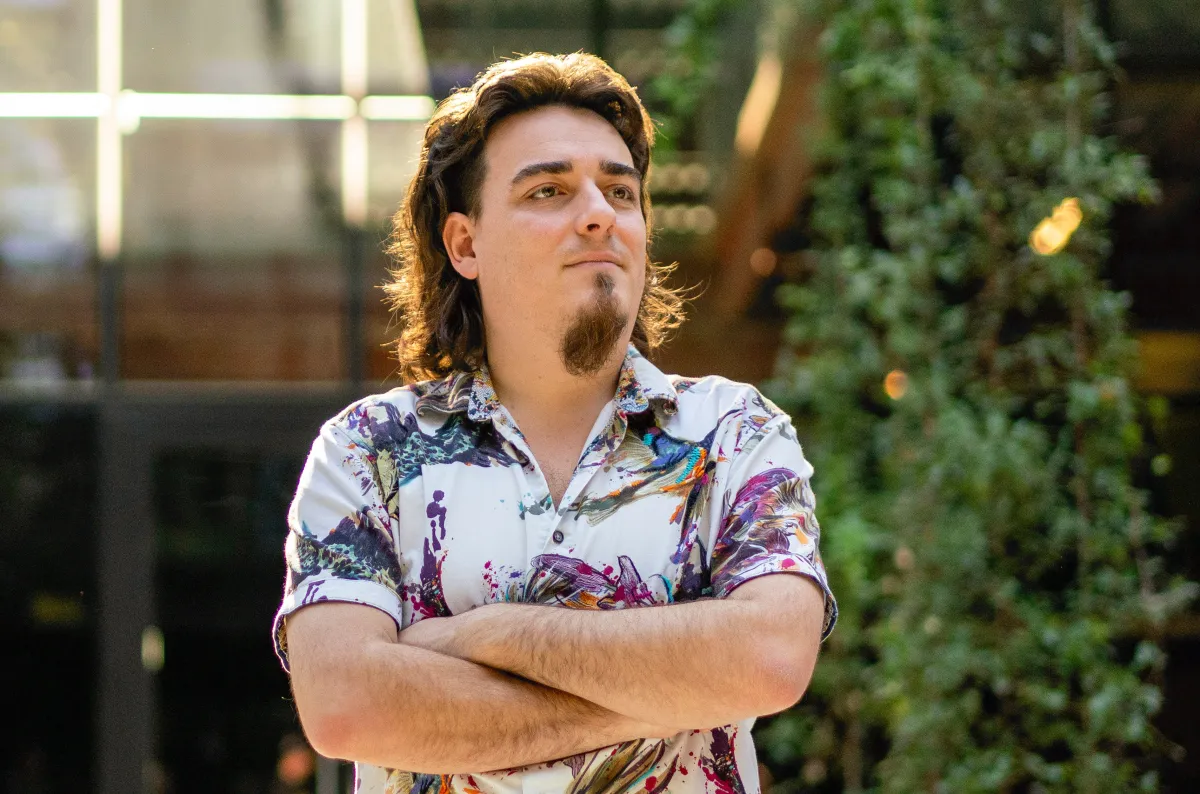
Palmer Luckey has been a California billionaire since he was 21 years old, when he sold his first company, virtual reality headset maker Oculus VR, to Facebook for $2 billion in 2014. His current company, defense tech firm Anduril, is headquartered in Costa Mesa, California, not far from Long Beach, where Luckey grew up. And Anduril is worth far more. It was last valued at $61 billion.
While Luckey clearly despises the proposed California billionaire wealth tax, a ballot measure that would tax the net worth of the state’s richest residents, he said he’s not leaving California over it.
“I think that this tax act, if you can call it a tax, is going to cause a lot of problems. It’s causing a lot of people to run who I don’t want to be running. It’s going to cause companies that I work with to leave the state, which is a problem for me. As of right now, though, I’m not running. I am staying. I think California is something special. I want to fight for California,” Luckey said during an invite-only press conference on Monday.
He added that he’s felt pressure from other billionaires to declare his intention to leave.
“This has been a point of friction between me and some of my other billionaire friends,” he said. “They’ve said things like ‘Palmer, you have to have solidarity for us. You can’t enable these really bad policies. If you stay and if you don’t leave, it’s going to show them that there’s no consequences.’ I empathize with that argument, but it’s not one that I’m going to participate in right now because I still believe that we can fix things.”
Luckey added that it’s not the idea of paying taxes that he takes issue with, but that the bill is sponsored by a specific union, a unit of the United Healthcare Workers, that wants to use the money the tax would raise “for their uses,” he said. The measure’s sponsors say the money will be used for “health care, education, and food assistance” programs in the state, and they specifically name Medi-Cal, California’s health coverage program for low-income residents.
Another issue for Luckey, as for others, is how the proposal would assess the tax owed, as well as the penalties. It would tax “wealth” including unrealized assets that haven’t been sold, and illiquid assets that are hard to turn into cash. And penalties can be assessed as high as 40%.
“It’s almost like a seizure of future wealth in that way. That’s not even the real problem. The biggest problem is the tax on control of your own company,” he said. According to the Tax Foundation, a tax policy think tank, the proposal would treat someone with voting control as owning at least that same share of the company. This would affect founders with super-voting shares, which carry extra votes per share, because they may own only a minority of the company. A founder with 40% of the votes but 10% of the ownership, for example, could be taxed as if they owned at least 40%, and selling all their shares might not cover the bill. (The measure’s drafters say that reading is mistaken, arguing that super-voting shares are publicly traded assets and are valued differently.)
“I’m a founder who’s raised a bunch of money, I’ve diluted myself a lot. I’ve given equity to my employees,” Luckey said of his own situation. “My employees have more equity in Anduril than me. I’ve given a lot of equity out to people, but what I have done is I’ve preserved the voting rights so that as those employees sell their shares to pay off their home loans or whatever, that the voting control doesn’t go to other people outside the company.”
He also said that if he were ever to leave, “I lose all those voting rights. My voting rights only stick as long as I’m an American citizen living in America, running Anduril.” The condition makes sense given that Anduril is primarily a defense contractor selling equipment to the U.S. military.
In Luckey’s case, he believes he could owe 5% of Anduril’s $61 billion, a bill of around $3 billion, just on that asset alone. (For comparison, Larry Page, the Google co-founder who did leave California, still has 27% voting control of Alphabet, Google’s parent company, which has a market value of just under $4 trillion.)
“But I’m planning on staying in California. I’m going to keep fighting it,” he said. “I’m hoping that this doesn’t pass. I’m hoping if it does pass, that there are legal challenges to say, ‘Hey, you can’t post facto seize people’s past and future wealth, nor can you tax their voting interests in their own company.’ That’s truly unprecedented. That is not a tax on ownership. It is a tax on control.”
Food
Ceasefire brokered by Melania Trump goes into effect in Russian-occupied town ‘on the brink of disaster’

A rare humanitarian ceasefire brokered by first lady Melania Trump to save people trapped in a Russian-occupied Ukrainian town went into effect early Tuesday.
After months of warnings from Ukrainian officials about an unraveling humanitarian catastrophe in the front-line town of Oleshky, in the southern Kherson region, the White House announced last week that the first lady had secured a pause in the fighting.
The agreement would “temporarily stop all military action in Oleshky to allow for humanitarian aid to enter and to prepare a civilian evacuation through a designated safe passageway,” it said.
Hours after it began at 3 a.m. local time (9 p.m. ET Monday), the ceasefire appeared to be holding, with the two sides conducting attacks elsewhere but not in Oleshky. Kremlin spokesman Dmitry Peskov said Tuesday there have been no reports of violations so far.
Hours after the truce came into effect, Russian President Vladimir Putin held a phone call with the leaders of Norway and Finland about ending the war in Ukraine — a rare instance of direct talks between the Russian leader and European leaders, whom the Kremlin has accused of prolonging the conflict by supporting Kyiv.
Neither side has indicated when the temporary ceasefire would end.
“An important humanitarian mission has begun in Oleshky. A bilateral ceasefire has been declared in the area where the mission is taking place,” the head of the Ukrainian president’s office, Kyrylo Budanov, said Tuesday in a post on X. The Russian Defense Ministry said in a statement that its forces had ceased firing at the agreed time “in connection with preparations for a humanitarian operation” in Oleshky.
The rare humanitarian agreement comes amid renewed pressure from President Donald Trump on Kyiv to agree to a deal to end the war, which began when Russia invaded Ukraine in February 2022.
Ukraine complained of gaps in intelligence sharing from the U.S. and a slowdown of Elon Musk’s Starlink service, both of which it says have now been restored. It has also said the U.S. is holding up supplies of crucial interceptor missiles.
Earlier this month, Trump also agreed to a deal allowing Russia to supply diesel to the global market, in an apparent bid to lower prices ahead of the midterm elections. The move, and his later waiving of sanctions, reversed years of American policy and raised alarm in Ukraine and Europe.
But in a rare intervention from the first lady, the White House quoted her as saying last week that Oleshky was “on the brink of disaster” and its remaining population, composed primarily of elderly residents, was in urgent need of medical attention, medicine, food and clean water.
“The people of Oleshky have limited electricity, live amid mined roads, and endure regular military attacks,” she said. “It was abundantly clear that without my intervention, the possibility to bring humanitarian aid into the city and to evacuate the elderly would be impossible.”
Civilian representatives from both sides will visit the town, which had a population of around 24,000 people before the war, to determine the level of assistance the remaining residents require, the statement said.
An “impartial American media organization” will document the process to ensure “that the wishes of each family are faithfully respected,” it added.
Both sides blame each other for the crisis in Oleshky.
Kyiv has accused Russian forces of mining nearby roads and using the remaining residents as human shields to prevent Ukraine’s army from conducting offensive operations in the town. Meanwhile, Russia has blamed Ukraine for “laying siege to the town” with drone strikes and preventing humanitarian aid from getting in.
Last month, the Kremlin acknowledged problems with food and medical supplies getting into Oleshky, saying its military was working to resolve them.
Ukrainian media has for months been featuring interviews with people who have managed to escape Oleshky and spoken to relatives of those who remain there — an estimated 2,000 people, including children.
Some said the town was on the verge of starvation and residents were relying on homegrown produce to survive. Others had reportedly resorted to eating grass.
With winter looming, fears of famine are growing in the town where communication is difficult because of a severely compromised internet and cellphone service in the area.
The United Nations Human Rights Monitoring Mission in Ukraine, which has been documenting the crisis for months, said there have been no food deliveries to the town since the end of May.
The ceasefire is likely to last several days as the Russian side has to “clear the roads of mines,” Ukrainian President Volodymyr Zelenskyy said in an interview with Ukraine’s TSN TV channel Sunday, adding that his forces would have to verify the area is clear.
“There is no doubt that Russia will do everything it can to clear the roads of mines so that these people head toward Russia and stay there. They are not going to simply let people go,” he said.
Oleshky, like a large portion of the Kherson region, has been occupied by Russian forces since the early weeks of the invasion.
Drone footage of the town, shared by Ukraine’s 34th Separate Marine Brigade “Borysfen” last month and verified by NBC News, shows the charred ruins of desolate residential and administrative buildings inside the town, in a rare look at the level of destruction.
Ukraine’s human rights ombudsman, Dmytro Lubinets, shared another video earlier this month, geolocated by NBC News, showing residents leaving Oleshky on foot, bicycles and mopeds in what he said was a desperate search for food. He said they faced the impossible choice of being blown up on a mine or dying from hunger.
Their plight received international attention in recent weeks after Pope Leo XIV directly raised the growing crisis with Putin, and European Parliament Vice President Pina Picierno went on a hunger strike, saying “the people of Oleshky cannot be abandoned.”
While both Kyiv and Moscow have unilaterally announced Easter or Christmas ceasefires before, they did not revolve around a humanitarian crisis and have not involved open mediation by the U.S., making the Oleshky ceasefire an unprecedented halting of fire between the two sides.
The ceasefire could serve as a model for similar humanitarian arrangements in other areas, Kremlin spokesman Dmitry Peskov said Monday, especially given the “highly positive” American involvement, including from the first lady.
Melania Trump has been involved in the humanitarian campaign to bring back Ukrainian children taken by Russia, and the White House statement said she leveraged the “communication channel” established through those efforts to bring about a humanitarian ceasefire in Oleshky.
Food
New poll shows Democrats have midterm edge, with caution signs : NPR
📲 Get the latest on the midterms & more in the NPR App
Democrats retain significant midterm electoral advantages, with key data pointing to them being the favorites to win control of the U.S. House. But, there are indications of why a potential wave could be limited, a new NPR/PBS News/Marist poll finds.
The poll also sheds light on the issues driving voters across the ideological spectrum. The cost of living continues to be top of mind overall with a third of people saying they’ve experienced financial hardship in the past year and 4 in 10 saying their personal finances have gotten worse.
“The economy is at the top of my list right now,” said Shun Maurice, a 47-year-old from Arizona who participated in the poll. He’s an independent who leans toward Democrats and said high food and gas prices are a strain.
“They’re too expensive for everybody, no matter who you voted for,” he said. “They’re just too expensive for the American people in general, and I don’t like that.”
Preserving democracy also continues to resonate with Democrats and independents, while immigration is the biggest concern for self-described MAGA supporters.
The poll of 1,289 registered voters was conducted Oct. 19-20. When registered voters are mentioned, the margin of error is +/- 3.7 percentage points. When likely voters are mentioned, it is +/- 3.8 points.
Most don’t think Trump is doing a good job and don’t like him
This was the first survey this cycle that Marist applied a likely voter screen, and on multiple questions, likely voters were — within the margin of error — slightly less likely than registered voters to disapprove of the president. Likely voters overall were also slightly less likely to want Democrats to run Congress.
Likely voters are something of a special sauce in polling. Survey researchers apply various metrics — like levels of enthusiasm, past voting history and how important voting is to different respondents — to try to identify the subsample of people who are most likely to vote.
In this survey, just 38% of registered voters approved of the job President Trump is doing, with 61% disapproving (-23). Likely voters gave him a 40% to 59% rating (-19), still not very good, but even a slight margin can make a difference in how significant the gains either party might make in the election are.
That said, an equal share — 53% — of registered and likely voters said they “strongly disapprove” of the job Trump is doing, tied with last month as the highest ever in the poll.
Trump’s favorability rating is even lower — just 37% of likely voters have a favorable impression of Trump, while 59% have a negative one.
Democrats retain the edge on the congressional ballot
Democrats also had a strong advantage on which party’s candidate people said they are more likely to vote for in their district if the election were held today, known as the generic congressional ballot. Among registered voters, it was a 10-point advantage. With likely voters, it was 8 points, still indicative of Democratic gains.
When Democrats have had that kind of lead on the congressional ballot, they have historically done very well. On average, it was +7 in 2018 and +12 in 2006. In both years, Democrats won the House with at least 30 seats flipped.
But that was before the 2020 Census and ensuing regular redistricting — and the rare, mid-decade redistricting in the last year and a half after Trump asked Republican states to redraw their maps to potentially give Republicans more seats. Though Democrats followed suit, both redistricting periods have tilted congressional seats in Republicans’ direction and given them a relative advantage nationally.
Perhaps because of some of those structural disadvantages and past performance, there is a notable degree of nervousness among Democrats.
While 98% of Democratic likely voters said they would vote for a Democrat, just 81% thought the Democrat would win, a 17-point difference. Republicans were only 10 points less likely to believe their candidate would win. Notably, among independents, a higher share thought the Democratic candidate would win.
‘Change’ continues to be powerful
Working in Democrats’ favor — and against incumbents: 55% of likely voters said it’s more important in this election to vote for candidates with new ideas who will bring about change. (It was a tick higher with registered voters at 57%.)
Chris Agan, a 43-year-old Democrat in Tyler, Texas, who participated in the survey, never saw himself as an impassioned midterm voter, until this year.
“This year is different. This year, it feels like every opportunity to vote is a referendum against the party in power,” said Agan, who’s backing Democrat James Talarico over Republican Ken Paxton in the race for U.S. Senate.
“We’ve been seeing a very slow decline in the standard of living in this state, and it’s becoming apparently evident to more people at this time,” he added. “I think Talarico embodies that realization that there needs to be change.”
Double the percentage of likely voters also said their vote would be one against Trump (44%) as opposed to one for him (21%). In the 2024 presidential election, 55% of those who voted for Trump said their vote was for their candidate, according to exit polls.
Trump is not on the ballot, but he has asked voters to “pretend” he is.
Though Trump’s unpopularity poses challenges for Republicans, it may not directly translate to more votes for Democrats. Some swing voters don’t like the lurch in some corners of the Democratic Party toward democratic socialism.
Matthew Schroder is a 38-year-old independent living in Charlotte, N.C., who was part of the poll. He backed Joe Biden in 2020 and Trump in 2024. Now, he says that while he’s unhappy with Trump’s job performance, it isn’t what’s driving his vote this year.
“What I have seen on the left-hand side is a little bit more of an embrace of democratic socialism, which I just oppose completely,” said Schroder, who’s supporting Republican Michael Whatley over Democrat Roy Cooper in the state’s closely watched race for U.S. Senate.
“I know Roy Cooper is considered a moderate, but the fact that the Democratic Party is even letting some of these voices be heard a little bit more … is not something I’m interested in in the least,” he added. “It’s not a vote of ‘yes for Trump’ as much as a vote of, Democrats need to completely reject [democratic socialism] and go a completely different direction.”
Democrats also have the enthusiasm advantage, but there are some caution flags, too
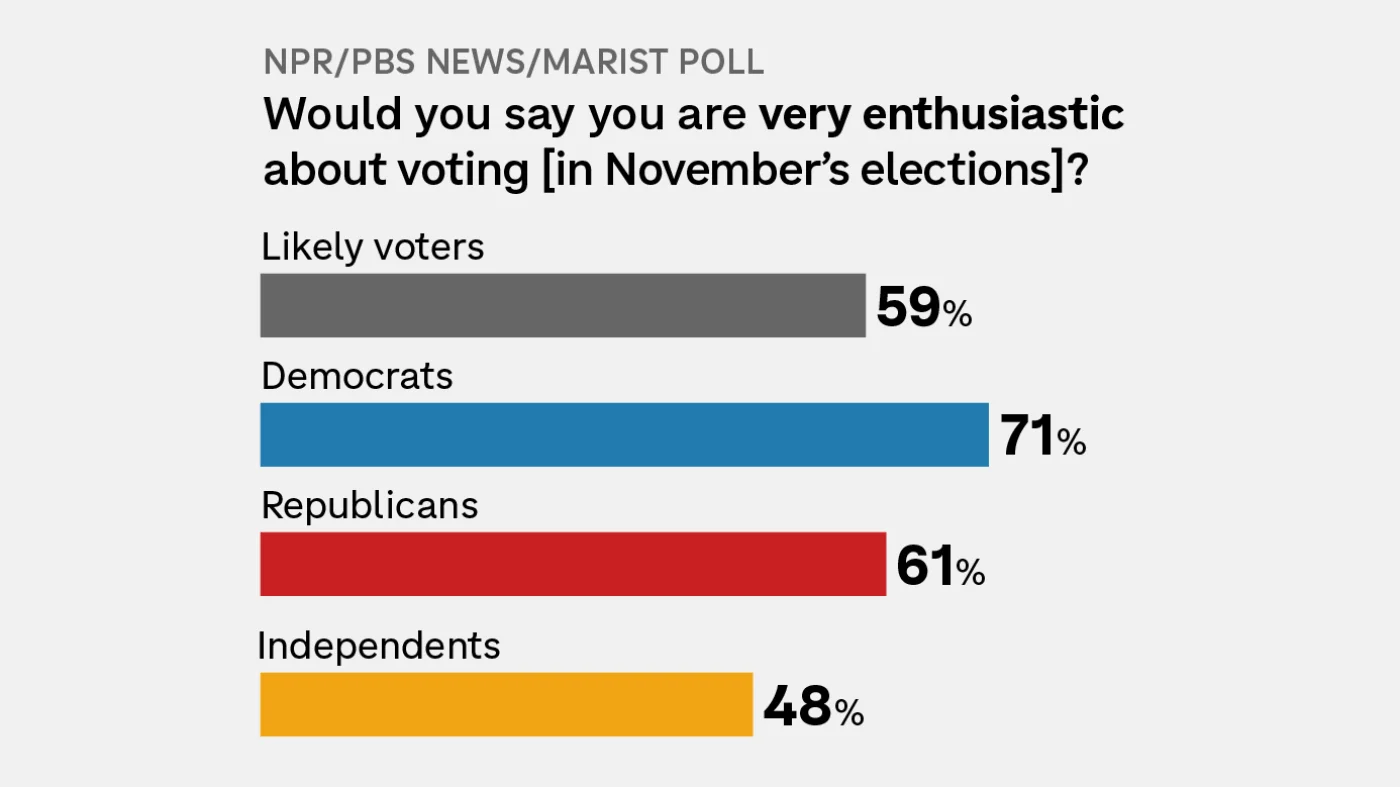
Democratic likely voters are 10 points more likely to say they are “very enthusiastic” about voting (71% vs. 61%). That’s actually wider than the difference between Democratic and Republican registered voters in the poll.
The caution for Democrats, though, is that several of their key pillar groups are not very enthusiastic to vote, and Republicans have closed the gap on who is following the election “very closely.”
Just 42% of likely voters under 45, 53% of non-white voters and 56% of white women with college degrees said they are “very enthusiastic” to vote. All of those groups disapproved of the job Trump is doing.
Compare that to pro-Trump groups — MAGA voters (68%), white women without degrees (66%) and white evangelical voters (61%).
For independents, 48% report being very enthusiastic to vote.
Traditionally, younger, as well as Black and Latino voters turn out at disproportionately lower rates in midterm elections. But with the realignment under Trump, more white, college-educated voters are voting Democratic and, as a group, they turn out at the highest rates.
When it comes to paying close attention, last month just 34% of registered Republicans said they’re following the election very closely, compared to 42% of Democrats.
Now, they’re even – 46% of Democrats and 45% of Republicans said they’re paying very close attention. When it comes to likely voters, there’s no difference either – 51% of Democrats to 50% of Republicans.
On the positive side for Democrats: those who voted for Democrat Kamala Harris in 2024 are 15 points more likely than Trump 2024 voters to say they are very enthusiastic. And Democrats overall have an 8-point advantage over Republicans when it comes to who cares a “great deal” about who controls Congress.
Most are confident elections will be fair and accurate, but Republicans lag
Three-quarters of likely voters are confident that their state and local governments will run a fair and accurate election.
That includes solid majorities of Democrats (88%), Republicans (68%) and independents (75%), but Republicans were 20 points less likely than Democrats to think they would be run well. MAGA supporters were almost 30 points less likely.
Large majorities also said their preferred candidate should accept the results of the election. That included 70% of Republicans, but again, they were 20 points less likely than Democrats to say they should accept the results. A quarter of Republicans said their candidate should probably or definitely challenge the results.
There was also a sharp divide between those who identified as democratic socialists and MAGA supporters — 86% of democratic socialists but only 65% of MAGA supporters said their preferred candidate should accept the result. MAGA supporters were twice as likely to say they should challenge.
Other key issues
Personal finances: 38% said their personal finances have gotten worse in the past year, though 44% said they’ve stayed about the same. Younger generations are experiencing more financial insecurity than older ones. And they’re more likely to have moved, changed jobs or lost one in the past year.
AI continues to face an uphill public-opinion challenge: 6-in-10 said the construction of new data centers will mostly have a negative impact on the country, though majorities of Republicans and MAGA supporters said it would be a net-positive. An even higher percentage (66%) said they oppose construction of a data center in their community. Republicans are split on this, but Democrats and independents overwhelmingly oppose them. The intensity of opposition is pretty high, as well, with 41% saying they strongly oppose them.
Immigration: 61% said immigrants should have a way to stay in the country legally if they meet certain requirements. Two-thirds of Republicans, though, said they should be required to leave.
Government continues to be a sharp dividing line: 57% said government is almost always wasteful and inefficient. That included majorities of Republicans and independents. Almost 6 in 10 Democrats, though, said government often does a better job than people give it credit for. That also included 59% of democratic socialists.
People are split on guns: 48% said it’s more important to pass stricter gun-control laws, while 46% said protecting the right of Americans to own guns was the higher priority. While independents were largely split, roughly 9 in 10 Democrats said gun control and 85% of Republicans said gun rights.
Theoretical belief in equality: People were asked which comes closer to their view – An ideal society needs equality for all groups or one that needs some groups to be on top and others to be on the bottom – 70% said equality, though Republicans were largely split. Meanwhile, this is a core pillar for democratic socialists, as 97% of them surveyed said equality.


Flávio Bolsonaro seen landing in Miami with family after Brazil presidential election defeat
Where has Bolsonaro been? By Thomas Copeland and Jake Horton Flavio Bolsonaro has not taken a straightforward route to the...


Nvidia Partner Vertiv Soars After AI Data Center Play’s Blowout Earnings, Strong Guidance
Information in Investor’s Business Daily is for informational and educational purposes only and should not be construed as an offer,...

Nelson Peltz’s Trian offers to buy Wendy’s for $1.4 billion
A group of investors led by Nelson Peltz’s Trian Fund Management has offered $1.4 billion to buy Wendy’s , according...


Dow Jones Futures Fall, Techs Rise As SK Hynix Crushes Views; Fed, Microsoft, Google On Deck
Information in Investor’s Business Daily is for informational and educational purposes only and should not be construed as an offer,...


The income required to retire comfortably in each state
Households around the country are facing financial stress amid persistent inflation, and retirees facing rising expenses need to ensure their...


Why China is desperate to ship cars outside of the country
To understand why China is desperate to ship cars overseas, visit a dealership in Beijing. Autumn has traditionally been the...

Fed meeting today: Live updates
The Federal Reserve’s interest rate decision Wednesday likely will be short on suspense, with markets expecting the central bank to...


Russell Brand Takes Stand in Trial, Says No One Will Testify for Him
Russell Brand took the stand for the first time in his ongoing rape and sexual assault trial on Wednesday and...


Amazon relaxes push for AI use as Anthropic reveals shocking stats
An Amazon memo published Tuesday encouraged its software engineers to stop “tokenmaxxing” and start being more judicious about how they...


Calif. just broke a 28-year-old record for fatal rabies detections
A pair of sick raccoons found this month in a Los Angeles suburb set off alarm bells from California to...
-

 Business1 week ago
‘Black Monday’ fears intensify as prediction markets shrug off 2026 crash
-
Business2 weeks ago
Why BlackRock is suddenly more bearish on stocks
-
Business2 weeks ago
AI Agent Company Decagon Held Early M&A Talks With ServiceNow, Others
-

 Business2 weeks ago
Dow Jones Futures: Stock Market Holds Up As Meta, AMD Lead Buys; ASML, CPI Inflation Due
-

 Business2 weeks ago
CPI inflation report September 2026
-

 Food2 weeks ago
Wall Street Sees Inflation Easing Even With Oil Above $90
-

 HealthNews2 weeks ago
Carefree panty liners face lawsuit over dangerous carcinogenic claim
-

 Entertainment2 weeks ago
Reese Witherspoon Partners With Mediawan To Buy Hello Sunshine